You see an inverse ETF on your brokerage platform. It tracks the S&P 500, but in reverse. The market has been falling for a week, and this product promises to rise when the index drops. It looks like insurance. It looks like a short position you can buy as easily as any other fund.
It is not. And the gap between what you think this product does and what it actually does is where real money gets lost.
Inverse ETFs are available to retail investors on exchanges including the ASX and across US markets, and renewed coverage of speculative ETF products through 2025 and into 2026 has brought them back into mainstream conversation. The access is easy. The mechanics are not.
Here is what this piece gives you: a precise understanding of how inverse ETFs actually behave, why their returns diverge from a clean mirror of the market, and whether there is any legitimate place for them in a long-term portfolio. By the end, you will have a framework for evaluating any inverse ETF product you encounter, built on the arithmetic rather than the marketing.
What an inverse ETF actually is (and what it is not)
An inverse ETF is an exchange-traded fund engineered to move in the opposite direction of a given index or benchmark. If the tracked index falls 1% in a single day, a standard inverse ETF aims to rise approximately 1% that same day.
That sounds like a short position. It is not. The critical distinction is in two words: daily basis.
The comparison to a short position is intuitive but misleading in a critical way: short selling risks for retail investors include theoretically unlimited losses, mandatory margin requirements, and daily borrow fees that can exceed 15% annualised, none of which apply to an inverse ETF holder.
Inverse ETFs do not provide a sustained short position against the market. They provide a daily reset that recalibrates the fund’s exposure every 24 hours. This means the product is re-engineered at market close each day to target the inverse of the next day’s move, not the inverse of the index’s cumulative return over any longer period.
The key characteristics that define these products:
- Target exposure: The opposite of a benchmark’s single-day return
- Mechanism: Derivatives (swaps, futures, options) and short positions
- Daily reset: Exposure recalibrated at market close every trading day
- Product variants: Leveraged inverse ETFs (−2x, −3x) multiply the daily inverse return, so a −2x product targets +4% for a −2% index move, and −4% for a +2% move
Inverse ETFs target the opposite of a benchmark’s daily return, not its return over weeks, months, or years.
The ASX lists only a limited number of leveraged inverse products at present, while US markets offer a considerably wider and more varied selection. But regardless of which exchange you are using, the daily qualifier is not fine print. It is the entire design logic of the product, and everything else in this article flows from it.
When big ASX news breaks, our subscribers know first
The daily reset: why the clock resets every 24 hours
The daily reset is not a quirk. It is an engineering necessity.
Inverse ETFs use derivatives to construct their exposure. Those derivatives, primarily swaps and futures contracts, need to be recalibrated at the end of each trading day so the fund starts the next session with the correct level of inverse exposure. If the fund did not rebalance, its exposure would drift as the index moved, and it would no longer deliver on its stated objective.
This means the fund’s performance compounds on a daily basis. Each day’s return is calculated from the previous day’s closing value, not from the original purchase price. Over multiple days, the cumulative return depends on the specific path the index takes, not just where it ends up.
Prospectuses and regulator bulletins are explicit about this: performance over periods longer than one day can differ significantly from the inverse of the index over that same period. This is not a hidden flaw. It is a disclosed design feature.
The implication is direct. Even if your directional view on the market over the next month proves correct, the sequence of daily moves the index makes along the way will determine whether the inverse ETF performed as you anticipated. That sequence is a factor entirely outside your control.
What daily rebalancing involves in practice
The rebalancing sequence repeats every trading day:
- At market open, the fund holds derivatives exposure calibrated to deliver the inverse of that day’s index move
- Throughout the session, the fund’s value moves in opposition to the index
- At market close, the fund’s derivatives positions are reset to recalibrate for the next day’s targeted exposure
- The next morning, the cycle begins again from the new base value
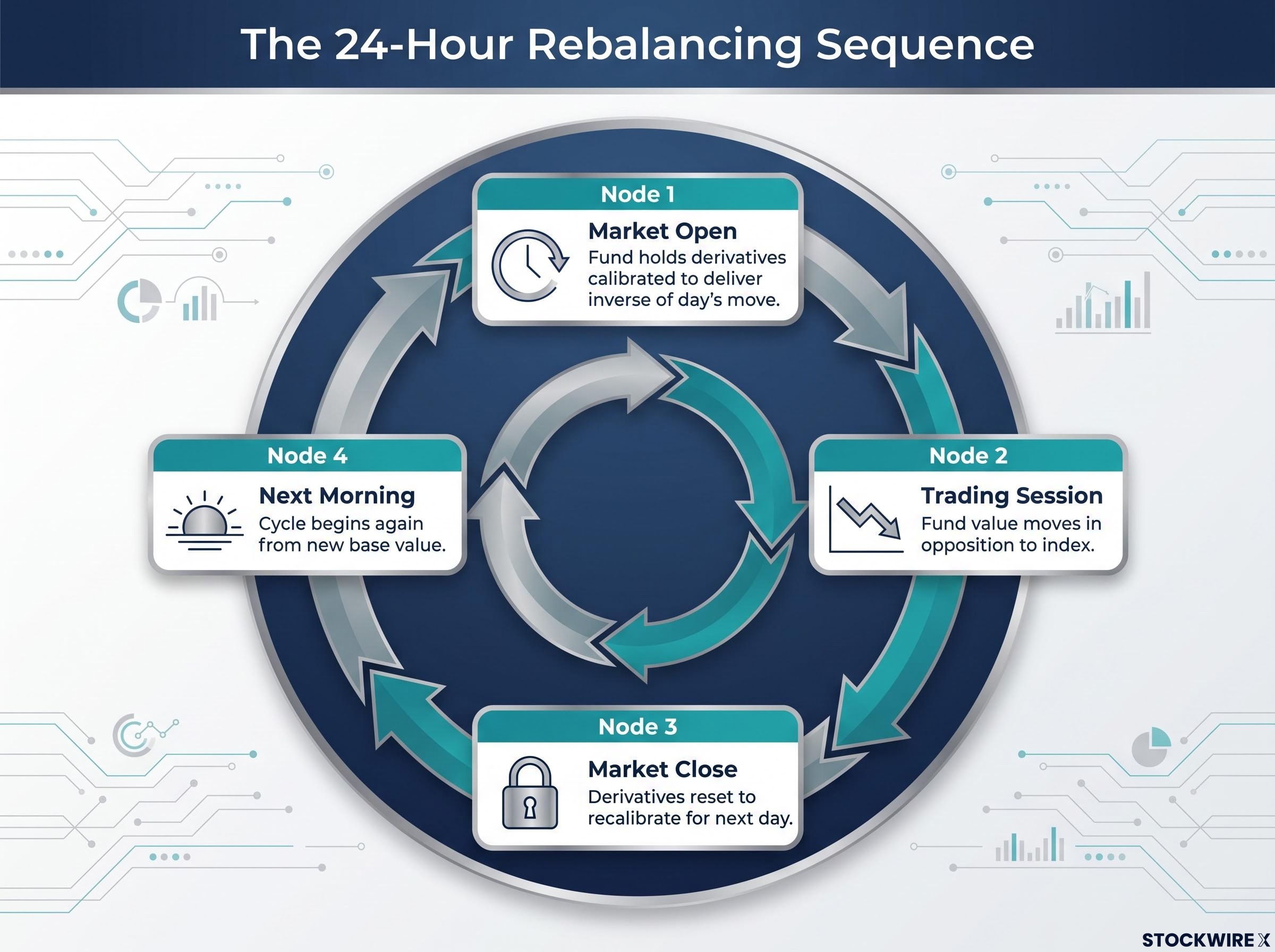
The consequence is daily compounding. Each day’s gain or loss changes the base from which the next day’s return is calculated. Over multiple sessions, this compounding creates results that can look nothing like the simple inverse of the index’s total return, a problem the next section makes visible with arithmetic.
Volatility decay and the compounding trap
This is where the arithmetic proves something that intuition misses entirely.
Volatility decay, also called beta slippage or compounding risk, is the mechanism by which inverse ETF returns diverge from the theoretical inverse of the index over time. It is not a market event. It is a mathematical consequence of daily compounding.
A two-day example makes it visible.
| Day | Index daily return | Index level | Inverse ETF daily return | Inverse ETF level |
|---|---|---|---|---|
| Start | 100 | 100 | ||
| Day 1 | −10% | 90 | +10% | 110 |
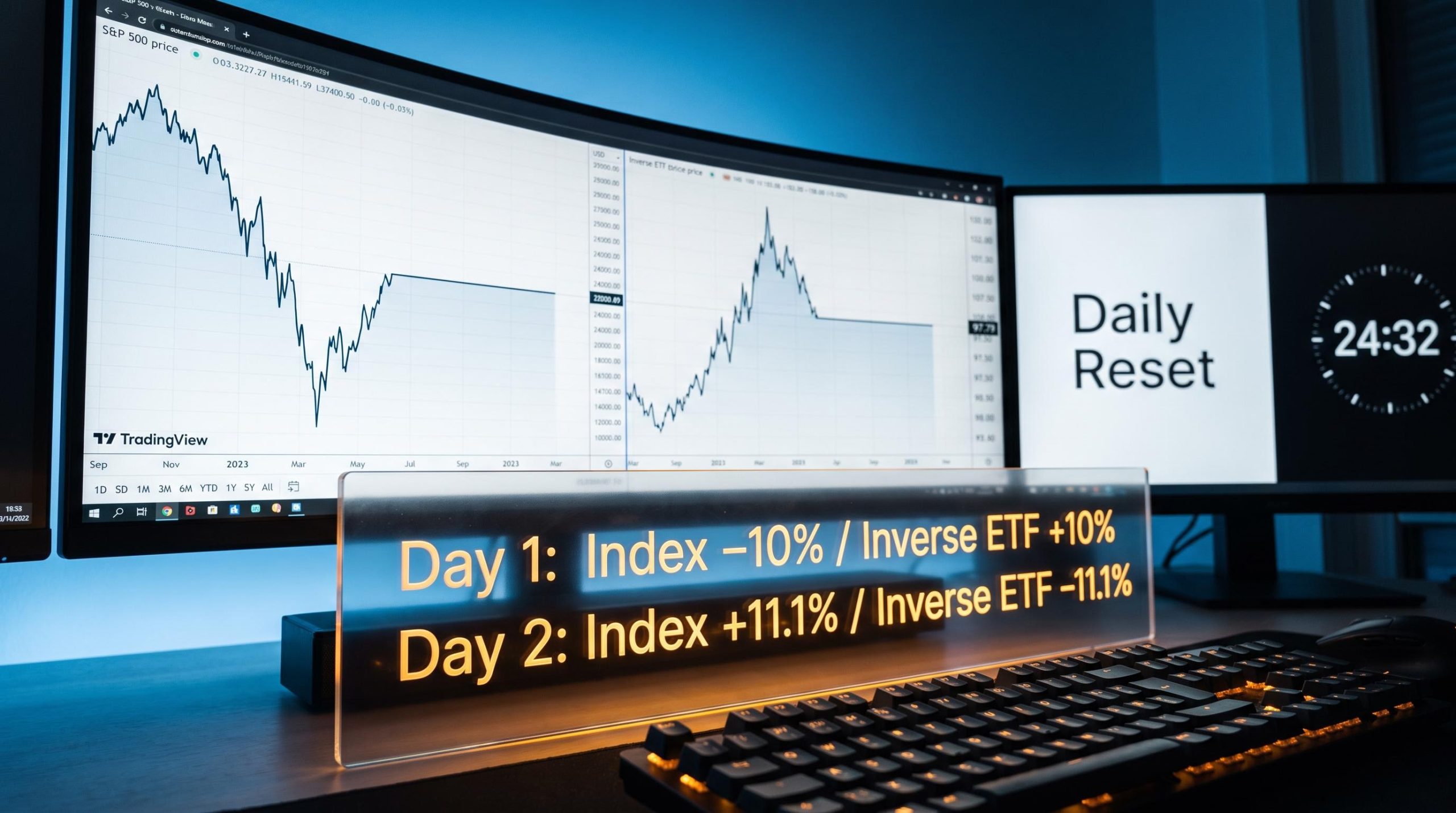
| Day 2 | +11.1% | 100 | −11.1% | 97.79 |
The index fell 10% on Day 1, then rose 11.1% on Day 2, returning exactly to its starting value of 100. Flat over two days.
The inverse ETF rose 10% on Day 1, reaching 110. Then it fell 11.1% on Day 2, but that 11.1% loss was calculated from the new base of 110, not the original 100. The result: the inverse ETF ends at approximately 97.79, below where it started.
The market went nowhere. The inverse ETF lost money.
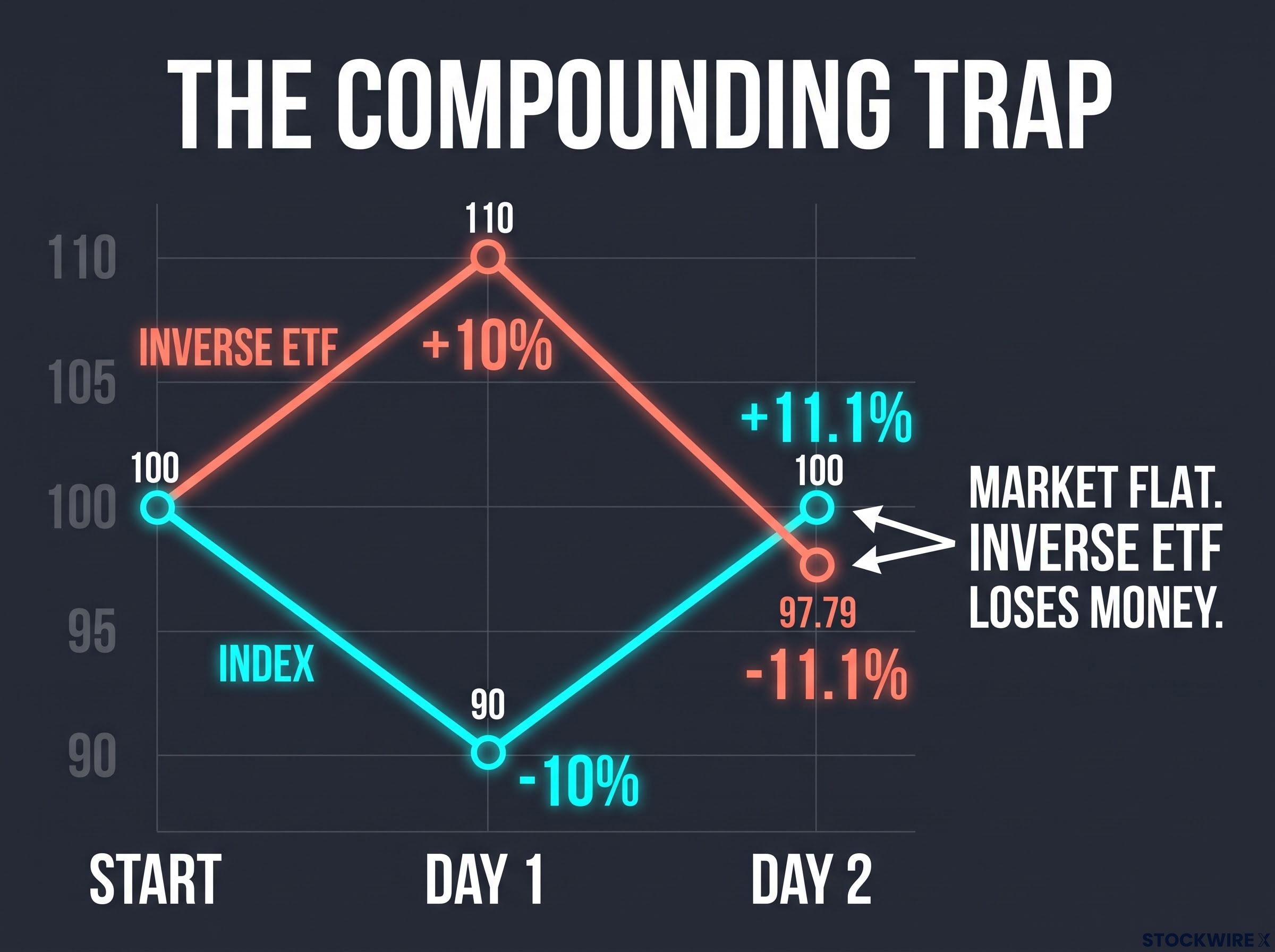
This effect worsens with higher volatility, longer holding periods, and leverage. A −2x or −3x product amplifies every one of these compounding distortions substantially. You can be directionally right about where the market is heading and still lose money in your inverse ETF, because the daily swings the index experienced along the way eroded your position regardless of the final destination.
The same compounding mechanics operate on single-stock leveraged ETFs, where beta slippage eroded roughly 58 percentage points of return for a Tesla position even when the three-year directional thesis proved correct, illustrating that the damage from daily compounding scales with the underlying asset’s volatility regardless of the investor’s view.
Regulatory guidance makes clear that investors who hold these products beyond a single day may face losses that are both substantial and difficult to anticipate from the stated daily objective alone.
The key insight here is not that these products are poorly designed. They are correctly designed for a different purpose than most retail investors are using them for. The arithmetic proves it without any need for opinion.
The full risk inventory: beyond volatility decay
Volatility decay is the most counter-intuitive risk, but it is not the only one. Inverse ETFs carry a set of overlapping structural risks that compound under stress conditions.
- Leverage amplification (−2x/−3x products): Leveraged inverse ETFs magnify both gains and losses, and amplify all volatility-related distortions simultaneously
- Derivative and counterparty risk: The swaps, futures, and options used to construct inverse exposure introduce correlation risk, credit (counterparty) risk, liquidity risk, and exposure to futures term-structure effects such as contango
- Tracking error: Daily resets, derivatives costs, and path dependency cause the ETF’s performance to deviate materially from the intended inverse of the benchmark
- Higher ongoing costs: Inverse ETFs carry higher expense ratios than standard ETFs, with additional costs from derivatives and daily rebalancing that create a permanent drag on returns
- Market direction risk: If the underlying index rises, an inverse ETF loses money. Leveraged inverse products lose capital at a much faster rate than their standard counterparts
These risks are additive, not standalone. Under stress conditions, when volatility spikes and liquidity dries up, counterparty risk, tracking error, and cost drag can all worsen simultaneously.
The cost drag and counterparty exposure mean the product is working against you even on days when nothing dramatic happens in the market. It is a slow erosion that long-term holders may not notice until the cumulative damage is visible in their account balance.
Why leverage amplifies every one of these risks
Leveraged inverse ETFs do not simply double or triple the risk of a standard inverse ETF. They compound all of the structural issues simultaneously.
A −3x product experiences −3x the volatility decay, −3x the tracking error from its more complex derivatives book, and higher costs from maintaining that leveraged position daily. Each of these factors feeds the others: larger daily moves mean larger rebalancing requirements, which mean higher transaction costs, which mean greater drift from the target return.
The result is a product where the gap between what you expect and what you receive widens faster than the leverage ratio alone would suggest.
The structural distortions created by daily rebalancing extend beyond individual portfolios: geared ETF systemic risk has become a market-structure concern as US leveraged and inverse assets approached $198 billion at mid-2026, with daily rebalancing flows identified by JPMorgan as contributing approximately $100 billion in forced selling during April 2026.
The psychology pulling investors toward these products
Most investors who consider inverse ETFs are not doing so in calm markets. They are doing so when their portfolio is falling, when losses feel urgent, and when the desire to do something, anything, is at its strongest.
Two psychological drivers explain this pattern.
The first is loss aversion, the tendency to feel the pain of portfolio declines more acutely than the satisfaction of equivalent gains. When your portfolio drops 10%, the psychological discomfort of that fall tends to outweigh the pleasure you experienced when it rose by the same amount. An instrument that “makes money when the market falls” is emotionally compelling precisely because it seems to offer relief from that discomfort, regardless of whether its structural mechanics actually deliver on that promise over your holding period.
The second is the illusion of control. During volatile periods, buying an inverse ETF can feel like taking action, like you are doing something to protect your portfolio rather than watching it decline. That sense of restored agency is powerful. But it is an emotional response, not a strategic one.
Simonelle Mody, Associate Investment Specialist at Morningstar Australasia, views inverse ETFs as a form of speculative, directional bet on near-term market movements rather than a genuine investment tool, and on that basis considers them unsuitable for long-term, growth-focused portfolios.
Recognising whether the impulse to buy an inverse ETF is coming from strategy or from emotional discomfort is the single most useful self-diagnostic you can apply before acting. If the urge to buy is strongest when your anxiety about the market is highest, that is worth pausing on.
What to use instead, and who these products actually suit
For long-horizon investors, broad market drawdowns are better managed through diversification, appropriate asset allocation, and time in the market rather than through decaying inverse products. Markets have historically recovered from downturns. An instrument designed to move against that long-term trend is a sustained bet against economic growth over time.
The legitimate use case for inverse ETFs is narrow. Short-term traders with active monitoring, strict risk controls, and precise entry and exit discipline can use them to express tactical bearish views over very short timeframes. Institutional and professional users who can model path-dependent scenarios across volatility regimes represent the other legitimate audience.
Even for these users, three constraints apply:
- Small position sizes relative to total capital
- Clear exit rules established before entering the position
- Awareness that holding beyond the intended timeframe rapidly and materially changes the product’s risk profile
Effective use requires accurate short-term timing: precise entry, sizing, and exit. That requirement conflicts structurally with a long-term investment philosophy. The investor population for whom inverse ETFs are genuinely appropriate is far narrower than their retail availability implies.
| Feature | Standard inverse ETF | Leveraged inverse ETF (−2x/−3x) |
|---|---|---|
| Daily objective | Opposite of index daily return | Multiplied opposite of index daily return |
| Mechanism | Derivatives, short selling | Derivatives, leverage, short selling |
| Holding period suitability | Short-term only | Short-term only (higher risk) |
| Volatility decay severity | Present | Amplified |
| Buy-and-hold suitability | Not suitable | Not suitable |
A product designed for precision, not patience
Inverse ETFs are not broken products. They are precision instruments with a clearly defined and narrow appropriate use. The problem arises when retail investors deploy them outside that use, treating a daily tactical tool as long-term portfolio insurance.
The daily reset, volatility decay, and structural cost drag are not theoretical concerns. They are compounding forces that materially affect real portfolio outcomes over time. A market that goes nowhere can still erode your inverse ETF position. A market that falls exactly the way you predicted can still deliver less than you expected.
If the impulse to buy an inverse ETF is strongest during market stress, that is the moment to slow down, not accelerate. Read the prospectus with the daily reset as your interpretive lens. And before acting, seek advice from a qualified financial professional.
For readers who want to audit their broader ETF holdings beyond inverse products, our dedicated guide to common ETF portfolio mistakes covers how thematic overlap, hidden concentration in mega-cap names, and fee compounding silently erode long-term returns across portfolios that look diversified on the surface.
Inverse ETFs target the opposite of a benchmark’s daily return, not its return over weeks, months, or years. That single sentence, properly understood, tells you most of what you need to know about whether these products belong in your portfolio.
This article is for informational purposes only and should not be considered financial advice. Investors should conduct their own research and consult with financial professionals before making investment decisions. Past performance does not guarantee future results. These products involve derivatives and leverage, and their behaviour may differ materially from expectations over holding periods longer than one day.
—