Australian investors have never had access to more financial information, and yet the evidence suggests they are making worse decisions because of it. That is not a paradox. It is a structural problem with two reinforcing causes.
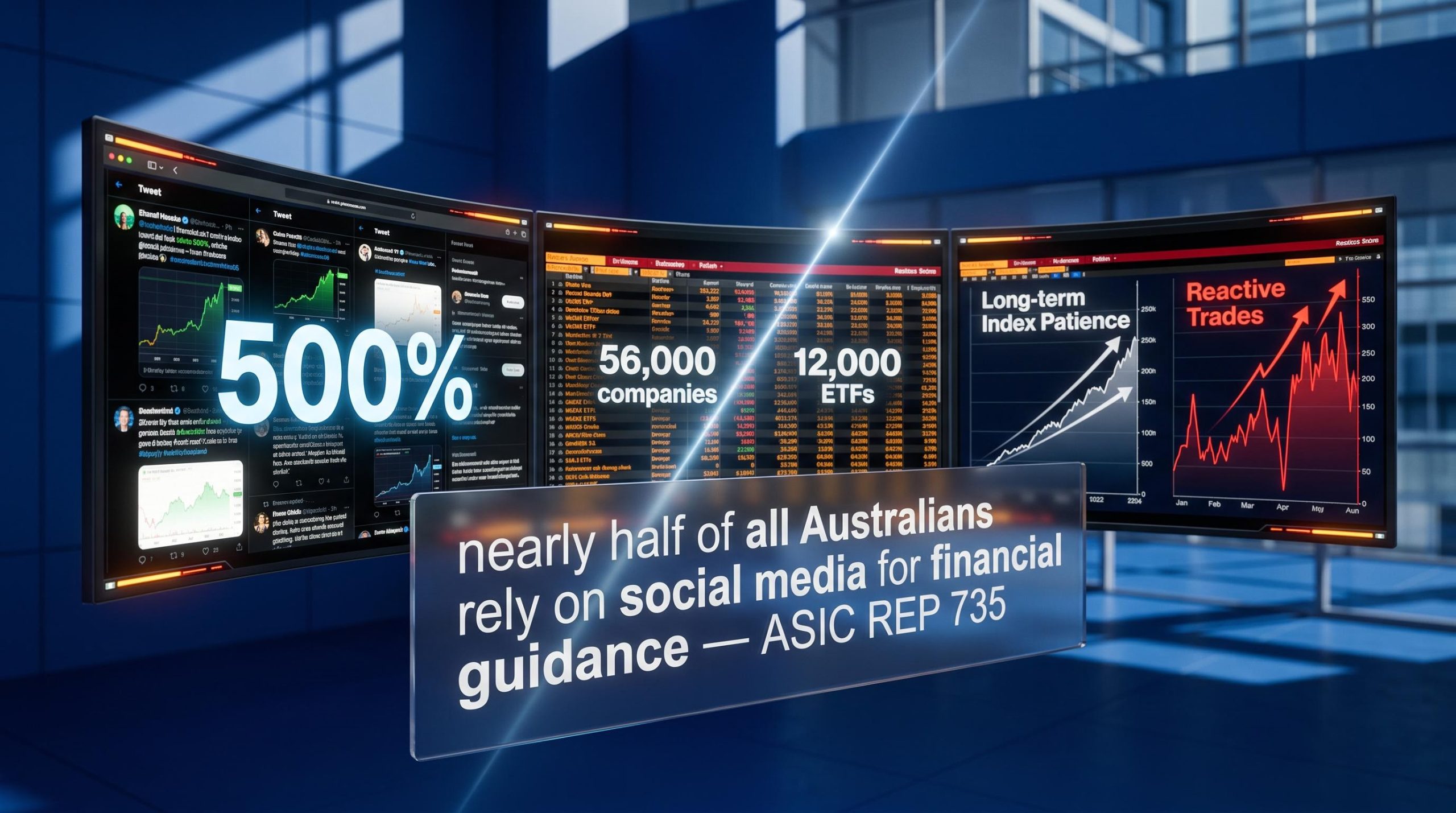
Social media distorts the direction of investment decisions by amplifying excitement and trend-chasing over evidence. Information abundance, meanwhile, prevents decisions from being made at all. ASIC data shows that nearly half of all Australians turn to social media for financial guidance, a proportion that climbs considerably among younger demographics. The two forces do not simply coexist; they compound each other.
Here is what the research actually shows about how these forces interact, and a four-step framework you can apply to insulate your own decision-making from both.
The social media problem is not information; it is distortion
The issue is not that social media contains bad financial content. The issue is that the platforms distributing it are engineered to maximise engagement, and engagement-optimised distribution structurally favours drama, urgency, and exceptional outcomes over statistically representative ones. Accurate, measured, long-term investment content is algorithmically disadvantaged relative to stories about parabolic rallies, “life-changing” trades, and crash predictions.
This is not a content quality problem that better self-control can fix. It is a distribution problem. The content reaching your feed has already been filtered by an algorithm that rewards emotional arousal, not accuracy.
The content that travels furthest online maps directly onto three well-documented behavioural biases:
Each of these behavioural patterns connects to a broader system of cognitive bias that intensifies precisely at market extremes, when loss aversion, herd behaviour, and recency bias form a feedback loop that makes the most expensive decisions feel like the most rational ones.
- Salience bias: you overweight information that is vivid and emotionally striking, such as a screenshot of a 500% return, and underweight dull base-rate data about long-term index performance.
- Availability bias: you judge the likelihood of an outcome by how easily examples come to mind, and social media ensures dramatic examples are always fresh.
- Representativeness bias: you assume a vivid individual story (one trader’s windfall) is representative of the typical experience, when it is a statistical outlier.
ASIC has explicitly warned first-time investors against making rash decisions driven by fear of missing out (FOMO) from online and social media commentary, urging them to focus on long-term goals before trading.
ASIC’s own retail investor research (REP 735) found that Google was cited as the “main” information source by 34% of investors and personal networks by 24%, with social platforms and forums featuring prominently. Australian commentators describe the resulting environment as an “overload of prices, charts, alerts, product pages, newsletters, social media commentary, fund rankings and market opinions.”
If your investment beliefs were shaped primarily by social media consumption, those beliefs are statistically more likely to reflect outlier events than the base-rate experience of investors. That is a calibration problem worth correcting deliberately, rather than hoping willpower alone will do the work.
When big ASX news breaks, our subscribers know first
What disciplined investing actually looks like, and why it does not go viral
The evidence base for what actually builds wealth over time is not contested. Morningstar research and work from the Centre for Retirement Research (CRR) consistently show that most individuals achieve better outcomes with simple, diversified asset mixes than with frequent tactical repositioning. Financial markets tend to reward patience and consistent participation, not the constant search for the next high-performing opportunity.
The structural case for long-term investing is compounded by a specific exit risk: approximately 30.9% of investors who panic-sold during a major downturn never re-entered equities, permanently forfeiting the recovery gains that automated, scheduled contributions would have captured throughout the decline.
The five core properties of evidence-based investing are:
- Patience: staying invested across market cycles rather than reacting to short-term noise
- Cost control: minimising fees and transaction costs that erode compounding
- Diversification: spreading exposure across asset classes, sectors, and geographies
- Risk management: sizing positions and maintaining liquidity appropriate to your goals and timeline
- Consistent participation: contributing regularly regardless of market sentiment
None of these properties generate compelling online content. A diversified portfolio rebalanced once a year does not make for a viral post.
AMP’s chief economist Shane Oliver has argued that information overload from digital technology is causing investors to lose sight of the long view, pulling them instead into short-term reactive decisions. The shift toward social-media-style trend-chasing has occurred over the past decade, concurrent with the mainstream adoption of these platforms. It is a recent cultural development, not a permanent condition.
The gap between what goes viral and what actually builds wealth is not a minor discrepancy. It is the central tension in the modern investment environment. Recognising that gap is itself a competitive advantage that most retail investors do not currently have.
When more choice produces less action
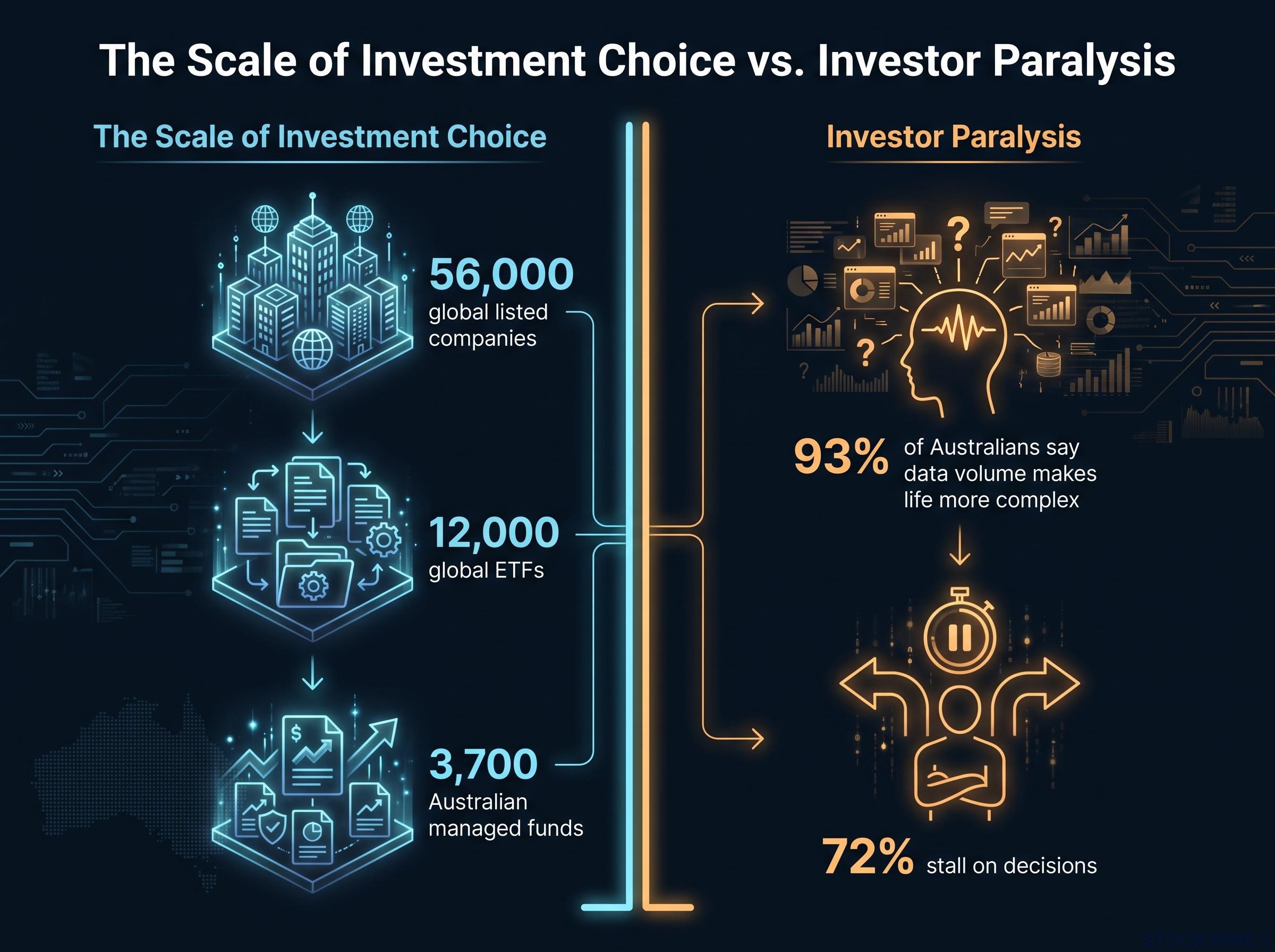
Consider the scale of what is available to you. Global listed markets encompass around 56,000 companies and 12,000 ETFs, while Australian investors alone can access roughly 3,700 managed funds. This is the universe you are theoretically comparing when you choose where to put your money.
The behavioural research is clear about what happens when menus expand beyond a certain threshold. A 2019 Morningstar report titled Bigger Is Better, drawing on data from 500 US defined contribution retirement plans with a combined participant base exceeding 500,000 individuals, identified a direct relationship between menu size and default behaviour.
| Menu Size | Default Usage Rate | Source |
|---|---|---|
| 10 options | 74% | Morningstar ‘Bigger Is Better’ (2019) |
| 30 options | 84% | Morningstar ‘Bigger Is Better’ (2019) |
Expanding the menu from 10 to 30 options did not produce more optimised selections. It pushed an additional 10 percentage points of participants into the default option, the one chosen for them rather than by them.
ASIC’s report on investors in IPOs (REP 540) notes that people have finite cognitive bandwidth and that “having to comprehend too much information with varying levels of complexity can lead to information overload”, prompting reliance on heuristics or decision deferral.
CRR’s research on asset allocation reinforces the pattern: when people face more asset choices, reported overload increases and many gravitate toward defaults rather than optimising across large menus. HPartners, an Australian advisory firm, points out that this overload frequently leads people either to passively accept default super options or to make suboptimal product choices.
The NBER research on default options in retirement savings demonstrates that plan participants exhibit a strong tendency to remain in whatever option is selected on their behalf, with default status itself functioning as a powerful behavioural anchor that is difficult to dislodge even when better alternatives are readily available.
For Australian readers with superannuation, the direct implication is worth sitting with. If you have never actively reviewed your fund selection, you are likely in a default option chosen by your employer, not by your financial goals. The primary driver is probably not indifference. It is the genuine complexity of the comparison process.
How the two problems amplify each other
The two forces described above are not parallel problems requiring separate solutions. They form a single compounding system.
Social media adds volume and velocity to financial information. The sheer scale of available data and investment options adds complexity. Together, they create a feedback loop where both active engagement and passive withdrawal produce poor outcomes.
Three ways the loop plays out for investors
- The active engager follows social media signals and risks being pulled toward high-excitement, low-evidence strategies, chasing the dramatic outlier content the algorithm rewards.
- The thorough researcher tries to process everything available and risks paralysis from the scale and complexity of the information, never reaching a decision point.
- The disengaged investor retreats from the noise entirely and risks defaulting to suboptimal passive positions, the exact pattern the Morningstar plan data documents.
Balmain Private’s analysis of the current environment captures the interaction directly: “a wealth of information may lead to more confusion than clarity”, creating the risk of “an age of foolishness in decision making, not an age of wisdom.” Shane Oliver’s observation about time horizon compression among Australian investors fits the same pattern: more information is not producing more considered decisions; it is producing more reactive ones.
An Oracle study found that 93% of Australians surveyed said the growing volume of data had made their lives more complex, while 72% reported that the sheer quantity of available information had caused them to stall on decisions altogether. These figures have not been independently confirmed and should be treated as indicative, but they are consistent with ASIC’s findings and the broader behavioural evidence on overload.
The structural point here is that the two problems are not additive but multiplicative. Resolving to “research more carefully” is not a solution if the research environment itself is the source of distortion. That is precisely what most investors attempting to become more informed are unknowingly walking into.
For investors exploring how the active engager archetype plays out at the moment of exit, our full explainer on sell decision biases covers four specific mechanisms — including the disposition effect and herd behaviour — that cause retail investors to exit at the worst possible time, drawing on a University of Chicago study where random exits outperformed professional managers by up to 150 basis points annually.
A four-step framework for cutting through the noise
Each step below represents a structural intervention in your decision-making environment, not a resolution that erodes under the next news cycle. Applying even one creates a meaningful filter between the noise and the decision you actually make.
- Goals: Anchor every decision to clearly defined financial goals. A specific goal (retirement income of a certain amount by a certain age, a house deposit within a set timeframe) functions as a deliberate filter that narrows the relevant information set. Most social media content becomes irrelevant by definition because it does not serve your stated objective.
- Media literacy: Treat social media financial content as entertainment unless it passes three checks: is the claim consistent with long-term market evidence? Is the source licensed or regulated? Is this story representative of typical outcomes, or is it an outlier? ASIC’s guidance reinforces this: verify licences, read disclosure documents, and be sceptical of promises of high returns with little risk.
- Constrain: Deliberately limit the investment universe you are choosing from, rather than trying to optimise across everything available. Research first, trade second, and ask what role a specific investment plays in your overall portfolio before acting. CRR and Morningstar data both show that deliberately reduced option sets lead to better engagement and fewer default outcomes.
- Act: Recognise that not deciding is itself a decision with compounding consequences. Defaulting to cash or to a default super option is not neutral; it carries real long-term costs. A good-enough, goal-aligned decision made now is superior to waiting for perfect information that will never arrive.
The Lowy Institute’s analysis of the modern information environment notes that much online content is “synthetic, shaped by AI and curated for engagement”, requiring digital literacy, critical thinking, and awareness of how algorithms shape what you see.
| Step | The Problem It Addresses | One Concrete Action |
|---|---|---|
| Goals | Information overload: too many options, no filter | Write down your three financial objectives with specific dollar amounts and timeframes |
| Media literacy | Social media distortion: outlier content rewarded | Apply the three-check test before acting on any social media financial claim |
| Constrain | Choice overload: expanding menus drive defaulting | Limit your research to a shortlist of 5-7 options that match your stated goals |
| Act | Decision paralysis: waiting for perfect information | Set a review date and commit to a goal-aligned decision by that date |
This article is for informational purposes only and should not be considered financial advice. Investors should conduct their own research and consult with financial professionals before making investment decisions.
The investor who survives the noise environment
The problem is structural, not personal. Stronger willpower and more information consumption are not solutions when the structure of the information environment itself is the source of distortion and overload. Structural problems require structural responses.
What you are defending against is specific: the compounding of social media distortion and information paralysis, which reliably pulls investors away from goal-aligned, evidence-based strategies unless a deliberate counterstructure is in place. The framework above provides that counterstructure.
The practical payoff is grounded in compounding logic. The investor who makes fewer reactive errors and stays invested across market cycles does not need to find the next great opportunity. Time in market and cost control do the work. The goal is not to optimise every decision but to avoid the systematic errors that compound negatively over decades.
ASIC REP 735 records that roughly half of Australian investors draw on social media when forming financial views, which means the investor who approaches those channels with structured scepticism already holds an informational edge over the typical market participant. The bar is not perfect decision-making. It is consistent, defensible decision-making. In the current environment, that is enough to put you ahead.
For readers ready to move from the framework above to the mechanics of actual implementation, our dedicated guide to starting investing covers vehicle selection across index ETFs, managed funds, and blue-chip shares, fee drag mathematics, and how to match a portfolio structure to your risk profile and time horizon.
—