An experienced financial professional with 44 years in the industry and thousands of client portfolios reviewed keeps finding the same patterns. The specific investments change. The mistakes do not.
ETFs are genuinely powerful instruments, but their accessibility creates a false sense of simplicity. Many retail investors assume the structure itself does the work. It does not. The five mistakes covered here are the ones that appear most persistently across real portfolios, regardless of how long the investor has been in the market.
Here is what those patterns look like, how to spot them in your own holdings, and what to do about each one. After reading, you will be able to run a fast self-audit of your own ETF portfolio against every item on this list and know exactly what to look for.
The five core ETF portfolio mistakes:
- Treating the ETF wrapper as a risk guarantee
- Over-diversifying into redundancy
- Letting thematic overlap create hidden concentration
- Confusing passive, active, and leveraged products
- Falling into the “set it and forget it” trap
Mistake 1: The ETF wrapper is a delivery system, not a risk guarantee
ETFs sound diversified, and diversified sounds safer. That intuition is so strong it survives years of investing experience. It is also wrong, or at least incomplete enough to be dangerous.
The ETF wrapper does not confer safety. What matters is the contents. An ETF is a delivery mechanism, not a risk category. A fund holding thousands of diversified global equities is a fundamentally different product from a leveraged single-sector ETF, even though both carry the same four-letter label.
The structural difference between owning an ETF and owning the underlying stocks directly shapes how concentration, tax events, and control over individual positions work in practice, and what you actually own inside each wrapper determines how your portfolio behaves during stress periods.
Market risk persists even in broad, well-diversified ETFs. They can fall sharply in bear markets. Diversification reduces single-stock risk, but it does not eliminate the risk that the entire market declines. And the ETF label spans products as different as a total-market index fund and a 2x leveraged semiconductor instrument.
Before you buy any ETF, check three numbers on the fund’s fact sheet:
- Total number of holdings in the fund
- Sector and geography weightings to see where the exposure actually sits
- Percentage represented by the top ten positions to gauge concentration
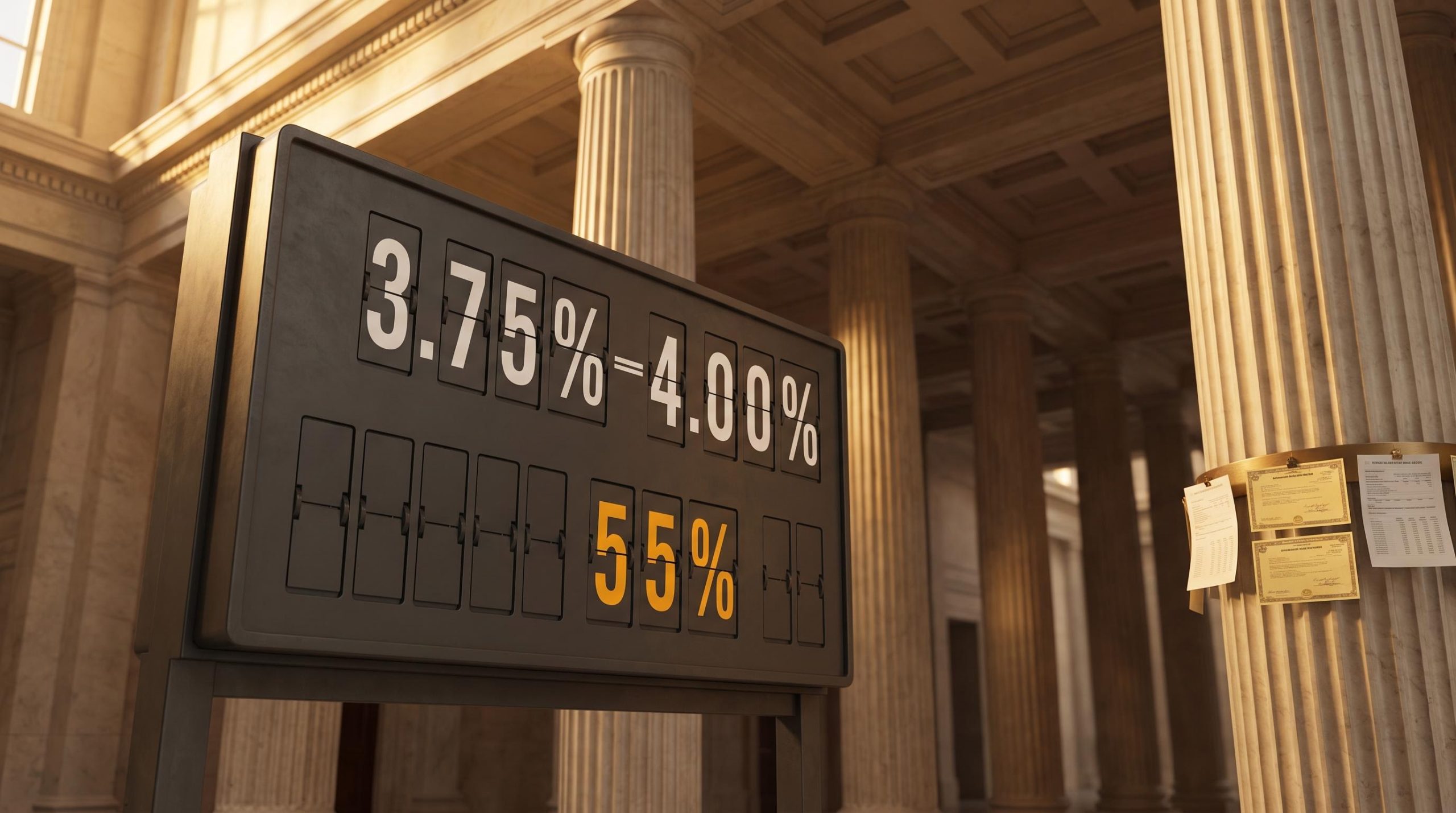
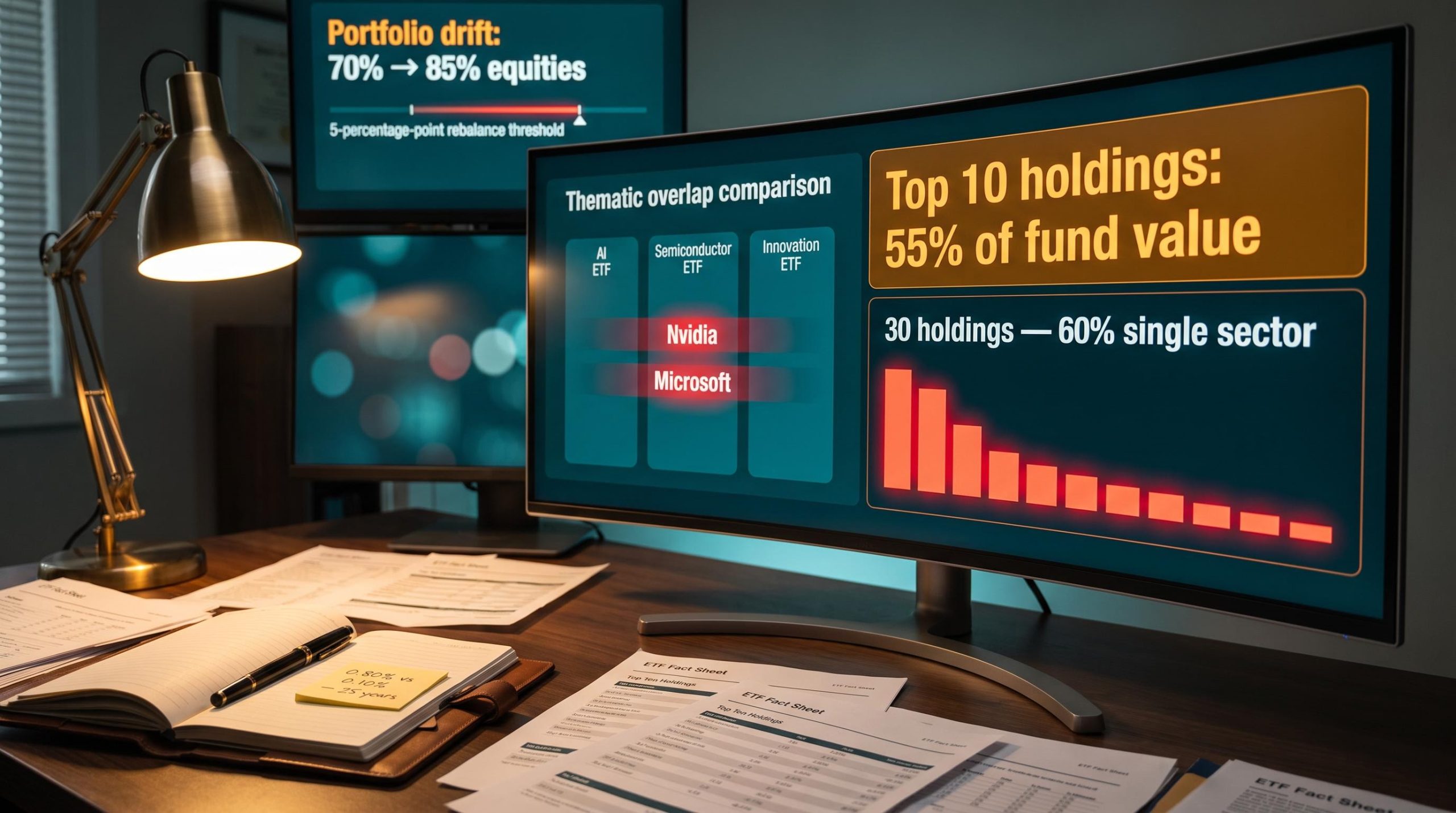
A fund with 30 holdings, 60% in one sector, and 55% in its top ten will behave nothing like a broad index fund holding thousands of stocks. If your ETF’s top-ten holdings represent more than half its value, you are not holding a diversified fund in any meaningful sense. Understanding that distinction is what separates investors who survive drawdowns from those who are surprised by them.
When big ASX news breaks, our subscribers know first
Mistake 2: Accidental overlap: when more ETFs mean less diversification
Consider a portfolio built from 20 ETFs, each holding hundreds of underlying stocks. Tally up all the indirect exposures and the total reaches roughly 6,000 stocks spread across multiple countries. On the surface, that figure sounds like serious diversification.
Now look at what you are actually holding. Many of those ETFs own the same underlying companies. The overlap means you are paying multiple expense ratios, one for each fund, to own essentially the same basket of stocks. That fee drag compounds against you over decades in a way that is almost invisible until you calculate it.
Hidden concentration risk persists even in funds with hundreds of holdings: a practical overlap audit typically reveals a unique stock count 30-40% lower than investors initially estimate across a multi-fund portfolio, because the same large-cap names dominate multiple indexes simultaneously.
Then there is the behavioural cost. A crowded, hard-to-monitor portfolio increases the likelihood of reactive trading and plan abandonment. When you cannot easily see what you own, the temptation to tinker, chase recent winners, or panic during drawdowns grows. A smaller core of well-chosen, non-overlapping funds typically delivers comparable diversification at lower cost and with far simpler monitoring.
What to do instead
- Audit for overlap before adding any new fund. Pull the top-ten holdings of each ETF you own and compare them side by side.
- Consolidate toward a small core of broad, non-overlapping ETFs. “Fewer, broader” is the principle, not a specific number.
- Compare expense ratios across all current holdings. If two funds hold substantially similar stocks, the cheaper one is doing the same job at a lower price.
Every additional overlapping ETF in your portfolio is quietly charging you a management fee for exposure you already own. That redundancy is not diversification. It is duplication with a recurring bill.
Mistake 3: Assuming sector themes diversify you when they actually concentrate you
A thematic ETF focused on artificial intelligence holds 80 companies. That looks diversified. Now check the top-ten holdings. Nvidia sits near the top. So does Microsoft. So do several other mega-cap technology names you already own in your semiconductor ETF, your innovation ETF, and your broad technology fund.
When 30-40% of a thematic ETF’s value sits in the same handful of mega-cap names that appear across your other holdings, the real exposure is far narrower than the marketing suggests. You are not getting three independent bets on technology growth. You are amplifying a single stock’s impact on your portfolio while believing you are spread across dozens of companies.
ETF Database concentration risk analysis shows that the top ten holdings of the S&P 500 now comprise nearly 40% of the index, a level that amplifies the hidden overlap problem when multiple thematic and sector ETFs share the same mega-cap names across their top positions.
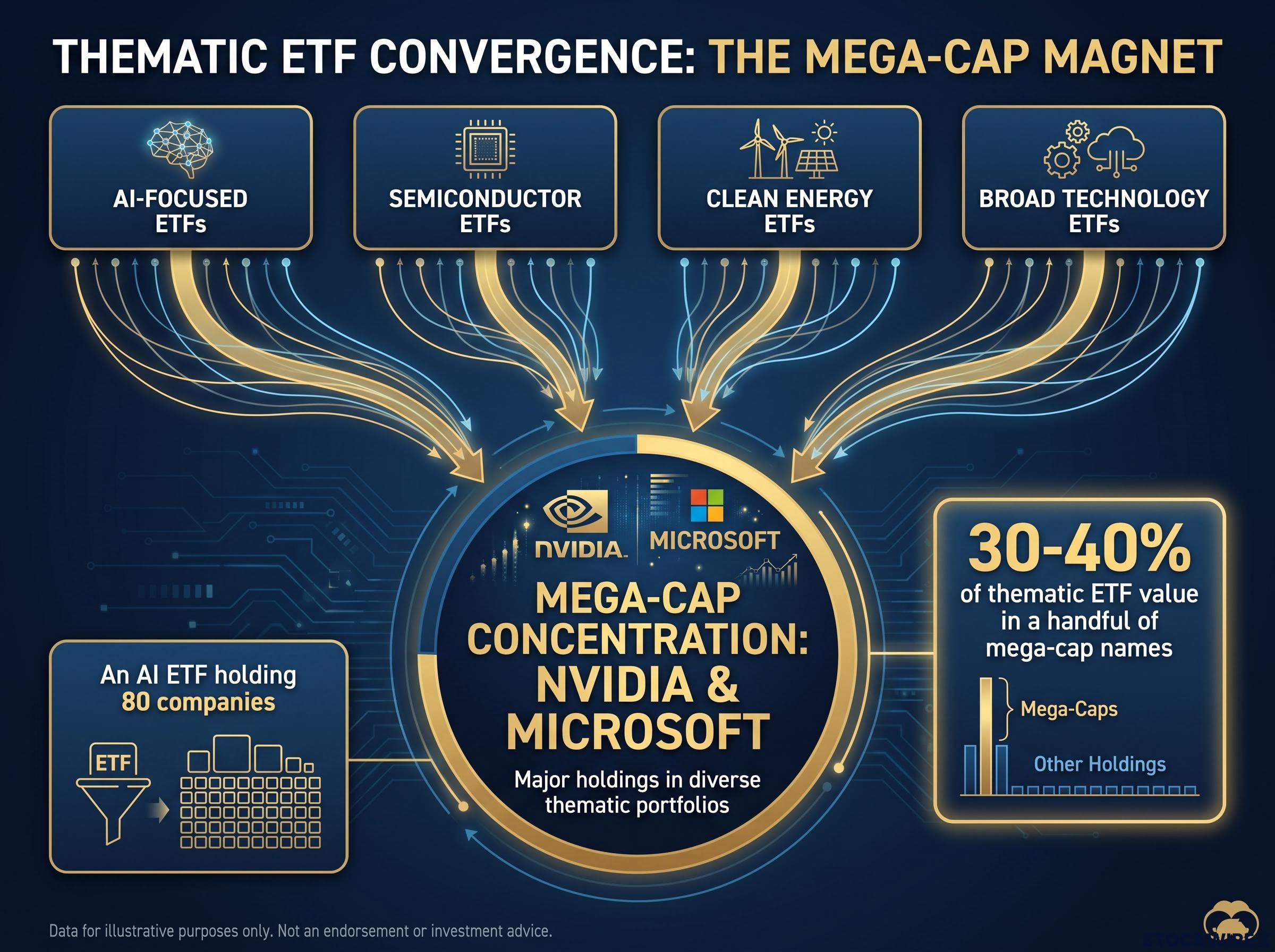
The most common categories where this overlap appears:
- AI-focused ETFs sharing mega-cap technology holdings
- Semiconductor ETFs concentrated in the same chipmakers
- Clean energy ETFs overlapping with broad technology names through shared supply-chain companies
- Broad technology and innovation ETFs dominated by the same top-five names
How to check for overlap before you buy
This takes under five minutes and eliminates the most common source of hidden concentration:
- Pull the top-ten holdings of the ETF you are considering. Most fund providers publish these on the product page.
- Compare against the top-ten holdings of every fund already in your portfolio using a broker’s holdings comparison tool or an ETF research site. If the same names dominate multiple funds, you are adding concentration, not diversification.
Size thematic allocations as satellite positions rather than core holdings. They can serve a purpose, but only when you understand exactly what overlap they introduce.
Mistake 4: The thematic illusion: chasing sectors creates concentration, not diversification
Many investors assume all ETFs are essentially index trackers with minor variations. The reality is that the same four-letter label describes products with fundamentally incompatible risk profiles and holding periods. Before you buy, you need to know which of three product types you are looking at.
| Type | How it works | Typical cost | Appropriate holding period |
|---|---|---|---|
| Passive index-tracking | Follows an index mechanically with minimal human intervention | Low (often 0.03-0.20%) | Long-term core holding |
| Active | Managed by humans or systematic strategies; may use derivatives, buffer structures, or tactical allocation | Moderate to high (often 0.40-1.00%+) | Varies by strategy |
| Leveraged or inverse | Uses derivatives to deliver 2x or 3x the daily movement of an underlying index (long or inverse) | High (0.75-1.00%+, plus hidden costs from daily resets) | Short-term tactical trades only |
Active ETFs are often more complex than “a fund manager picks stocks” implies. Many incorporate derivatives, systematic strategies, or buffer structures that change the product’s risk profile substantially.
Leveraged ETFs deserve particular caution. A 2x Nasdaq ETF is structured to return twice the index’s movement on any given day, meaning your downside exposure is equally doubled.
Volatility decay is the compounding effect that erodes returns when an asset fluctuates over time. Because leveraged ETFs reset daily, a period of up-and-down movement can cause the fund to significantly underperform its stated multiple over holding periods longer than a single day, even if the underlying index ends up roughly flat.
If you are holding a leveraged ETF as a core long-term position rather than a short-term tactical trade, volatility decay is working against you every day the market moves in any direction. The cumulative effect is almost always worse than investors expect. Knowing a fund’s classification before purchase is the single fastest way to avoid placing the wrong product in the wrong position.
Volatility decay compounds against leveraged ETF holders even when the underlying index trends sideways, because the daily reset mechanism locks in losses from up-and-down movement before any recovery can offset them.
Mistake 5: The ‘set it and forget it’ trap: long-term investing still needs vigilance
Long-term investing requires patience. It does not require blindness. Too many investors conflate the two, treating a buy-and-hold philosophy as permission to stop looking at their portfolio entirely.
A portfolio that started as 70% equities and 30% bonds can drift to 85% equities after a sustained rally without a single deliberate decision. Your risk exposure has quietly changed even though your plan has not.
Portfolio drift is not a theoretical concern: multi-year equity rallies have pushed many 60/40 allocations toward 70/30 or beyond without a single deliberate decision, quietly converting moderate-risk portfolios into aggressive ones.
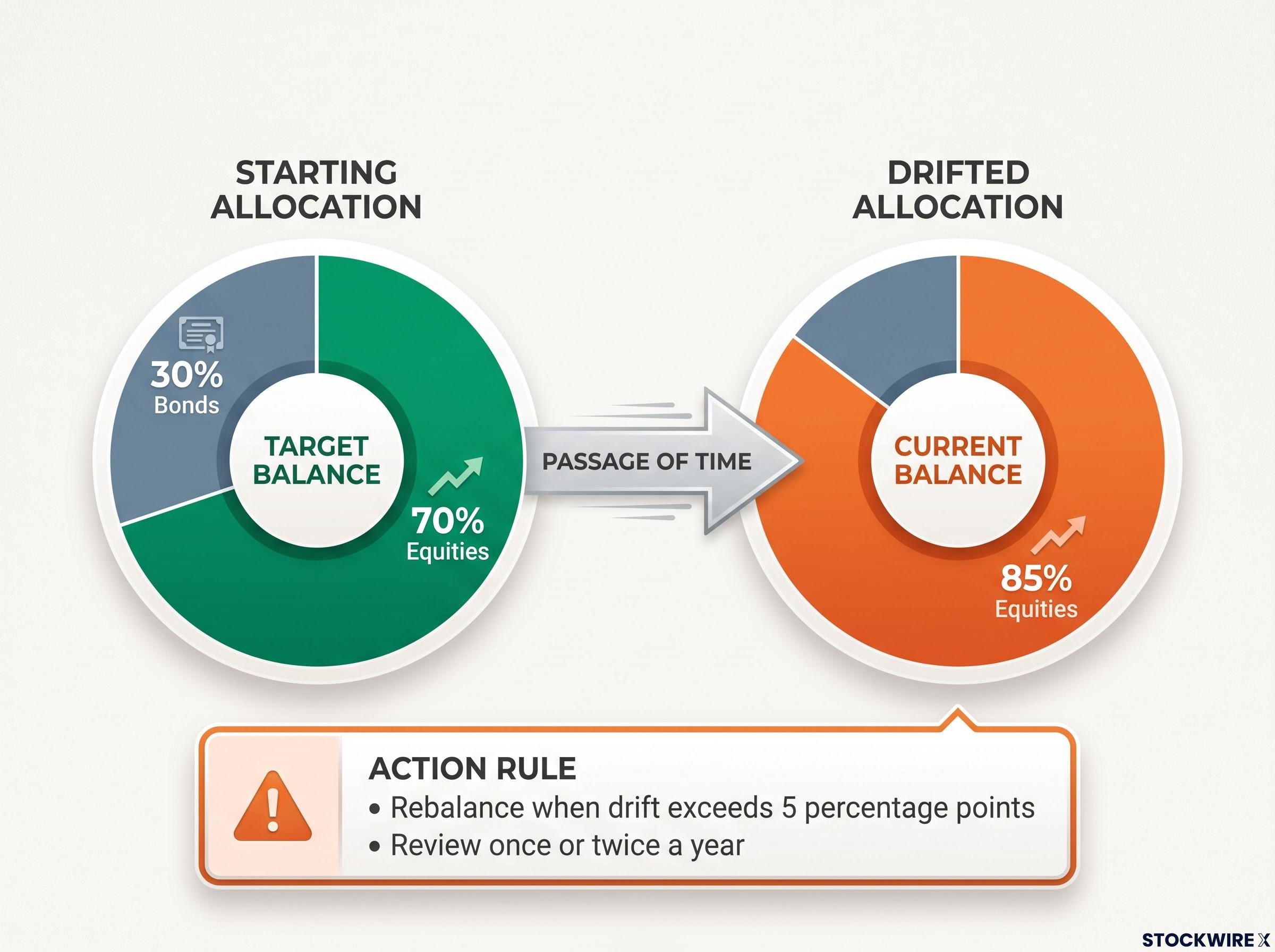
A practical drift threshold: review once or twice a year, and rebalance when any asset class drifts more than approximately 5 percentage points from its target weight.
The triggers for a portfolio review fall into two categories:
- Scheduled reviews: Once or twice a year, check your allocations against your targets. This preserves the benefits of discipline without encouraging constant trading.
- Out-of-cycle triggers: Large market moves (significant rallies or drawdowns) and major life changes (approaching retirement, a large income shift, a change in financial goals) warrant a review outside the regular schedule.
This is not about timing the market. It is about maintaining the allocation you deliberately chose. A structured review schedule protects the diversification you worked to build in the first place.
Two more pitfalls hiding in plain sight: fees and performance chasing
The five mistakes above are structural. These two are the invisible multipliers that make every structural mistake more expensive than it appears.
- Fees and trading costs: Even small differences in expense ratios compound substantially over time. A fund charging 0.80% annually versus one charging 0.10% will produce a meaningfully different outcome over a 20-30 year horizon. Beyond expense ratios, niche thematic and leveraged ETFs often carry wider bid-ask spreads, the gap between the buying and selling price, that function as a hidden transaction cost on every trade.
A 0.70% annual difference in fees sounds trivial. Over 25 years on a $100,000 portfolio, it represents tens of thousands of dollars in lost compounding. Fees are quiet, but they are not small.
- Performance chasing: Investors consistently pour into thematic ETFs after periods of strong recent returns, effectively buying near peak valuations. The fund’s reported return and the return you actually receive can diverge dramatically when your entry point was driven by recent performance rather than a deliberate investment rationale. This gap is one of the most consistent and underappreciated costs in retail investing.
DALBAR investor behavior research consistently quantifies this gap, finding that the returns investors actually receive trail the reported fund returns by a meaningful margin, with the shortfall driven primarily by poorly timed entries and exits rather than fund underperformance.
| Mistake | Core problem | What to do instead |
|---|---|---|
| Assuming structural safety | Treating the ETF label as a risk guarantee | Check total holdings, sector weightings, and top-10 concentration before buying |
| Over-diversifying into redundancy | Paying multiple fees for overlapping exposure | Use a small core of broad, non-overlapping ETFs; compare expense ratios |
| Hidden thematic concentration | Same mega-cap names dominating multiple funds | Use overlap tools; compare top holdings; size thematic ETFs as satellites |
| Confusing product types | Holding leveraged or complex products as core positions | Confirm whether a fund is passive, active, or leveraged before purchasing |
| Set-and-forget approach | Allocation drift changing risk exposure silently | Review once or twice a year; rebalance when drift exceeds 5 percentage points |
| Ignoring fees | Expense ratios and bid-ask spreads compounding over decades | Compare expense ratios; be aware of spreads on thinly traded funds |
| Performance chasing | Buying after peaks and realising returns below the fund’s reported performance | Establish an investment rationale before buying; do not add funds based on recent returns alone |
Running your own ETF portfolio audit
You now have the same checklist that experienced portfolio reviewers use when they sit down with a client’s holdings. Here is how to run it on your own portfolio today:
- Do I know the top-ten holdings and sector concentration of every ETF I own? If not, pull each fund’s fact sheet and check.
- Are any of my ETFs holding substantially the same underlying stocks? Compare holdings across funds and consolidate where overlap is high.
- Have I checked whether each fund is passive, active, or leveraged? Confirm the product type and ensure it matches my intended holding period.
- Do any of my thematic ETFs share the same mega-cap names in their top holdings? If so, size them as satellite positions, not core holdings.
- When did I last review my allocation targets and rebalance? If it has been more than a year, schedule a review this month.
ETF investing done well is genuinely powerful. The goal is not to make you cautious about using them. It is to make you a more deliberate user of them. These five questions, asked once or twice a year, are the difference between a portfolio that works as intended and one that has quietly drifted into something you never chose.
This article is for informational purposes only and should not be considered financial advice. Investors should conduct their own research and consult with financial professionals before making investment decisions.