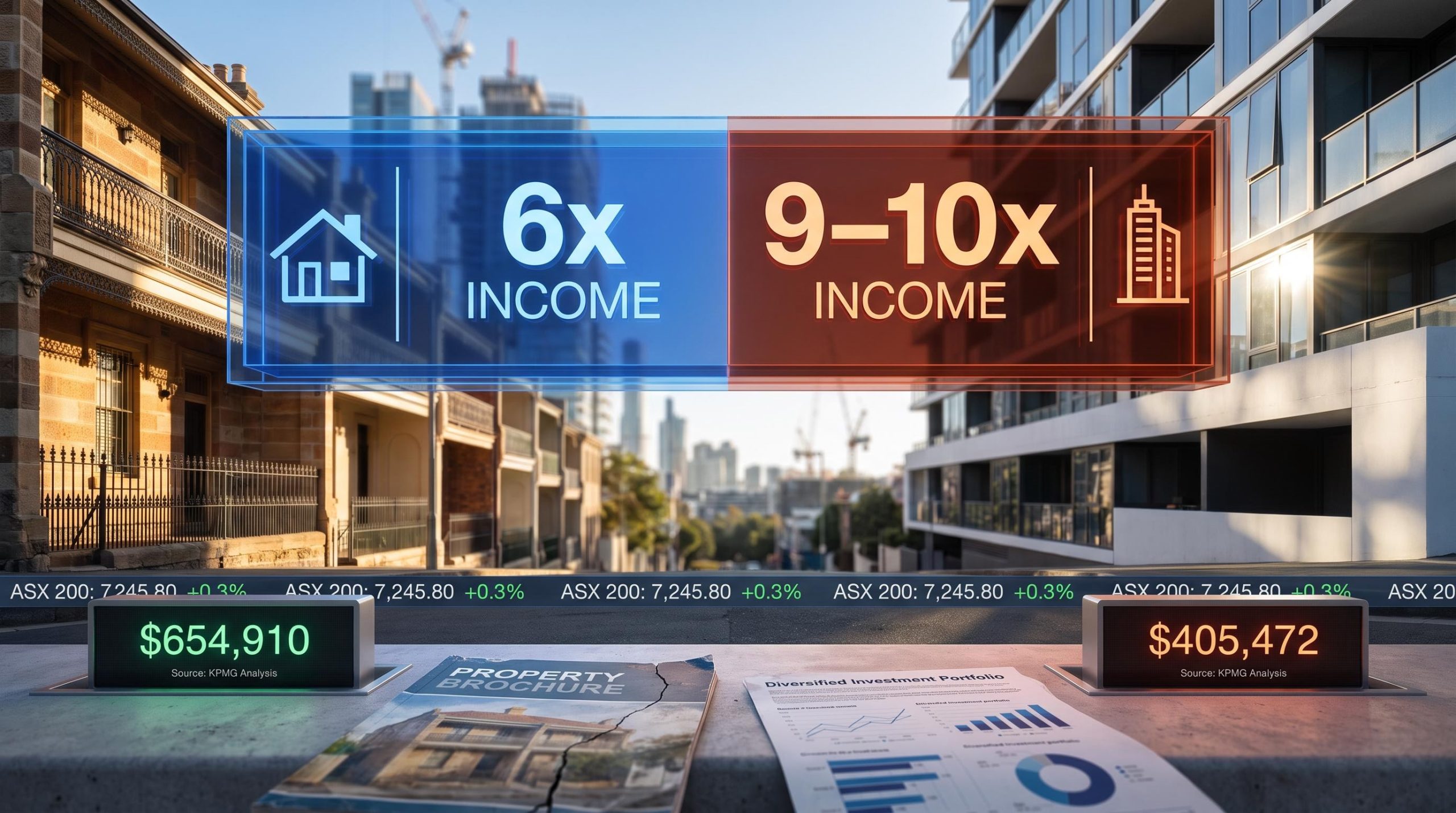
A home that cost six times the average income in the 1990s now costs nine to ten times. The generation that bought early and built substantial wealth through property did not do so because they were more disciplined, more ambitious, or better with money. They bought when the conditions made it possible.
That distinction matters because the cultural assumption that property is the singular path to wealth in Australia was built on a specific set of structural tailwinds: falling interest rates, expanding credit, and affordable entry prices. The belief persisted long after those conditions had already shifted. For Millennials, the assumption remains powerful, but the economics underneath it have changed materially.
Here is a framework for separating the housing decision from the wealth decision, and a practical sense of where the real alternatives sit. The aim is diagnostic and forward-looking: not to argue that property is bad, but to show that the conditions which made it exceptional were always temporary, and that the strongest wealth outcomes for the generation immediately before you were built on diversification, not on property alone.
How earlier generations actually built wealth through property
The gains were real. A 25-year-old Gen Xer who bought a median Australian home in 1997 would have realised approximately $654,910 in capital gains by mid-2025, according to KPMG analysis. That is a life-changing sum, and it happened across a broad cohort, not just a handful of savvy buyers.
But those gains were rooted in a confluence of timing, not a universal property law. Buyers who entered in the 1990s locked in returns because of when they bought: median homes cost approximately six times the average income, interest rates were falling from their early-1990s peaks, and shifting lending practices meant households could take on considerably greater debt relative to their earnings across the following two decades. Greater borrowing capacity fed directly into rising prices across the whole market, producing conditions that bear little resemblance to the environment buyers encounter today.
The timing gap in numbers: KPMG data show a Gen Xer entering in 1997 realised approximately $654,910 in capital gains by mid-2025, compared with $405,472 for an equivalent Millennial purchase. That difference is not a measure of Millennial disadvantage alone; it is a measure of what structural timing is worth.
The KPMG data also reveal something less discussed: Gen X achieved its strongest wealth outcomes not from property alone but from combining early property entry with diversified share holdings. The generation that benefited most from property also benefited from not relying on it exclusively.
When big ASX news breaks, our subscribers know first
Why the same playbook is structurally harder to run today
The affordability problem is not a single barrier. It is a stack of compounding headwinds arriving simultaneously for the Millennial cohort, and each one reinforces the others.
Start with entry prices. The median Australian home now costs approximately nine to ten times the average income, up from roughly six times in the 1990s. That alone compresses the capital gains runway available to new buyers: there is less room between entry price and the next meaningful appreciation threshold.
RBA research on housing affordability confirms that the house price-to-income ratio has risen substantially over recent decades, with the central bank’s own analysis linking the trajectory directly to the sustained decline in interest rates that has now reversed.
Layer on debt. The average Millennial household holds property valued at approximately $890,000 with around $460,000 in outstanding loans, according to available estimates. That leverage means net worth sits much closer to the asset’s value than it does to genuine financial freedom. For many, the property is still largely a liability in practical terms.
Then add the macro backdrop. A portion of early-career Millennials began working during or in the aftermath of the Global Financial Crisis, which held back earnings growth compared to earlier cohorts. When rate rises followed the post-pandemic inflation surge, they landed precisely as this cohort was first reaching a position to seriously consider buying property, squeezing affordability from both sides.
| Generation | Approx. entry price-to-income ratio | Interest rate environment | Estimated capital gain (KPMG) |
|---|---|---|---|
| Boomers | ~3-4x (indicative; data less precise) | High rates, then decades of decline | Substantial (not separately quantified by KPMG in this analysis) |
| Gen X (1997 entry) | ~6x | Falling rates, expanding credit | ~$654,910 by mid-2025 |
| Millennials (current) | ~9-10x | Low-rate window closed; higher rates post-2022 | ~$405,472 (equivalent purchase) |
KPMG explicitly warns that the ultra-low interest rate period that accelerated recent property gains “has now closed,” reducing the probability of equivalent windfall returns for buyers entering today.
For a Millennial considering property now, the question is not whether prices will rise. It is whether the risk-adjusted return from a highly leveraged, illiquid position justifies crowding out more diversified, accessible alternatives.
What a property-only strategy actually costs in flexibility and risk
Property appreciating in value does not, on its own, make you financially flexible. A home cannot be partially sold. You cannot liquidate 5% of your house to fund a career break, cover a period of income disruption, or support a family member. Unlocking value typically requires either a full sale or taking on more debt, and both carry costs and timing constraints that do not apply to liquid assets.
The practical triggers where illiquidity becomes a problem arrive faster than most people expect:
The liquidity constraint of direct ownership is precisely where listed property alternatives such as A-REITs offer a structural advantage: positions settle in two business days, can be sold in small parcels, and carry none of the stamp duty costs that apply to an equivalent direct property transaction.
- An unplanned career break or redundancy
- Income disruption from illness or caring responsibilities
- Supporting children through education or early adulthood
- Wanting to retire before the mortgage is fully repaid
Each of these is common. None of them can be solved by pointing at a rising property valuation.
Concentration risk compounds the problem
Beyond illiquidity, a single dwelling in one suburb is a maximally concentrated position. It is exposed to local planning decisions, shifts in the employment base of the surrounding area, and demographic changes in ways that a diversified portfolio of Australian shares, global shares, listed property, and bonds is not. The increasing cost of acquiring and maintaining property raises the opportunity cost: those funds could alternatively be directed toward income-generating and growth-oriented diversified holdings.
Consider the contrast in practical terms. On paper, $1.5 million concentrated in a single property with few other assets can look like substantial wealth, yet a peer sitting at the same net worth but spread across a smaller home and a meaningful investment portfolio commands far greater day-to-day financial flexibility, and that gap compounds over time as the diversified portfolio generates returns that can be accessed without selling the underlying asset.
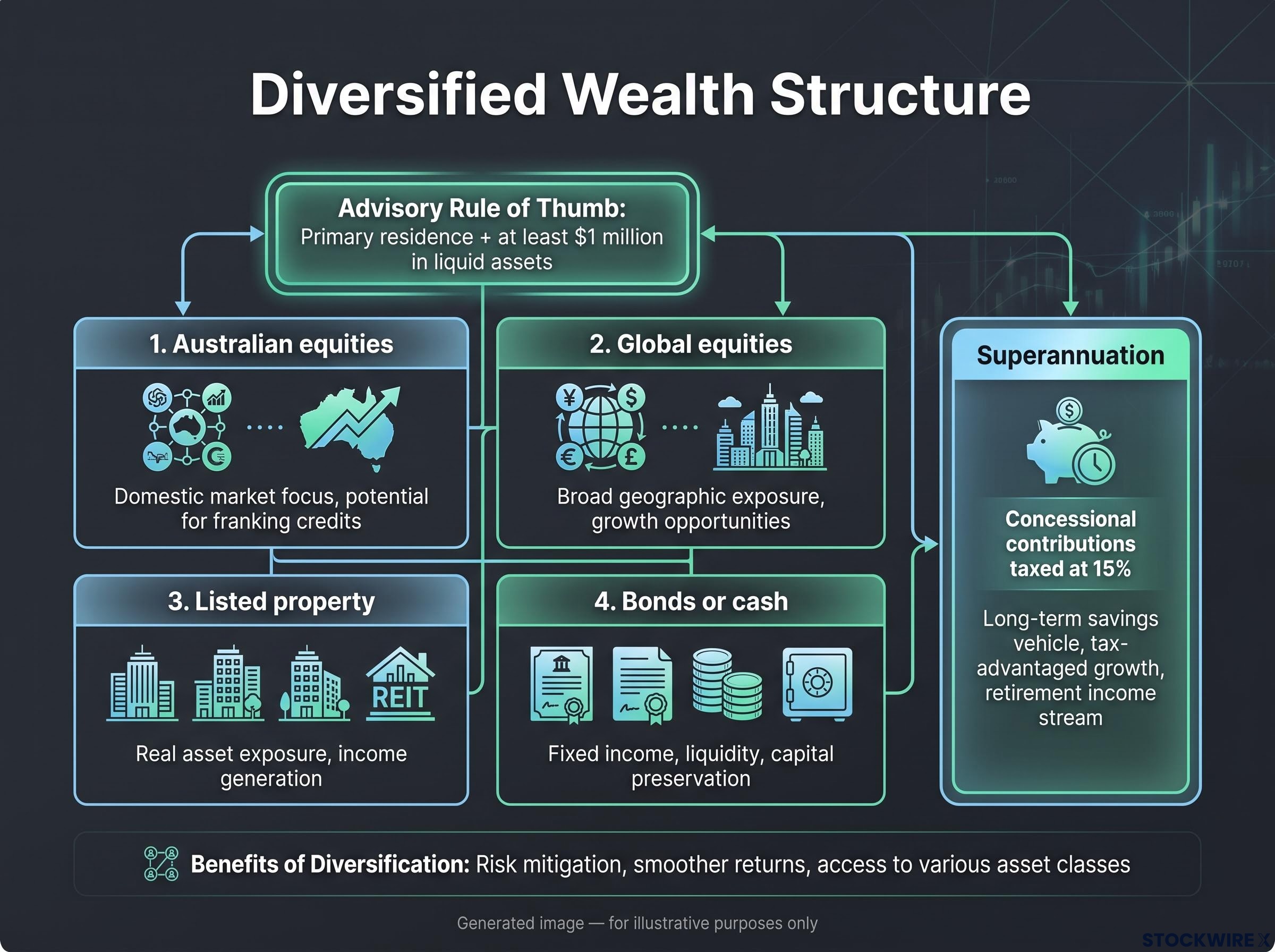
A well-established rule of thumb within financial advisory practice holds that a comfortable retirement requires a primary residence plus at least $1 million in liquid assets. The home provides shelter, but it is liquid, income-producing assets that provide spending power. Advisory benchmarks of this kind were set more than a decade ago and have probably moved upward since, yet the underlying logic holds: property keeps a roof over your head, while liquid assets fund the life you actually want to live.
Understanding superannuation and diversified portfolios as wealth-building vehicles
Australia’s superannuation system is a long-term wealth accumulation structure with a specific advantage: concessional contributions, which are salary contributions taxed at 15% rather than your marginal tax rate, compound within a tax-advantaged environment over decades. Superannuation is not a product you buy; it is a structure that holds investments (shares, bonds, property, cash) and shields their growth from the higher tax rates that apply outside it. For a Millennial with 30-plus years until preservation age, the compounding effect of consistent concessional contributions is substantial.
Outside superannuation, low-cost index funds have made broad market exposure accessible to ordinary investors at a scale and cost that did not exist a generation ago. An index fund tracks a market (such as the ASX 200 or a global share index) by holding the same stocks in the same proportions, delivering market returns without requiring active management or large capital. This is the mechanism through which diversification becomes practical.
ETF portfolio construction for Australian investors involves more nuance than simply selecting a broad market fund: the cap-weighted structure of the ASX 200 concentrates nearly half of domestic equity exposure in banks and miners before any active allocation decision is made, which means asset allocation choices matter considerably more than fund selection alone.
A diversified portfolio typically holds exposure across four broad asset class categories:
- Australian equities (shares in ASX-listed companies)
- Global equities (shares in companies listed on international exchanges)
- Listed property (real estate investment trusts that trade on exchanges, providing property exposure with daily liquidity)
- Bonds or cash (lower-risk holdings that provide stability and income)
This spread of risk across sectors, geographies, and asset types is what a single property in one suburb cannot provide.
The KPMG finding that Gen X’s strongest wealth outcomes combined early property entry with diversified share holdings establishes this as empirically validated, not speculative. Diversification is what made the strongest generation of property owners wealthier, not property concentration.
Morningstar Australia hosts Shani Jayamanne and Mark LaMonica have framed homeownership as a valid but not obligatory choice, reflecting a broader shift in how the financial advice profession approaches the housing question.
Around $3.5 trillion in Baby Boomer wealth is projected to transfer to younger Australians over the coming decades, according to available estimates. How that transfer builds wealth depends heavily on whether recipients deploy it into diversified portfolios or concentrate it further into expensive property. For a Millennial who cannot access property at scale today, superannuation and diversified share portfolios are not consolation prizes; they are the same structural tools that gave Gen X its strong outcomes, now more accessible and lower-cost than at any prior point.
Renting, rent-vesting, and reframing the housing choice
Renting and investing the difference is a mathematically legitimate strategy, not a fallback. State-based tenant protections across Australia have strengthened considerably in recent years, reducing the chronic insecurity that previously made long-term renting a less viable way to live. For a Millennial in a high-cost city, renting in a preferred location while directing surplus capital into superannuation and diversified investments can deliver stronger long-term wealth outcomes than stretching to buy at a price-to-income ratio of nine to ten times.
Rent-vesting takes this a step further. The strategy involves renting where you want to live while owning an investment property in a more affordable or higher-yield area, capturing the financial benefits of property ownership (including tax treatment of investment property expenses) without sacrificing lifestyle flexibility. It is not theoretical: Millennials are reportedly the most active cohort of new investment property purchases, accounting for an estimated 46% of new investment property purchases at one major bank in 2023. Many in this generation have already separated the housing question from the wealth question in practice, even if the cultural narrative has not caught up.
Investment property tax changes announced in the 2026-27 Federal Budget, including the removal of negative gearing on existing residential dwellings and replacement of the 50% CGT discount, are already reshaping the after-tax return calculus for leveraged property positions before a single bill has been formally tabled.
Alan Kohler, appearing on the Equity Mates podcast, stated that property has become a poor investment and should revert to functioning purely as a place of residence rather than a wealth-building mechanism.
The assumption that renting signals failure is a generational artefact, not a financial law. The practical comparison makes this concrete:
- Capital deployed: Traditional homeownership concentrates capital in a single asset; rent-vesting splits it between a yield-generating investment and liquid portfolio holdings
- Flexibility: Renters can relocate for career opportunities or lifestyle without the friction and cost of selling a primary residence
- Tax treatment: Investment property expenses may be deductible in ways that primary residence costs are not
- Lifestyle control: Renting in a preferred area while owning elsewhere means neither the financial decision nor the lifestyle decision has to compromise
What a recalibrated wealth strategy looks like for Millennials today
The core reframe is straightforward: the housing decision and the wealth decision are separable. Treating them as one is what forces the binary of “buy at any cost or fall behind.” Separating them opens a set of options that are more flexible, more diversified, and more consistent with how the strongest wealth outcomes were actually built.
The practical components of a recalibrated approach sit across a handful of deliberate choices:
- Superannuation contributions: Maximise concessional contributions to compound within a tax-advantaged structure over decades
- Diversified portfolio: Build low-cost index fund exposure across Australian equities, global equities, listed property, and bonds
- Deliberate housing choice: Own, rent, or rent-vest based on personal circumstances, financial capacity, and lifestyle needs, not cultural obligation
- Rent-vesting if applicable: Capture property ownership benefits while maintaining lifestyle and geographic flexibility
KPMG data confirm that Gen X’s strongest outcomes combined early property entry with diversified share holdings. That is the empirical anchor: the generation that benefited most from property did not rely on property alone. A Millennial who treats homeownership as one option among several is not retreating from wealth-building; they are adopting the same diversified approach that produced the strongest outcomes for the generation immediately before them.
The retirement benchmark of a primary residence alongside approximately $1 million in liquid assets provides a practical frame for what “enough” looks like. The structural tools to get there, including superannuation, low-cost index funds, and rent-vesting, are more accessible and lower-cost today than at any prior point in Australian financial history. The conditions that made property a singular vehicle have shifted. The conditions that make diversification effective have improved.
For readers ready to act on the recalibrated strategy outlined above, our comprehensive walkthrough of starting to invest in Australia covers the emergency fund prerequisite, brokerage account structure, and first ETF trade steps needed to move from framework to portfolio.
This article is for informational purposes only and should not be considered financial advice. Investors should conduct their own research and consult with financial professionals before making investment decisions. Past performance does not guarantee future results, and financial projections are subject to market conditions and various risk factors.