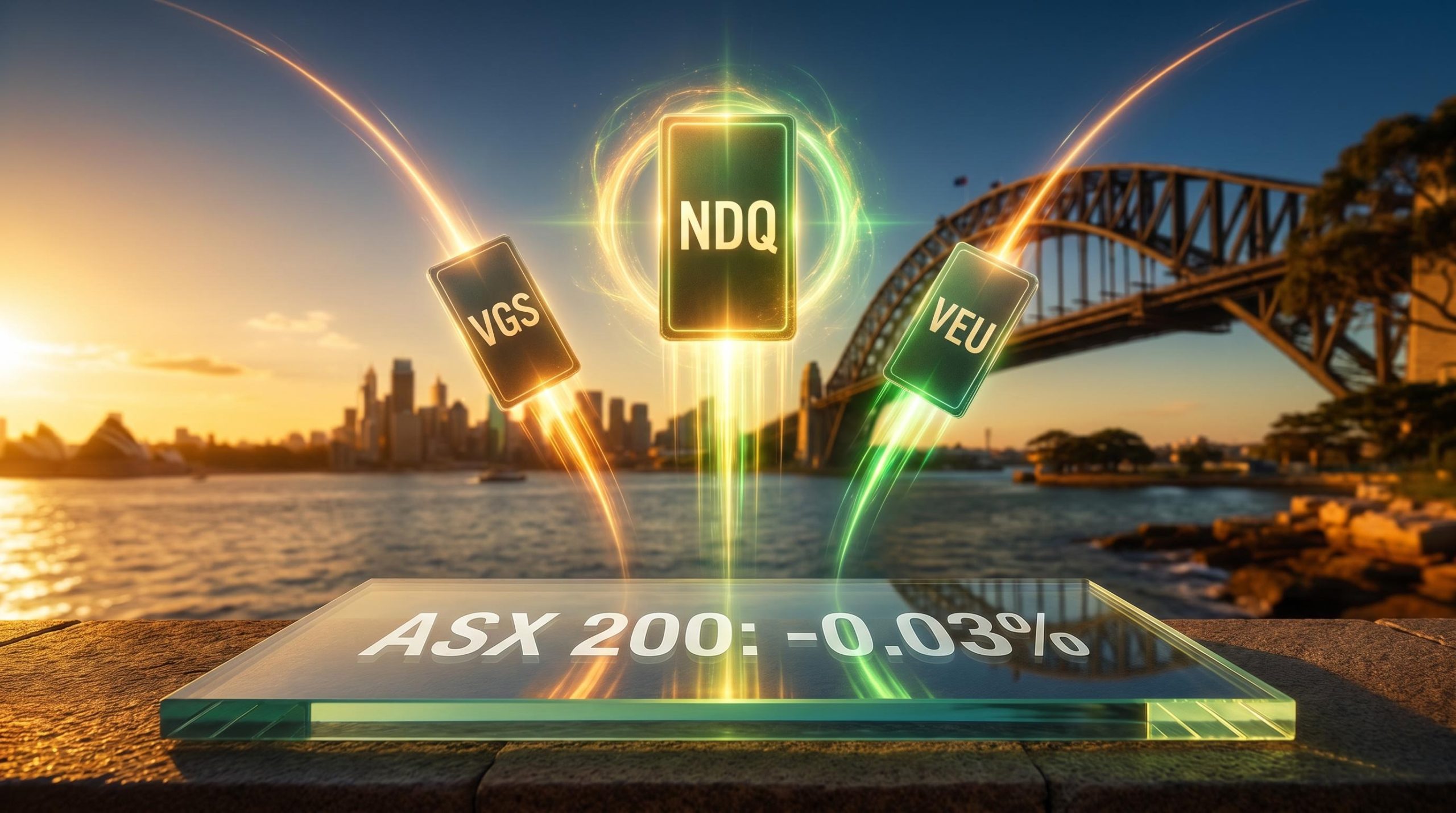
The S&P/ASX 200 has delivered essentially zero return in 2026. As at 1 June 2026, the index sat at -0.03% year to date, well below its long-run historical average of approximately 9% per annum. Three ASX-listed international ETFs tell a different story, each posting five-year annualised returns above 10%. What follows is a practical breakdown of NDQ, VGS, and VEU: what each fund holds, its performance record, its annual fee, and which investor profile it suits best. All three trade on the ASX in Australian dollars, so no foreign brokerage account is required.
Why a flat ASX is pushing investors to look at international ETFs in 2026
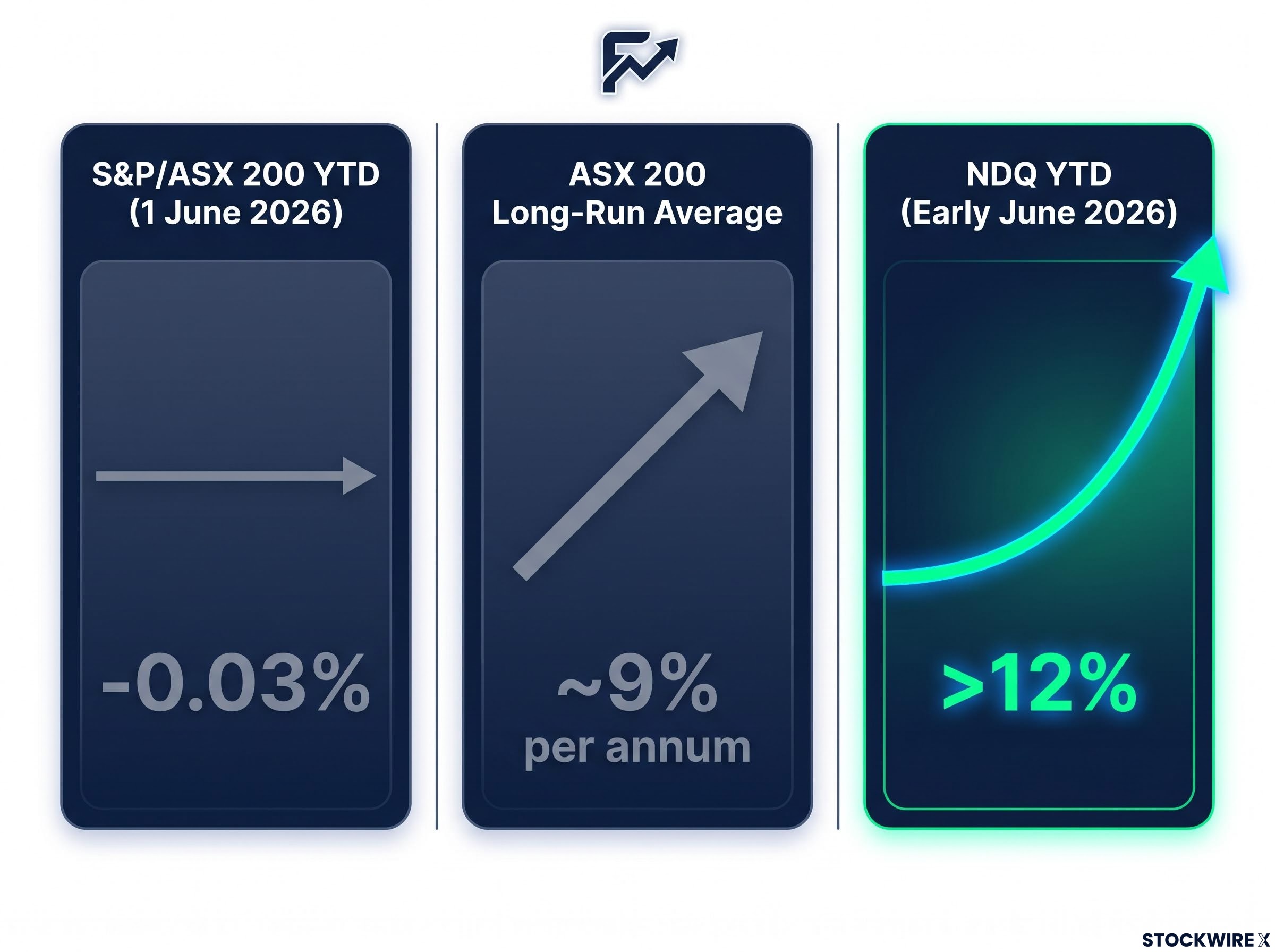
The numbers make the case on their own. The S&P/ASX 200 returned -0.03% on 1 June 2026 and remained near flat on 3 June 2026. Set that against the index’s long-run average of roughly 9% per annum, and the gap is hard to ignore.
The S&P/ASX 200 has returned approximately 0% year to date in 2026, compared with a long-run historical average of approximately 9% per annum.
Part of the explanation is structural. The ASX is heavily concentrated in a narrow band of sectors, and Australian investors who hold only domestic equities are exposed to a limited slice of the global economy. The sectors most underrepresented on the ASX include:
ASX sector concentration is more pronounced than headline index numbers suggest: financials and materials together account for roughly 52% of the S&P/ASX 200 by market-cap weight, which means a domestic-only portfolio is structurally underweight the technology, healthcare, and global consumer sectors that have driven the most significant wealth creation over the past decade.
AUSIEX research on ASX sector concentration confirms that Australian equities are heavily weighted toward financials and resources, leaving technology and healthcare materially underrepresented relative to their share of global market capitalisation.
- Technology, including the companies behind AI, cloud infrastructure, and software platforms
- Healthcare, particularly large-cap pharmaceutical and medical device firms listed offshore
- Global growth companies operating at the intersection of digital services, e-commerce, and emerging consumer markets
Australia’s share market represents only a minor fraction of total global equity market capitalisation. International ETFs listed on the ASX offer a practical response: investors can buy them through a standard brokerage account in Australian dollars, gaining exposure to thousands of global companies without needing offshore access or a foreign currency account.
When big ASX news breaks, our subscribers know first
What to understand about international ETFs before buying one on the ASX
Before comparing individual funds, three mechanical concepts shape how these products actually work and how returns can differ from the underlying markets they track.
- Index tracking: ASX-listed international ETFs hold baskets of foreign equities designed to replicate a specific index. They trade in AUD on the ASX like any ordinary share, but their underlying holdings are priced in foreign currencies.
- Unhedged currency exposure: All three ETFs in this article (NDQ, VGS, and VEU) are unhedged. That means AUD movements directly affect returns. A weaker Australian dollar amplifies gains when converted back to AUD; a stronger Australian dollar reduces them. Currency swings can add or subtract several percentage points from a fund’s return in any given year, independent of how the underlying stocks perform.
- Management expense ratio (MER) compounding: Fees are deducted from the fund’s assets, not invoiced separately. Over long holding periods, the difference between a 0.04% fee and a 0.48% fee compounds meaningfully. Fee comparison is not a minor detail; it is a structural component of long-term returns.
The fee range across the three funds spans 0.04% to 0.48% per annum. ASX announcements and periodic product disclosure statements (PDS) remain the primary channels for monitoring ETF holdings, costs, and any changes to fund structure.
State Street’s investor guide to ETFs outlines how product disclosure statements set out the specific cost and structural details of each fund, including the treatment of indirect costs that can affect the total expense burden beyond the headline management fee.
NDQ: concentrated US technology exposure with strong recent momentum
NDQ has returned more than 12% year to date in 2026. Against the flat ASX, that contrast is the headline.
NDQ year-to-date return as at early June 2026: more than 12%
The BetaShares Nasdaq 100 ETF tracks the Nasdaq 100 Index, holding the 100 largest non-financial companies listed on the Nasdaq exchange. The portfolio is heavily weighted toward US technology and growth names, including the companies driving AI, cloud computing, and the digital economy. NDQ is ranked among the largest ASX-listed ETFs by market capitalisation as at April 2026.
- Index tracked: Nasdaq 100
- Number of holdings: 100 non-financial Nasdaq-listed companies
- Management fee: 0.48% per annum
- Currency: Unhedged (AUD)
- Key sectors: US technology, growth, AI, digital infrastructure
- Five-year annualised return: Exceeds 10%
NAV per unit stood at $62.89 as at 2 June 2026.
NDQ suits investors comfortable with concentration risk in US technology who are seeking growth-oriented exposure unavailable on the ASX. It is the most concentrated and highest-conviction vehicle of the three, though also the most geographically and sectorally narrow. A portfolio already heavy in US equities would be doubling down with NDQ rather than diversifying.
NDQ’s role in a broader portfolio is shaped by what it deliberately excludes: the Nasdaq 100 carries zero financial sector exposure by construction, which means its return profile is structurally decoupled from the RBA rate cycle that drives much of the ASX’s movement.
VGS: broad developed-market exposure at a low annual cost
Where NDQ is a concentrated bet, VGS is the diversifier’s default. The Vanguard MSCI Index International Shares ETF tracks the MSCI World ex-Australia index, holding approximately 1,300 large companies across major developed economies. The scope covers the United States, Europe, Japan, and other developed markets while explicitly excluding Australia, which means investors avoid doubling up on the ASX holdings they already own.
- Index tracked: MSCI World ex-Australia
- Number of holdings: Approximately 1,300 large companies
- Management fee: 0.18% per annum (zero indirect and net transaction costs)
- Currency: Unhedged (AUD)
- Markets covered: US, Europe, Japan, developed international markets (ex-Australia)
- Five-year annualised return: Exceeds 10%
The 0.18% fee is meaningfully lower than NDQ’s 0.48%, and over a multi-decade holding period that difference compounds. For cost-conscious investors building a long-term international allocation, VGS offers the broadest developed-market coverage of the three funds at the most competitive fee for its category.
Who VGS suits best
VGS is positioned as a balanced core holding. It provides genuine global diversification without a concentrated single-country or single-sector tilt, making it a natural fit for investors who want international exposure as a permanent portfolio building block rather than a tactical position.
VEU: one trade for emerging and developed markets outside the US
Most global ETFs are dominated by US equities. VEU exists to solve that specific problem.
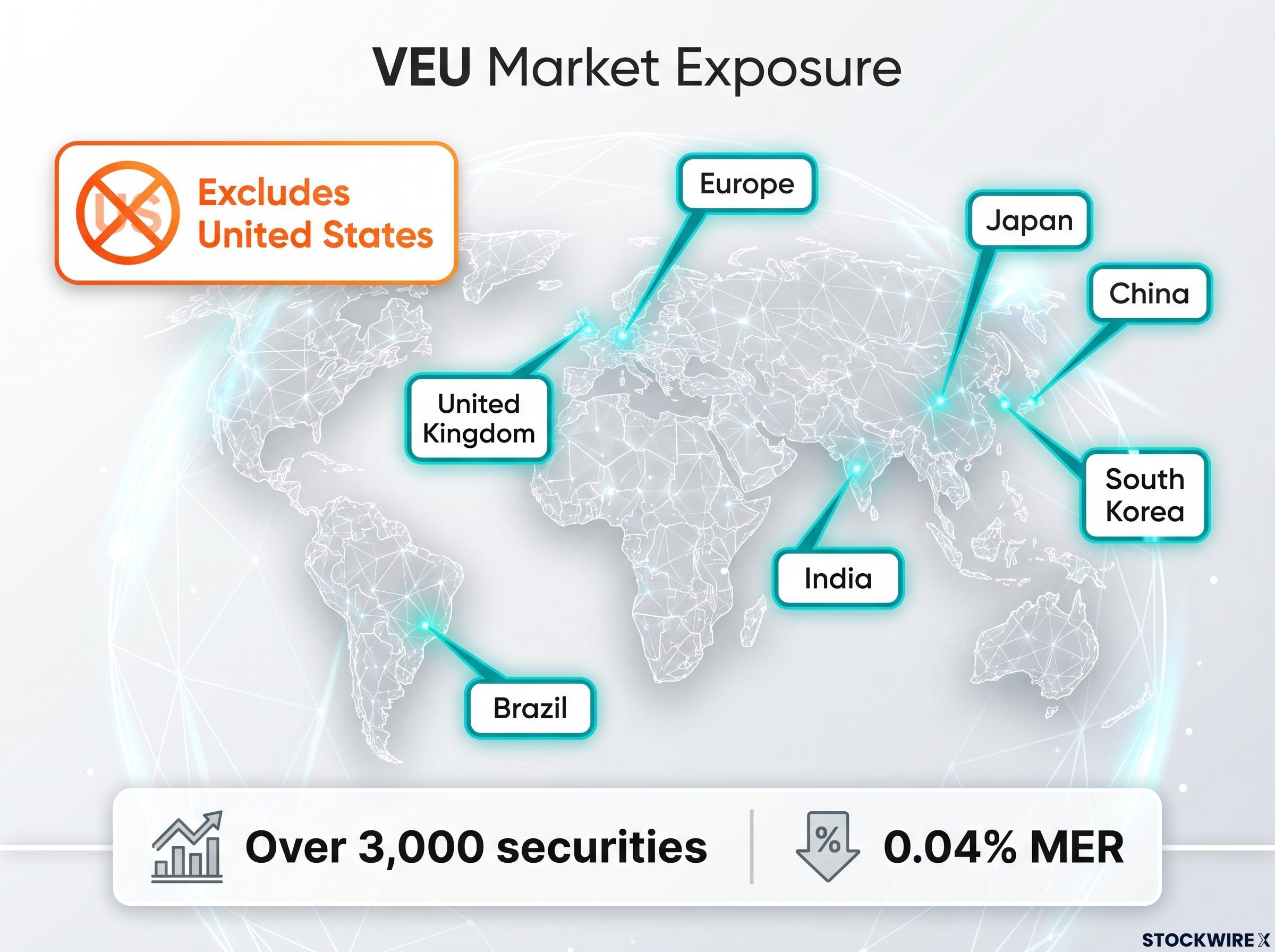
The Vanguard All-World ex-US Shares Index ETF holds over 3,000 individual securities across both developed and emerging markets, explicitly excluding the United States. In a single transaction, an investor gains exposure to Europe, Japan, the United Kingdom, China, India, South Korea, Brazil, and dozens of other markets.
- Index tracked: FTSE All-World ex-US
- Number of holdings: Over 3,000 securities
- Management fee (MER): 0.04% (indirect cost ratio: 0.07%)
- Currency: Unhedged (AUD)
- Markets covered: Developed and emerging markets, excluding the US
- Five-year annualised return: Approximately 10%
VEU’s MER of 0.04% makes it one of the lowest-cost internationally diversified ETFs available on the ASX.
VEU is the logical complement to either NDQ or a US-heavy VGS allocation. An investor who already holds significant US or ASX exposure can use VEU to balance their geographic weighting with broad international coverage at minimal cost. The ultra-low fee means fee drag is almost negligible, even over very long holding periods.
Comparing NDQ, VGS, and VEU side by side
The three funds cover different slices of the global market at different price points. The table below sets them on a single comparison surface.
| ETF | Markets Covered | No. of Holdings | Annual Fee | 5-Year Annualised Return |
|---|---|---|---|---|
| NDQ | US (Nasdaq 100) | 100 | 0.48% | Exceeds 10% |
| VGS | Developed markets ex-Australia | ~1,300 | 0.18% | Exceeds 10% |
| VEU | Developed + emerging markets ex-US | 3,000+ | 0.04% | ~10% |
Fees are sourced from product disclosures current as at 3 June 2026 and are gross of any additional costs per the respective PDS documents. All three funds are unhedged (AUD).
The three investor profiles break down clearly:
- NDQ suits growth-tilted investors with high conviction in US technology and comfort with concentration risk
- VGS suits investors seeking a broad developed-market core holding at a competitive fee
- VEU suits investors who want ex-US global completion, particularly as a complement to NDQ or a US-heavy VGS allocation
All three can coexist in a single portfolio. An investor might hold VGS as a core allocation, add NDQ for a growth tilt toward US technology, and layer in VEU to balance the US weighting with emerging-market exposure. The structural advantage is that all three trade on the ASX through a standard brokerage account in Australian dollars.
ETF portfolio structure, specifically the proportional split between domestic and international holdings and the number of funds held, has a larger influence on long-term outcomes than the choice of any individual fund; Morningstar research positions asset allocation as the primary driver of returns, ahead of fund selection.
The global portfolio starts at home, and the ASX makes it straightforward
The flat ASX environment in 2026 is not a theoretical argument for diversification. It is a data point. The gap between the index’s near-zero year-to-date return and its long-run 9% average is wide enough to prompt a practical question: how much of a portfolio is concentrated in a single market?
NDQ, VGS, and VEU each offer a different answer to that question, and all three are accessible through a standard ASX brokerage account in AUD. The comparison table above provides a starting point for evaluating which fund, or combination of funds, fits a given risk profile and time horizon. The next step is to review existing portfolio holdings, assess geographic concentration, and determine how much non-ASX exposure currently exists.
Investors exploring whether NDQ belongs in a growth-tilted satellite allocation rather than a core holding will find our dedicated guide to ASX growth ETFs, which ranks five funds including NDQ, FANG, and RBTZ on beta, fee, and five-year return across the current RBA rate environment, with sizing guidance for managing drawdown risk.
This article is for informational purposes only and should not be considered financial advice. Investors should conduct their own research and consult with financial professionals before making investment decisions. Past performance does not guarantee future results.