Morningstar published a formal moat downgrade on Ansell on 28 July 2026, stripping the company of the narrow moat classification it had held and concluding that brand strength in the protective wear industry does not reliably translate into pricing power. This is a specific, consequential analytical verdict from one of the most widely followed equity research houses covering the ASX.
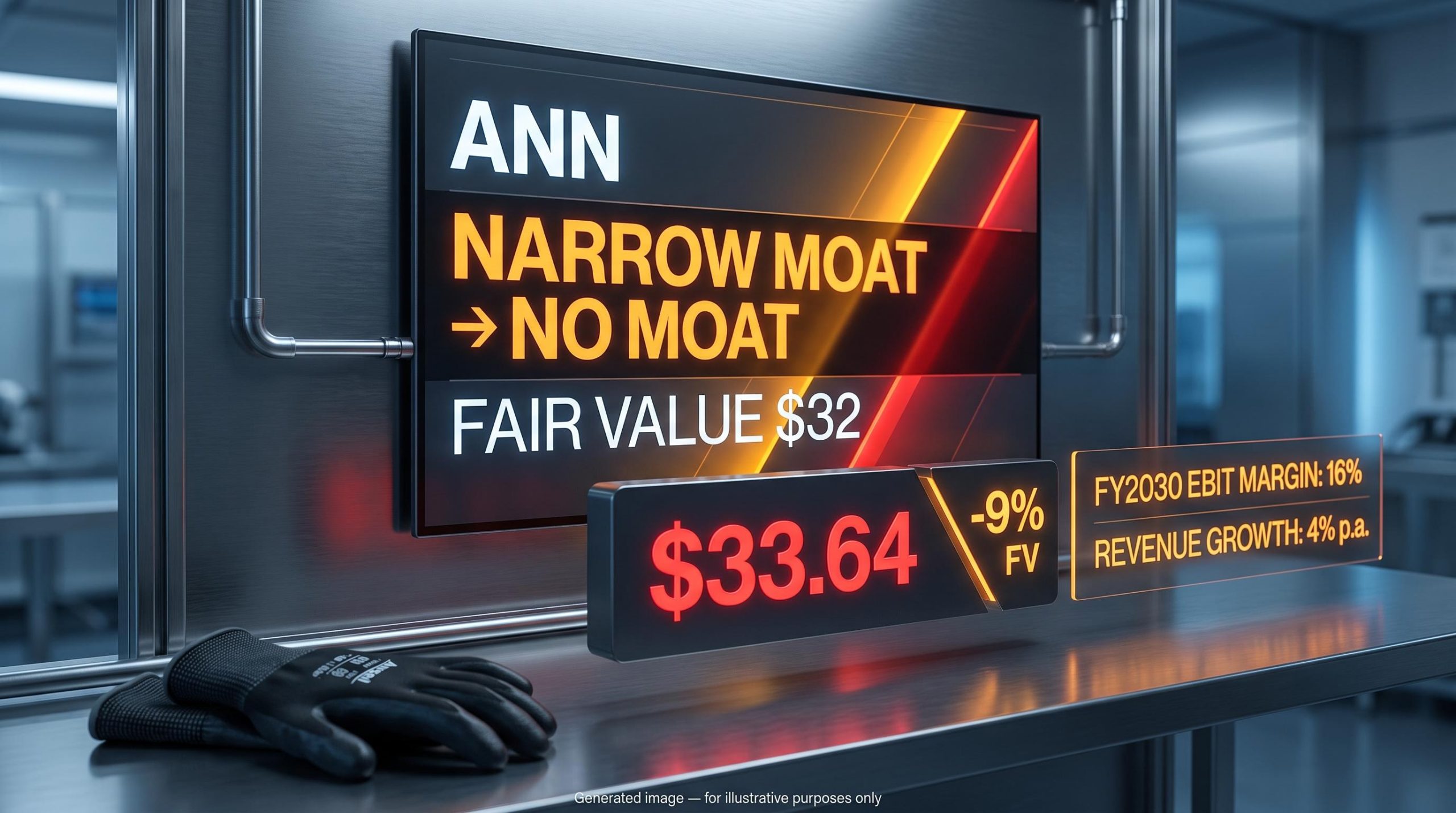
The downgrade triggered a 9% cut to Morningstar’s fair value estimate, landing at $32 per share against a trading price of $33.64 on the day of publication. For investors who had treated the narrow moat as a structural quality signal underpinning their position, the reclassification changes the analytical foundation of the investment, not merely the headline number.
Here is what actually shifted in Morningstar’s thinking, why the valuation moved the way it did despite an improved revenue outlook, and how current and prospective ANN shareholders should reframe their position given the revised competitive assessment.
What Morningstar actually decided, and why it matters now
Morningstar analyst Esther Holloway (Morningstar Australasia Pty Ltd) downgraded Ansell from narrow moat to no moat on 28 July 2026. The revised fair value estimate dropped from approximately $35 to $32, a 9% reduction. On the day of publication, shares were trading at $33.64, up $0.96 (approximately +2.94%), placing them modestly above the new fair value.
The distinction matters. A moat downgrade is a quality reclassification, not a distress signal. It does not say Ansell is in trouble. It says Morningstar no longer has conviction that the company can earn returns above its cost of capital for long enough to justify a premium long-run valuation.
Morningstar formalises competitive durability into five sources of competitive advantage, covering intangible assets, switching costs, network effects, cost advantage, and efficient scale, with companies holding multiple reinforcing sources generally considered more resilient than those relying on a single driver.
Morningstar’s central finding: A recognisable brand does not automatically confer the ability to command premium prices. In Ansell’s broader markets, being a recognised brand is a condition of entry, not a durable competitive advantage.
The 9% valuation cut is not primarily a change in the near-term earnings view. It reflects a reduction in what Morningstar is willing to credit for long-run competitive durability, and that is a structurally different concern for investors than a simple earnings miss. If you held ANN partly because of its moat classification, the foundation of that thesis has changed.
When big ASX news breaks, our subscribers know first
How removing the moat changes the valuation model
Morningstar’s economic moat framework centres on one question: can this company earn returns on invested capital above its cost of capital for an extended period? A narrow moat means Morningstar has conviction those excess returns can be sustained for at least 10 years. Removing the moat removes that conviction.
Morningstar’s economic moat framework defines a narrow moat as conviction that a company can sustain excess returns above its cost of capital for at least 10 years, a duration threshold that the Ansell downgrade explicitly no longer clears.
That feeds directly into how the company is valued. Morningstar uses a discounted cash flow (DCF) model, which estimates the present value of all future earnings. The moat status shapes the terminal value, the portion of the valuation that captures the long tail of earnings stretching years into the future. Less durable competitive advantage means excess returns fade faster back toward the cost of capital, compressing that terminal value.
The three inputs that shifted in Morningstar’s revised model
- Moat status: Narrow to none, which reduces the duration of assumed excess returns and compresses the terminal value
- FY2030 midcycle EBIT margin: Reduced by 160 basis points to 16%, reflecting lower confidence in long-run pricing power
- Revenue growth rate: Raised to 4% per annum from 3%, driven by healthcare segment optimism
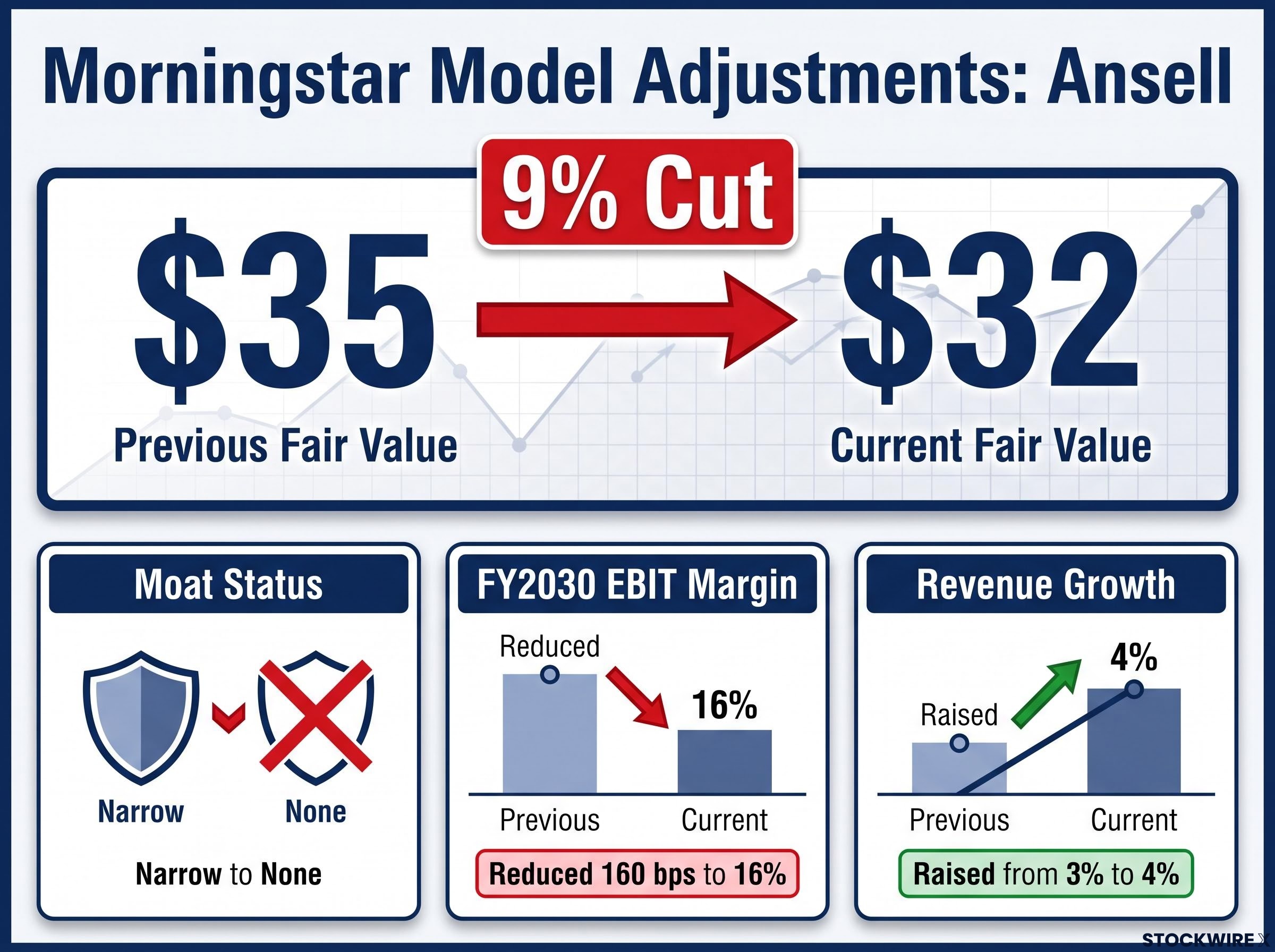
The fact that revenue growth assumptions were raised while the valuation still fell tells you the core issue is competitive durability, not business volume. Morningstar expects Ansell to grow faster than previously modelled, but it no longer believes the company can protect those earnings from competitive erosion over a decade-plus horizon. That distinction should shape how you interpret future earnings upgrades: stronger revenue alone does not restore the moat.
How competitive structure limits brand as a pricing weapon in protective wear
Ansell does have segments where brand creates genuine stickiness. The Hyflex brand commands loyalty among skilled industrial workers, and portions of the healthcare division, particularly surgical gloves and cleanroom products, benefit from real switching friction. When a surgeon or cleanroom operator is trained on a specific glove, changing creates perceived risk. That supports pricing power and repeat purchasing.
The problem is that these segments sit within a broader portfolio where brand does far less work. Across the wider PPE and medical glove markets, procurement teams run competitive tenders. Regulatory requirements are largely uniform across all participants. Raw material inputs are commoditised. And Ansell is not the only recognisable name at the table: 3M, Honeywell (PIP), Owens and Minor (Halyard Health), and Cardinal Health are all well-capitalised rivals with substantial brand equity of their own.
| Segment | Brand stickiness assessment | Moat implication |
|---|---|---|
| Specialised healthcare (surgical and cleanroom) | High: end-user loyalty, switching friction, perceived risk of change | Moat-like characteristics plausibly present |
| Hyflex industrial | Moderate to high: skilled-user preference, brand recognition among tradespeople | Supports pricing power in specific applications but limited by tender processes |
| Broad PPE and commodity gloves | Low: procurement-driven, tender-dominated, commoditised inputs | Brand is table stakes, not a structural advantage |
In a market where every major participant holds recognisable brand equity, being a branded player is a condition of entry, not a source of durable advantage. That distinction is exactly what Morningstar’s downgrade formalises. The question for investors is whether the higher-margin specialist segments can grow fast enough to dominate the overall earnings mix, or whether the broader commodity-exposed portfolio will continue to define the competitive reality.
Pricing power as a moat test is considered the most actionable diagnostic available to individual investors because it can be assessed directly from earnings transcripts, annual reports, and competitor filings, without requiring access to proprietary analyst models.
Where other analysts stand on ANN right now
Morningstar’s $32 no-moat view sits at the conservative end of the analyst spectrum, but it is not the only published opinion.
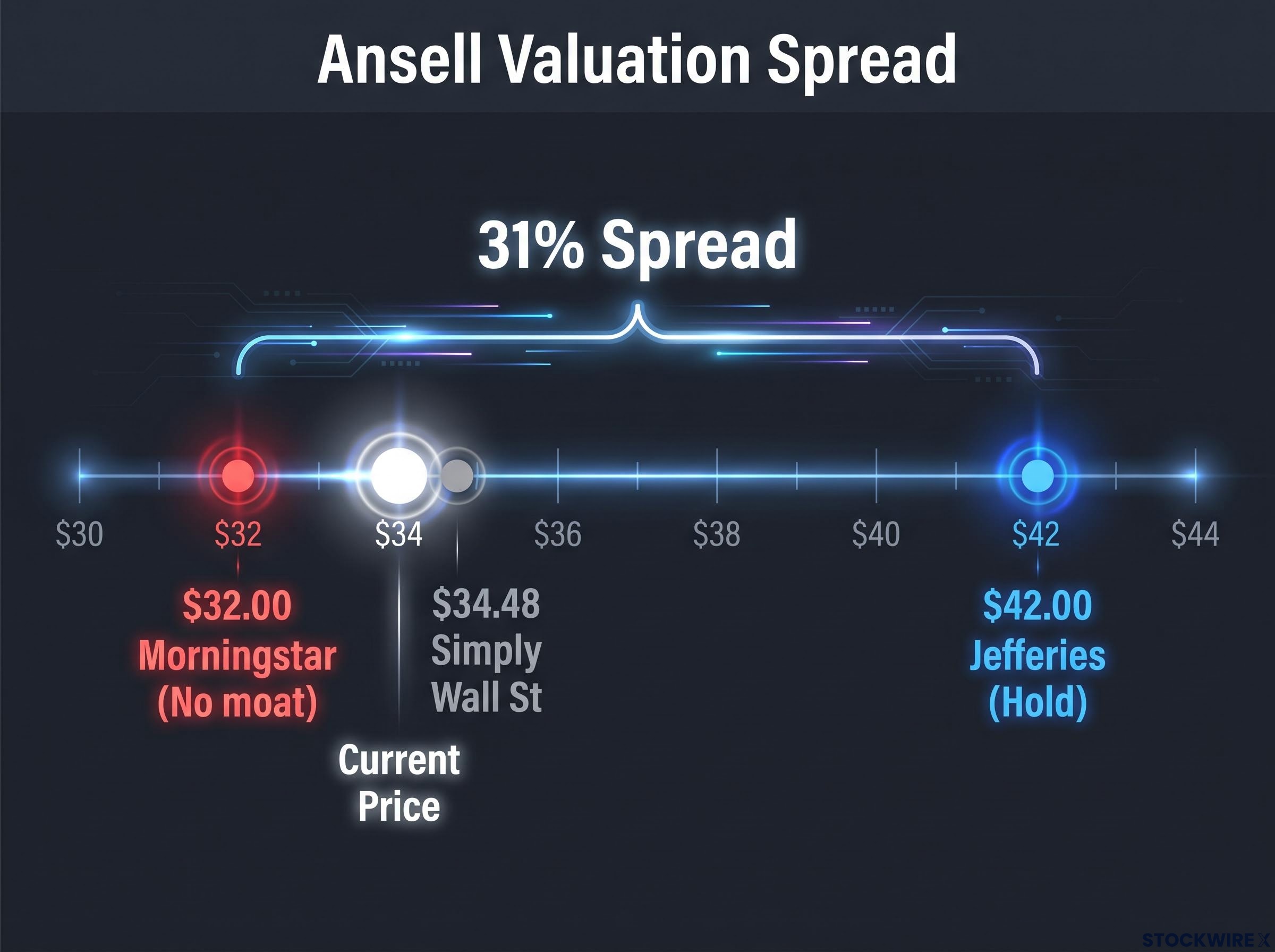
| Source | Fair value or price target (AUD) | Rating or moat view | Verification status |
|---|---|---|---|
| Morningstar (Holloway, July 2026) | $32 | No moat | Confirmed |
| Simply Wall St | $34.48 | Not rated | Unverified; treat as indicative only |
| Jefferies | $42 (Hold) | Not rated | Unverified; treat as indicative only |
At $33.64, Ansell trades just $1.64 above Morningstar’s revised $32 fair value, a gap of roughly 5%. That is not a margin of safety.
The divergence is not noise. It maps directly onto the unresolved question of whether Ansell’s specialist segments are large enough and fast-growing enough to dominate the competitive dynamics of the overall business. Morningstar emphasises competitive durability and long-run margin limits. Jefferies and Simply Wall St appear to weigh near-term demand stability and operational execution more heavily. The range from $32 to $42, a 31% spread, gives you a calibrated sense of the genuine uncertainty embedded in this stock at current prices.
What the downgrade changes for current and prospective ANN shareholders
The moat downgrade means different things depending on where you sit.
- Existing holders: The margin of safety previously associated with the narrow moat classification is materially weaker. At $33.64 against a $32 fair value, you are holding a stock that is modestly above fair value on Morningstar’s inputs, without the quality buffer that previously supported patience through competitive pressure. Position sizing and return expectations should be reassessed to reflect a more ordinary risk profile. A no-moat designation does not mean Ansell is a bad business; it means the business should be valued and sized as a competitively exposed industrial and healthcare consumables company, not as a long-run compounder.
- Prospective buyers using Morningstar’s framework: A no-moat stock typically requires a larger discount to fair value before screening as clearly attractive. Under Morningstar’s methodology, that often implies at least a 20% discount. On these inputs, that would place the implied threshold for a fully discounted entry at approximately $25.60 (illustrative only, not a recommendation).
At $33.64, you are not in distress, but you are no longer holding a stock trading at a discount underpinned by a quality moat buffer. The investment proposition is now “decent business at fair price,” and that is a different risk-return profile than the prior framing.
ASX industrials valuation discipline matters most when stocks trade near or above fair value, because the sector’s outperformance over the broader ASX 200 has historically depended on buying businesses at a margin of safety rather than at elevated multiples where earnings surprises carry asymmetric downside.
This article is for informational purposes only and should not be considered financial advice. Investors should conduct their own research and consult with financial professionals before making investment decisions.
Three signals that could reopen the moat debate for Ansell
The no-moat verdict is not necessarily permanent. Three specific, observable signals would either reinforce Morningstar’s conclusion or build a case for revisiting it, and each is trackable through Ansell’s own divisional reporting.
- Segment mix shift toward surgical and cleanroom: If higher-margin, stickier segments grow as a share of total earnings over the next two to three reporting periods, it strengthens the argument that moat-like characteristics are becoming more representative of the overall business. Watch divisional revenue splits in half-year and full-year results.
- EBIT margin trajectory toward and above 16%: Morningstar’s revised midcycle margin assumption is 16%. Persistent expansion above that level, particularly under competitive pressure, would challenge the no-moat thesis. Stalling or compression would validate it.
- Pricing resilience in competitive tenders: Whether Ansell can hold margins against 3M, Honeywell, Cardinal Health, and Owens and Minor over successive reporting periods is the most direct test of brand-as-moat. Margin erosion alongside volume growth is the clearest confirmation that brand is not protecting pricing.
Each of these signals is directly observable from Ansell’s own disclosures, which means you have a practical monitoring framework grounded in the same variables that drove the downgrade in the first place.
Moat trajectory, whether a competitive advantage is widening, stable, or eroding over successive reporting periods, matters as much as the initial moat classification, because a business on a widening trajectory may deserve a quality premium even before Morningstar formally upgrades its rating.
Ansell is a decent business at fair value, not a discounted compounder
The Morningstar downgrade repositions Ansell from a narrow-moat compounder that could be held with confidence through competitive pressure, to a solid but exposed industrial and healthcare consumables business that requires more disciplined price sensitivity. That is not a verdict on whether the company will grow. It is a verdict on whether that growth will be protected from competitive erosion.
Morningstar’s characterisation: Ansell is a decent business facing intense competition.
The analyst spread from $32 to $42 reflects real disagreement about whether the specialist segments can dominate the earnings story. The next set of divisional results, and any update on surgical or cleanroom segment growth, will be the first empirical test of whether the no-moat verdict holds. That is where your attention should sit.
Past performance does not guarantee future results. Financial projections are subject to market conditions and various risk factors.