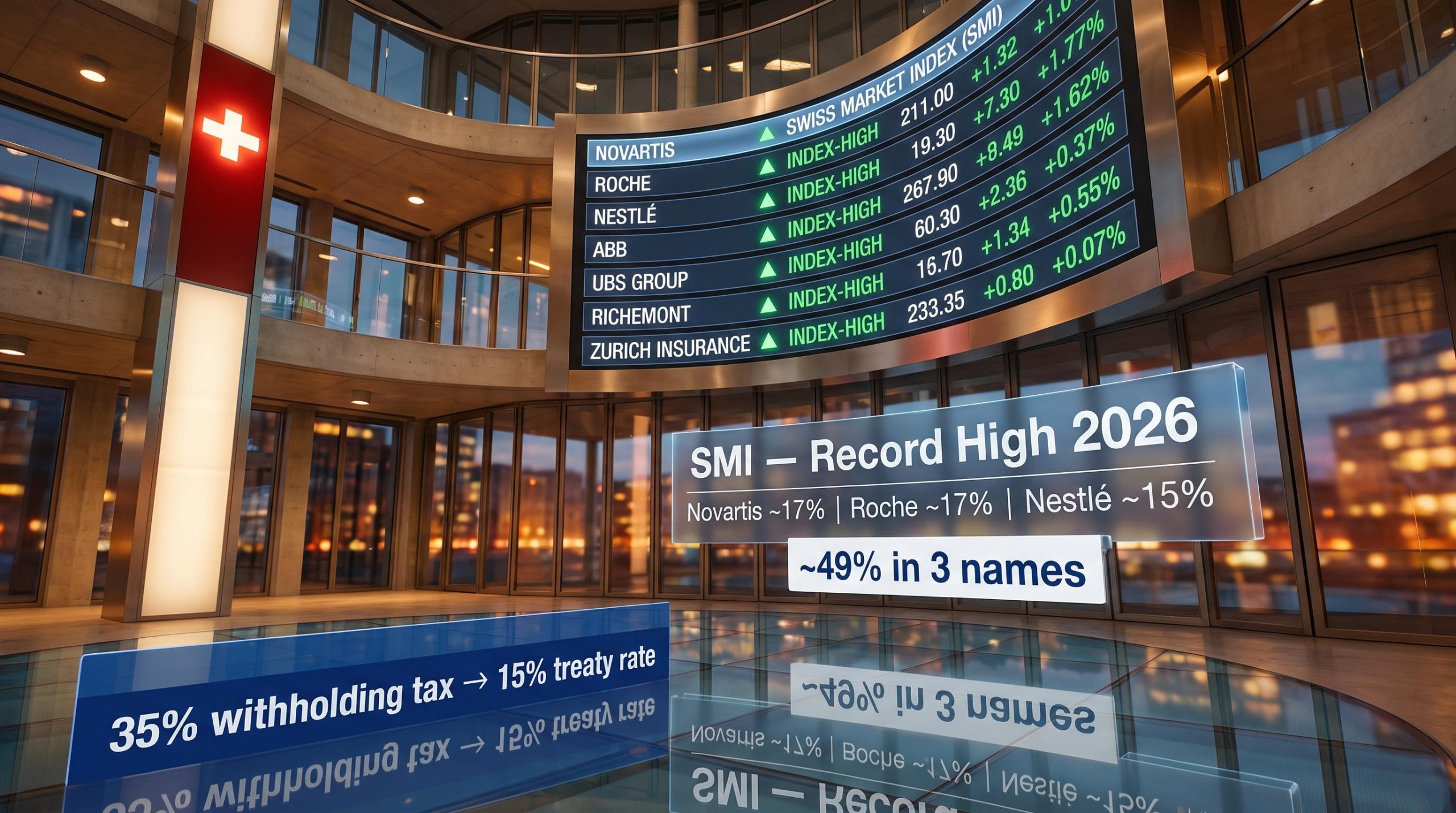
Three of Europe’s five largest listed companies call Switzerland home. Yet most retail investors outside the continent allocate precisely zero to Swiss equities. If your portfolio claims to be global, that gap deserves a closer look.
The case for paying attention has sharpened in 2026. The Swiss Market Index (SMI) hit record highs this year, the companies anchoring it generate revenues across every major economy on earth, and a growing number of investors are questioning whether their portfolios lean too heavily on US technology. Switzerland offers a structurally different answer to that concentration problem: defensive sectors, a safe-haven currency, and some of the most cash-generative businesses in global markets.
Here is what you need to walk away with: which Swiss blue-chip stocks actually matter, how to access them without specialist accounts, what risks come with the allocation, and how the 35% withholding tax on dividends works in practice, including how treaty relief can cut it to 15%. This is decision-support, not a geography lesson.
Why Switzerland produces global companies, not just a domestic market
The instinct is reasonable: Switzerland has a population under 10 million and a modest domestic economy, so its stock market should be a regional footnote. The reality runs in the opposite direction.
Among all European exchanges, the SIX Swiss Exchange claims three of the five largest blue-chip companies by market capitalisation. It holds the continent’s top position in pharmaceuticals, food products, and life sciences. In 2026, the SMI has pushed steadily to new highs, with monthly trading turnover posting consistent gains.
What explains the mismatch between the country’s size and its corporate weight? The major Swiss blue-chips, Nestlé, Roche, Novartis, ABB, UBS, Richemont, and Zurich Insurance, generate the large majority of their revenues outside Switzerland. These are global businesses with a Swiss institutional and currency wrapper, not domestic-market plays. Three structural advantages reinforce each other to keep it that way:
- Political stability: Switzerland’s consistent record of neutrality, restrained public borrowing, and stable governance limits the institutional risk that can undermine corporate earnings or capital flows in less predictable markets.
- CHF safe-haven status: The Swiss franc is widely recognised as a reserve of value in turbulent times, with investors directing capital toward CHF-denominated assets when global conditions deteriorate, providing an additional buffer for foreign holders.
- Innovation intensity: Switzerland places at or near the top of global innovation rankings, with concentrated strength across pharmaceutical research, biotechnology, precision engineering, and industrial automation.
The takeaway for your portfolio is straightforward. Buying Swiss equities is not a bet on the Swiss economy’s size. It is a way to access global healthcare, consumer, financial, and industrial demand through businesses that happen to be headquartered in Switzerland and reported in CHF.
The broader argument for European diversification rests partly on valuation: MSCI Europe has traded at a persistent 31% discount to the S&P 500 on forward earnings multiples, a gap that has held even after European markets rallied in early 2026, giving geographic rebalancing a quantitative foundation beyond narrative appeal.
When big ASX news breaks, our subscribers know first
The companies that define the Swiss blue-chip universe
Seven names define what the SMI actually is, and understanding them tells you more about the index than any performance chart.
Verifying blue chip credentials beyond brand recognition requires checking index membership, market cap screens, earnings history, and dividend records, a process that matters here because the SMI’s top names carry reputations that sometimes substitute for scrutiny rather than invite it.
| Company | Sector | Approx. SMI Weight | Portfolio Role |
|---|---|---|---|
| Novartis | Pharmaceuticals | ~17% | Large-cap pharma; oncology, cell and gene therapies |
| Roche | Pharmaceuticals / Diagnostics | ~17% | Global oncology, immunology, and diagnostics leader |
| Nestlé | Consumer Staples | ~15% | World’s largest food and beverage company; defensive income |
| ABB | Industrial Automation | ~9% | Electrification, robotics, grid modernisation exposure |
| UBS Group | Banking / Wealth Management | ~8% | Global wealth management; reinforced post-Credit Suisse absorption |
| Richemont | Luxury Goods | Major constituent | Cartier, Van Cleef & Arpels; global luxury consumption |
| Zurich Insurance | Insurance | Major constituent | One of the world’s largest global insurers; defensive cash flow |
Together, these seven span healthcare, consumer staples, luxury goods, global banking and wealth management, industrial automation, and insurance. That breadth is real, but the weight distribution tells a more concentrated story.
Novartis, Roche, and Nestlé alone account for approximately 49% of the SMI’s total weight, making the index structurally a large-cap healthcare-plus-staples position with financials and industrials on the side.
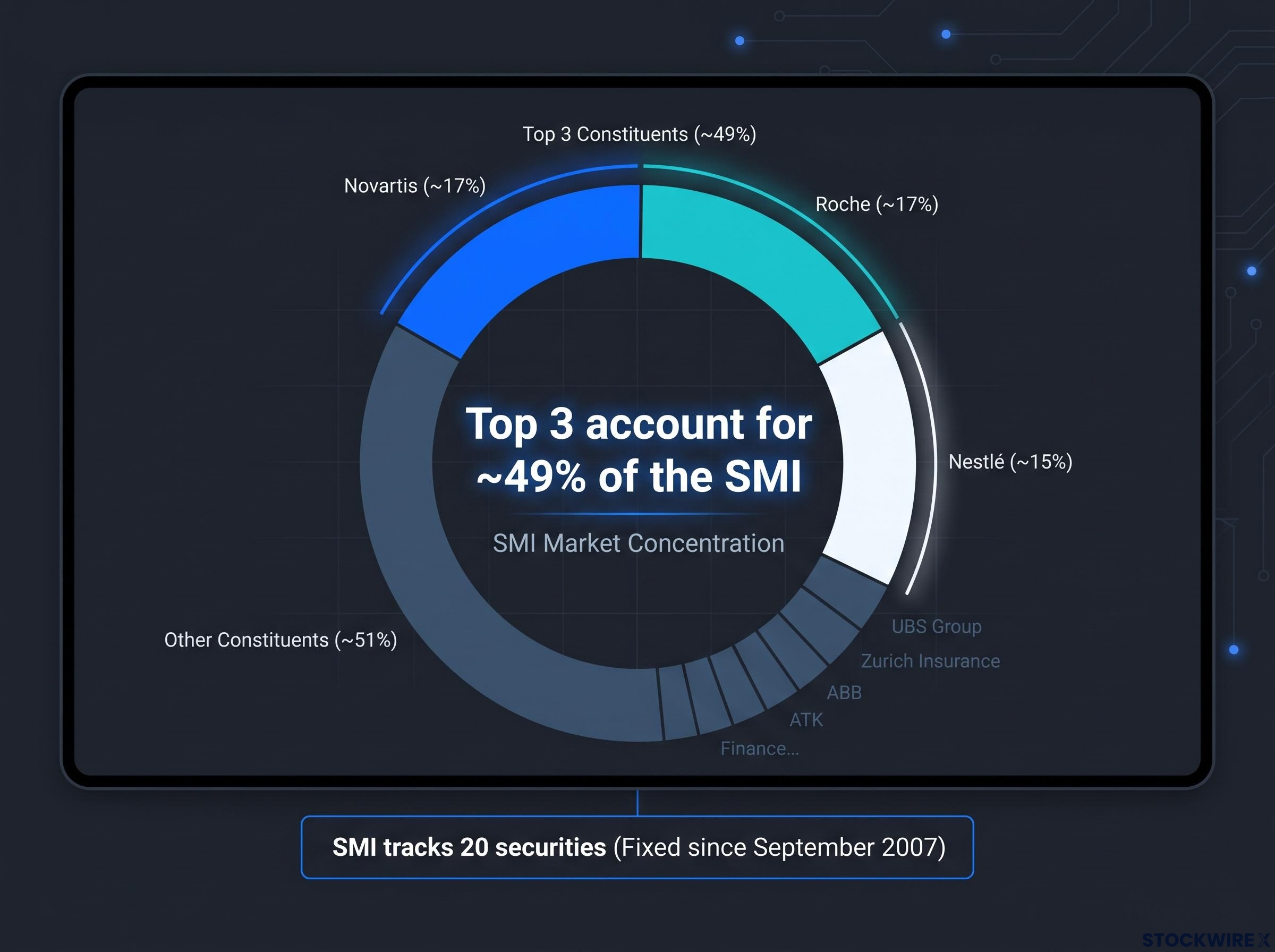
That concentration is not a footnote. It means buying the SMI is closer to a targeted sector allocation than a diversified Swiss market bet. If you already hold substantial global healthcare or consumer staples positions, you need to know that before you size a Swiss allocation, because you may be doubling up rather than diversifying.
SIX Group’s SMI index methodology governs constituent selection using free-float market capitalisation weighting, which is why the three largest companies by float naturally absorb the majority of the index weight and why that concentration cannot be engineered away through rebalancing alone.
How to buy into the Swiss market: the SMI and your options beyond it
You do not need a Swiss bank account or specialist access to own Swiss equities. The mechanics are more straightforward than most investors assume.
The SMI tracks 20 of the largest and most liquid stocks on the SIX Swiss Exchange. The constituent count has been fixed at 20 securities since the September 2007 review. For most retail investors, there are three access routes, ordered from simplest to most hands-on:
- SMI-tracking ETFs and index funds. The most common entry point. Several ETFs replicate the SMI, giving you the full 20-stock basket in a single position. This is the simplest route, but remember that approximately 49% of your exposure will sit in three names.
- Broader Swiss index funds or active funds. If you want exposure beyond the top 20, the UBS 100 Index and the Swiss Performance Index cover mid-cap and additional sector names that the SMI does not reach. Active funds with small and mid-cap mandates add further breadth.
- Direct share ownership via an international broker with SIX access. Standard international brokerage accounts increasingly offer access to the SIX Swiss Exchange. There are no special minimum capital requirements beyond the broker’s own rules. You place orders the same way you would for any other major market.
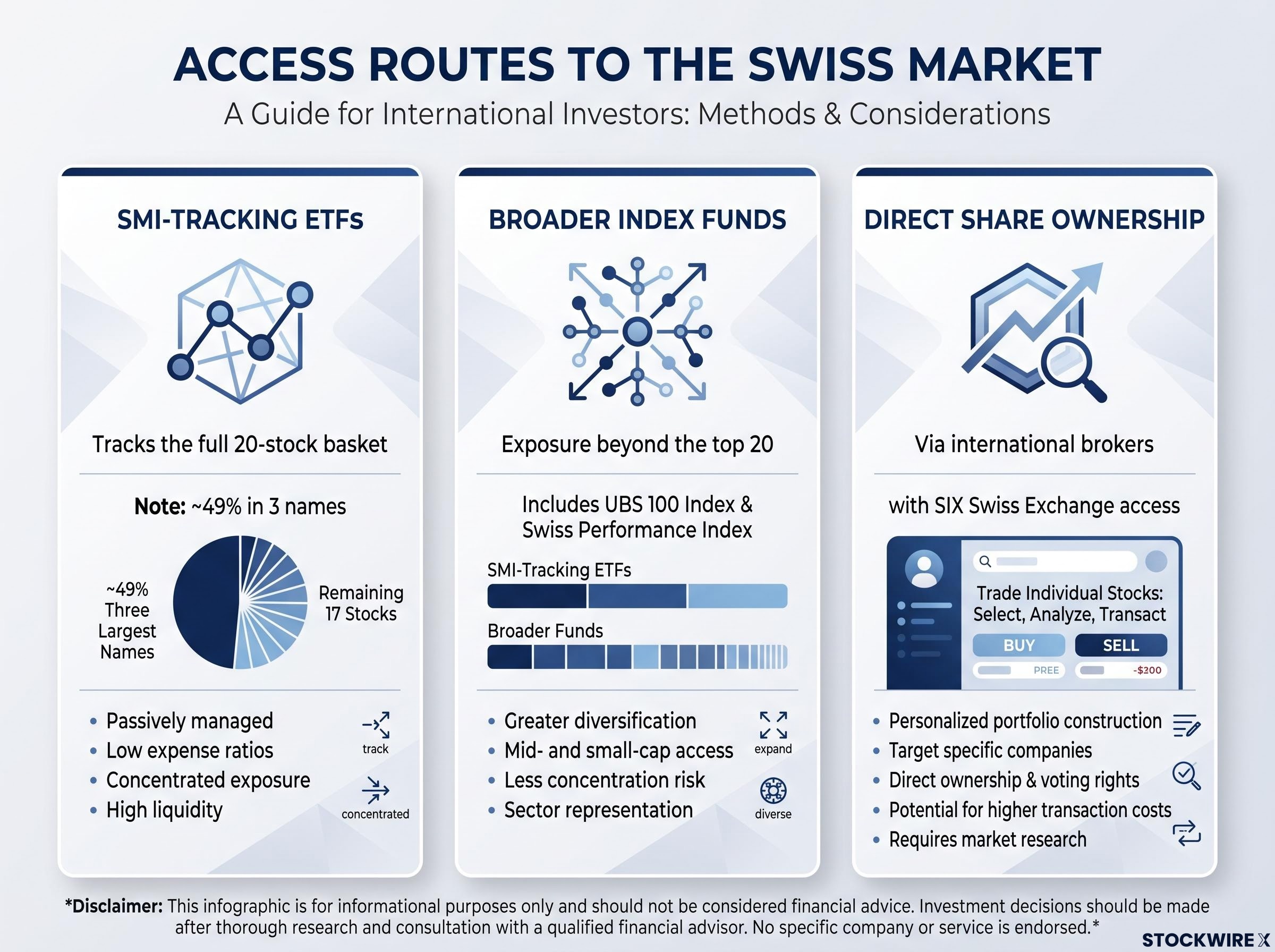
The real question is not whether you can access Swiss equities. It is whether you want concentrated large-cap healthcare and staples exposure or a broader slice of the Swiss market. That decision should drive your product choice, not the other way around.
What can go wrong: risks every Swiss equity investor should understand
The structural case for Swiss equities is strong, but treating the risks as fine print rather than genuine decision inputs is the fastest way to misallocate.
Here are the five risk categories you should weigh before sizing a position:
- Index concentration. Nearly half the SMI sits in three names (Novartis, Roche, Nestlé), tilting the index heavily toward pharma and consumer staples. If those sectors underperform, the index has limited room to offset.
- Currency risk. For non-CHF investors, the Swiss franc adds a second variable. CHF tends to appreciate during stress periods, which can boost your returns when you need it most, but a strong franc also compresses the earnings of Swiss multinationals when their foreign revenues translate back into CHF. It cuts both ways.
- Premium valuations. Leading Swiss blue-chips command price-to-earnings ratios above global market averages as of 2026, reflecting their quality and consistency. That premium means expectations are already priced high; if earnings disappoint, the downside can be sharper than for cheaper names.
- Standard equity market volatility. Swiss equities carry all the usual risks: drawdowns, sensitivity to global cycles, and the reality that the SMI’s record performance in 2026 reflects past performance, not a guarantee of future returns.
- Sector-specific risks. Pharma faces patent expiries, regulatory pressure, and clinical setbacks. Luxury goods are sensitive to Chinese consumer demand. Financials move with credit cycles and regulatory change. Industrials depend on global capex spending.
The overlap test matters most. If your global portfolio already holds substantial healthcare ETFs or consumer staples positions, a full SMI allocation may increase your sector concentration rather than reduce it. Run that check before deciding how much to allocate.
Currency risk deserves a second look
The CHF’s safe-haven behaviour creates an unusual dynamic. In a global sell-off, the franc often strengthens, which can partially cushion your Swiss equity losses when measured in your home currency. But in calmer periods, a persistently strong franc can act as a headwind to the earnings growth of the very multinationals you are holding. You need to weigh that two-sided exposure against your own currency profile.
The 35% withholding tax and how treaties change the equation
Switzerland levies a 35% withholding tax at source on dividends flowing to overseas investors. This rate sits well above what most comparable markets impose and will meaningfully erode your net yield unless you take steps to address it.
That number is enough to make some investors walk away from Swiss equities entirely. Before you do, understand how the mechanics actually work in practice.
Under double taxation agreements (DTAs) between Switzerland and many other countries, the withholding rate can be reduced, often to 15% for qualifying portfolio investors. The exact rate depends on the specific treaty your country of residence holds with Switzerland.
| Rate Scenario | Withholding Rate | Required Action | Net Yield Impact |
|---|---|---|---|
| Standard (no treaty claim) | 35% | None; default applied at source | Significant reduction in dividend income |
| Treaty-reduced rate | 15% (typical) | DTA claim with correct residency documentation | Materially higher net income retained |
To take a specific example, investors who are individual residents of Singapore can typically access a 15% withholding rate on Swiss dividends, with this preferential treatment flowing from the bilateral tax agreement between the two countries, provided the relevant conditions are satisfied and the required documentation is in order. Similar relief is available under many other bilateral treaties; the specific rate and procedure depend on your country of residence.
The practical steps: check the Swiss treaty with your home country for the applicable rate, coordinate with your broker or custodian on the correct documentation, and consider consulting a tax adviser for your individual circumstances. Tax information here is current as of mid-2026; you should verify the latest treaty text.
The gap between 35% and 15% is not administrative detail. Nestlé, Roche, and Novartis all have extended histories of regular dividend payments, and dividend income is a meaningful component of total return from Swiss equities. For income-oriented investors, getting the treaty relief right is the difference between a yield that makes the allocation worthwhile and one that largely disappears before it reaches your portfolio.
The relationship between dividend income and total return is less intuitive than it appears: research across more than 500 S&P 500 firms found ex-dividend price drops average approximately 99.8% of the payout size, which means the dividend reinvestment arithmetic matters as much as the gross yield figure when modelling Swiss equity returns after withholding tax.
This article is for informational purposes only and should not be considered financial advice. Investors should conduct their own research and consult with financial professionals before making investment decisions. Past performance does not guarantee future results.
Making the Swiss allocation work inside a global portfolio
The case for Swiss equities
The argument pulls together several reinforcing strands:
- Defensive revenue characteristics. Healthcare and consumer staples demand does not disappear in recessions. People need medicines, diagnostics, and food regardless of the economic cycle.
- Global diversification through a single market. Swiss blue-chips derive the bulk of their revenues internationally, giving you exposure to global healthcare, consumer, financial, industrial, and luxury demand rather than a narrow bet on Swiss GDP.
- Safe-haven currency layer. CHF has historically appreciated during stress periods, adding a form of portfolio cushion that differs from USD, EUR, or emerging-market currency exposure.
- Innovation-driven competitive advantages. Switzerland’s depth in pharmaceuticals, diagnostics, and industrial automation connects your allocation to secular growth themes including precision medicine, electrification, and factory automation.
- Dividend consistency. With treaty relief managing the tax drag, Swiss blue-chip dividends can contribute meaningfully to total return.
Sizing and portfolio fit considerations
Against those strengths, you need to weigh the honest counterweights:
- Index concentration in three mega-caps and two primary sectors means the SMI is not a balanced allocation.
- Premium valuations for many leading names mean expectations are already elevated.
- Potential sector overlap if your portfolio already holds healthcare and consumer staples positions through other vehicles.
- Currency variability that can enhance or erode returns depending on timing and your home currency.
For portfolios heavily tilted toward US technology and growth, a measured Swiss allocation adds something genuinely different: oncology, diagnostics, consumer staples, luxury, insurance, and industrial automation, all with earnings drivers that behave differently from semiconductors and cloud platforms. Swiss equities have historically delivered long-term returns comparable to or better than global and US markets with lower volatility and smaller drawdowns, reflecting the defensive sector tilt.
Geopolitical fragmentation adds a further dimension to the Swiss case: as regional industrial blocs diverge and supply-chain affiliations become a portfolio variable, Switzerland’s structural neutrality and its companies’ global revenue footprints offer a degree of jurisdictional insulation that is difficult to replicate through straightforward developed-market allocation.
The SMI’s record highs in 2026 are context, not a signal. Past performance provides no assurance of future returns.
The one question that should drive your decision: given your existing portfolio’s sector and geographic weights, does adding Swiss equities reduce concentration or increase it? If the answer is that it diversifies your exposure to healthcare, staples, and defensive sectors while introducing CHF, the allocation has a clear role. If you are already overweight those sectors, a smaller or more targeted position may serve you better than full index exposure.
These statements are speculative and subject to change based on market developments and company performance.