
Ansell’s Healthcare segment grew organic revenue at 9.4% in constant currency in FY25, while its Industrial segment delivered 5.6%. The company holds an Exemplary Capital Allocation rating from Morningstar. And yet the stock sits in a market where most investors still frame it as a commodity glove manufacturer. That framing is the investment thesis gap worth closing.
Ansell is executing a deliberate shift away from price-sensitive, low-margin protective wear toward regulated niches, particularly cleanroom and surgical products, where qualification cycles are long, switching costs are meaningful, and pricing power is structurally higher. The $1.1 billion Healthcare segment now accounts for roughly 55% of group revenue, a tilt accelerated by the mid-2024 acquisition of Kimberly-Clark’s personal protective equipment (PPE) business.
Whether this strategic repositioning creates durable shareholder value, or whether it runs into real structural limits, is the question Australian investors need answered. Here is the evidence base for deciding whether Ansell belongs in a portfolio oriented toward defensible, compounding businesses: the segment architecture, the niche strategy, the capital deployment pattern, the emerging market tailwind, and the risks most likely to materialise.
How Ansell’s two-segment structure actually works
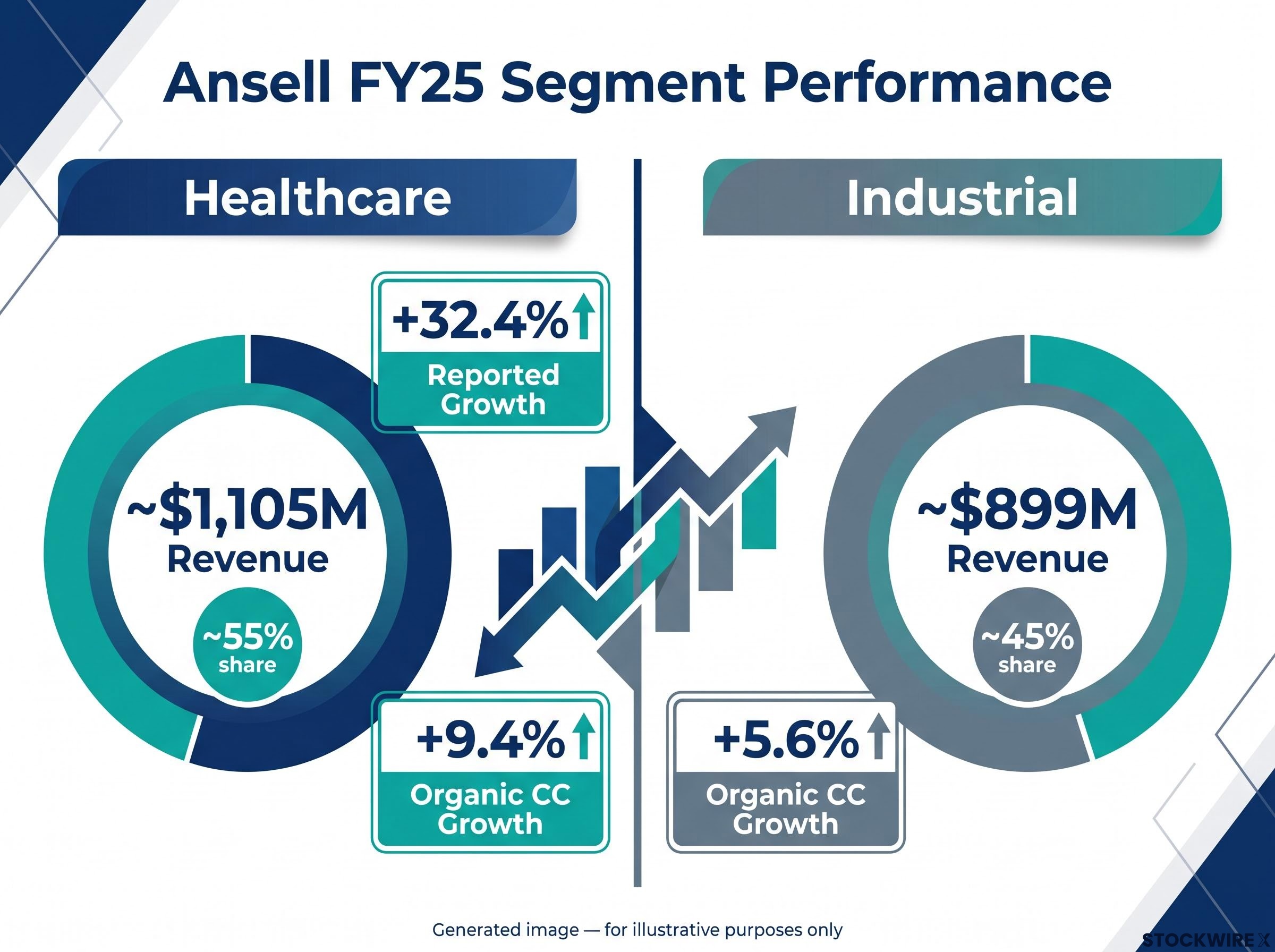
Ansell operates two segments, and the distinction between them is more than cosmetic. Healthcare, which includes surgical, examination, and cleanroom gloves for hospitals and life-science firms, generated approximately $1,105 million in FY25 revenue. Industrial, covering mechanical, chemical, and specialty protective solutions for manufacturing, mining, and logistics, contributed approximately $899 million.
| Metric | Healthcare | Industrial |
|---|---|---|
| Revenue (FY25) | ~$1,105M | ~$899M |
| Revenue share | ~55% | ~45% |
| Reported growth | +32.4% | +14.4% |
| Organic CC growth | +9.4% | +5.6% |
| Primary demand driver | Procedure volumes, infection-control mandates | Global manufacturing activity, US PMI cycle |
The demand drivers matter because they shape how each segment behaves in different market environments. Healthcare earnings are more defensive and recurring; they move with hospital procedure volumes and compliance mandates rather than factory output. Industrial earnings track the broader manufacturing cycle; when factory activity contracts, so does demand, and the US purchasing managers’ index (PMI), a monthly survey of factory conditions, tends to move ahead of that shift.
That 55/45 split toward Healthcare tells you something specific: more than half of Ansell’s earnings base now sits in a segment that is structurally less sensitive to a manufacturing downturn. That has direct implications for how the stock should perform through the next industrial slowdown.
The framing gap the article opens with, commodity glove manufacturer versus regulated niche compounder, is a textbook case of market inefficiency: passive index exposure and category-level heuristics depress prices below what fundamental analysis of the underlying business would support.
When big ASX news breaks, our subscribers know first
The cleanroom opportunity and why it changes the margin conversation
Within the broader Healthcare segment, cleanroom PPE is where Ansell’s niche strategy comes into sharpest focus. Cleanroom products serve pharma, biotech, semiconductor, and life-science facilities where contamination control is non-negotiable. The products must meet strict particle, extractable, and sterility specifications that take years to qualify.
Semiconductor and life-science capital flows in 2026 are accelerating the buildout of cleanroom-dependent fabrication and research facilities globally, a structural spending cycle that directly expands the installed base of facilities requiring Ansell’s highest-specification contamination control products.
The commercial characteristics of this niche are structurally different from commodity protective wear:
- Qualification barriers: Long product validation cycles that screen out casual competitors
- Customer profile: Institutional buyers with rigid compliance requirements, favouring established suppliers and long-term contracts
- Pricing headroom: Specification-driven procurement, not price-driven tenders
- Competitive density: A small number of credible suppliers operate in this space; Ansell is one of them
The Kimberly-Clark PPE acquisition, announced in April 2024 and closed on 2 July 2024, brought the Kimtech, KleenGuard, and RightCycle brands into Ansell’s portfolio. Kimtech directly deepens cleanroom positioning; it is not simply a revenue bolt-on but a structural expansion of Ansell’s credibility in the regulated niche where margins are most defensible.
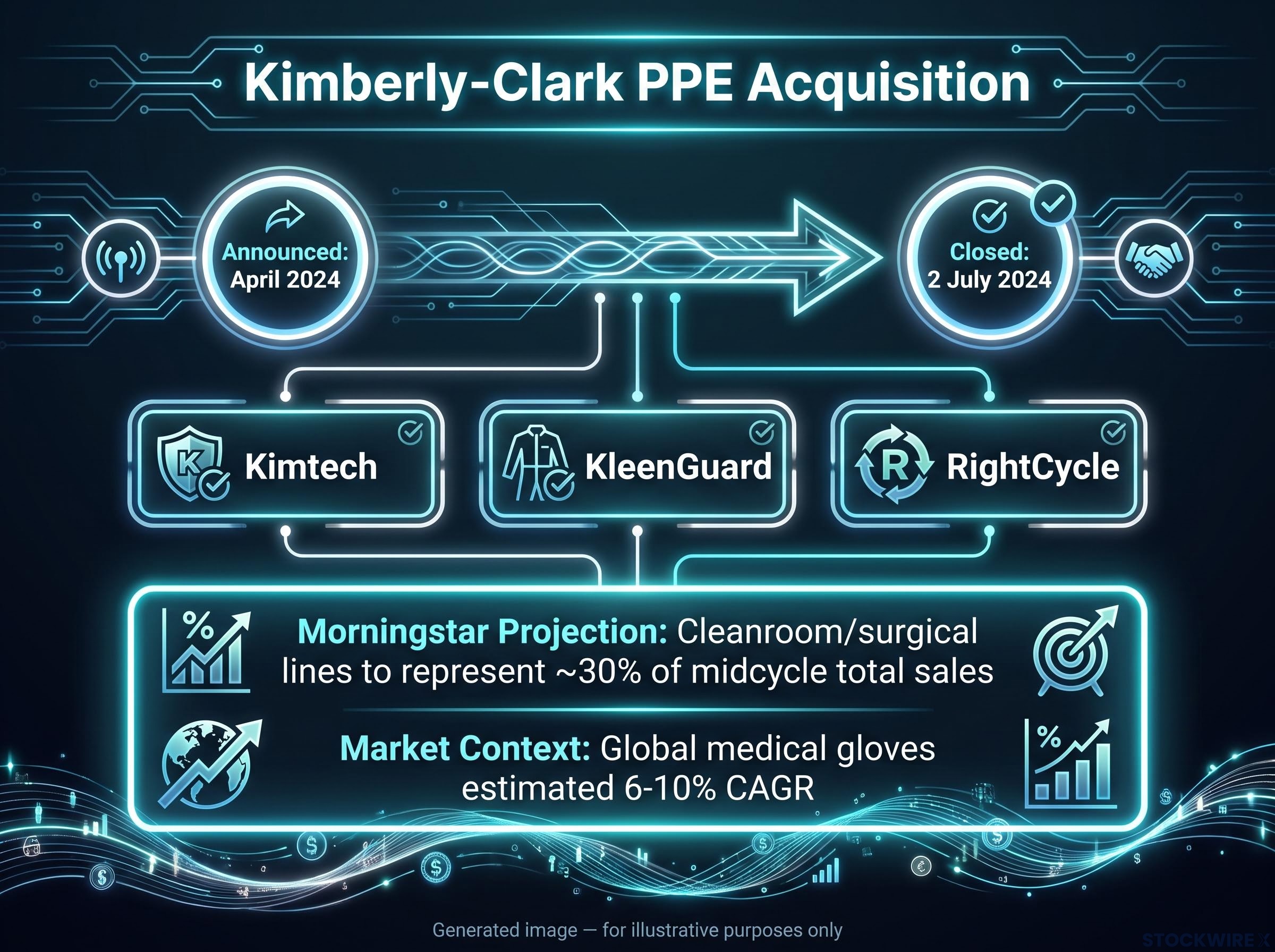
Morningstar projects cleanroom and surgical lines will represent approximately 30% of Ansell’s midcycle total sales, up from a smaller base, within a global medical gloves market growing at an estimated 6-10% compound annual growth rate (CAGR) through the 2030s.
For an Australian investor evaluating Ansell as a long-term compounder, this is the part of the business where the premium pricing aspiration is most credible. Long qualification cycles and institutional compliance requirements translate to durable customer relationships and lower churn. Whether the margin improvement thesis holds over time depends most directly on how this segment scales.
Tracking Ansell’s capital deployment decisions
Morningstar assigns Ansell an Exemplary Capital Allocation rating, its highest designation. That label carries weight, but the evidence behind it matters more than the rating itself.
The acquisition track record
The pattern is consistent: Ansell has directed capital into acquisitions that deepen niche positioning rather than pursuing scale-for-scale diversification. The Kimberly-Clark PPE transaction, with integration ongoing through FY25 and beyond, is the most recent and most consequential example. It expanded cleanroom and regulated healthcare exposure at a moment when the company’s strategy explicitly called for exactly that move.
Management has framed the growth strategy around a defined set of levers:
- Selective, capability-aligned acquisitions
- Simplified operations and portfolio focus
- Increased investment in under-developed verticals and fast-growing markets
- Innovation in comfort, ergonomics, and product performance
Forward capital capacity
The company’s balance sheet carries sufficient headroom to fund both further acquisitions and share repurchase activity. The company has also reorganised around New Verticals growth units targeting food, janitorial and sanitation, auto aftermarket, first responders, and military markets.
The Exemplary rating earns its weight here as a prompt, not a conclusion. The question for the next phase is whether future capital decisions will continue to reinforce niche positioning, or whether the New Verticals expansion signals a drift toward complexity that dilutes focus. Each future announcement Ansell makes should be evaluated against that question.
Emerging markets and the slow upgrade cycle that funds long-run growth
The emerging markets growth story is not a speculative upside case. It is already showing up in the numbers.
Ansell’s emerging markets sales grew at a CAGR of 8.6% from FY19 to FY24, evidence that the structural upgrade cycle is happening, not just projected.
The driver is straightforward. In many developing markets, workers either use no PPE or use basic, low-specification protection. Regulatory tightening and rising workplace safety standards are gradually shifting demand toward better-specified products. This is not a rapid inflection; it is a slow, compounding upgrade that rewards patience.
Ansell’s approach to this market is deliberate:
- Current penetration gap: Many workers in developing economies use no gloves or only commodity-grade protection
- Regulatory driver: Tightening workplace safety standards create mandatory demand for higher-specification products
- Entry-level strategy: Ranges such as Edge are designed for price-sensitive markets where PPE adoption is still nascent
- Premium migration: As customers adopt basic products, they gradually migrate up the value chain toward branded, higher-margin lines
Asia-Pacific accounted for 13.8% of global sales in recent reporting. The company targets 4-6% annual growth globally, with ambitions to outpace in select markets including Japan.
For Australian investors, this is the segment most likely to sustain Ansell’s organic growth rate through the latter half of the decade. The tailwinds, regulatory tightening and rising workplace standards, do not reverse quickly. That makes the emerging markets upgrade cycle the most predictable component of the medium-term growth story, independent of where the industrial cycle sits.
The global trade realignment underway in 2026, driven by US protectionism and three major trade agreements excluding Washington, has accelerated ASEAN and India’s position as manufacturing hubs, which directly expands the addressable market for Ansell’s Industrial segment in regions where workplace safety regulation is tightening.
The real risks: input costs, channel structure, and where the niche thesis could stall
The opportunity sections above need to be weighed against risks that are genuine, not hypothetical.
- Input cost volatility: Key raw materials such as yarn, butadiene-derived nitrile rubber, and natural rubber latex are exposed to price movements driven by agricultural conditions, energy markets, and geopolitical disruption
- Channel structure: Selling primarily through distribution intermediaries limits direct visibility into end-customer demand patterns, which can amplify the swings of both restocking surges and destocking contractions across quarterly results
- Niche TAM concentration: Cleanroom and surgical are structurally attractive but are subsets of the global PPE market; over-concentration without cultivating adjacent niches could cap long-run growth
- Integration and strategic drift: The New Verticals expansion and ongoing Kimberly-Clark integration introduce organisational complexity that could dilute focus on core niches
| Risk category | Structural vs. execution | Mitigant | Residual exposure |
|---|---|---|---|
| Input cost volatility | Structural | ~5-month procurement lag allows pricing adjustments; niche lines offer more pricing headroom | Commodity lines remain exposed to competitive undercutting and customer resistance |
| Channel structure | Structural | Intermediaries provide reach and lower selling costs | Demand signal distortion; lumpy quarterly performance from over/under-stocking |
| Niche TAM concentration | Execution | New Verticals strategy targeting adjacent markets | Core niches could mature faster than expected if adjacent expansion stalls |
| Integration and strategic drift | Execution | Exemplary allocation track record; management discipline to date | Future management teams may pursue scale over capability alignment |
The roughly five-month gap between when raw materials are procured and when finished products are sold, a feature noted in Morningstar’s analysis, creates a built-in window for cost pass-throughs but also introduces predictable earnings volatility. It is not a flaw in management’s strategy. What matters for the investment case is whether Ansell can sustain pass-throughs in niche lines, where the evidence is supportive, and whether it can exit or prune commodity lines where it cannot. That pruning process is in progress but not complete.
The global manufacturing cycle faces a specific stress test in mid-2026: the Hormuz disruption has introduced input cost volatility that flows directly into butadiene and nitrile rubber prices, the same raw material chain that drives margin variability in Ansell’s Industrial segment.
Distinguishing between a bad quarter caused by a raw material spike and a genuine failure in niche positioning is the difference between a buying opportunity and a thesis break. Morningstar’s Medium Uncertainty rating reflects this balanced risk profile.
What to watch before forming a view on Ansell’s long-term position
Every analytical claim in this piece converts into a specific monitoring question for your next review of Ansell’s quarterly or annual results.
Near-term: Kimberly-Clark integration
- Is the Kimberly-Clark integration delivering cleanroom share growth through the Kimtech brand, or is margin dilution emerging?
- Are input cost pass-throughs holding in both niche and commodity lines, or is competitive pressure forcing margin concessions in lower-specification products?
Medium-term: structural thesis confirmation
- Are new acquisitions and capital projects reinforcing cleanroom, surgical, and high-specification industrial niches, or drifting toward volume and complexity?
- Is capital being redeployed away from low-return commodity PPE segments, and are the New Verticals generating margin-accretive growth or consuming management bandwidth?
- Are emerging market initiatives building sustainable, compliant usage at margins that justify the investment, not just chasing volume at low margin?
The Healthcare organic constant currency growth rate of 9.4% in FY25 is the baseline to track. Sustained performance near that level confirms the niche strategy is working. A material deterioration, particularly if it coincides with rising cleanroom competition or stalling emerging market adoption, would challenge the thesis directly.
An investor who knows specifically what to watch in each earnings cycle can distinguish signal from noise in Ansell’s quarterly reports. That is the practical output of the structural analysis above.
This article is for informational purposes only and should not be considered financial advice. Investors should conduct their own research and consult with financial professionals before making investment decisions. Past performance does not guarantee future results. Financial projections referenced are subject to market conditions and various risk factors.