
The cursor hovers over the sell button. The position just moved 8% after earnings, and the instinct is to act before the number changes again. Sell now and lock in the gain, or hold and risk watching it evaporate by morning. This is the moment where most individual investors make their worst decisions of the quarter, not because they lack information, but because the earnings event itself creates conditions that override rational analysis.
Q1 2026 earnings season is in its final stretch, with roughly 89% of S&P 500 companies having reported as of early May. The season has delivered genuinely confusing signals. Companies beat estimates and fell. Companies missed and rose. Blended EPS growth came in at 27.7% year-over-year, per FactSet, yet price reactions were wildly dispersed. For anyone holding individual positions through this, the environment has been tailor-made for costly reactive decisions.
This guide does not explain what earnings reports mean. It addresses what to do after one lands on a position already held: a structured hold, trim, or wait framework; an honest account of the biases that cause investors to act badly at these moments; and the timing and tax considerations that rarely surface in market commentary.
Why the post-earnings moment is uniquely dangerous for individual investors
Earnings season compresses what is normally a slow, deliberate decision process into a matter of hours. A position that required weeks of research to build is suddenly up for reconsideration because of a single data release, and the compressed timeline is exactly when cognitive shortcuts and emotional reflexes take over from reasoned analysis.
The core problem is a misread of what the price move actually signals. A stock’s reaction to earnings reflects the gap between the reported results and the expectations already embedded in the share price, not the absolute health of the business. When a company “beats” estimates, the stock can still fall if the market had already priced in an even larger beat. When a company “misses,” the stock can rise if the market had priced in something far worse.
The pattern is consistent across earnings seasons: earnings season price expectations, embedded in a stock’s price before results land, carry more weight than the absolute quality of the reported numbers, which is why a record profit quarter and a sharply lower share price are not contradictions but the expected outcome when the market had already priced in something even better.
Q1 2026 offered textbook cases of both patterns:
- Meta and Goldman Sachs both beat Q1 2026 estimates. Both produced negative price reactions. In each case, pre-earnings expectations had run so high that strong absolute results still fell short of what the share price already reflected.
- Boeing delivered a mixed result and saw a positive price reaction. The market had priced in strike-related damage and order book uncertainty. Management’s affirmation of the backlog resolved that overhanging fear, and the stock moved up on what looked, by the headline number alone, like a disappointment.
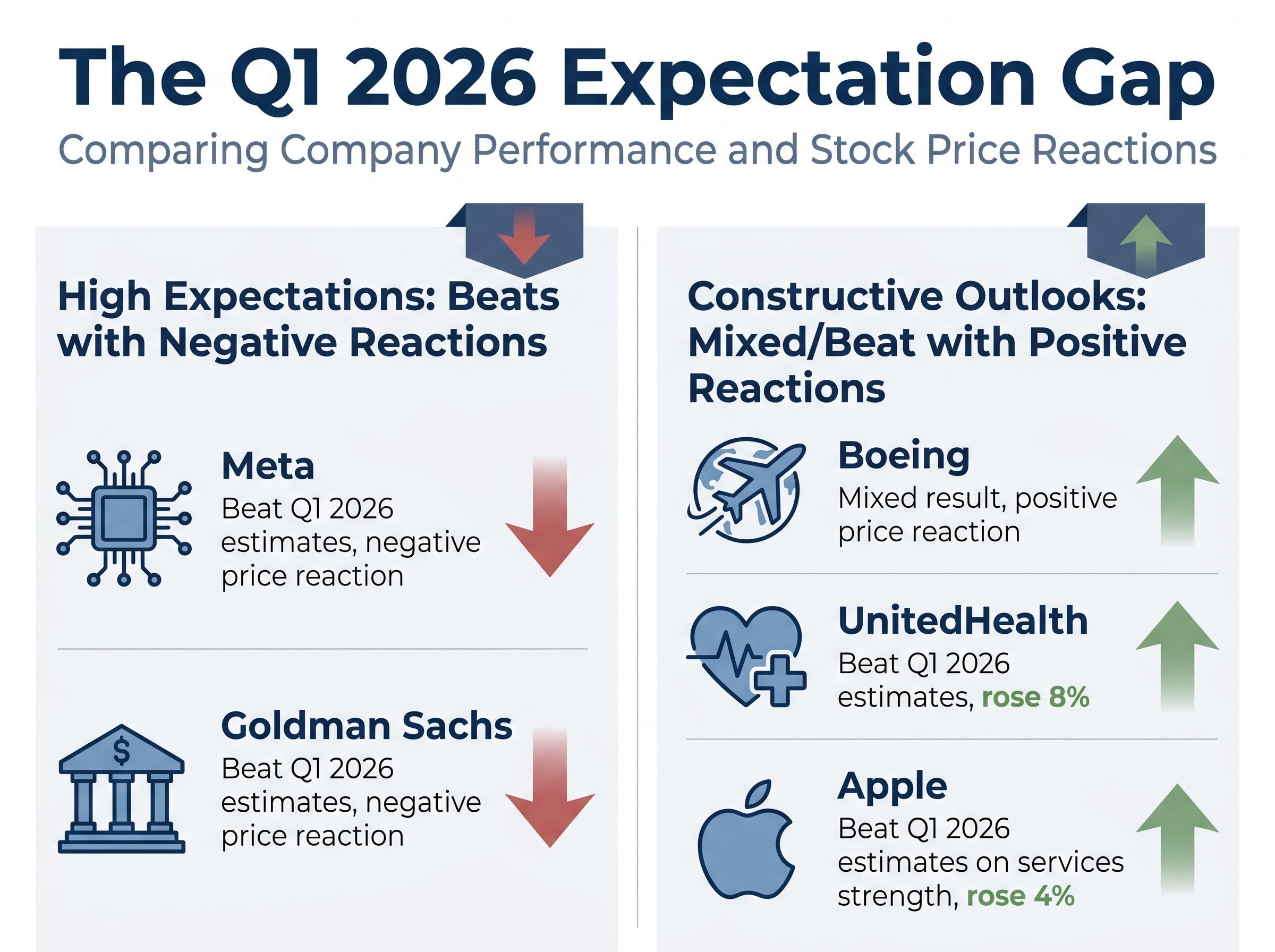
A beat is not automatically good news for a position. A miss is not automatically bad news. The price reaction reflects where expectations were set, not where the business stands.
Before any decision framework can work, this distinction needs to be internalised. The instinct to sell after a negative post-earnings move, or to add aggressively after a positive one, assumes that the price reaction is telling the truth about the business. It is not. It is telling the truth about the gap between reality and expectations. Confusing the two is the root of most post-earnings mistakes.
When big ASX news breaks, our subscribers know first
The case for waiting: what the first 48 hours actually tell you
The strongest single improvement most individual investors can make during earnings season is doing less in the first 24 hours. Not because passivity is a virtue, but because deliberate inaction in the initial window is often the highest-quality decision available.
The majority of the raw price move occurs on Day 1. But the meaningful drift, the kind driven by analyst revisions, institutional repositioning, and digestion of guidance detail, continues over the following 3-5 trading days. Acting in the first few hours frequently means selling into noise or buying into momentum that has not yet been confirmed by the slower, more reliable layer of market processing.
Three specific conditions justify a deliberate “wait” decision:
- Ambiguous results: Revenue beats but earnings miss, or vice versa, with no clear directional read.
- Unresolved management commentary: The earnings call raised more questions than it answered, particularly around guidance, supply chain exposure, or regulatory timelines.
- Noisy initial price move: A sharp move in either direction on high volume that appears reactive rather than substantive, especially when it reverses partially within the first trading session.
In Q1 2026, approximately 40% of retail investors trimmed winning positions within 24 hours of earnings, capturing less of the subsequent drift than institutional holders who waited for revision signals. That gap is not about sophistication. It is about timing discipline.
Using analyst revisions as a retail investor’s confirmation signal
Retail investors do not need to generate their own estimate revisions. The 24-48 hour analyst note cycle functions as a free confirmation signal.
The first wave of updated price targets and rating changes typically publishes within one to two days of the earnings release. These revisions are historically directionally accurate at a high rate, meaning they tend to confirm the direction of the eventual price resolution rather than contradict it.
Most major brokerage platforms surface analyst rating and price target changes in real time. The practical step is straightforward: before committing to a position change after earnings, wait for the first revision wave and look for directional consensus across multiple analyst notes, not a single call.
Deciding what to do: four post-earnings scenarios and how to respond
A decision framework prevents the binary trap of “hold everything” versus “sell everything” by creating intermediate paths, partial trimming and deliberate waiting, both of which tend to produce better expected outcomes than impulsive full exits or entries.
The following matrix maps four primary post-earnings scenarios to specific responses and timing windows. Each scenario requires a different reaction, not a variation on a single default.
| Scenario | Key Signal | Recommended Response | Timing Window |
|---|---|---|---|
| Beat + upbeat guidance intact | Full-year guidance maintained or raised; revenue growth stable relative to recent quarters | Hold 3-5 days to capture drift, then reassess position size | Day 1-5 |
| Beat but “priced in” | Large pre-earnings price run; flat or cautious guidance despite strong results | Consider trimming 20-50% of position on Day 2-3 pop | Day 2-3 |
| Miss but positive forward commentary | Headline miss offset by constructive management guidance or order pipeline strength | Wait 48 hours for analyst revision signals before acting | Day 2-3 |
| Miss + guidance cut + macro headwinds | Earnings miss accompanied by reduced forward guidance and sector-level pressure | Avoid catching the falling knife; reassess after full revision cycle | Day 5+ |
For the hold case, the anchor is whether the original investment thesis remains intact. UnitedHealth beat Q1 2026 estimates and rose 8%, affirming the hold signal: better-than-feared results, stable forward outlook, no thesis change required. Apple beat on services strength and rose 4%, a similar pattern of constructive guidance reinforcing the existing position rationale.
For the trim case, the specific triggers are a stretched valuation following a large pre-earnings run, decelerating sales growth quarter-over-quarter, or quietly reduced guidance that did not generate headline attention but materially alters the forward earnings trajectory.
Forward guidance signals consistently carry more market-moving weight than the reported quarter itself, particularly in an environment where the S&P 500 is pricing in exceptional future results, and the week in which companies representing 44% of index market cap reported simultaneously made guidance commentary from tech, pharma, and consumer names the single most scrutinised variable of the season.
The question is not “what did the stock do?” It is “is the reason I own this still true?”
The partial trim (the 20-50% reduction) exists precisely for the grey zone where the thesis is not broken but the risk-reward has shifted. It converts a binary decision into a calibrated one.
The biases that break the framework at exactly the wrong moment
A framework on paper and a framework under pressure are two different things. The three biases most reliably activated by earnings events are worth naming explicitly, because recognising them in real time is the difference between following the plan and abandoning it.
- Loss aversion: The psychological pain of a post-earnings decline is roughly twice as powerful as the pleasure of an equivalent gain, per behavioural finance research. This causes investors to hold losers too long, hoping for a bounce, while selling winners too early to lock in gains before they reverse. The 40% of retail investors who trimmed winning positions within 24 hours of Q1 2026 earnings likely exhibited exactly this pattern: fear of the gain disappearing outweighed the evidence for holding.
- Recency bias: Q1 2026’s high-expectation environment in AI-adjacent Technology names was fuelled by extrapolation of recent strong results. The AAII bullish sentiment reading stood at 38.31% as of 7 May 2026, reflecting moderate rather than extreme optimism at the index level. But sector-level sentiment in Technology ran considerably hotter, setting up disappointment even when absolute results were objectively strong.
Loss aversion and recency bias do not operate independently during earnings events; they form an interlocking feedback loop in which the pain of a declining position amplifies the distorted extrapolation of recent results, and breaking that loop requires recognising both biases simultaneously rather than treating them as separate psychological risks.
- Overconfidence following a beat: The post-beat rally is often the most dangerous moment to add aggressively to a position. Confidence peaks just as valuation risk has typically increased. Options volume running approximately 3x average levels on Q1 2026 earnings announcement days reflected, in part, this FOMO-driven speculative positioning.
One technique that actually works: the pre-earnings decision rule
Writing down a conditional decision rule before the earnings release, not after, fundamentally changes the psychology. The decision is made outside the emotional context of the actual result, which removes the in-the-moment load that causes the biases above to take over.
Two concrete templates:
- Trim trigger: “If full-year guidance is reduced by more than 5%, I will trim 25% of my position within 48 hours, regardless of the headline EPS number.”
- Hold trigger: “If revenue growth comes in within 5% of last quarter and the core thesis (for example, services revenue acceleration, margin expansion, or order backlog stability) remains intact, I will hold for the full 3-5 day drift window before reassessing.”
These rules are not predictions. They are pre-commitments that bypass the emotional interference of the live result. The act of writing them down, before the release, is what gives them their power.
The tax dimension most investors overlook when trimming after earnings
The hold-versus-trim decision has a layer most market commentary ignores entirely: the after-tax maths.
For U.S. investors, positions held for fewer than 12 months are subject to short-term capital gains tax at ordinary income rates, which reach up to 37% depending on tax bracket. Positions held longer than one year qualify for long-term capital gains rates of 0%, 15%, or 20%, depending on income level, per IRS Publication 550.
IRS Topic 409 capital gains rates confirm that short-term gains on assets held one year or less are taxed at ordinary income rates reaching up to 37%, while long-term gains qualify for the 0%, 15%, or 20% preferential rates, a distinction that makes the 12-month holding period a concrete decision variable rather than an abstract consideration.
Most earnings-driven trims involve short holding periods. The net after-tax return on a quick trim is substantially lower than the gross number suggests. Consider a position that gains 10% on an earnings pop: trimmed within 48 hours, an investor in the top bracket retains approximately 6-7% after tax. Held to long-term status, the same gain could net approximately 8%, a difference that compounds meaningfully across multiple positions and multiple earnings seasons.
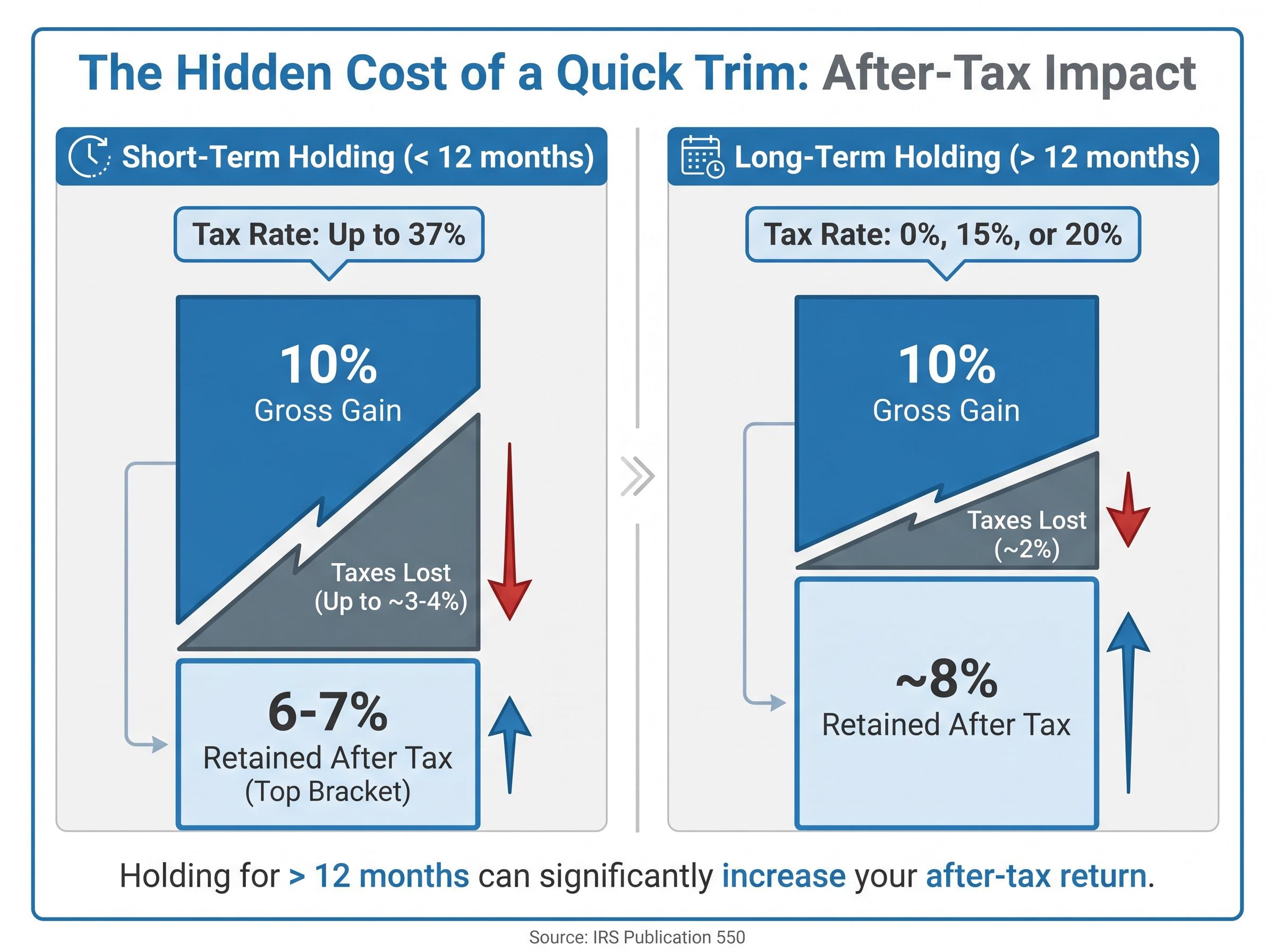
The practical pre-trim tax check involves three steps:
- Determine the holding period relative to the 12-month mark. A position purchased 10 months ago has a very different tax profile from one purchased 14 months ago.
- Estimate the after-tax net on the trim gain at the investor’s marginal rate. A 10% gross gain is not a 10% gain in the portfolio.
- Compare to the expected drift plus long-term rate benefit if held. When the additional expected return from holding through the drift window would also convert the gain to long-term treatment, the maths can flip the optimal decision from “trim now” to “hold.”
Source: IRS Publication 550, Investment Income and Expenses (https://www.irs.gov/publications/p550), provides the authoritative reference for U.S. capital gains rate schedules and holding period definitions.
For investors who want to understand the broader legislative landscape surrounding capital gains taxation, our full explainer on unrealized capital gains tax proposals examines the constitutional questions left open by Moore v. United States, active state-level experiments, and the conditions under which federal proposals could resurface, context that bears directly on long-term hold-versus-trim decisions.
For investors already close to the 12-month mark on a position, this consideration is directly actionable. The tax maths can be the tiebreaker in an otherwise marginal trim decision.
Discipline compounds: building a repeatable process for every earnings season
No single earnings report should fundamentally alter a long-term investor’s view of a company absent a genuine change to the underlying business. The signal sits in trends across multiple quarters, not in any individual release.
Q1 2026 demonstrated this clearly. Blended EPS growth of 27.7% year-over-year (FactSet) was well above pre-season estimates, yet the strong aggregate result did not prevent wide dispersion in individual stock outcomes. The investors who navigated it most effectively combined structured criteria with the patience to let the first wave of analyst revisions inform their decisions rather than reacting to the headline number.
The highest-leverage action for earnings season is preparation done before results land. A three-step pre-season routine converts the framework from a reactive tool into a durable habit:
- Review the investment thesis for each position. Write down, in one or two sentences, the core reason the position is held. This becomes the reference point when results arrive.
- Write conditional decision rules. Define the specific triggers that would prompt a trim (guidance cut, margin compression, thesis change) and the specific conditions under which the default is to hold. Commit these to paper before the earnings date.
- Identify the thesis-changing metrics. For each position, name the one or two guidance figures or operational metrics that, if they moved materially, would change the investment case. Everything else is noise.
With the full-year 2026 EPS growth outlook at 17.4% year-over-year (FactSet), the backdrop heading into Q2 2026 earnings season supports a constructive but not complacent posture. The same framework applies. The same biases will activate. The difference is whether the process is in place before the numbers land.
This article is for informational purposes only and should not be considered financial advice. Investors should conduct their own research and consult with financial professionals before making investment decisions. Past performance does not guarantee future results. Financial projections are subject to market conditions and various risk factors.