American Airlines Kills United Merger Bid Before Talks Begin
6 hrs ago


NAVER shares surged nearly 30% on 1 June 2026, six days before either company had formally confirmed a word of the deal. The market moved first, pricing in what became official on 7 June 2026: a full-stack AI infrastructure alliance between NAVER Cloud and NVIDIA, positioning NAVER as a “Global AI Factory” with an initial 55MW deployment and ambitions stretching to gigawatt-scale capacity. The announcement arrived during NVIDIA CEO Jensen Huang’s visit to South Korea, a trip that itself became a catalyst for investor sentiment across the Korean technology sector. What follows covers the partnership’s infrastructure scope, its model-layer depth, sovereign AI as an investment concept, NAVER’s multi-vendor procurement strategy, and the market signal embedded in a stock move that preceded the formal announcement by nearly a week.
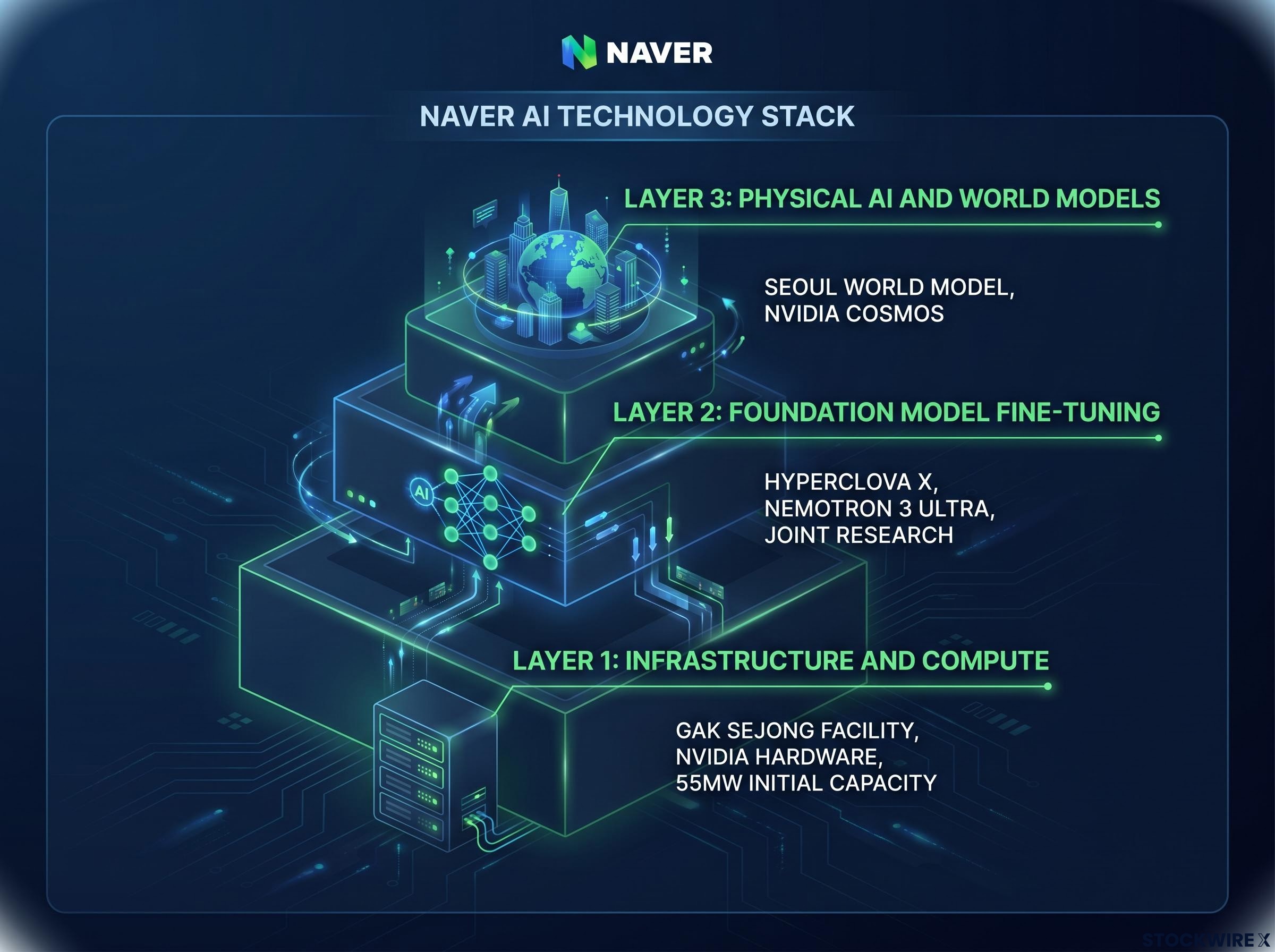
The companies described the arrangement as a “full-stack alliance across infrastructure, models and services.” In practice, full-stack means NAVER will deploy NVIDIA’s complete suite of AI platforms, models, and software, not just procure GPUs. The GAK Sejong facility in South Korea serves as the physical starting point, engineered for high-density accelerated computing workloads using NVIDIA hardware, with an initial capacity of 55MW.
NVIDIA’s four-layer platform model, which analysts now decompose into GPU silicon, networking, systems, and software revenue streams with distinct margin profiles, is precisely what NAVER is accessing through the full-stack alliance; procurement of the complete suite rather than discrete GPU units materially changes the per-rack revenue and software attach rate calculations that drive NVIDIA’s own valuation.
The stated ceiling is gigawatt-scale expansion. The gap between 55MW today and 1,000MW as a target is considerable; it represents a roadmap rather than a current state. NAVER Cloud had already deployed over 60,000 NVIDIA GPUs for enterprise and physical AI workloads prior to this announcement, providing the operational base from which the expansion builds.
NAVER Cloud CEO Kim Yu-won: “Our collaboration with NVIDIA goes beyond a simple GPU supplier-customer relationship. It is a strategic decision to develop AI technologies together and expand the global AI ecosystem.”
Kim Yu-won framed NAVER Cloud as an ideal partner for NVIDIA’s AI factory platform strategy, which he described as covering five components:
Jensen Huang characterised demand for AI factory infrastructure as “extraordinary,” a word that, given the capacity figures attached to this deal, carried specific commercial weight rather than promotional framing.
The term “sovereign AI” appears throughout both companies’ statements, but what does it mean in operational terms? Sovereign AI infrastructure refers to nationally controlled compute, model development, and cloud services that allow governments and enterprises to keep data, training, and inference within their own regulatory jurisdiction.
Three forces drive the premium attached to sovereign AI deployments. Regulatory requirements for data residency mean certain workloads cannot leave national borders. National security considerations require that sensitive inference and training occur on domestically controlled hardware. And there is a commercial advantage to models fine-tuned on local-language and local-context data, which generic hyperscaler offerings typically do not provide.
These dynamics explain why NAVER, rather than a US hyperscaler, is being positioned as the AI infrastructure partner for Asian and Middle Eastern clients. NVIDIA’s corporate statement emphasised supporting customers globally to “build sovereign AI, industrial AI, and enterprise AI” via the NAVER collaboration. NAVER already maintains sovereign AI deployments in Europe and the Middle East. AMD’s March 2026 collaboration with NAVER Cloud also explicitly used sovereign AI infrastructure language, corroborating that multiple chip vendors are orienting around this concept with NAVER as a delivery partner.
South Korea’s National AI Computing Center initiative, outlined by the Ministry of Science and ICT in early 2025 alongside the country’s AI Framework Act, established the public-private partnership model that makes NAVER Cloud a natural anchor tenant for nationally controlled compute capacity.
The CSIS analysis of sovereign AI economics identifies geopolitical competition and the desire for operational and governance control as the primary forces pushing governments toward nationally controlled compute, framing sovereign AI infrastructure as a strategic imperative rather than a technical preference.
The sovereign AI use cases cluster into three categories:
A data centre lease dressed up in partnership language would not include joint research into hyperscale language model optimisation. This deal does.
The core technical differentiator sits in NAVER’s fine-tuning of NVIDIA’s Nemotron 3 Ultra open large language model using proprietary Korean-language datasets as part of the HyperCLOVA X roadmap. NAVER reportedly became the first South Korean organisation to join the NVIDIA Nemotron Coalition, a detail reported by NAVER’s corporate announcement that has not yet been independently confirmed in primary indexed public documents.
The model-layer work extends beyond language. NAVER unveiled the Seoul World Model in March 2026, built on NVIDIA’s Cosmos physical AI platform using 1.2 million panoramic images of Seoul to recreate the city’s road environments and spatial structures. This positions NAVER in the physical AI and world-model space, not just natural language processing.
NAVER’s AI technology stack, as revealed by this partnership, operates across three layers:
NVIDIA corporate statement: Through collaborations like NAVER, customers across Asia and worldwide can “make broad use of NVIDIA’s integrated AI platform as they build sovereign AI, industrial AI, and enterprise AI.”
NAVER also plans to launch an AI Agent Platform within South Korea in the second half of 2026, though this detail has not been independently confirmed beyond original source reporting.
Three months before the NVIDIA formalisation, NAVER Cloud and AMD announced a strategic collaboration on 18 March 2026. That deal included deployment of AMD EPYC processors, early access to AMD Instinct accelerators, and co-optimisation of NAVER Cloud’s AI services on AMD ROCm.
Operating both NVIDIA and AMD hardware stacks simultaneously is strategically rational for a company positioning itself as sovereign AI infrastructure for governments. Single-vendor lock-in is a structural risk that sovereign clients, by definition, seek to avoid. NAVER’s dual-vendor posture signals mature procurement rather than an opportunistic hardware partnership.
No comparable sovereign AI infrastructure commitment at this scale from AWS, Google Cloud, or Microsoft Azure has been identified in South Korea or Japan as of 8 June 2026. Hyperscalers operate cloud regions in the Asia-Pacific, but none has combined explicit “sovereign AI” language with named infrastructure capacity figures and national-scale deployment commitments in these markets.
Hyperscaler custom silicon programmes at Alphabet, Amazon, and Microsoft represent the most credible structural threat to NVIDIA’s accelerator dominance, and NAVER’s sovereign AI positioning is partly a response to the same dynamic: enterprises and governments in Asia seeking alternatives to US cloud dependency have limited options if both the hyperscaler cloud layer and the GPU supply chain concentrate in American firms.
| Partner | Announcement Date | Hardware Components | Strategic Focus |
|---|---|---|---|
| NVIDIA | 7 June 2026 | Full AI platform suite, GPUs (60,000+ pre-existing base) | Full-stack AI factory; gigawatt-scale sovereign infrastructure |
| AMD | 18 March 2026 | EPYC processors, Instinct accelerators, ROCm software | Sovereign AI compute diversification; open platform co-optimisation |
29.91%: NAVER’s approximate intraday peak surge on 1 June 2026, six days before the formal partnership announcement.
The move did not occur in a vacuum. Jensen Huang’s visit to Korea provided the catalyst context, and investors appeared to be pricing in the infrastructure partnership specifically rather than responding to a general AI sentiment wave. The pre-existing NAVER Cloud GPU base of over 60,000 NVIDIA GPUs gave institutional investors a quantifiable foundation from which to extrapolate the partnership’s commercial value.
The Korean tech equity rotation that sent the Kospi up approximately 57% in the first four months of 2026 created the investor context in which a single partnership announcement could move a large-cap stock by nearly 30% in a single session; NAVER’s surge was extreme in magnitude but not structurally surprising given the capital already repositioning toward Asian AI hardware beneficiaries.
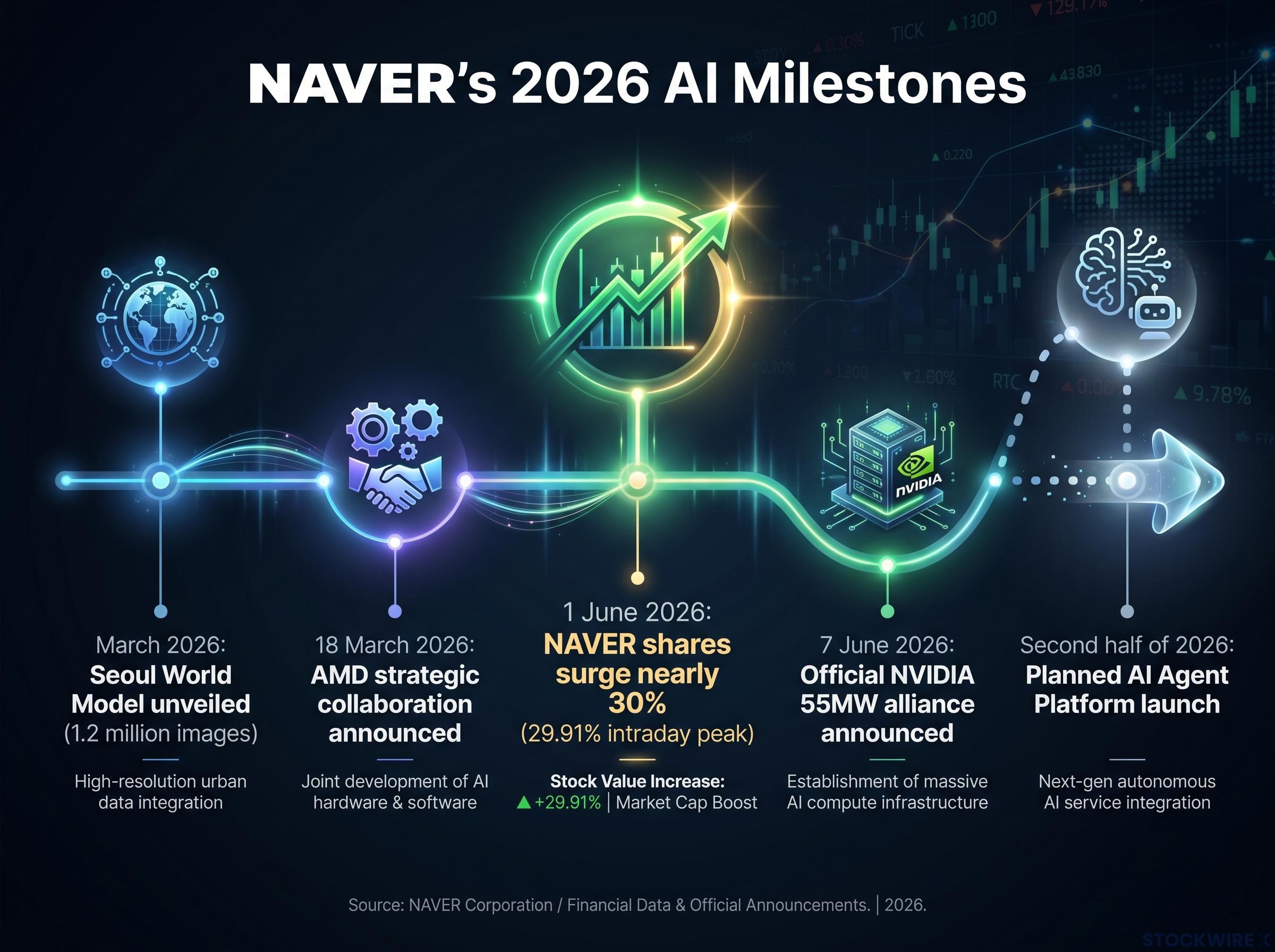
What the stock move reveals is which elements of the deal investors were most sensitive to. The magnitude of the surge suggests the market was pricing in infrastructure-scale ambition, not incremental GPU procurement. A supplier relationship does not move a stock 30%; a strategic repositioning as Asia’s sovereign AI infrastructure provider does.
As of 8 June 2026, no named analyst upgrades or rating changes tied specifically to the 7 June announcement have been identified in English-language coverage. Post-announcement analysis from equity research desks may emerge in subsequent days, and investors should monitor for formal target price revisions.
NAVER’s sovereign AI footprint is already operational in European and Middle Eastern regions. The gigawatt-scale ambition announced on 7 June extends that positioning from deployed international infrastructure to a stated intent to define what Asian-origin sovereign AI looks like at scale.
Kim Yu-won stated that NAVER Cloud aims to become “a core provider supporting Asia’s explosive AI demand.” NAVER founder Haejin Lee framed sovereign AI infrastructure as serving both South Korean industries and international customers. The language is geographic in scope, not bilateral in structure.
For enterprise and government clients in Asia who face US hyperscaler dependency as a structural risk, NAVER’s positioning offers an alternative that did not exist at this scale twelve months ago. The planned AI Agent Platform launch in South Korea during the second half of 2026 represents the next near-term milestone for commercial validation.
Three open questions investors and enterprise buyers should monitor:
NAVER and NVIDIA have constructed a full-stack alliance that positions a non-hyperscaler Asian cloud provider as the primary sovereign AI infrastructure option for governments and enterprises across Asia, Europe, and the Middle East. The model layer, spanning HyperCLOVA X fine-tuning, Nemotron Coalition membership, and the Seoul World Model, is what distinguishes this from a standard data centre procurement arrangement. NAVER’s quarterly earnings updates and the AI Agent Platform launch timeline represent the next measurable milestones for investors tracking whether gigawatt-scale ambition translates into commercial delivery.
For investors wanting to translate the NAVER and NVIDIA partnership into a portfolio positioning framework, our dedicated guide to AI infrastructure stock allocation covers the three-layer hardware, cloud, and software allocation structure that US financial advisors are using to build AI infrastructure exposure, including the specific valuation metrics and concentration risks relevant to Asian cloud and semiconductor holdings.
This article is for informational purposes only and should not be considered financial advice. Investors should conduct their own research and consult with financial professionals before making investment decisions. Capacity figures and timeline projections referenced in this article are based on company statements and original source reporting, and are subject to change based on market developments and company performance.
The NAVER NVIDIA partnership is a full-stack AI infrastructure alliance announced on 7 June 2026, covering NVIDIA's complete suite of AI platforms, models, and software deployed at NAVER Cloud's GAK Sejong facility in South Korea, starting at 55MW of capacity with ambitions to reach gigawatt scale.
Sovereign AI infrastructure refers to nationally controlled compute, model development, and cloud services that keep data, training, and inference within a specific regulatory jurisdiction. It commands a premium because governments and regulated industries often cannot legally or strategically rely on foreign hyperscaler cloud platforms for sensitive workloads.
NAVER shares surged approximately 29.91% on 1 June 2026, six days before the formal announcement, as Jensen Huang's visit to South Korea provided a visible catalyst and investors appeared to price in the scale of the infrastructure partnership based on NAVER Cloud's pre-existing base of over 60,000 NVIDIA GPUs.
NAVER Cloud operates both NVIDIA and AMD hardware stacks simultaneously, having announced a strategic AMD collaboration in March 2026 covering EPYC processors and Instinct accelerators, while formalising the full-stack NVIDIA alliance in June 2026. This multi-vendor approach reduces single-vendor dependency, which is a key requirement for sovereign AI clients such as governments.
Investors should monitor whether the gigawatt-scale expansion timeline receives formal capital commitment, when NAVER's AI Agent Platform launches publicly in South Korea in the second half of 2026, and how major hyperscalers respond if sovereign AI becomes an established competitive category across the Asia-Pacific region.