US analysts have beaten Nvidia’s earnings estimates for two consecutive years. The stock has still underperformed both the Philadelphia Semiconductor Index and the S&P 500 semiconductors sector year-to-date as of 20 May 2026. That disconnect, between consistent beats and inconsistent price appreciation, sits at the centre of how the Nvidia investment thesis is being rewritten across Wall Street.
Nvidia reports Q1 FY2027 earnings today against a backdrop where bond yields are competing with AI optimism for investor attention and where the standard GPU-centric earnings narrative is increasingly insufficient for sophisticated analysis. Analysts are no longer asking only how many GPUs Nvidia sold. They are asking how much networking, systems, and software revenue accompanied each rack deployment. What follows is an examination of what the shift from GPU vendor to full-stack AI infrastructure company means in practice, how US analysts are restructuring their valuation frameworks accordingly, and what specific metrics investors should track to evaluate whether the transformation is delivering durable revenue.
Why beating earnings no longer tells the whole story
Nvidia has beaten consensus revenue and EPS estimates in every quarter for more than two years. The reward for that streak has been remarkably thin.
Wolfe Research analyst Chris Senyek has characterised Nvidia’s earnings pattern as one where consistent beats fail to produce sustained post-earnings price gains, a dynamic where investors buy the anticipation and sell the confirmation.
The numbers from the most recent full fiscal year reinforce the paradox:
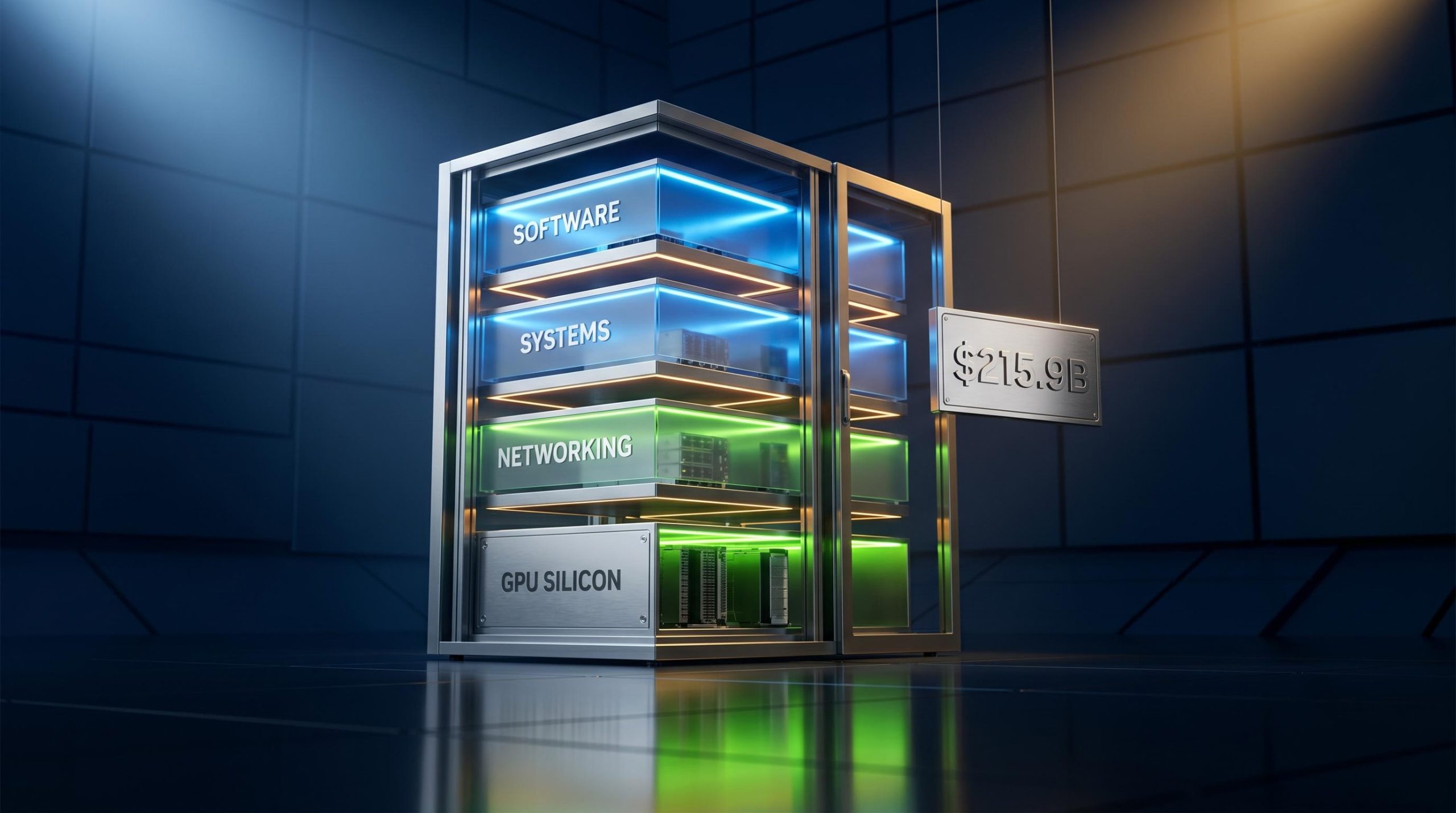
- FY2026 full-year revenue: $215.9 billion, up 65% year-over-year
- Q4 FY2026 revenue: $68.1 billion, up 20% quarter-over-quarter and 73% year-over-year
- Year-to-date stock performance has lagged both the Philadelphia Semiconductor Index and the S&P 500 semiconductors sector
At $215.9 billion in annual revenue, Nvidia has reached a scale where asking whether the company beat estimates by a few hundred million dollars produces diminishing analytical signal. The market is pricing forward expectations, not backward beats. That shifts analytical weight toward guidance, product mix evolution, and infrastructure diversification signals. Investors who continue to evaluate Nvidia solely through quarterly beat-and-raise optics are working with an incomplete model. Understanding why the framework needs updating is the prerequisite to building a more durable thesis.
Q2 FY2027 guidance language has historically moved Nvidia’s stock more than the reported quarter itself, a dynamic that holds regardless of macro conditions; with the 10-year Treasury yield at 4.604% and WTI crude elevated, any ambiguity in the forward outlook carries larger downside consequences than it would in a lower-rate environment.
When big ASX news breaks, our subscribers know first
What full-stack AI infrastructure actually means for Nvidia’s revenue
US analysts at Goldman Sachs, Morgan Stanley, and William Blair now decompose Nvidia’s data centre business into four distinct revenue layers. The framework is not marketing language; it is the structure these firms use to model forward revenue and margin trajectories.
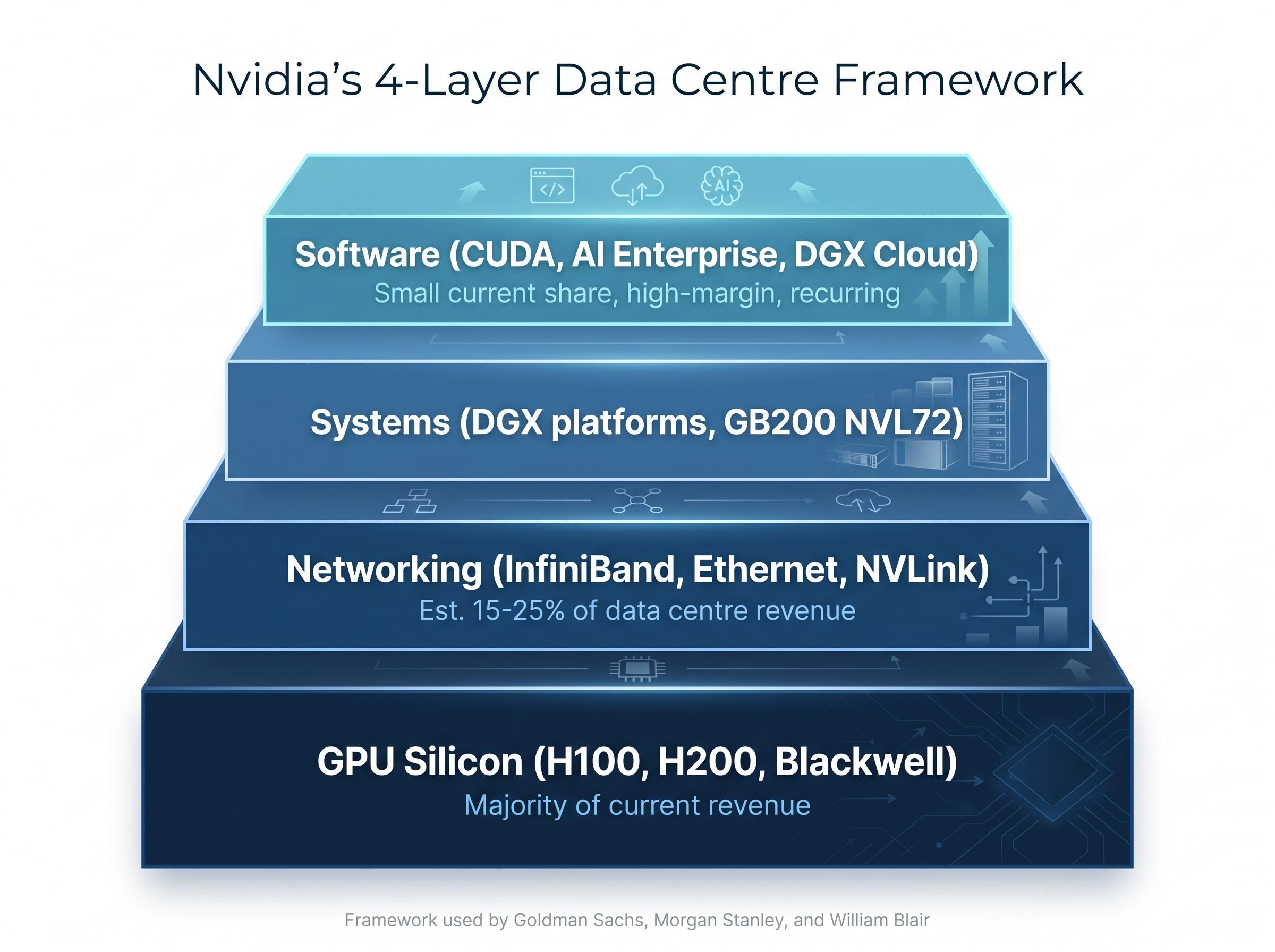
| Layer | What it includes | GAAP disclosure status | Analyst materiality assessment |
|---|---|---|---|
| GPU silicon | H100, H200, Blackwell accelerators | Embedded in Data Centre segment | Majority of current revenue |
| Networking | InfiniBand, Ethernet, NVLink | No standalone line item | Estimated at 15-25% of data centre revenue; growing faster than GPU units |
| Systems | DGX platforms, GB200 NVL72 rack configurations | No standalone line item | Increasing as rack-level sales replace chip-level sales |
| Software | CUDA, AI Enterprise, DGX Cloud | No standalone line item | Small current share; strategically high-margin and recurring |
Nvidia does not break out networking or software as separate GAAP line items. That absence is itself informative: the business is integrated by design. Jensen Huang’s framing in the Q4 FY2026 release aligned explicitly with the analyst framework:
“Data center revenue was driven by strong demand for the NVIDIA HGX platform, including both H100 and H200 GPUs, and our end-to-end networking and software stacks.”
Investors who reconstruct the four layers analytically gain a more accurate picture of margin structure and growth durability than those reading only segment totals.
Software and platform revenue: the recurring layer analysts treat as a hedge
CUDA, AI Enterprise, and DGX Cloud are framed by analysts as a hedge against future GPU ASP compression from hyperscaler custom silicon competition. Software attach rates are viewed as creating ecosystem lock-in and improving the sustainability of data centre margins over time. Nvidia does not publish AI software revenue as a standalone GAAP figure; analyst estimates are embedded in qualitative commentary rather than public disclosures. The transition from qualitatively important to quantitatively material is what the street is watching for.
The networking division: Nvidia’s most overlooked moat
Nvidia’s InfiniBand networking (built on the Mellanox acquisition) functions as the de facto standard for large-scale AI training clusters. Lower latency, higher scalability, and in-network computing features such as SHARP give hyperscalers reason to purchase the full Nvidia rack rather than mixing vendors.
Morgan Stanley has described Nvidia as a “system and networking company, not just a GPU vendor,” arguing that investors should increasingly separate attach revenue from core GPU ASPs when modelling data centre growth.
The counterargument is specific and named. Meta Platforms has leaned heavily into Ethernet-centric AI cluster design using Arista Networks switches and Broadcom silicon, which limits Nvidia’s networking revenue penetration even where GPU sales remain strong. Amazon Web Services has similarly built its networking infrastructure around Ethernet with Broadcom and Arista-based solutions, reducing Nvidia’s networking share relative to deployments where InfiniBand dominates.
Cisco’s $1 billion AI networking restructuring announced on 14 May 2026 reinforces the competitive pressure that Ethernet-based AI networking is placing on InfiniBand deployments: Arista, Broadcom, and now a restructured Cisco are all competing for the switching and fabric revenue that Nvidia captures in full-rack deployments but loses in Ethernet-preference environments.
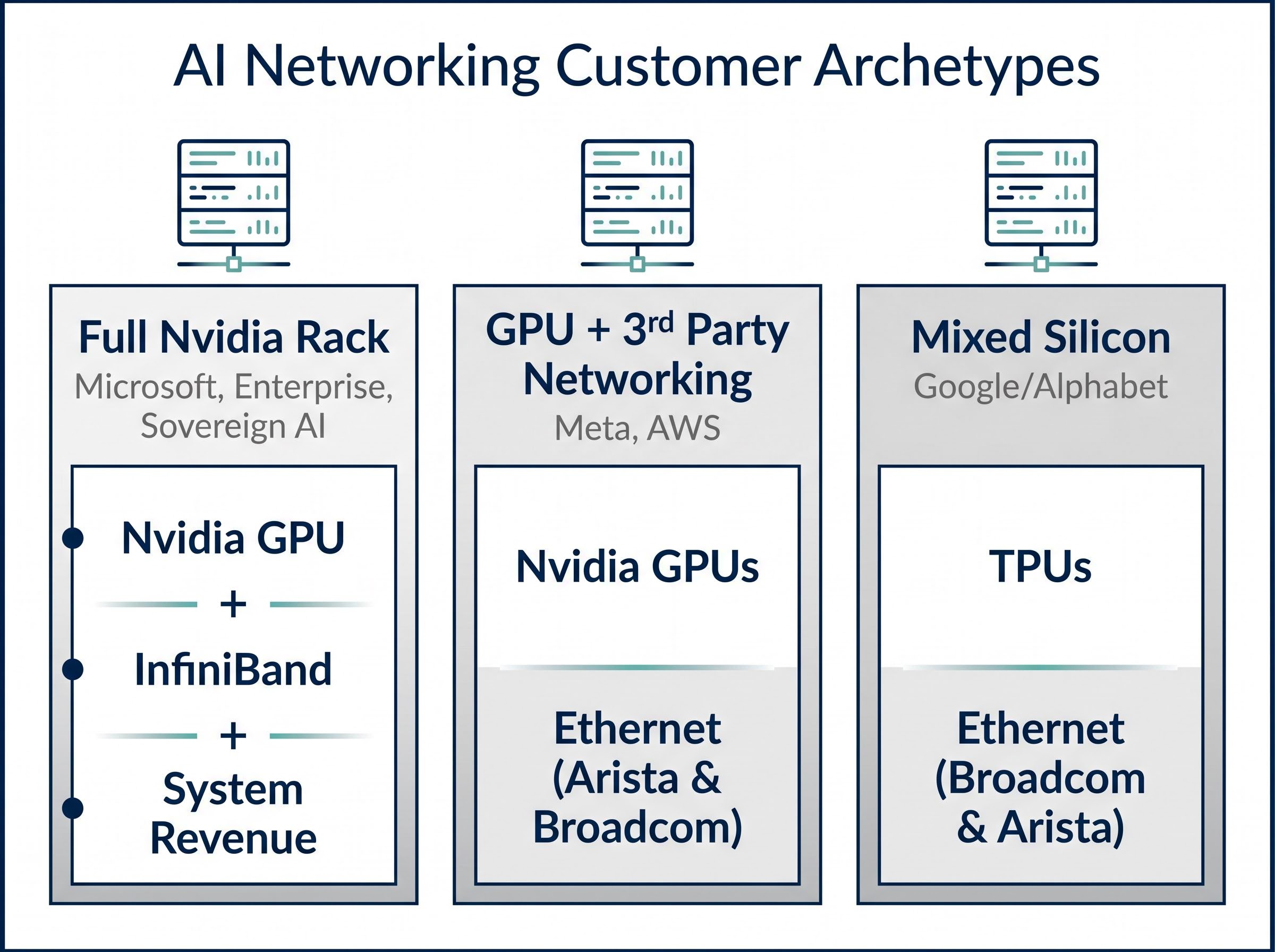
Three customer archetypes illustrate where networking revenue attaches and where it does not:
- Full Nvidia rack adopters (some Microsoft deployments, enterprise, sovereign AI): GPU plus InfiniBand plus system revenue captured together
- GPU-plus-third-party-networking adopters (Meta, some AWS): Nvidia GPUs purchased, but Ethernet switching from Arista and Broadcom limits networking attach
- Mixed silicon environments (Google/Alphabet): TPU deployments compete with Nvidia GPUs at the margin, and Ethernet-based fabrics give more room to Broadcom and Arista
Enterprise and sovereign AI customers represent the highest-value networking segment. These buyers typically lack internal expertise to design custom networks and therefore purchase integrated Nvidia systems more readily than hyperscalers. Goldman Sachs has framed networking and software as “high-margin layers” that improve the sustainability of data centre margins. Networking revenue does not arrive automatically with every GPU sale; understanding which customer segments generate full-rack revenue versus GPU-only revenue is where the modelling precision lives.
Blackwell architecture and the per-rack revenue expansion
The structural argument and the product-roadmap argument converge in Blackwell. Nvidia’s GB200 NVL72 and related configurations are marketed as rack-level AI factories, integrating GPUs, InfiniBand and NVLink networking, storage, and system management as a single turnkey purchase.
The per-rack revenue expansion follows three sequential steps:
- Higher GPU count per rack, concentrating more accelerator silicon into each deployment
- Higher networking bandwidth per GPU, requiring more InfiniBand or advanced Ethernet capacity per rack than Hopper-generation products
- Higher software and orchestration attach per deployment, with AI Enterprise and DGX Cloud tooling integrated into the system sale
Blackwell-generation systems carry higher networking intensity per GPU than Hopper-generation products. That means more networking and software revenue attaches to each rack than in prior cycles. Analysts recommend updating per-rack revenue models upward for Blackwell relative to Hopper assumptions.
What Blackwell means for gross margin modelling
William Blair, which carries an Outperform rating on Nvidia, has framed networking plus system ASP per rack as potentially matching or exceeding the GPU portion over time. The firm’s projected Q2 FY2027 revenue guidance above $90 billion reflects sustained demand trajectory into Blackwell ramp.
Higher system ASPs and greater software attach are expected to sustain or expand gross margins relative to the Hopper cycle. Standalone GPU gross margins may face pressure as competition grows, but integrated system and software layers are expected to offset this at the blended segment level. For investors, Blackwell’s networking intensity is a revenue model assumption with direct implications for gross margin forecasts and the durability of data centre segment growth beyond GPU unit counts.
How to evaluate Nvidia beyond semiconductor metrics
The traditional semiconductor evaluation framework, price-to-earnings relative to semiconductor peers and quarterly EPS beat size, systematically undervalues Nvidia’s platform and infrastructure characteristics. Analysts at Goldman Sachs, Morgan Stanley, and William Blair all recommend treating it as a platform company instead.
An investor using semiconductor-sector P/E benchmarks alone will perpetually conclude that Nvidia looks expensive. The question is whether those benchmarks are the right measuring stick, and the analyst consensus is increasingly that they are not.
| Metric | What it measures | Limitation for Nvidia analysis |
|---|---|---|
| Quarterly EPS beat | Backward-looking execution vs. consensus | Market already prices forward; beats alone do not drive sustained appreciation |
| P/E vs. semiconductor peers | Relative valuation within chip sector | Misses platform, software, and recurring revenue characteristics |
| Blended system ASP per rack | Total revenue captured per deployment | Not disclosed by Nvidia; requires analyst reconstruction |
| Networking revenue attach rate | Non-GPU revenue generated per GPU sold | Varies dramatically by customer segment; no GAAP disclosure |
| Software attach rate | Recurring and high-margin revenue trajectory | Currently qualitative; no standalone GAAP figure published |
Goldman Sachs recommends treating the four layers (GPU silicon, networking, systems, software) as distinct value drivers. William Blair’s vertically integrated AI platform framing forms the basis for assigning higher and more durable valuation multiples than a traditional GPU vendor would warrant. The blended system ASP per rack and software attach rate are the two metrics that capture what per-chip ASP does not: the compounding revenue from the layers built around the GPU.
The risks analysts are not ignoring
The bear case against Nvidia’s infrastructure thesis is not that GPU demand disappears. It is that the non-GPU layers scale more slowly and unevenly than the bull case assumes.
Three distinct risk vectors warrant close tracking:
- Hyperscaler custom silicon reducing full-rack adoption: Google TPUs, Amazon Trainium, and Azure Maia all reduce GPU demand at the margin. Where custom silicon dominates, Nvidia’s networking and systems revenue also falls because these environments lean toward Ethernet and third-party switching.
- Ethernet-preference deployments reducing networking attach: Meta’s and AWS’s commitment to Ethernet-based AI networking limits Nvidia’s networking revenue even where GPU sales volumes remain strong.
- GPU ASP pressure as competition intensifies: AMD and Intel continue developing competing accelerators, though analyst consensus frames CUDA ecosystem lock-in and rapid product cadence (Hopper to Blackwell to future families) as the primary moats against this risk.
CUDA ecosystem lock-in is the moat characteristic that separates Nvidia from commodity accelerator manufacturers: Morningstar’s wide-moat rating framework applied to AI semiconductor companies treats proprietary software ecosystems and switching costs as the durable earnings advantages that justify premium valuation multiples over a full capital expenditure cycle.
Nvidia does not break out revenue concentration by individual hyperscaler customer in public filings, which limits precise modelling of the first risk.
Where the infrastructure thesis has the most execution uncertainty
Enterprise and sovereign AI adoption is the segment most critical to the non-GPU revenue thesis, and the pace of enterprise uptake remains the highest uncertainty in current analyst models. Software revenue scaling, from qualitatively important to quantitatively material, is the key transition point analysts are watching for in future earnings releases.
The investment case is a platform argument, not a cycle argument
Nvidia’s long-term revenue story is not resolved by asking whether GPU demand persists. It is resolved by asking whether the networking, systems, and software layers scale in proportion to, or faster than, GPU revenue as AI capital expenditure matures.
Today’s Q1 FY2027 earnings call is a near-term test of this thesis. Beyond headline revenue, the signals to track are Q2 FY2027 guidance, any management commentary on systems and networking mix, and software attach trajectory. Investors who track Nvidia as a platform company with four compounding revenue layers are working with a structurally more accurate framework than those benchmarking it as a cyclical GPU hardware manufacturer.
Readers building or updating their Nvidia position models should review the Q1 FY2027 earnings transcript for management language on networking and systems contribution, not only the headline revenue and EPS figures.
Investors wanting to translate the four-layer platform framework into a specific portfolio decision will find our full explainer on Nvidia versus Broadcom valuations, which unpacks why Nvidia trades at approximately 24x forward earnings despite continued revenue acceleration while Broadcom commands 37x on contract-backed certainty, and examines whether both names can coexist in a single AI infrastructure allocation.
This article is for informational purposes only and should not be considered financial advice. Investors should conduct their own research and consult with financial professionals before making investment decisions. Past performance does not guarantee future results. Financial projections are subject to market conditions and various risk factors.