Westpac Fined $26M for Gross Negligence in Hardship Failures
49 mins ago


Until 12 May 2026, Australian investors wanting direct exposure to the global space industry through the ASX had no listed option. That changed when the BetaShares Space Industry ETF (ASX: RCKT) began trading, and in under three weeks the fund has climbed nearly 30%. Now Global X has announced a competing product under the ticker MOON, giving the ASX two space-sector ETFs before most investors have had time to assess the first.
For Australian retail investors, the emergence of a new thematic category on the local exchange raises immediate questions. What does RCKT actually hold? What will MOON offer, and when? How do both funds compare on cost with established US-listed alternatives? And what role does the widely anticipated SpaceX initial public offering play in the timing of both launches? What follows covers each of those questions, alongside the specific considerations investors should weigh before committing capital to either fund.
The speed of RCKT’s early move deserves attention. A 30% gain in under three weeks is unusual for any ETF, let alone a thematic fund listing into a category that did not previously exist on the ASX.
RCKT has gained approximately 30% since its 12 May 2026 listing, making it one of the strongest ETF debuts on the ASX this year.
The fund tracks the Solactive Space Industry Index, a passive benchmark that gives investors exposure to a basket of global space-sector equities without requiring a US brokerage account or direct foreign currency transactions. Its annual management fee sits at 0.57%.
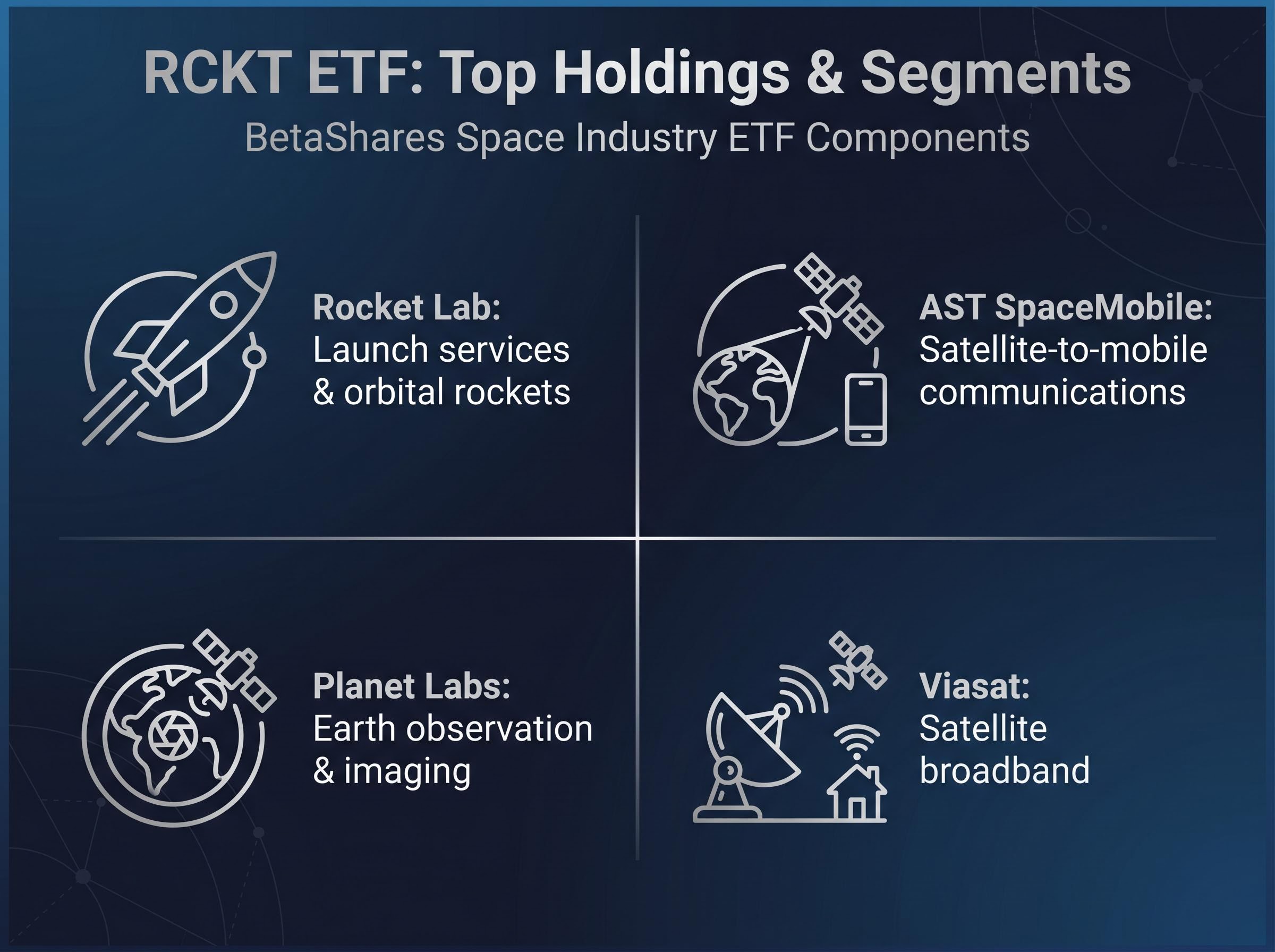
The confirmed top holdings span three distinct segments of the space economy:
That breadth matters. The rally is not driven by a single launch-vehicle stock. It reflects demand across satellite communications, imaging, and infrastructure names, suggesting broad investor appetite for the sector rather than a single-name spike.
“Space sector” as an investment category extends well beyond rocket launches. It encompasses satellite communications, earth observation, launch services, space infrastructure, and the enabling technologies that support commercial operations in orbit.
The shift from government-dominated space programmes to commercial activity, sometimes called the “new space” era, is what made the sector investable through diversified equity funds. Private companies now operate satellite constellations, provide broadband from orbit, and sell earth-imaging data to agriculture, insurance, and defence clients.
RCKT’s top holdings illustrate the range:
For Australian retail investors, an ASX-listed space ETF removes the friction of opening a US brokerage account, managing foreign exchange exposure, and navigating US tax reporting obligations. It also means settlement occurs in Australian dollars through a standard broker. The trade-off is that thematic ETFs carry higher volatility and sector concentration than broad-market funds, a characteristic investors should weigh against the convenience of local access.
When a second issuer enters a brand-new product category within weeks of the first, it signals commercial conviction rather than duplication. Global X announced the Global X Space Tech ETF (ASX: MOON) in May 2026, positioning it as a direct competitor to RCKT.
Beyond the announcement itself, confirmed product details remain absent. As of 27 May 2026, Global X has not disclosed MOON’s management fee, underlying index, or anticipated holdings.
The table below makes the information gap visible.
| Detail | RCKT (BetaShares) | MOON (Global X) |
|---|---|---|
| Issuer | BetaShares | Global X |
| Ticker | RCKT | MOON |
| Management fee | 0.57% p.a. | Not yet disclosed |
| Underlying index | Solactive Space Industry Index | Not yet disclosed |
Because both funds target the same sector, their holdings are expected to overlap significantly. Differences in index methodology could produce divergence over time, but that comparison cannot be made until MOON’s product disclosure is released. Investors weighing a choice between the two do not yet have the information to make it on fee or holdings grounds.
ASIC’s regulatory guide for ETF issuers sets out the product disclosure and ongoing reporting obligations that both BetaShares and Global X must satisfy before and after listing a thematic fund on the ASX, including the requirements that will govern MOON’s eventual product disclosure statement.
The timing of both product launches is not coincidental. ETF providers are widely understood to be positioning their ASX space products in anticipation of a SpaceX IPO, which, if it proceeds, would rank among the largest public offerings in history.
According to Reuters, SpaceX has been valued in the range of US$170-200 billion across secondary share transactions and internal tender offers during 2025-2026.
SpaceX valuation fundamentals present a more complicated picture than secondary market pricing alone suggests: Q1 2026 financials show a US$4.28 billion net loss on US$4.69 billion in revenue, implying the US$1.75 trillion to US$2 trillion anticipated IPO valuation prices in roughly US$1.8 trillion of optionality above current fundamental value estimates, with Starlink as the only profitable operating segment.
Once SpaceX lists publicly, the company is expected to enter both RCKT and MOON as a constituent, potentially their largest holding. That makes these funds, in part, a proxy trade on the IPO itself.
SpaceX’s portfolio spans several entities:
The caveat is material. As of 27 May 2026, no IPO filing, confirmed listing venue, or regulator-cleared timetable exists for either SpaceX or Starlink. All current references to a public offering are based on investor expectation and analyst speculation, not corporate guidance or SEC filings. Buying RCKT or MOON now is partly a forward bet on that event materialising, a legitimate thesis, but one with no confirmed timeline.
The SpaceX Nasdaq debut is now targeting June 12 under ticker SPCX, with pricing expected June 11 and anticipated proceeds of US$50 billion to US$75 billion that would surpass the combined IPO totals of Saudi Aramco and Alibaba, giving both RCKT and MOON a concrete timeline to incorporate into the forward thesis underlying each fund.
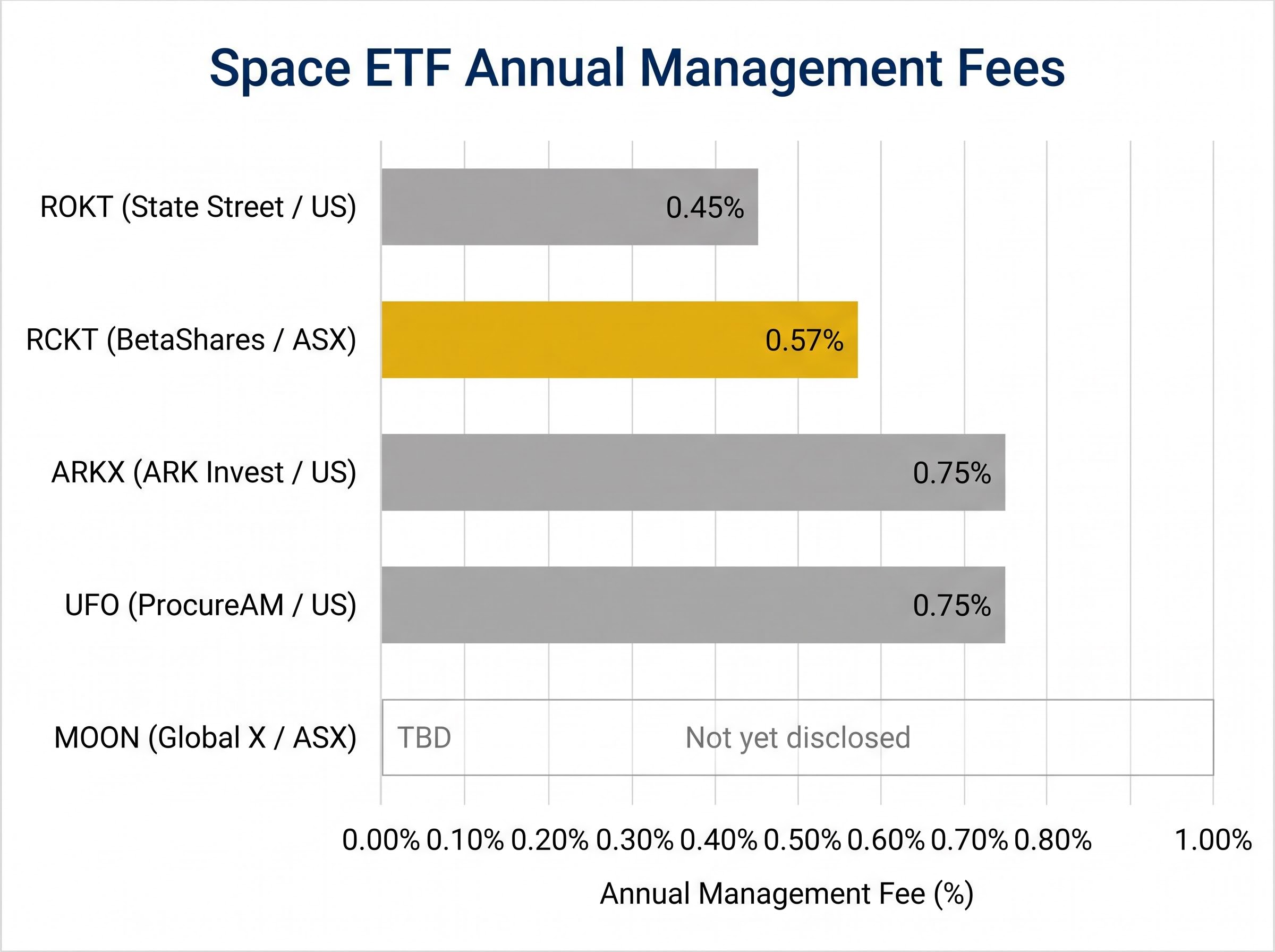
RCKT’s 0.57% annual fee sits in the middle of the range set by established US-listed peers. The comparison provides a useful anchor for what Australian investors are being asked to pay for space-sector access.
| Fund / Ticker | Issuer / Exchange | Annual fee |
|---|---|---|
| RCKT | BetaShares / ASX | 0.57% |
| ARKX | ARK Invest / US (actively managed) | 0.75% |
| UFO | ProcureAM / US | 0.75% |
| ROKT | State Street / US | 0.45% |
| MOON | Global X / ASX | Not yet disclosed |
One point of potential confusion: the US ticker ROKT (State Street) and the ASX ticker RCKT (BetaShares) share near-identical names but are entirely separate products listed on different exchanges.
Fee alone does not determine the better product. Index methodology, holdings breadth, currency exposure, and the convenience of ASX settlement all factor into the assessment for Australian investors. Still, RCKT sits below the two 0.75% US funds and above State Street’s 0.45% offering, giving MOON a clear benchmark to compete against once its fee is disclosed.
The reporting above translates into a specific set of questions for investors considering either fund.
The thematic ETF behaviour gap — the divergence between a fund’s reported time-weighted return and the actual money-weighted return experienced by investors who entered near peak valuations — is widest in high-momentum sector products; Morningstar estimates thematic funds carry 2-3% annualised underperformance from poor investor timing alone, a structural drag that compounds materially over multi-year holding periods.
Space sector collapses like Virgin Galactic’s 99.7% fall from above US$1,100 to under US$3 per share illustrate how quickly narrative-driven valuations unravel when execution falls short, a pattern that ran through the SPAC-listed space company cohort of 2020 to 2022 and left most investors with near-total capital losses.
This article is for informational purposes only and should not be considered financial advice. Investors should conduct their own research and consult with financial professionals before making investment decisions. Past performance does not guarantee future results. Forward-looking statements regarding a potential SpaceX IPO are speculative and subject to change.
The ASX has moved from zero to two space ETFs in a matter of weeks, a structural shift in what Australian investors can access on the local exchange. RCKT is live, has delivered a strong early return, and holds a diversified basket of space-sector names across launch, satellite, and earth observation segments. MOON is announced but carries no confirmed fee, index, or holdings data.
Underneath both products sits the same catalyst: the expectation that SpaceX will eventually list publicly and enter these funds as a major constituent. That remains unconfirmed.
The practical next step is straightforward. MOON’s listing, and the product disclosure that accompanies it, will be the moment a genuine fund-versus-fund comparison becomes possible. Until then, investors have one product to assess, one to watch, and a thesis that depends on an event no one has put a date on.
RCKT is an ASX-listed ETF launched on 12 May 2026 that tracks the Solactive Space Industry Index, giving Australian investors exposure to global space-sector equities including rocket launch, satellite communications, and earth observation companies at an annual management fee of 0.57%.
MOON is a space-sector ETF announced by Global X in May 2026 as a direct competitor to RCKT on the ASX; as of 27 May 2026, its management fee, underlying index, holdings, and confirmed listing date have not yet been disclosed.
RCKT charges 0.57% per annum, which sits below the 0.75% fees charged by US-listed ARK Invest's ARKX and ProcureAM's UFO, but above the 0.45% fee of State Street's US-listed ROKT fund.
If SpaceX lists publicly, it is expected to enter both RCKT and MOON as a constituent and potentially their largest holding; however, as of 27 May 2026, no confirmed IPO filing or regulatory-cleared timetable exists, making this an unconfirmed forward thesis for both funds.
Key risks include high thematic concentration in a single sector, elevated volatility relative to broad-market funds, uncertainty around the SpaceX IPO timeline, and the possibility of entering at inflated valuations after RCKT's nearly 30% post-listing gain, which Morningstar data suggests can result in 2-3% annualised underperformance from poor investor timing in thematic funds.