Many investors assume that a geared ETF is just a margin loan in different packaging. Same debt, same risk, same exposure to a lender who can force you to sell at the worst possible time. The assumption is understandable, but it misses the structural feature that makes these products operationally distinct: in an internally geared ETF, the debt is never in your name.
That distinction matters more now than it did five years ago. Internally geared ETFs, most visibly the BetaShares Wealth Builder range, have made leveraged market exposure accessible to everyday Australian investors without a credit application, without a loan contract, and at borrowing rates that retail investors cannot access on their own. The structural features that make this possible are frequently misunderstood, or overlooked entirely, when investors compare geared ETFs to traditional margin lending.
Here is what you need to walk away with: a working understanding of how fund-level borrowing is structured, what the loan-to-value ratio means for your actual exposure, and how the real cost of leverage inside a geared ETF compares to a retail margin loan. This is practical, decision-relevant knowledge, not a product endorsement.
What sits inside a geared ETF (and where the debt actually lives)
The structural fact that surprises most people is simple: a geared ETF is a managed borrowing facility held inside a fund wrapper. The fund manager borrows money, invests it alongside your capital, and manages the debt entirely at the fund level. The lender’s relationship is with the ETF manager, not with you.
That single fact changes almost everything about the investor’s experience.
Margin lending in Australia operates under Chapter 7 of the Corporations Act 2001, which entitles borrowers to product disclosure, responsible lending assessments, and ASIC-approved dispute resolution, protections that do not apply to geared ETF unit holders because no personal loan contract exists.
You buy ETF units on the exchange exactly as you would with any other ETF. No loan application. No credit check. No personal financial documentation. Cameron Gleeson, Senior Investment Strategist at BetaShares, has described the Wealth Builder range (including G200 and GGBL) as products where the fund manager handles all gearing mechanics: borrowing, rebalancing to maintain the leverage target, and interest payments. Your operational experience is identical to holding a standard ETF.
The debt itself is secured against the fund’s assets, not against your personal holdings or any other asset you own. What you get is leveraged market exposure without taking on a personal liability. That is a genuine structural distinction, not a marketing claim, and it is the foundation for every other comparison in this article.
Here is what “fund-level borrowing” means operationally:
- No credit check or loan application required from the investor
- No margin calls issued to the unit holder
- The fund manager handles all rebalancing to maintain the target leverage
- Debt is secured against the fund’s assets, not the investor’s personal portfolio
When big ASX news breaks, our subscribers know first
How the loan-to-value ratio translates into actual market exposure
The amount of leverage you receive from a geared ETF depends on a single number: the loan-to-value ratio, or LVR. The LVR is the share of total fund assets funded by debt rather than investor capital. A higher LVR means more borrowed money in the mix, and more amplification of returns in both directions.
For the BetaShares Wealth Builder range, the target LVR is 30-40%, producing approximately 1.5x exposure to the underlying portfolio. Here is how the arithmetic works:
- Every $100 you invest is paired with roughly $50 in borrowed funds at the fund level.
- The combined pool of $150 is then deployed into the underlying portfolio.
- Your effective market exposure is therefore around 1.5x your contributed capital.
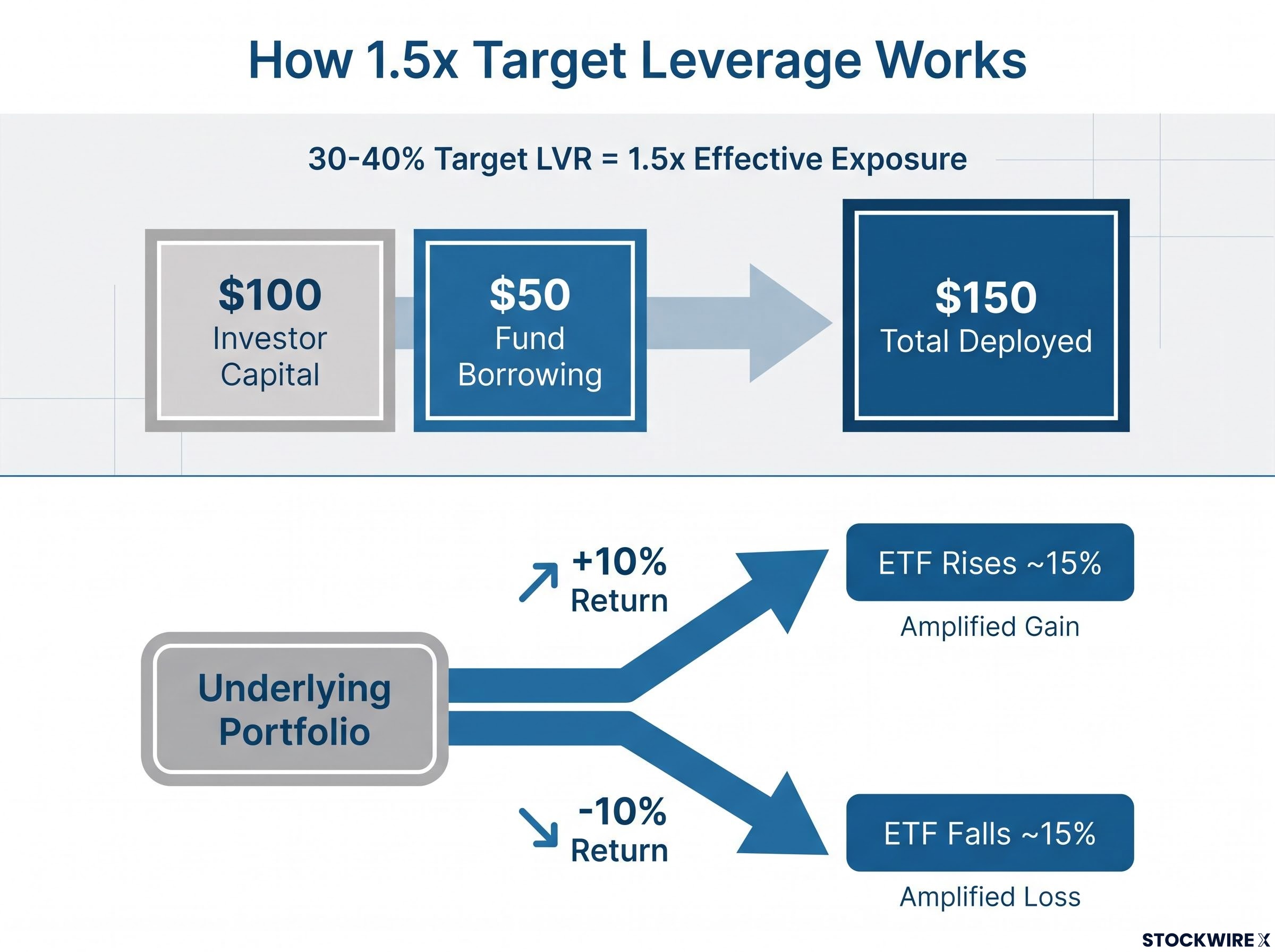
The symmetry is exact. If the underlying portfolio rises 10%, the geared ETF’s value rises approximately 15% before costs. If the underlying falls 10%, your loss is similarly amplified to approximately 15%.
The underlying asset allocation is the same as the ungeared equivalent. G200 holds A200 (Australian equities) and GGBL holds BGBL (global equities). You choose the asset class first; then you choose whether you want 1x or approximately 1.5x exposure. The leverage decision and the asset allocation decision are separate.
Moderate gearing and strong gearing are not the same thing. A product targeting 1.5x exposure within a 30-40% LVR band sits in a fundamentally different risk category from a highly geared product such as GGUS, which runs a 50-65% gearing ratio and can deliver market exposure ranging from 2x to roughly 2.86x. The gap in amplification between these two types of product is large enough that they warrant separate evaluation rather than being grouped together under a single “geared ETF” label.
Reset period mechanics separate internally geared ETFs like G200 from daily-reset leveraged products: because the BetaShares Wealth Builder range carries no daily reset, it does not compound volatility drag the way 2x and 3x tactical products do, which is one reason the 1.5x target is more compatible with a multi-year holding horizon.
How the fund manages leverage risk, and what investors still carry themselves
What changes
With a traditional margin loan, your personal LVR typically sits around 70%. If markets fall and your LVR breaches the lender’s limit, you receive a margin call: add cash, reduce the loan, or the lender sells your assets. That forced selling often happens at distressed prices, at the precise moment when holding on would serve you best.
Internally geared ETFs remove that dynamic entirely. The fund manager, not you, is responsible for keeping the LVR within the target band of 30-40%. If markets fall sharply, rebalancing happens inside the fund. You do not receive a margin call. You are not required to inject additional capital. The “forced selling at the worst time” scenario that has hurt many margin-loan investors does not apply to you as a unit holder.
What stays the same
The removal of margin calls does not remove the risk of large losses. In a sharp market fall, the ETF’s unit price can still drop substantially, and that drop is amplified relative to an ungeared equivalent. If the underlying portfolio falls 20%, your geared position falls roughly 30% before costs.
What you gain here is protection from being forced to act at the worst moment. You retain the freedom to hold through a drawdown, or to sell on your own terms. What you do not gain is protection from the drawdown itself. Be clear on that distinction before using this feature as a reason to increase your position size.
Why fund-level borrowing costs matter more than the headline fee
The economics of gearing come down to a simple question: does the underlying portfolio return enough to clear the cost of borrowing? That is where the institutional borrowing rate advantage becomes genuinely significant, and where the specific numbers may surprise you.
According to Cameron Gleeson, Senior Investment Strategist at BetaShares, retail margin loan interest rates in Australia were sitting at approximately 8.5% at the time of discussion. Independent research corroborates a typical range of 8-9% depending on the provider. The borrowing rate applicable to Wealth Builder geared ETFs was below 5% at the same time, reflecting institutional-level terms.
Retail margin loan rates at major Australian providers have exceeded 10% per annum at some institutions, a figure that sits well above the sub-5% institutional borrowing cost applicable to Wealth Builder geared ETFs and materially raises the return hurdle any leveraged equity position must clear.
The rate gap in numbers: BetaShares Wealth Builder products were borrowing at below 5%, while retail margin loans were charging approximately 8.5%. That spread changes the performance hurdle for leverage to add value.
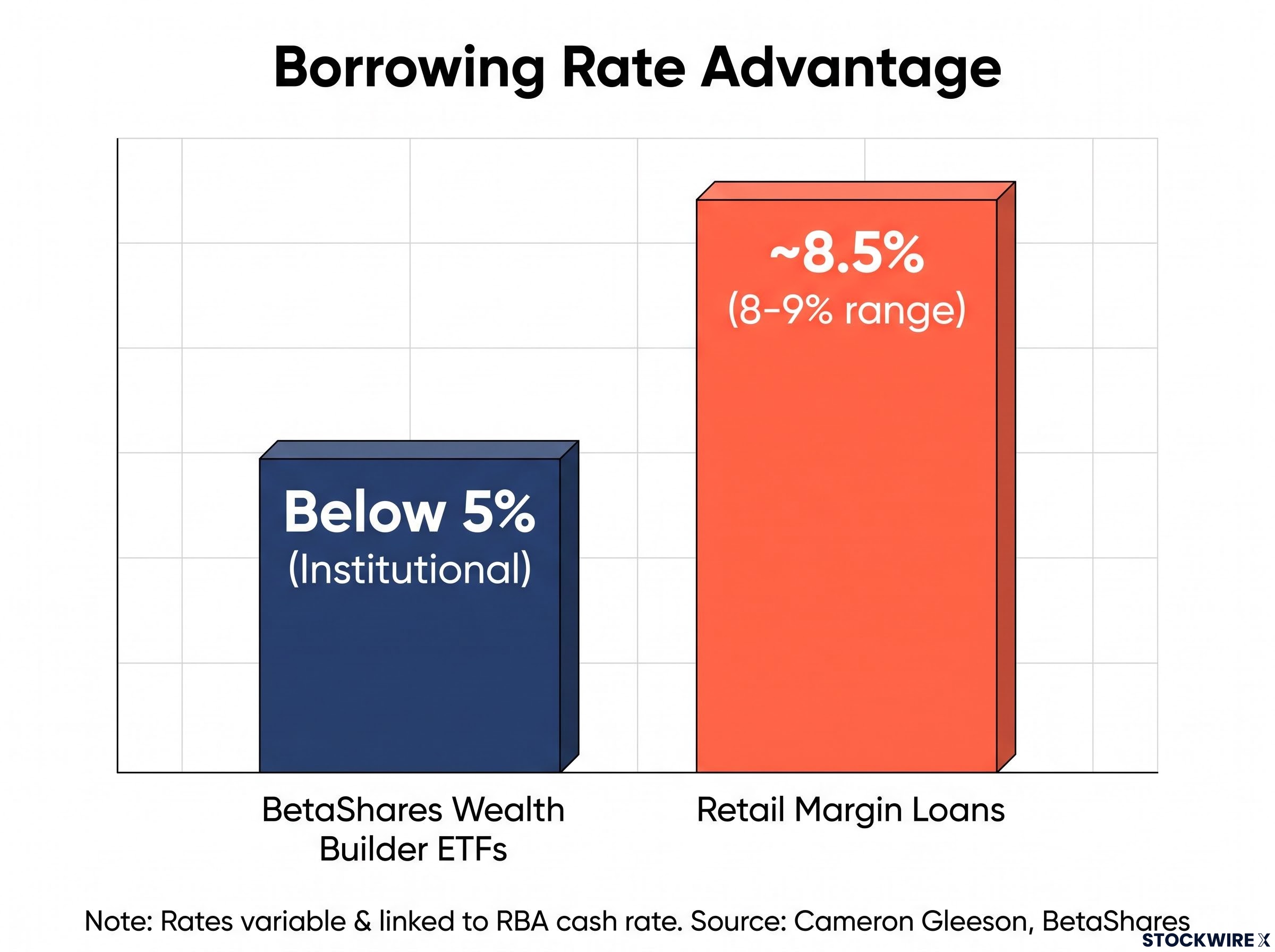
That spread is not a minor technical detail. The underlying equity portfolio must outperform the borrowing rate plus fees for leverage to be value-additive. A borrowing rate below 5% versus a retail rate of approximately 8.5% means the performance hurdle inside the fund is materially lower than it would be if you ran a personal margin loan. That difference is worth quantifying before making any product comparison.
The caveat is real: these borrowing rates are variable and linked to the Reserve Bank of Australia’s cash rate. If the RBA lifts rates materially, ETF borrowing costs rise, and the advantage over retail loans can narrow or reverse.
| Feature | Internally geared ETF | Retail margin loan |
|---|---|---|
| Borrowing rate | Below 5% (institutional) | Approximately 8-9% (retail) |
| Who manages the loan | Fund manager | Investor |
| Are rates variable? | Yes, linked to RBA cash rate | Yes, varies by provider |
| Who bears margin call risk | Fund manager (investor not called) | Investor (must respond or face forced sale) |
How management fees are calculated, and what the effective cost on your capital actually is
The headline management fee on a geared ETF looks manageable. G200 charges approximately 0.35% per annum. Its ungeared equivalent, A200, charges approximately 0.04%. The gap is noticeable but not alarming.
The detail that changes the comparison is where those fees are applied. Unlike ungeared funds, which charge fees only on investor capital, geared ETFs apply their management fee to total gross assets, including the borrowed portion. At roughly 1.5x leverage, a stated fee of 0.35% on the full asset base works out to approximately 0.5% relative to the capital you actually put in. That makes the true cost noticeably steeper than the headline figure implies.
If you are comparing geared ETF costs to ungeared alternatives, use the gross-assets-adjusted figure, not the 0.35% headline. That is the number that reflects what you are actually paying relative to your capital.
One structural feature works in your favour here. When G200 holds A200 internally, BetaShares rebates the underlying A200 management fees at the fund level. You pay only the geared ETF’s headline fee on the overall structure, not both layers stacked together.
| Fund | Type | Management fee | Fee basis |
|---|---|---|---|
| A200 | Ungeared Australian equities | ~0.04% | Net assets |
| G200 | Geared Australian equities | ~0.35% | Gross assets |
| BGBL | Ungeared global equities | ~0.08% | Net assets |
| GGBL | Geared global equities | ~0.35% | Gross assets |
At 1.5x leverage, the effective fee on your contributed capital for both G200 and GGBL is approximately 0.5% per annum. Fees referenced as current at mid-2026 per BetaShares fund documentation.
What geared ETFs suit, and the questions worth asking before using one
The mechanics are clear. The suitability question is personal. Whether a geared ETF fits your circumstances turns on three factors, and only you can answer them.
The first is your risk tolerance for amplified drawdowns, not the tolerance you state on a questionnaire, but how you actually behave when a position falls 30% on paper. The second is your investment horizon: longer horizons give the underlying assets more time to generate returns above the borrowing rate and fees, reducing the probability that leverage subtracts value. The third is clarity on how you will respond to sharp falls without being forced to sell.
The absence of margin calls is a structural advantage. But if your actual behaviour under stress is to sell at the bottom, leverage amplifies a behavioural mistake rather than an investment return.
Ask yourself these questions before using a geared ETF:
- What is your investment horizon, and is it long enough for the underlying to clear the performance hurdle?
- How would you respond to a 30% drawdown in this specific holding?
- Are you comfortable delegating all loan management to the fund manager?
- Do you understand that moderate gearing (approximately 1.5x) and strongly geared products (2x to approximately 2.86x) are different risk categories?
Suitability ultimately comes down to behaviour. If you would be tempted to sell under pressure during a sharp fall, treat amplified volatility as a design constraint, not just a risk disclosure. The product is built for investors who can hold through drawdowns, not for those who expect to.
For investors with high credit quality who want maximum control and flexibility, a traditional margin loan may still be the better fit. For investors who want leverage without the operational complexity and personal loan administration, the geared ETF structure may suit better. Neither approach is universally superior.
A structure with real advantages, and real conditions attached
Internally geared ETFs offer three structural advantages that are genuine and quantifiable: no personal debt or margin calls to the investor, institutional borrowing rates materially below what retail margin loans charge, and operational simplicity with all gearing mechanics managed by the fund.
The trade-offs are equally real. Your effective management fee on contributed capital is higher than the headline number. Borrowing rates are variable and linked to the RBA cash rate, meaning the cost advantage can shift. And amplified losses are not buffered by the absence of margin calls; the fund protects you from forced selling, not from drawdowns.
The clearest way to understand these products is as a lower-complexity alternative to retail margin lending for investors with the right risk profile and the right horizon. They are not a risk-free way to boost returns. They are a structure that removes specific operational burdens while preserving, and amplifying, the market risk you are choosing to take.
For readers who have decided that a geared ETF suits their risk profile and want to think about how it fits within a broader allocation, our full explainer on building an ETF portfolio covers core-satellite construction, fee discipline across a multi-fund structure, and the domestic-global split that affects franking credit outcomes.
This article is for informational purposes only and should not be considered financial advice. Geared ETFs can significantly amplify losses as well as gains. Investors should conduct their own research and consult with financial professionals before making investment decisions. Past performance does not guarantee future results.