Most investors who read about geared investing come away thinking it is either a sophisticated accelerant for long-term wealth or a reckless gamble. The truth is more specific than either view, and whether gearing makes sense for you depends on factors that have nothing to do with which outcome you prefer.
Geared investing amplifies both gains and losses by putting more capital to work than you personally contribute. That is not inherently dangerous, but it is categorically different from ungeared investing. The conditions that make it appropriate are narrower than marketing materials typically suggest. For Australian investors already comfortable with ETFs, the question is rarely “what is gearing?” and almost always “should I use it, and if so, how?”
This guide works through the full investor decision framework: suitability criteria, the behavioural dimension most people underestimate, practical allocation approaches that fit gearing into an existing portfolio without disrupting it, and the lifecycle logic of knowing when to start winding back. After reading, you will have a clear basis for your own decision, whether that decision is yes, no, or not yet.
What gearing is actually asking of you
Gearing means borrowing to invest. You earn returns on a larger pool of capital than you personally own, and when those returns are positive, the maths works in your favour. When they are negative, the same maths works against you, harder and faster.
The mechanics come in two forms:
- External gearing: You borrow directly (margin loan, home equity line) and invest the proceeds. You are personally liable for the debt and exposed to margin calls if asset values fall below required thresholds.
- Internally geared ETFs: The fund borrows inside the product. You buy units like any other ETF. No personal margin call, but the unit price fully reflects the leverage and borrowing costs embedded in the structure.
- Fee transparency: Internally geared ETFs typically bundle borrowing costs into the management expense ratio, making total cost easier to track. External gearing requires you to monitor loan interest separately.
- Typical use case: Internally geared ETFs suit investors who want leveraged exposure without managing a separate loan facility. External gearing suits those who want more control over the borrowing terms.
The mechanics are relatively simple. The commitment is not.
Beyond internally geared ETFs, there are several leverage tools available to ASX investors, including margin lending, Exchange-Traded Options, and MINI Warrants, each with distinct cost structures, margin call mechanics, and risk profiles that determine which instrument fits which investor situation.
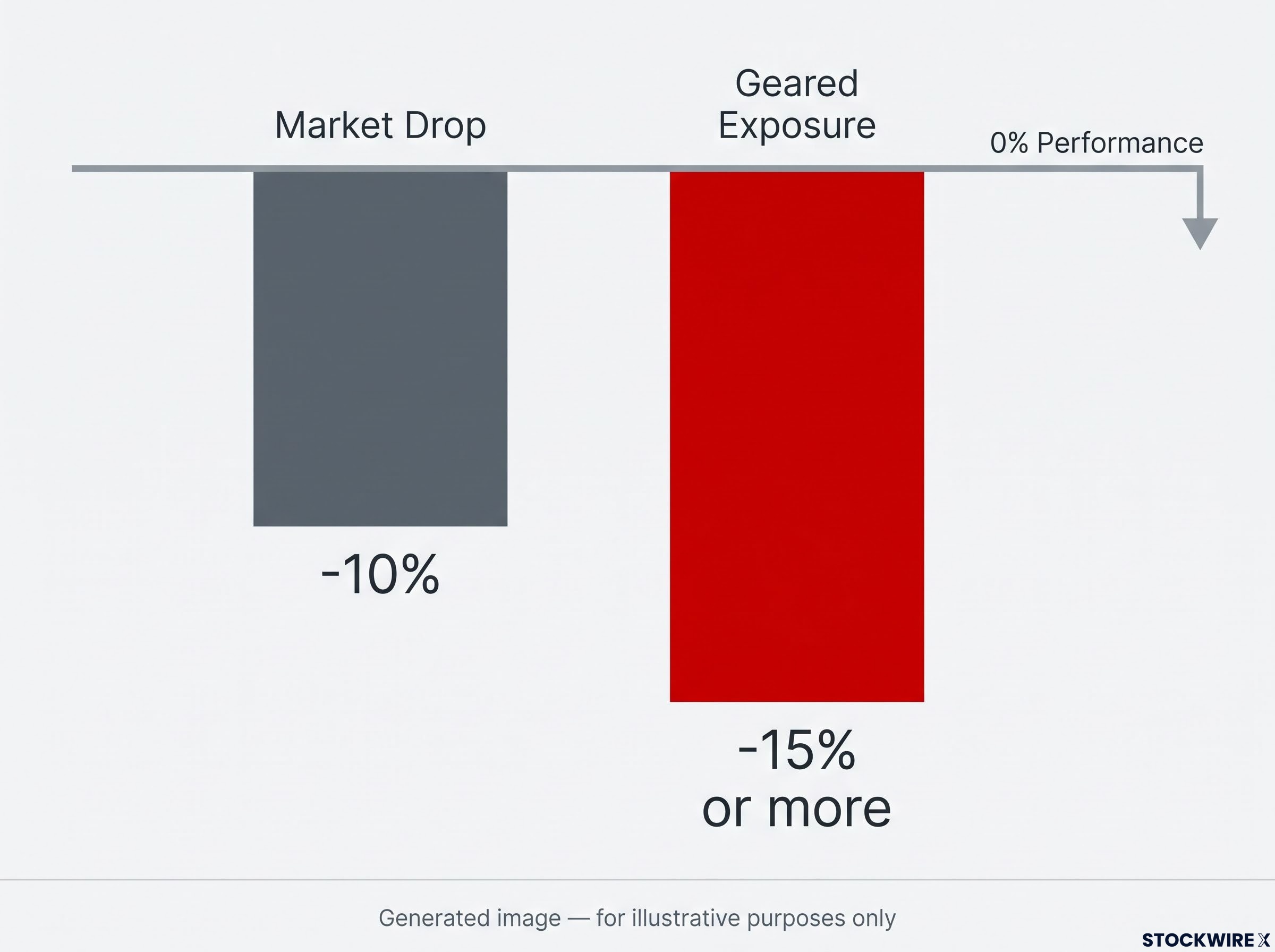
When markets drop by around 10%, a geared exposure can lose 15% or more of its value. That is not a worst-case scenario. It is a routine characteristic of leverage.
The geared ETF return mechanics behind a product like GHHF illustrate the amplification principle concretely: for every 25% market decline, investors can expect roughly a 38% loss on their equity, a figure produced by internal gearing at a 30-40% LVR target rather than any unusual market event.
Every prospective geared investor should sit with that number before making a decision. If a 15% portfolio drawdown when the market is down 10% feels abstract, imagine watching it happen across three or four consecutive red weeks while your ungeared colleagues are down far less. That is the lived experience of gearing, and it is the price of the amplified upside.
When big ASX news breaks, our subscribers know first
Are you objectively suited to gearing?
Before you look at any product or allocation model, you need to pass a suitability filter. These are not soft suggestions. They are concrete thresholds, and failing any one of them changes the answer from “maybe” to “not now.”
- Time horizon of at least five years. Gearing is a multi-year strategy. Seven-plus years is commonly cited as the realistic minimum for the maths to overcome interim drawdowns. If your horizon is shorter, the probability of being forced to exit at the wrong time rises substantially.
- No near-term major capital needs. If you are saving for a property purchase, a business venture, or any large planned withdrawal within the next few years, gearing introduces a risk you cannot control: the market falling right when you need the money.
- Financial resilience. You need a fully funded emergency reserve, stable income, and the ability to service borrowing costs even if interest rates rise, without relying on your investment returns to cover the gap.
- Genuine risk tolerance. You must accept that your portfolio will fall harder than the market in downturns and still hold through those periods. Intellectual understanding alone is not enough; your past behaviour under stress is the better guide.
If all four criteria hold, you are an objective candidate. If any one fails, gearing is not a risk-adjusted opportunity for you. It is an unnecessary exposure that the other criteria cannot compensate for.
The ASIC MoneySmart guidance on borrowing to invest sets out the regulatory framework Australian investors must understand before taking on leverage, covering margin loan mechanics, the risk of amplified losses, and the conditions under which margin calls are triggered.
When the answer is clearly no
Some situations are clear disqualifiers. If your income is variable and you cannot guarantee loan servicing across a full cycle, gearing adds fragility to a position that is already exposed. If you lack an emergency buffer, a forced sale under leverage locks in amplified losses permanently.
Being intellectually interested in gearing is not the same as being suited to it. Sitting out is a legitimate strategic choice, not a missed opportunity.
The suitability test most investors fail
Passing the objective criteria above is necessary but not sufficient. The dimension that actually breaks most gearing strategies is behavioural, and it is the one that financial checklists cannot capture.
Behavioural tolerance is not the same as intellectual understanding of risk. You can understand perfectly well that a geared portfolio may fall 15% when the market falls 10%, and still sell when you watch it happen in real time. Most investors find that their actual behaviour in a downturn falls considerably short of what they predicted of themselves beforehand.
A practical self-test: In prior market falls, such as the COVID-era declines, did you hold, rebalance, or sell? Your answer to that question is more informative than any risk-tolerance questionnaire.
If you sold, or came close to selling, treat that as evidence. Your behavioural tolerance is lower than your intellectual assessment suggests. That is not a character flaw. It is data, and it should directly inform the size of any geared allocation you consider.
Selling in a downturn is the specific mechanism through which gearing destroys value. A 30% drawdown in a geared ETF is temporary if you hold. It becomes a permanent loss the moment you sell. A prolonged bear market combined with elevated borrowing costs represents the most adverse scenario for geared strategies, and that combination is precisely when the emotional pressure to exit is highest.
One illustration of how deeply risk aversion operates in practice: young children presented with a choice between a geared and an ungeared investment product, each backed by $100, consistently picked the ungeared option out of fear of losing their initial stake. Risk aversion consistently exceeds what logical analysis predicts, even at small stakes. At portfolio-relevant stakes, the effect intensifies.
What you did in a real market downturn is more informative than what you think you would do in the next one. That past behaviour should anchor the size of any geared allocation you consider.
How to size and integrate a geared position
Once you have passed both the objective and behavioural filters, the next question is practical: how do you bolt a geared allocation onto an existing portfolio without triggering a full restructure?
The standard integration model is core-and-satellite. Your broadly diversified, ungeared ETFs form the core, typically 70-90% of the portfolio. Geared ETFs sit as the satellite, typically 10-30%, sized according to your risk tolerance and experience.
The core-satellite portfolio structure used here allocates 70-90% of the portfolio to broadly diversified, low-cost ETFs and reserves the remaining 10-30% for targeted positions, giving investors the flexibility to add a geared satellite without rebuilding the entire portfolio from scratch.
| Approach | Mechanics | Best suited to | Key risk |
|---|---|---|---|
| Core-satellite | Ungeared ETFs as core (70-90%), geared ETFs as satellite (10-30%) | Investors building a new portfolio or restructuring an existing one | Satellite sizing too large for actual behavioural tolerance |
| New contributions | Keep existing ungeared holdings; direct new contributions into geared equivalents | Investors who already hold ungeared ETFs and want to avoid triggering capital gains tax events | Geared slice grows gradually; requires monitoring to stay within target allocation range |
| Experimental allocation | Small initial amount in a geared ETF, often via a zero-brokerage account | First-time geared investors who want to experience a real market cycle before committing more | Too small to be meaningful if never scaled; must be treated as a learning phase, not a permanent allocation |
Dollar-cost averaging is the preferred entry mechanism, particularly for geared positions. Three reasons stand out:
- You buy more units when prices are low and fewer when prices are high, smoothing your entry point across market conditions.
- It reduces the damage of entering just before a downturn, which is particularly painful with leverage applied.
- Consistent contributions made after market declines effectively purchase exposure at reduced prices, supporting long-term compounding.
The size of your satellite allocation should be set at the level where you could see it fall 30-40% without reconsidering the strategy. That scenario will almost certainly arise within any multi-year geared position, and your allocation needs to survive it without prompting a panic exit.
What not to do: gearing as a trading tool
Some investors and advisers attempt to switch between geared and ungeared funds to capture short-term rallies or dodge corrections. The logic sounds appealing: gear up before the market runs, de-gear before it falls.
The problem is structural. The strategy fails on its own terms for specific, repeatable reasons:
- Timing requirement is doubled. You need to time the entry correctly and the exit correctly, repeatedly, across conditions that professional fund managers also struggle to read consistently.
- Missed recovery days are catastrophic. The strongest recovery sessions tend to cluster immediately after the worst sessions. Missing just a few of those days can erase the entire theoretical return advantage of the strategy.
- Tax drag compounds. Each switch is a disposal event. Across multiple switches per year, the capital gains tax drag compresses returns that the strategy depends on to work.
- Transaction costs accumulate. Even where brokerage is low, frequent trading in and out of geared products adds friction that a buy-and-hold approach avoids entirely.
Tactical gearing is not a more sophisticated version of long-term gearing. It is a different and substantially harder strategy that requires a skill, consistent market timing, that most investors do not possess and that even professionals struggle to execute reliably. For the vast majority of investors, this is a mistake worth avoiding entirely.
Adjusting your gearing across your investing lifetime
Gearing suitability is not a one-time decision. It changes as your income, responsibilities, time horizon, and proximity to major financial goals evolve. The framework below helps you see where you currently sit and what the next decision point looks like from where you stand.
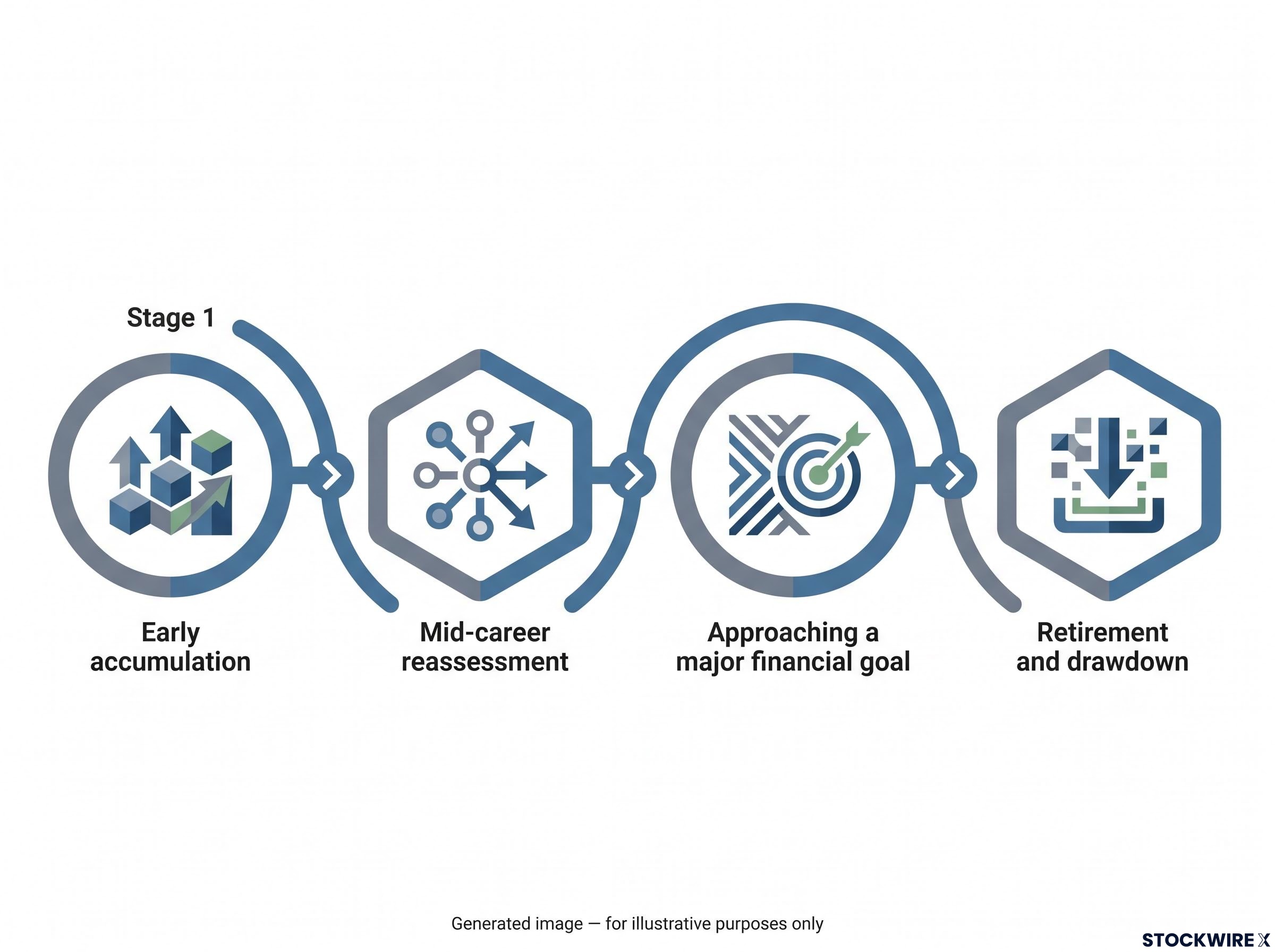
Early accumulation
- The mathematical case for gearing is strongest here. You have the longest time horizon, and subsequent contributions made at lower prices during downturns support long-term compounding.
- However, the maths only plays out if you stay in. Link back to your behavioural self-assessment: if your past behaviour suggests you would sell in a sharp downturn, even the best mathematical case cannot save the strategy.
- Consistent contributions are the mechanism, not lump-sum positioning.
Long-term compounding is the mechanism gearing is designed to accelerate, but it only operates if you remain invested through the full cycle; the second decade of a compounding position generates nearly double the dollar gains of the first decade on the same capital base, which is exactly what a premature exit under leverage destroys.
Mid-career reassessment
- As mortgage obligations, family costs, and career risk increase, your capacity to absorb geared drawdowns may shrink.
- Reassess your satellite allocation size. A smaller geared slice, or a pause on new geared contributions, may be the appropriate adjustment.
- The core-satellite structure gives you the flexibility to scale the satellite without disrupting the core.
Approaching a major financial goal
- Sequence-of-returns risk becomes the dominant concern here. In plain terms: a severe market fall just before or during a period of withdrawals can permanently impair your outcomes in a way that a mid-career fall does not, because you have no time or future contributions to recover.
- Begin a systematic transition from geared to ungeared equivalents. Gradual reduction is the appropriate path, not a sudden exit that may itself trigger adverse tax consequences or poor timing.
Retirement and drawdown
- Regular withdrawals and leverage interact dangerously when markets fall. You may be forced to sell units at depressed prices to fund living expenses, locking in amplified losses.
- Most guidance views significant gearing as inappropriate once you are regularly drawing down. You should have substantially reduced or eliminated gearing before reaching this phase.
The question is not only whether gearing is right for you today, but whether you have a plan for the transition points ahead. Failing to reduce gearing before a major goal is one of the most damaging lifecycle errors an investor can make.
Making a considered decision before you start
Before you commit, work through these six questions. They consolidate everything this guide covers into a portable decision framework you can return to as your circumstances change:
- Timeframe: Is your true investment horizon at least five to seven years, with no major planned withdrawals in the near term?
- Drawdown tolerance: If your portfolio fell 25-40% in a year, would you realistically hold or rebalance, or would you sell?
- Past behaviour: In prior market falls, did you stay invested, or did you de-risk at the bottom?
- Financial stability: Do you have a fully funded emergency reserve, stable income, and the ability to cover borrowing costs even if interest rates rise?
- Allocation sizing: What percentage of your portfolio could you see drop sharply without panicking? Can you start at that smaller level?
- Cost and tax awareness: Do you understand the specific ETF or loan structure, total fees and interest, and how they interact with tax in your situation?
If you cannot answer all six confidently and conservatively, the lowest-risk path is to either avoid gearing or start with a very small satellite allocation and learn from experience across real market cycles.
One cost dimension deserves particular emphasis. Gearing only adds value if your after-tax investment return exceeds total borrowing costs, including management fees. Rising interest rates can reverse a previously sound strategy, turning a wealth-building position into a loss-making one. Investing your geared allocation in broadly diversified assets spanning both domestic and international equities helps reduce the underlying volatility, which is particularly important when leverage is applied.
Gearing rewards patience and a sustained long-term perspective, not precision market timing.
The investors who use gearing most effectively are not those who are most confident about future returns. They are those who have honestly matched their allocation size to their real behavioural tolerance and built in a plan for the lifecycle transitions ahead. That honest matching, more than any product selection or market view, is what separates gearing that builds wealth from gearing that destroys it.
This article is for informational purposes only and should not be considered financial advice. Gearing involves significant risk and may not be suitable for all investors. Investors should conduct their own research and consult with a licensed financial adviser before making investment decisions. Past performance does not guarantee future results, and financial projections are subject to market conditions and various risk factors.