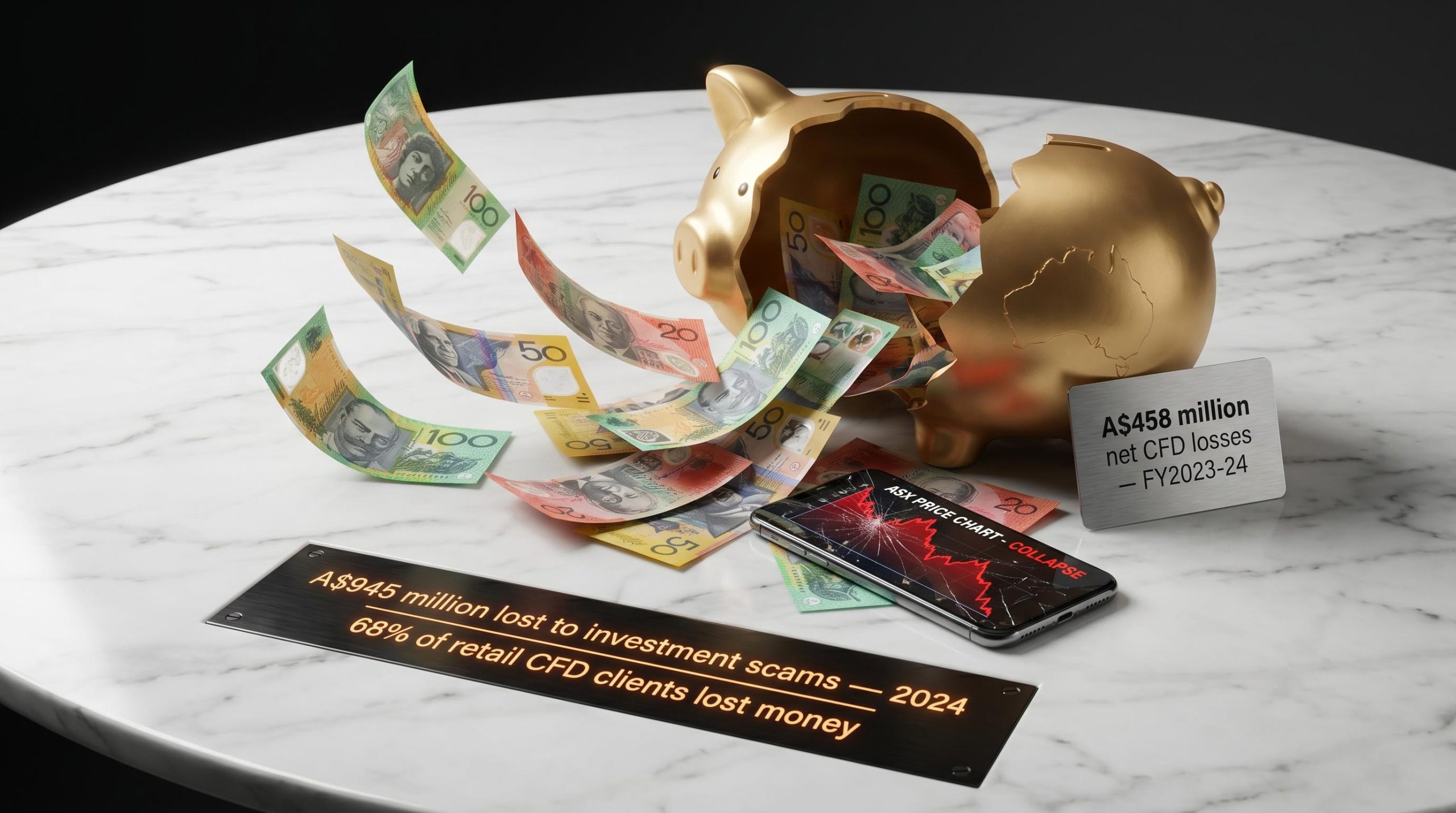
Australians lost A$945 million to investment scams in 2024 alone. That figure, drawn from the ACCC’s Targeting Scams Report published in March 2025, does not account for the capital quietly bled away through overtrading, leveraged products, and expensive courses that teach nothing a free government website cannot. New investors entering the Australian market face a landscape saturated with social media tips, high-leverage products marketed as wealth-builders, and paid education programmes of wildly variable quality. ASIC’s own data shows 68% of retail clients lose money trading CFDs. The education market compounds the problem by charging A$2,000 to A$10,000 for content freely available on ASIC’s MoneySmart platform. These are not fringe risks; they are the standard experience for beginners who do not know what to avoid. What follows identifies six of the most common and costly investing mistakes Australian beginners make, with verified data, clear red flags, and practical alternatives to protect capital before it is lost.
Chasing hot tips, meme stocks, and social media speculation
The logic of the hot tip is seductive because it sounds like insider access. A TikTok video names a microcap ASX stock. A Reddit thread promises a breakout. A WhatsApp group shares a “can’t miss” ticker. The beginner buys.
The problem is timing. By the time a tip reaches a retail investor through social media, the price move it describes has already occurred. Informed participants bought earlier, and the social media post is often the exit signal, not the entry signal. The beginner buys into a single-day spike on a speculative ASX stock, holds through the reversal, and absorbs a loss that the earlier participants have already avoided.
ASIC has repeatedly warned about speculative and high-momentum stock behaviour, flagging stocks experiencing single-day swings of 20% or more as high-risk purchases for beginners. The AI-linked ASX stocks and crypto ETF speculation of 2024-2025 are the current iteration of a pattern that repeats with every market cycle.
A 50-year veteran broker estimated that acting on insider tips cost him roughly A$1 million in forgone gains over his career. If a professional with five decades of experience cannot consistently benefit from tips, a beginner with a six-month-old brokerage account is not going to crack the code.
Three red flags that identify a social media tip before it does damage:
- The source is anonymous or uses a pseudonym with no verifiable track record
- The framing relies on urgency (“get in before it’s too late”, “this won’t last”)
- No verifiable performance history, audited returns, or credentials are provided
When big ASX news breaks, our subscribers know first
Why CFDs destroy most beginner accounts
The numbers arrive without commentary and do their own work. According to ASIC’s REP 828, published in January 2026, 68% of retail CFD clients lost money in FY2023-24. Net losses exceeded A$458 million.
ASIC REP 828, published in January 2026, found that 133,674 retail clients lost more than A$458 million trading CFDs in FY2023-24, making it the definitive regulatory record of retail CFD harm in the Australian market.
A$458 million in net retail CFD losses in a single financial year (ASIC REP 828, FY2023-24). The majority of those losses came from beginner and low-experience accounts.
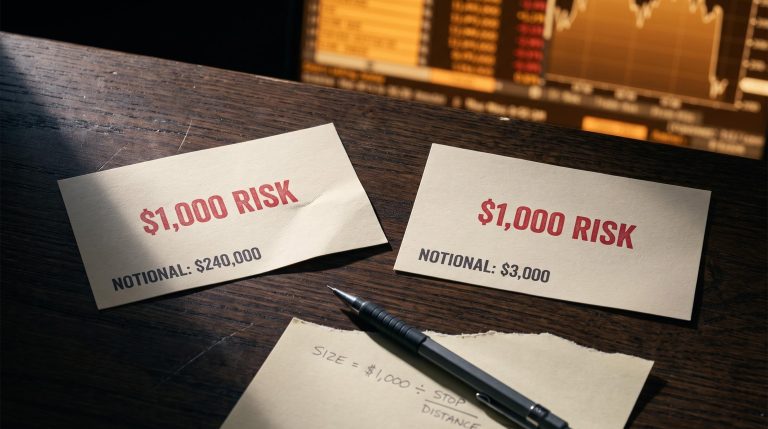
The mechanism is leverage. A CFD (contract for difference) allows a trader to take a position worth many times more than the capital deposited. On a 10:1 leveraged position, a 10% adverse price move does not produce a 10% loss. It wipes 100% of the margin. The market does not need to move far against a leveraged beginner to eliminate their entire account balance, and it frequently does.
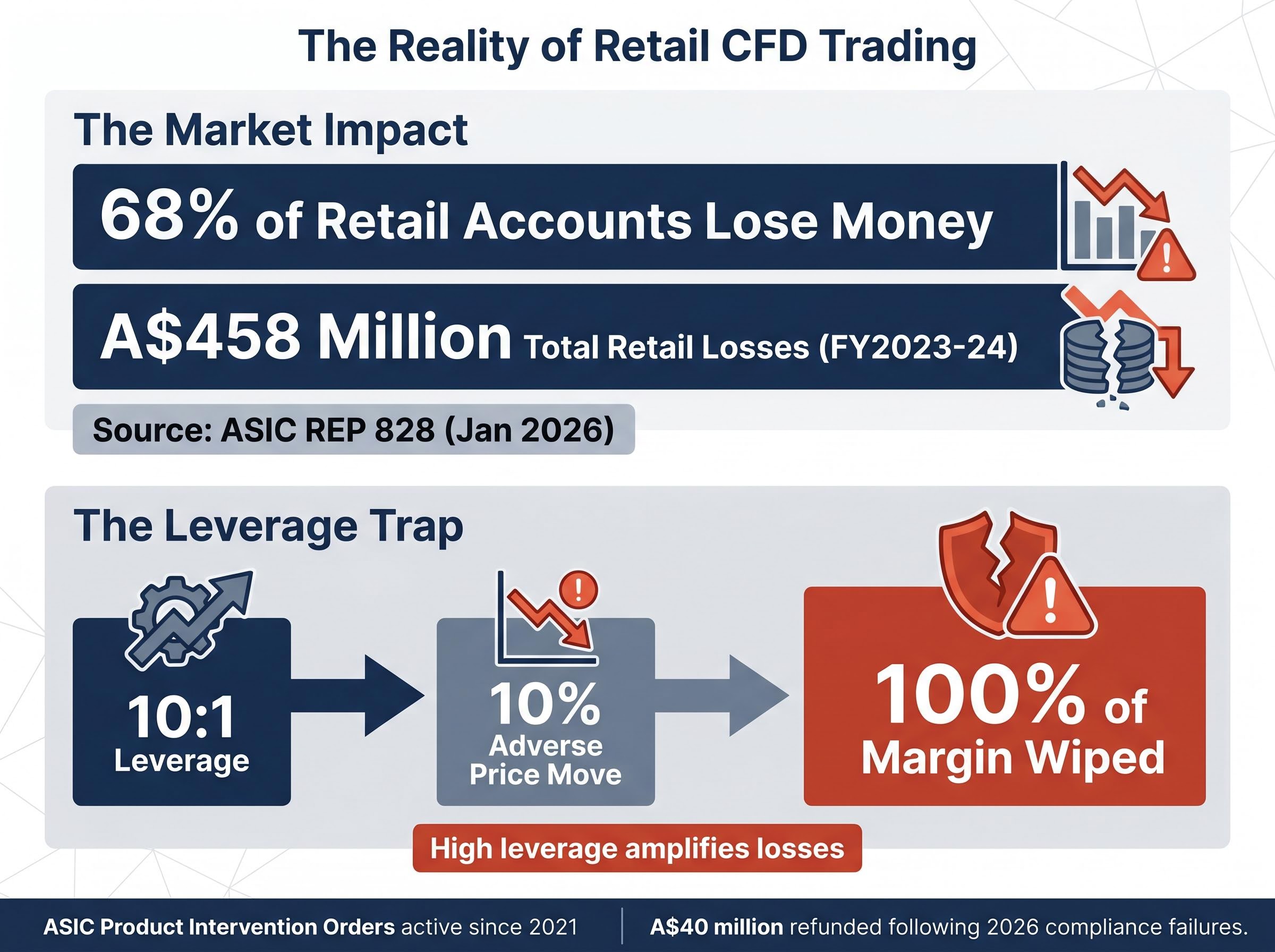
ASIC’s product intervention orders, active since 2021, limit CFD leverage for retail clients. The regulator itself views these products as unsuitable for beginners. In 2026, ASIC’s sector-wide CFD review resulted in nearly A$40 million in refunds to investors following compliance failures across the industry.
ASIC enforcement action in the crypto derivatives space has intensified in 2025-2026, with the Federal Court ordering Binance Australia Derivatives to pay a $10 million penalty for misclassifying 524 retail investors as wholesale clients, a compliance failure that denied those investors the legal protections ASIC’s regulatory framework is designed to provide.
| What CFD marketing promises | What ASIC data shows |
|---|---|
| Outsized returns on small capital | 68% of retail accounts lose money |
| Leverage amplifies gains | Leverage amplifies losses; a 10% move on 10:1 leverage wipes 100% of margin |
| Trade like the professionals | A$458 million in net retail losses in FY2023-24 |
| Accessible for all experience levels | ASIC product intervention orders restrict retail access (active since 2021) |
CFDs are marketed with exactly the proposition that appeals to beginners: large returns from small accounts. ASIC’s data confirms the opposite outcome is the norm.
What beginner investors need to understand about risk before they buy anything
Before selecting a single stock or ETF, two structural concepts determine long-term outcomes more reliably than any individual pick: diversification and fee drag. Most beginner content skips both.
- Diversification is the primary structural protection against beginner errors. Concentrating capital in one stock or one sector magnifies every mistake. If a single speculative position fails, a concentrated portfolio absorbs the full loss. A diversified portfolio, spread across sectors and asset classes, limits the damage any single poor decision can inflict. ASIC’s MoneySmart platform identifies diversification as the core risk mitigation tool for retail investors.
- Fee drag is the cost beginners consistently overlook. Average Australian ETF annual fees range from 0.2% to 0.5% per annum, according to ASX data. These percentages look small in isolation, but they compound. Over 20 years, the difference between a 0.2% fee and a 0.5% fee on a $50,000 portfolio is thousands of dollars in foregone returns. Brokerage fees on frequent trades compound the effect further.
The fee drag on long-term returns compounds silently: a 0.90% annual fee difference on a $10,000 position compounded at 7% gross over 20 years costs approximately $6,000 in foregone growth, making the choice of investment vehicle one of the highest-impact decisions a beginner makes before placing a single trade.
- Finishing year one with approximately the same capital as the starting balance is a legitimate benchmark, not a failure. Research estimates the negative psychological impact of a financial loss is approximately three times greater than the positive impact of an equivalent gain. A large early loss does not just reduce capital; it often drives beginners out of the market entirely before they have learned enough to improve. Preserving capital in the first year keeps the option of learning open.
The structure of a portfolio matters more than the individual selections inside it. This is the foundation almost every beginner skips.
Overtrading, emotional buying, and the FOMO cycle
The cycle follows a predictable arc. A beginner sees a stock or crypto asset that has already run hard, often through a social media feed or a group chat. The price has risen 30% in a week. The fear of missing out takes over. They buy.
The stock pulls back 10%. The beginner holds, hoping for recovery. It drops another 15%. The loss feels larger than any prior gain. Panic sets in. They sell near the bottom, crystallising a loss that started as a fear of missing a gain.
ASIC warnings and financial press coverage have documented this pattern recurring through AI-linked ASX stocks and crypto ETFs across 2024-2025. The assets change; the emotional sequence does not.
Four warning signs that a purchase is FOMO-driven rather than research-driven:
- The asset has already risen significantly in a short window (days, not months)
- The framing relies on urgency rather than analysis
- No fundamental reason for the move is cited (revenue growth, contract win, regulatory approval)
- The justification is social proof: “everyone is doing it”
Day trading and high-frequency intraday activity are disproportionately harmful for beginners. Brokerage costs stack up against small accounts, and the psychological load of watching intraday price movements overwhelms sound decision-making.
One dimension the FOMO cycle consistently triggers that this article does not cover is the CGT discount threshold: selling a position before the 12-month mark forfeits the ATO’s 50% capital gains tax discount, turning a panic sale into a double loss that combines realised capital losses with an avoidable tax liability.
Paper trading as a practical alternative
Tracking simulated purchases on a spreadsheet, or using the ASX Sharemarket Game, before committing real capital allows pattern recognition without financial consequence. A beginner who paper trades for three months can identify whether their instincts are consistently wrong before those instincts cost real money. Emotional trading is the delivery mechanism for most of the other mistakes on this list. Interrupting the cycle is the single most replicable behavioural fix available.
Paying too much for investment education that free resources already cover
Paying for quality education is a reasonable instinct. The problem is that the investment education market in Australia includes a significant number of providers whose business model depends on the student never realising the same content is available for free.
The scale of the broader problem provides context. According to the Targeting Scams Report published by ACCC/Scamwatch in March 2025, Australians lost A$945 million to investment scams in 2024. Investment scams remain the highest-loss scam category in the country. Not all paid courses are scams, but the line between an overpriced course and an outright fraudulent one can be thin.
CHOICE and Financial Counselling Australia advise beginners to avoid paid mentorships and use ASIC’s free resources instead. No paid trading course has been shown to produce better outcomes for beginners than the free, government-backed alternatives already available.
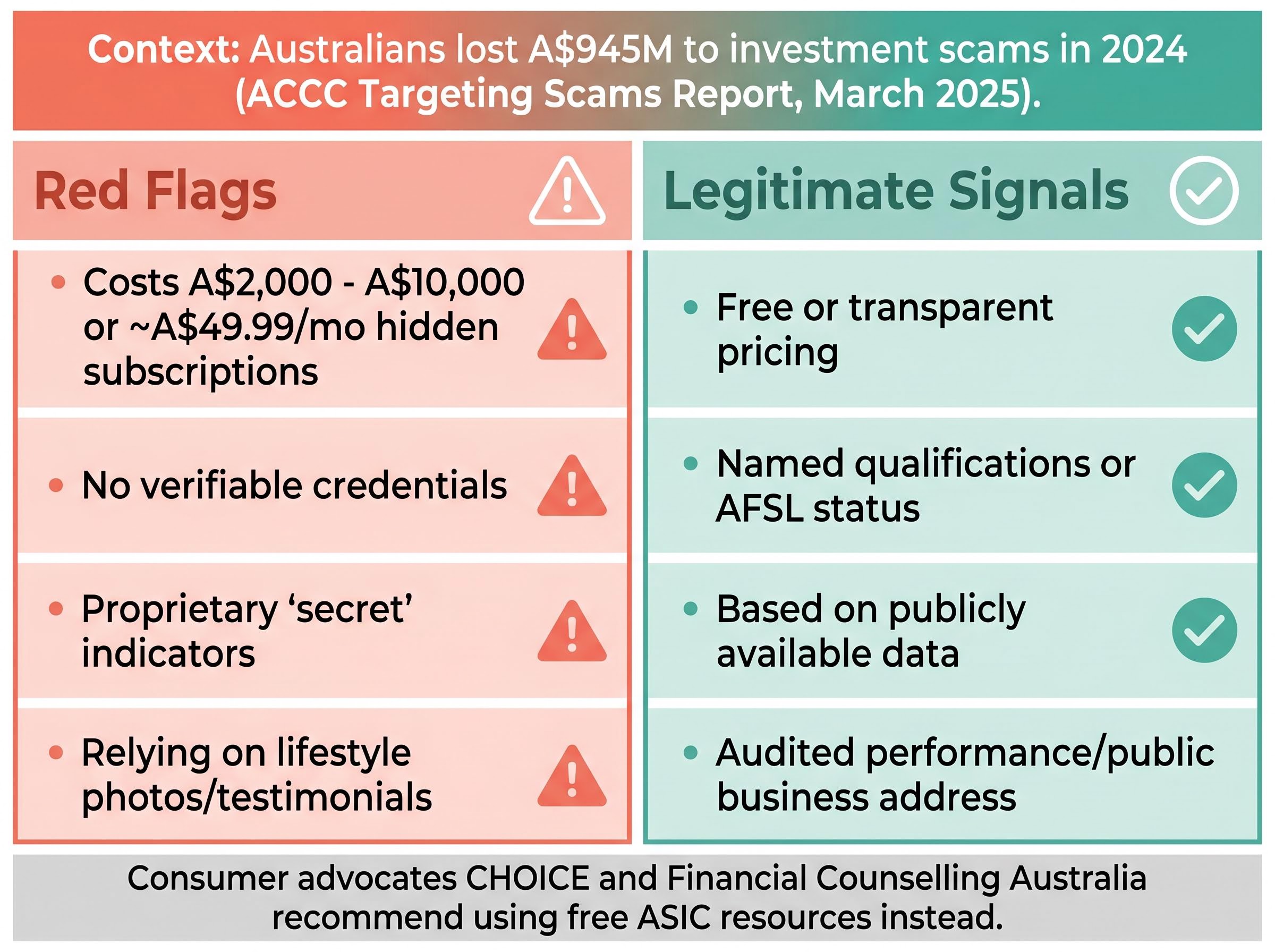
The specific red flags that separate predatory providers from legitimate ones are identifiable:
| Red flag | What it looks like | Legitimate alternative signal |
|---|---|---|
| No verifiable instructor credentials | Instructor biography lists only “years of experience” with no named employer, qualification, or licence | Named qualifications, verifiable employment history, AFSL or authorised representative status |
| Proprietary “secret” indicators | Course promises a trading system unavailable anywhere else, often with fabricated terminology | Content based on widely recognised financial principles and publicly available data |
| Price between A$2,000 and A$10,000 with no free preview | High upfront cost with no trial, sample module, or refund policy | Transparent pricing, free introductory content, clear refund terms |
| Deliberately obscure cancellation | Monthly subscription (~A$49.99) with cancellation buried in terms or requiring phone calls | One-click cancellation, clear terms, no lock-in contracts |
| Testimonials as primary proof | Screenshots of profits, lifestyle photos, and student testimonials with no audited performance data | Independently verifiable track record, publicly listed business address |
Spending A$5,000 on a course before investing a single dollar is a common and avoidable loss. Every dollar not spent on a predatory course is a dollar available for actual investment.
The free resources Australian beginners should be using instead
After five sections of what to avoid, the practical question is where to start. The answer is simpler than the paid education market wants beginners to believe.
- ASIC MoneySmart (moneysmart.gov.au/investing): Free modules covering trading pitfalls, diversification, CFD risks, and high-risk product warnings. This is the starting point recommended by ASIC itself, CHOICE, and Financial Counselling Australia.
- ASX Education Platform (asx.com.au/education): Free resources including webinars updated in 2026, the “New to Share Investing” series, and structured content on avoiding emotional trading and understanding market fundamentals.
- ASX Sharemarket Game: A free simulated trading platform that functions as a structured paper trading equivalent. Beginners can test strategies with virtual capital before committing real money.
- InvestSMART and AFR beginner guides: Free introductory investing content updated regularly, offering accessible explanations of portfolio construction, ETFs, and market fundamentals.
No single course, paid or free, completes the learning process. Investing education is a decade-long engagement with markets, not a weekend seminar. Readers who approach it as an ongoing process will outperform those seeking a shortcut. The difference is that these resources remove the financial risk from the learning phase entirely.
For readers ready to move from avoiding mistakes to constructing an actual portfolio, our dedicated guide to building a core ASX ETF portfolio covers the three most damaging beginner construction errors, including overlapping fund holdings and thematic FOMO, and walks through a specific A200, VGS, and VHY combination that keeps the combined weighted management expense ratio below 0.25%.
The first investment that protects your capital is paying attention to what not to do
The most expensive mistakes Australian beginners make share one characteristic: they are avoidable with publicly available information. This article has identified six of them.
The protective hierarchy is straightforward. Avoid CFDs and leveraged products until the ASIC loss data no longer describes the beginner’s own situation. Ignore social media tips, regardless of how convincing the source appears. Use paper trading or the ASX Sharemarket Game before committing real capital. Build a diversified portfolio with awareness of fee drag. Scrutinise any paid education provider against the red flags identified above, and default to the free alternatives first.
Finishing year one with approximately the same capital as the starting balance is a realistic and honourable goal. It means the investor stayed in the market, preserved the ability to learn, and avoided the losses that drive most beginners out permanently.
The next concrete step is the simplest one on this list: visit ASIC’s MoneySmart platform at moneysmart.gov.au/investing and the ASX Education Platform at asx.com.au/education. Both are free, both are current, and both are endorsed by the regulators and consumer advocates responsible for protecting Australian investors.
This article is for informational purposes only and should not be considered financial advice. Investors should conduct their own research and consult with financial professionals before making investment decisions.