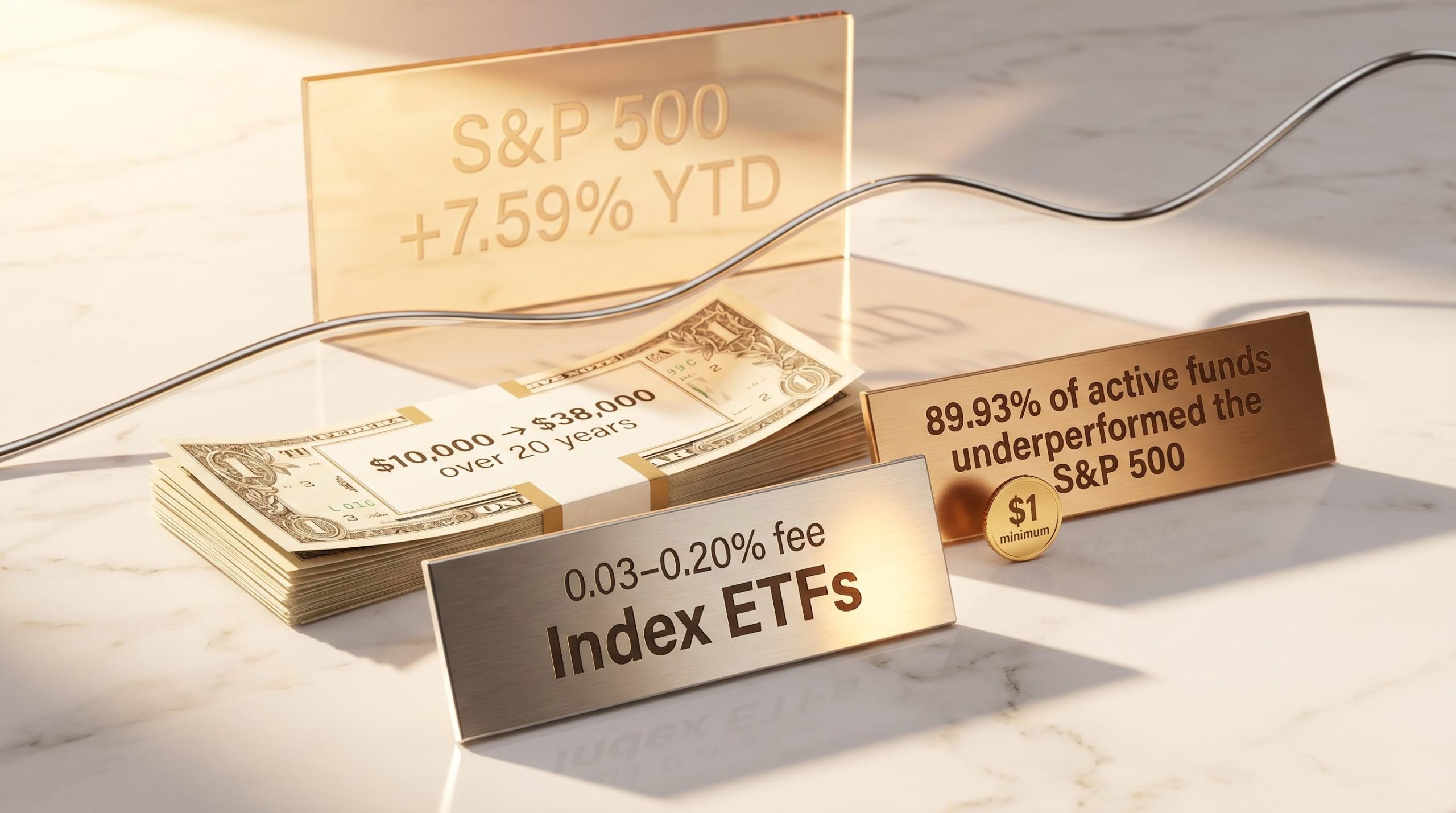
Nearly 90% of actively managed large-cap funds underperformed the S&P 500 over the past year, according to SPIVA Year-End 2025 data. Yet most first-time investors still assume that picking the right fund manager is the decision that matters most. It is not. The decisions that actually shape long-term wealth are simpler and more structural: how much risk to take, what vehicle to use, and how much to pay in fees.
2026 is a particularly instructive moment to begin investing for beginners. Equity returns have been moderate, inflation sits around 3.3% (above target), and zero-commission platforms have made opening an account a 15-minute task. Millennials and Gen Z now represent the largest and fastest-growing segment of new retail investors globally, with ETFs and low-cost index products their most common entry point, according to the World Economic Forum’s Global Retail Investor Outlook 2025.
This guide covers the three investment vehicles suited to beginners, how to match a vehicle to a personal risk profile, how to open a brokerage account with confidence, and how to avoid the structural mistakes that cost new investors the most over time. No specific products are recommended. The focus is on principles that hold regardless of what markets do next.
Before you invest a dollar, understand your risk tolerance
Risk tolerance is not about personality. It is not about whether someone considers themselves brave or cautious with money. In practice, it is a function of three concrete factors: how long the money can stay invested, how stable the income funding it is, and how a person genuinely responds to watching a portfolio drop 20-30% in value.
Those three factors produce a profile. Conservative investors have shorter time horizons, need capital stability, and would reduce their position during a downturn. Moderate investors can stay invested for five to ten years, tolerate meaningful short-term swings, and prefer a balanced mix of growth and stability. Aggressive investors have long time horizons (often 10+ years), stable income, and the discipline to hold through severe drawdowns.
The profiles are not personality types. They are structural descriptions that map directly to asset allocation and vehicle selection.
The relationship between risk and return across asset classes is not linear in practice: cash and short-duration bonds limit downside but impose a near-certain inflation penalty over long horizons, while equities introduce volatility that, for investors with adequate time, has historically resolved into meaningfully superior real returns.

| Risk Profile | Time Horizon | Loss Tolerance | Primary Vehicle | Secondary Vehicle |
|---|---|---|---|---|
| Conservative | 1-5 years | Low (uncomfortable with 10%+ drops) | Bond-heavy managed funds | Short-duration bond ETFs |
| Moderate | 5-10 years | Medium (can hold through 20% drawdowns) | Broad equity and bond index ETF mix | Balanced target-date funds |
| Aggressive | 10+ years | High (holds through severe downturns) | Broad equity ETFs | Limited individual blue-chip shares |
The IMF projects 3.9% growth for emerging markets in 2026, which reinforces that geographic diversity in a portfolio aligns with a moderate-to-aggressive profile. Investors with longer horizons have the structural ability to access that growth.
Free tools to assess your risk profile
The Vanguard Investor Questionnaire (available at investor.vanguard.com) is the most widely used and globally accessible free tool for this step. It scores responses across several dimensions and suggests an asset allocation range.
Most regulated brokers also require a suitability questionnaire during account opening. Completing it carefully, rather than clicking through it, produces a personalised output that goes beyond regulatory compliance. It is worth treating as a genuine diagnostic rather than a formality.
When big ASX news breaks, our subscribers know first
The three investment vehicles every beginner should know
Three vehicles form the core of most beginner portfolios: index ETFs, diversified managed funds, and blue-chip shares. They are not interchangeable. Each has a distinct cost structure, a distinct level of involvement, and a distinct limitation that matters most at the start.
SPIVA Year-End 2025: Approximately 89.93% of large-cap active funds underperformed the S&P 500 over the one-year period, a finding consistent with long-term data across multiple market cycles.
Index ETFs
An index ETF tracks a broad market index, such as the S&P 500, and holds hundreds or thousands of individual stocks within a single product. This delivers instant diversification at the lowest available cost.
Typical annual fees range from 0.03% to 0.20%. Minimum entry is as low as $1 with fractional shares on major platforms. ETFs trade throughout the day like individual stocks, giving beginners intraday liquidity and flexibility. The World Economic Forum’s Global Retail Investor Outlook 2025 found that millennials and Gen Z consistently favour ETFs and low-cost index products as their first investment.
The primary limitation is that an index ETF will never outperform its benchmark; it tracks it. For most beginners, that trade-off is favourable given the fee savings and diversification.
Diversified managed funds
Managed funds pool investor capital into a professionally managed portfolio. The structure suits investors who prefer a fully hands-off approach.
Actively managed funds typically charge 0.40% to 1.00%+ in annual fees. Passively managed mutual fund equivalents sit closer to ETF cost levels. Minimums often range from $500 to $5,000, though some platforms have eliminated minimums entirely.
The SPIVA data makes the performance case difficult for active management at higher fee levels. Managed funds price at the end of each trading day rather than intraday, which is a practical difference compared to ETFs but rarely a material disadvantage for long-term holders.
The SPIVA Year-End 2025 scorecard provides the authoritative benchmark comparison data behind this finding, covering active fund performance across large-cap, mid-cap, and small-cap categories against their respective S&P indices over one, five, ten, and twenty-year periods.
Blue-chip and large-cap shares
Buying shares in an individual company, such as a large-cap blue-chip stock, gives direct ownership and teaches beginners how equity markets work at the company level. Commission costs are near zero on major platforms, and fractional shares are available from around $10.
Concentration risk is the primary concern. A single company can underperform its sector, cut its dividend, or face an idiosyncratic event that a diversified fund would absorb. Limiting individual stock exposure to 5-10% of a total portfolio is widely advised. These are best treated as a learning tool alongside a diversified core, not as the core itself.
| Vehicle | Typical Annual Fee | Minimum Entry | Best Suited To | Key Limitation |
|---|---|---|---|---|
| Index ETFs | 0.03-0.20% | As low as $1 | Most beginners; passive, low-cost growth | Cannot outperform the index it tracks |
| Diversified Managed Funds | 0.40-1.00%+ (active); lower for passive | $500-$5,000 (some platforms: $0) | Hands-off investors preferring professional management | Higher fees; end-of-day pricing; active underperformance risk |
| Blue-Chip Shares | Near zero (commission-free) | From $10 (fractional) | Investors learning individual company ownership | Concentration risk; single-company exposure |
What costs and fees will actually do to your returns over time
The fee percentages in the table above look small. Over a 20-year horizon, they are not.
Consider an illustrative example. An investor places $10,000 into a vehicle earning a 7% gross annual return. At a 0.10% annual fee, the balance after 20 years grows to approximately $38,000. At a 1.00% annual fee, the same investment grows to approximately $32,000. The difference, roughly $6,000, is the compounding cost of a 0.90% annual fee gap on a single $10,000 investment. Scale that across decades of regular contributions and the gap widens substantially.
On a $10,000 investment over 20 years at 7% gross return, the difference between a 0.10% fee and a 1.00% fee amounts to approximately $6,000 in lost growth, entirely from fee drag.

With US CPI at approximately 3.3% as of March 2026 and the Federal Funds Rate at 3.50-3.75%, real returns (after inflation) are narrower than in previous decades. Minimising fee drag is more important in this environment, not less.
Three principles manage costs effectively over a long investing horizon:
- Choose low-fee vehicles. Index ETFs with annual fees below 0.20% are the most cost-efficient starting point for most beginners.
- Automate regular contributions. Dollar-cost averaging, investing a fixed amount on a regular schedule regardless of market conditions, removes timing risk and builds position size consistently. Vanguard research supports a meaningful long-run return advantage for disciplined systematic investors. Starting at as little as $50 per month with automated recurring deposits is accessible on most major platforms.
- Rebalance annually. Returning a portfolio to its target allocation once per year captures the discipline of trimming what has risen and adding to what has lagged, without incurring the costs and tax events of frequent trading.
How to open your first brokerage account in five steps
Opening a brokerage account is an administrative process, not a financial commitment requiring specialist knowledge. Most regulated platforms complete the process in 10-15 minutes. Zero-commission trading is now standard across major global platforms, according to StockBrokers.com 2026 data.
- Assess needs. Determine investment goals (retirement, medium-term savings, learning), whether tax-advantaged account types are available in the relevant jurisdiction, and any location-specific requirements.
- Choose a regulated platform. Select a broker that offers the account types, vehicles, and fee structure that match the assessment from step one. Verifying regulation is the primary due diligence step (see below).
- Gather documents. Know-Your-Customer (KYC) processes are standard and typically complete within 1-3 days. Preparing documents in advance removes the main friction point. Required documents typically include:
- Government-issued ID (passport or national ID)
- Proof of address (utility bill or bank statement)
- Tax identification number (SSN or ITIN for US, NI number for UK, or regional equivalent)
- Complete sign-up. The online application takes approximately 10-15 minutes. Enable two-factor authentication during setup.
- Automate the first deposit. Set up a recurring bank transfer for a fixed amount. Starting small is expected and normal.
Fractional shares are available from $1-$10 on major platforms, meaning minimum investment thresholds are no longer a practical barrier for most beginners globally. In the US, SEC T+1 settlement (implemented 28 May 2024) means sale proceeds are accessible the next business day. EU investors should note that the PFOF ban takes effect 30 June 2026, which may affect how chosen brokers route orders.
Verifying your broker is properly regulated
Checking a broker against its claimed regulator’s public register takes less than a minute and protects against unregistered platforms. FINRA BrokerCheck (US), the FCA Register (UK), and ASIC Connect (Australia) each maintain searchable databases.
Tax-advantaged account wrappers, such as IRAs (US), ISAs (UK), or regional equivalents, should be explored during the needs assessment step before selecting a platform. Not all platforms offer all account types in all jurisdictions.
The tax layer beginners almost always miss
Account type selection is a tax decision first and an investment decision second. Using a tax-advantaged wrapper where available is one of the highest-return structural choices a beginner can make, and it costs nothing.
| Region | Primary Tax-Advantaged Account | Key Feature |
|---|---|---|
| United States | Roth IRA / Traditional IRA / 401(k) | Tax-free growth (Roth) or tax-deferred growth (Traditional); workplace plans via 401(k) |
| United Kingdom | ISA | Up to £20,000 per tax year with no capital gains or income tax on returns |
| EU (Germany example) | Varies by country | Germany applies a flat 25% Abgeltungsteuer on investment income above allowances |
| Other Regions | Varies | Many countries offer equivalent wrapper accounts; check with a local tax professional |
Beyond account type, three tax concepts affect most beginners before their first trade:
- Capital gains tax treatment. Most jurisdictions distinguish between short-term (assets held under one year) and long-term (held over one year) gains, with long-term rates typically more favourable. Frequent trading in taxable accounts accelerates tax obligations.
- Dividend taxation. Dividends from shares and funds are often taxed as income in the year received, even if reinvested. Whether this triggers an immediate tax event depends on the account type.
- Foreign withholding tax. Cross-border dividends may be subject to withholding tax in the source country, which may or may not be recoverable via tax treaties.
Tax drag operates silently and compounds over decades. Choosing the right wrapper before the first trade meaningfully improves net long-term returns without taking on any additional investment risk. Consulting a local tax adviser or government tax authority resources before selecting an account is worth the time.
The five mistakes that derail beginners before they get started
These are not hypothetical warnings. They are the specific, documented patterns that separate beginners who build wealth from those who leave markets after their first downturn.
- Trying to time the market. Most novice investors who attempt to buy low and sell high end up selling during downturns and missing recoveries. This is the most common and costly beginner error, and it is driven by emotion rather than analysis.
- Neglecting fees. Every 1% in unnecessary annual fees compounds into significant lost wealth over decades. The illustrative example earlier in this guide showed approximately $6,000 in lost growth on a single $10,000 investment over 20 years. Scale that across a lifetime of contributions.
- Investing without an emergency fund. A 3-6 month emergency fund should precede any investment activity. Without it, liquidity needs force selling at the worst possible time.
- Chasing hype assets. Meme stocks, short-cycle themes, and speculative assets have historically destroyed value for retail participants who enter late. The excitement is real; the returns for latecomers rarely are.
- Ignoring tax structure. Investing in taxable accounts when tax-advantaged wrappers are available is an avoidable drag on net returns that compounds over the same decades the investment is meant to grow.
Behavioural biases in early investing, including FOMO, the disposition effect, and panic selling during drawdowns, are responsible for a larger share of beginner portfolio losses than poor stock selection, making psychological discipline a more important skill to develop than market analysis for most new investors.
Consistent, automated, diversified investing outperforms most active strategies for most people over most time horizons.
The overarching principle is straightforward. The combination of dollar-cost averaging, low-cost vehicles, and annual rebalancing produces outcomes that most active approaches fail to match for retail investors over the long run. Discipline, not brilliance, is what compounds.
The first principles that hold regardless of what markets do next
The S&P 500 has returned approximately +7.59% year to date as of early May 2026. Meaningful positive returns are available to investors who are in the market. US inflation at approximately 3.3% makes real return awareness and low-cost vehicles more important, not less. The IMF’s projection of 3.9% growth for emerging markets in 2026 gives global diversification a structural justification beyond preference.
Moderate equity returns, above-target inflation, and geopolitical uncertainty all reinforce the same conclusion: systematic, diversified, low-cost investing is more appropriate than timing or concentration.
The principles that hold:
- Build a 3-6 month emergency fund before investing any capital
- Know your risk tolerance and match your vehicle selection to your actual profile, not aspirations
- Prioritise low costs; fee differences compound over decades into meaningful wealth gaps
- Diversify broadly across geographies, sectors, and asset classes
- Automate contributions and remove emotion from the process
- Think in decades, not quarters
- Ignore short-term noise; selling in downturns is the most common and costly beginner error
- Consult local tax and financial professionals for jurisdiction-specific decisions that no global guide can replicate
The most important thing a beginner can do is start. A small, automated, diversified position added to consistently will outperform waiting for a certainty that will never arrive.
For readers ready to move beyond first principles and into the mechanics of building wealth across multi-decade horizons, our comprehensive walkthrough of long-term wealth accumulation covers compounding mechanics in detail, the structural case for total-return ETFs over distributing formats, and why the second decade of a compounding investment generates nearly double the dollar gains of the first decade on the same initial capital.
This article is for informational purposes only and should not be considered financial advice. Investors should conduct their own research and consult with financial professionals before making investment decisions. Past performance does not guarantee future results. Financial projections referenced are illustrative and subject to market conditions and various risk factors.