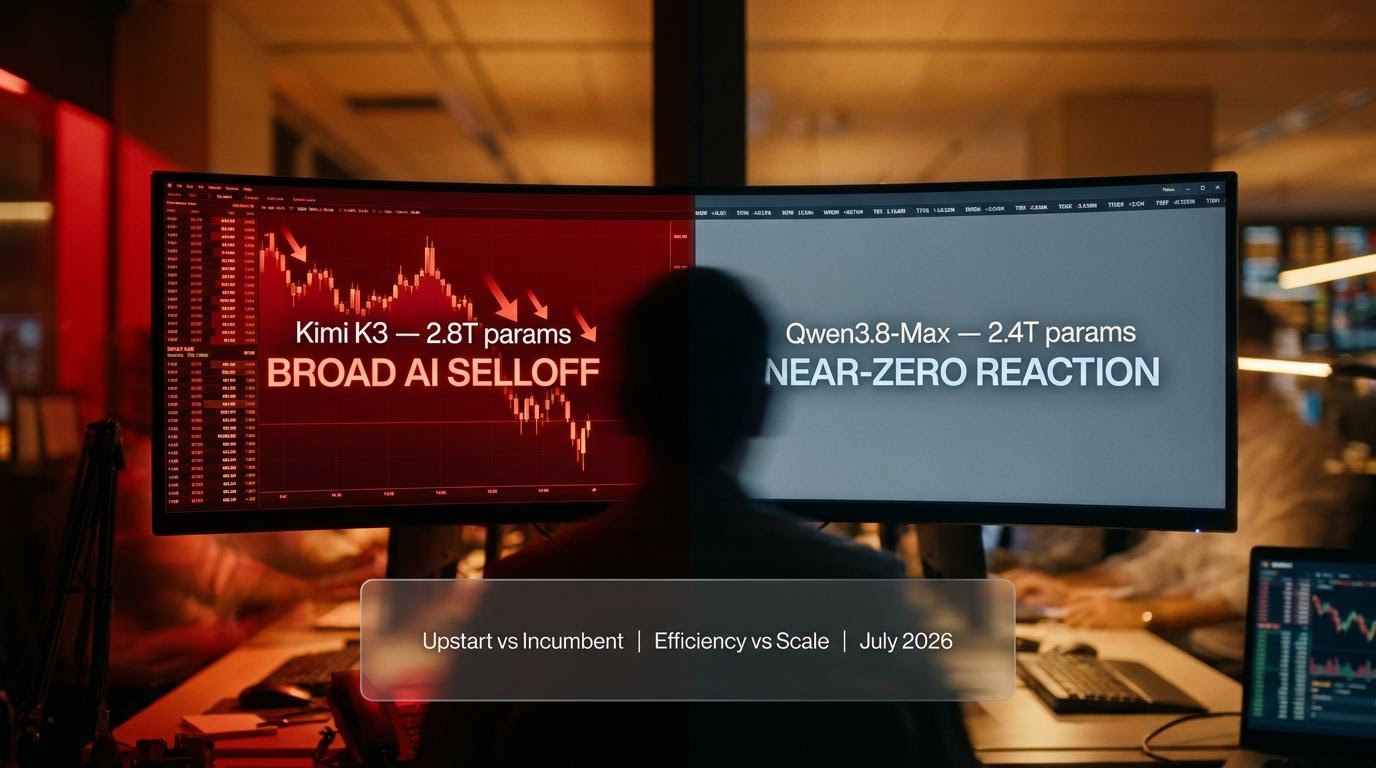
Two Chinese AI model releases landed within 72 hours of each other in July 2026. One wiped billions from AI-linked equities. The other generated almost no market reaction whatsoever.
The divergence was not primarily about which model was more capable. Alibaba’s Qwen3.8-Max carries 2.4 trillion parameters and benchmark claims that place it near the top of any current leaderboard. It moved nothing. Moonshot AI’s Kimi K3 arrived with a comparable parameter count and a narrative of efficiency, and it moved everything. The gap between those two outcomes is a lesson in how AI product news actually flows into equity risk.
The mechanics behind that divergence matter right now. Alphabet, Tesla, and Intel are all scheduled to report results this week, and each report will test the AI capital expenditure thesis directly. Here is the framework for reading the next AI model release before the market prices it for you, built from the clearest natural experiment the sector has produced this year.
The week two AI announcements landed on opposite sides of a market fault line
The timeline is tight enough to function as a controlled experiment. Kimi K3 launched on or around Friday 18 July 2026, a 2.8 trillion-parameter open-weight model with full weights scheduled for public release on 27 July. Its architecture leans on Kimi Delta Attention and increased Mixture of Experts (MoE) sparsity, a design approach that activates only a fraction of a model’s total parameters on any given task, reducing the compute required for each query. AI-linked equities sold off broadly in response.
Then came Qwen3.8-Max, announced between 19 and 21 July. Its 2.4 trillion parameters and Alibaba’s own benchmark claims, which characterised the model as ranking second only to Fable 5 (and, in separate reporting contexts, second only to Anthropic’s latest Claude model), made it a technical peer to Kimi K3 on paper. The market reaction was negligible.
Two models of comparable scale, released into the same news cycle, producing opposite outcomes. That divergence is the data point that demands explanation.
| Attribute | Kimi K3 | Qwen3.8-Max |
|---|---|---|
| Release date | ~18 July 2026 | 19-21 July 2026 |
| Parameter count | 2.8 trillion | 2.4 trillion |
| Architecture highlight | MoE sparsity, Kimi Delta Attention | Scale-focused, weights to be released |
| Benchmark positioning | Closing gap with frontier models including Fable 5 | Ranked second (per Alibaba’s claims) |
| Market reaction | Broad AI-linked equity selloff | Near-zero |
When big ASX news breaks, our subscribers know first
What made Kimi K3 the kind of announcement chip stocks fear
The AI-chip trade was already vulnerable before Kimi K3 arrived. AI-linked equities had run hard through the first half of 2026 on expectations of near-unlimited semiconductor demand, leaving the sector overowned and priced for a future where every hyperscaler keeps spending more, indefinitely. Reports of excess data-centre capacity and improving inference efficiency at major platforms had already introduced hairline cracks in that thesis. The positioning was crowded. The valuations were stretched. What the trade needed was a reason to sell.
AI capex concentration risk was already a live concern before the Kimi K3 release, with hyperscalers committed to $635-700 billion in FY2026 infrastructure spending and derivative markets underpricing the likelihood of an earnings-driven correction across technology conglomerates.
Kimi K3 supplied one. Four factors converged:
- Upstart identity. Moonshot AI is not a name most global investors track closely. Surprising capability from an unfamiliar entrant registers as new information about the competitive landscape, not confirmation of an existing expectation.
- Efficiency framing. The MoE sparsity architecture and Kimi Delta Attention were reported as enabling frontier-level performance with lower compute requirements, directly challenging the assumption that top-tier AI demands ever-growing chip orders.
- Crowded positioning. With semiconductor names heavily overowned, any narrative that questioned the demand trajectory hit leveraged positions that were primed to unwind.
- Open news window. Kimi K3 landed before the earnings calendar absorbed investor attention, giving the story room to dominate a news cycle without competing catalysts.
The efficiency narrative and why it hits semiconductors specifically
The chain is direct. Efficiency gains in model architecture reduce the compute required per query. Lower compute requirements reduce expected chip orders from hyperscalers. Lower expected orders reprice semiconductor stocks, which had been valued on the assumption that demand would keep compounding.
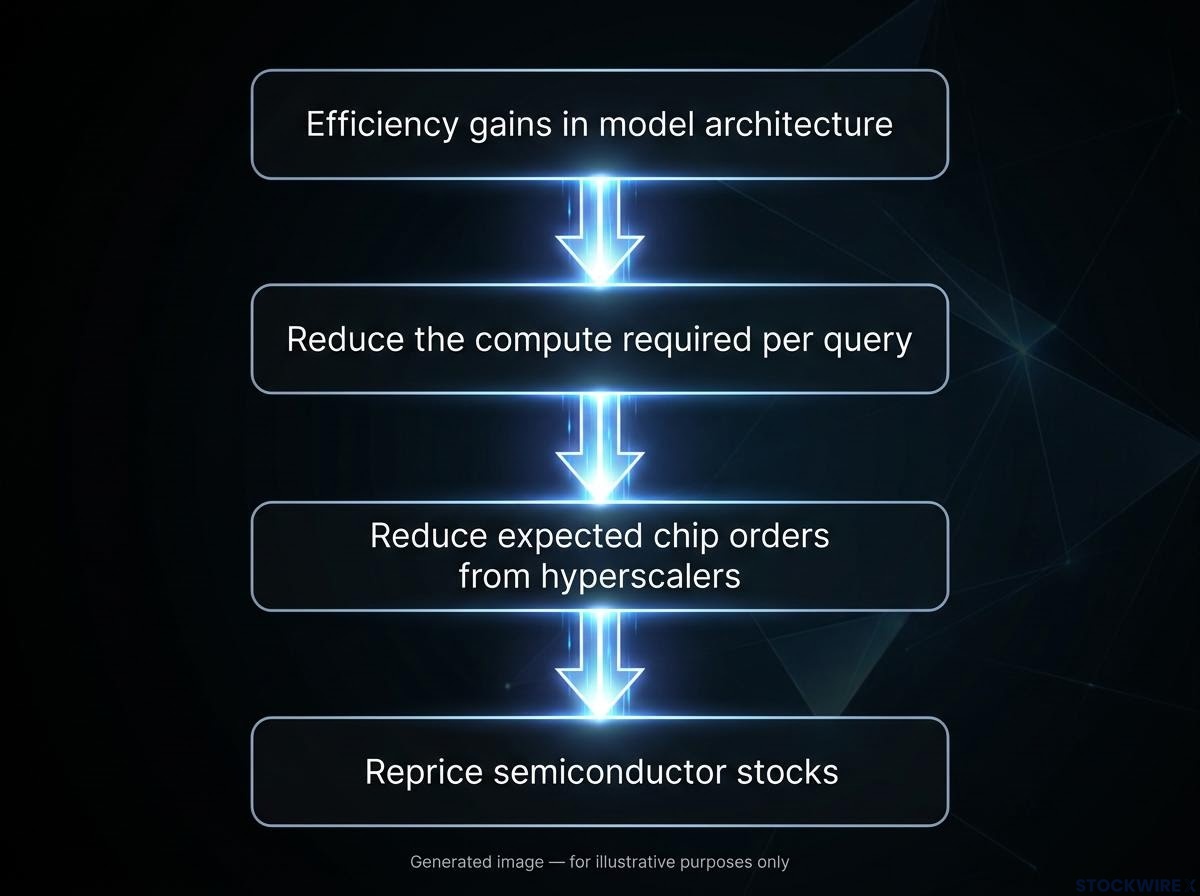
Similar dynamics had triggered comparable pullbacks earlier in 2026 when inference efficiency reports surfaced. What Kimi K3 did was attach a specific, high-profile product to that abstract concern. For anyone holding chip stocks, the question this raised was uncomfortable: if a relatively unknown Chinese lab can approach frontier performance with an efficiency-oriented architecture, how durable is the pricing power that justifies current semiconductor valuations?
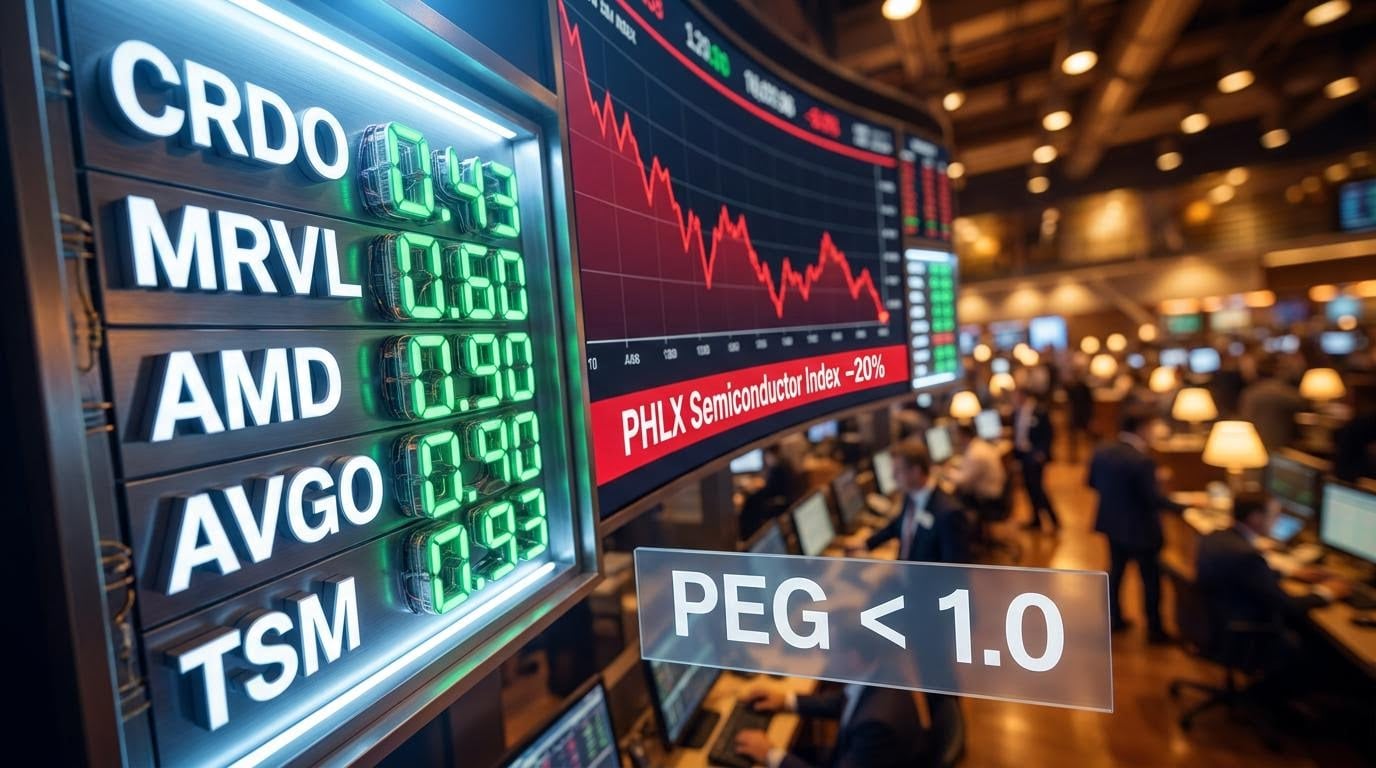
The Philadelphia Semiconductor Index entered a formal semiconductor bear market during the week of 17-20 July 2026, falling 21.6% from its June peak, confirming that the positioning vulnerability described here translated into a sustained repricing rather than a single-session overreaction.
Why Alibaba’s Qwen announcement barely registered
Qwen3.8-Max is, by any technical measure, an impressive model. But technical achievement and market impact are not synonyms. Four structural reasons explain why this announcement was absorbed without repricing:
- Incumbent identity. Markets already assume Alibaba will release progressively more capable models. Qwen3.8-Max confirmed that expectation rather than disrupting it. Confirmation of a priced-in trajectory does not force a revaluation.
- Scale, not efficiency. The defining marketing point, 2.4 trillion parameters, is a story of compute abundance, not compute reduction. A model that achieves performance through enormous parameter counts implicitly suggests heavy hardware requirements, which is directionally consistent with continued chip demand rather than a threat to it.
- Export control context. Investors already price in hardware constraints on Chinese firms under US export controls. A large new Chinese model does not force a revision to global chip demand expectations unless it demonstrates a clear efficiency workaround. Qwen3.8-Max, as presented, did not answer that question in a way that changed the consensus.
- Calendar saturation. The announcement landed as investor attention was rotating toward binary, near-term catalysts: earnings from Alphabet, Tesla, and Intel, all scheduled for the week of 20-24 July 2026. A model release that does not alter the infrastructure demand outlook is easily crowded out by anticipation of actual revenue and capex numbers.
The core principle is simple: narrative disruption, not raw capability, determines whether a model release becomes a market catalyst. An announcement that reinforces what investors already expect does not force a revaluation, regardless of the technical achievement it represents.
How to read an AI model release before the market does
The Kimi-Qwen contrast distils into a five-question triage framework. Run these in sequence when the next model release crosses the wire:
- Who is announcing? An upstart or unfamiliar entrant signals potential new information. An incumbent signals confirmation. New information reprices; confirmation does not.
- Is this an efficiency story or a scale story? Efficiency gains (same or better performance with fewer chips) are directionally bearish for AI infrastructure valuations. Scale stories (more parameters, more compute) tend to be neutral or supportive for chip demand.
- Does it plausibly revise capex or chip demand expectations? If the announcement hints at slower data-centre buildouts, excess capacity, or cheaper alternatives, expect selling in semiconductor names.
- What is the market’s current positioning? Overcrowded, leveraged AI trades are far more vulnerable to sharp reactions when a narrative shock appears. The same announcement in a less stretched market might register as a footnote.
- What else is on the calendar? A standalone release in a quiet week gets more attention. A release overshadowed by major earnings or macro events is more likely to be absorbed as noise.
Applied retrospectively, the framework’s predictive consistency is clear:
| Triage dimension | Kimi K3 | Qwen3.8-Max |
|---|---|---|
| Announcer identity | Upstart (new info) | Incumbent (confirmation) |
| Efficiency or scale | Efficiency-oriented | Scale-oriented |
| Capex revision potential | High | Low |
| Market positioning | Crowded, stretched | Crowded, but attention elsewhere |
| Calendar context | Open window | Saturated by earnings |
Kimi K3 checked every catalyst box. Qwen3.8-Max checked none. The framework does not guarantee prediction, but when multiple answers point the same direction, the signal sharpens considerably.
What efficiency-driven AI progress actually means for chip demand
The default assumption most investors carry is linear: more AI adoption means more compute, which means more chips, which means more data-centre capacity. For the past three years, that assumption has largely held. It is now becoming conditional.
The basic chain still operates. Model training and inference require compute. Compute requires chips. Chips require data-centre infrastructure. AI adoption has therefore been read as a straight-line driver of semiconductor demand.
Why open-weight models add a separate layer of demand uncertainty
The complication is architectural. Advances like MoE sparsity (which Kimi K3 employs), attention optimisations, and quantisation, a technique that compresses a model’s numerical precision to reduce the compute required to run it, can reduce the hardware needed for equivalent or better output. That breaks the linear assumption.
This does not automatically mean chip demand falls. The Jevons Paradox, which observes that efficiency improvements in resource use often expand total consumption rather than reduce it, applies here. Cheaper AI may unlock use cases that were previously uneconomical, expanding total compute consumption even as per-query costs decline. But efficiency does introduce genuine uncertainty about the rate of incremental hardware spending by hyperscalers, and that uncertainty is what reprices stocks.
Peer-reviewed research on the Jevons Paradox in AI systems confirms that efficiency improvements in model architecture have historically expanded total compute consumption rather than reduced it, as lower inference costs unlock previously uneconomical use cases and drive broader adoption.
Three factors determine whether an efficiency advance is bearish or expansionary for chip demand:
- Pace of adoption expansion. If cheaper inference opens new markets faster than efficiency compresses existing ones, total demand rises.
- Hyperscaler capex commitment timelines. Multi-year infrastructure contracts already locked in may insulate near-term demand regardless of efficiency gains.
- Openness of model weights. Both Kimi K3 and Qwen3.8-Max planned to release weights. Open-weight models allow any operator to run them without paying for API access, potentially distributing compute demand across smaller providers rather than concentrating it in hyperscaler infrastructure. This is a directional observation for medium-term chip demand, not a near-term trade signal.
The capex-to-revenue lag that Morningstar analyst Dennis Li identified as spanning 18-24 months means hyperscaler spending committed in 2025 and early 2026 will not appear as AI revenue until 2027 at the earliest, a timing mismatch that makes any efficiency narrative arriving before that revenue lands particularly damaging to crowded semiconductor positions.
What this means for you: chip stocks are not simply a play on AI adoption rates. They are a bet on a more specific question, whether AI efficiency improvements will expand the total addressable market or compress it. The Kimi K3 selloff happened because the market briefly concluded the answer might be “compress.”
Reading the AI earnings season with the Kimi-Qwen lens in view
The earnings calendar this week puts the AI-capex thesis under direct examination. Alphabet, Tesla, and Intel are all scheduled to report between 20 and 24 July 2026, and each report will carry specific data on whether AI infrastructure spending is producing returns at the scale the market has been pricing in.
The sentiment environment heading into these reports is not neutral. Kimi K3’s selloff has effectively set a bearish prior for AI-capex returns. That means the interpretive baseline is anxious, and any earnings guidance that reinforces optimism carries outsized positive surprise potential.
Three things to watch in AI-related earnings commentary this week:
- Capex guidance tone. Are hyperscalers maintaining, accelerating, or qualifying their AI infrastructure spend? Any language suggesting rationalisation would validate the efficiency anxiety.
- AI revenue contribution specifics. Concrete numbers on AI-driven revenue matter more than aspirational commentary. The market wants proof of return on investment, not restatements of ambition.
- Compute efficiency language. Any management commentary on inference cost improvements, infrastructure optimisation, or capacity utilisation feeds directly into the question Kimi K3 raised.
The Kimi K3 reaction has set a bearish prior heading into these earnings reports. If results show strong AI-driven revenue alongside maintained capex discipline, that selloff may look like a buying opportunity in retrospect. If guidance disappoints or capex plans are trimmed, the efficiency anxiety narrative gains further traction.
For investors wanting to calibrate how the Kimi K3 reaction fits within the broader valuation cycle, our full explainer on AI bull market risk signals covers Paul Tudor Jones’s dot-com parallel, Arm Holdings’ royalty miss, and the hyperscaler capex growth rate that analysts identify as the single most important indicator to monitor.
This article is for informational purposes only and should not be considered financial advice. Investors should conduct their own research and consult with financial professionals before making investment decisions. Past performance does not guarantee future results. Financial projections are subject to market conditions and various risk factors.
What the next AI model release will tell you, and what it will not
The Kimi-Qwen contrast established a distinction that will recur. Market impact follows narrative disruption of the infrastructure demand thesis, not technical achievement measured by benchmarks. Kimi K3 checked multiple catalyst boxes: upstart identity, efficiency framing, crowded positioning, and an open calendar. Qwen3.8-Max checked none, despite being a technically comparable model from one of the world’s largest technology companies.
The framework has limits. It is a triage filter, not a predictive model. Novel announcements can always confound established patterns, and the next release that reshapes AI markets may do so through a mechanism this contrast does not capture. But the diagnostic question at the centre of the framework will hold:
Does this announcement materially change the expected path of AI infrastructure demand or competitive returns?
If the answer is no, the release is a headline to note, not a position to trade around. If the answer is yes, the five-question triage tells you how urgently.
The pace of major AI model releases is accelerating. That means this interpretive skill will be exercised more frequently, not less. The goal is not to predict what any single model will do to markets, but to read the first paragraph of coverage and know, within two minutes, whether the news changes the demand story or simply confirms it.