Most Australians know they should be investing. Ask them to name the first thing they would actually do tomorrow to start, and the conversation stalls. The gap is not motivation. It is sequence.
In 2026, the barriers to entry are lower than they have ever been. ASX-listed ETFs let you build a diversified position from as little as $50, through platforms you can open on your phone in under ten minutes. The problem is not access. It is knowing which step comes first, which comes second, and what to skip entirely.
Here is the practical sequence, from financial foundation to your first ETF purchase to the ongoing habits that determine whether early decisions actually compound. If you have been meaning to start, this tells you exactly where you are in the process and what your next move is.
Get your financial foundation right before you invest a dollar
You might not be ready to invest yet. That is not a criticism. It is the most important thing this guide can tell you, because skipping this stage is the single most common reason new investors lock in losses they never needed to take.
Before you put money into any investment, three conditions should be in place:
- An emergency fund of roughly 3-6 months of living expenses, held in a high-interest savings account
- High-interest debt reduced, particularly credit card debt, which typically charges rates that no investment can reliably outpace
- Stable enough income that you will not be forced to sell investments at a bad time to cover bills
This is not a delay tactic. It is the move that protects every investment decision you make from being undone by a life event you did not plan for.
The most avoidable investment loss looks like this: you invest, the market drops 20%, and you need cash for an unexpected expense. You sell at the bottom because you have no buffer. The market recovers six months later, but your money is already gone. A patient investor with savings would have ridden it out and recovered the full amount.
The long-run Australian data on shares vs cash returns makes the cost of delay concrete: the Vanguard 2025 Index Chart shows $10,000 in Australian shares in 1995 grew to $143,786 by 2025, compared to $33,677 held in cash over the same period.
If you are carrying credit card debt or have no buffer savings, starting to invest now would expose you to a risk that has nothing to do with the market and everything to do with your own cash position. Fix this first.
When big ASX news breaks, our subscribers know first
What are you investing for, and when will you need the money?
Your goal and your timeline together determine which investments are appropriate, before any product enters the conversation. A reader saving for a home deposit in two years has a fundamentally different investment problem than a reader building a retirement fund over 25 years. Getting this distinction right now prevents the single most expensive mistake beginners make: putting money into the wrong type of investment for their actual need.
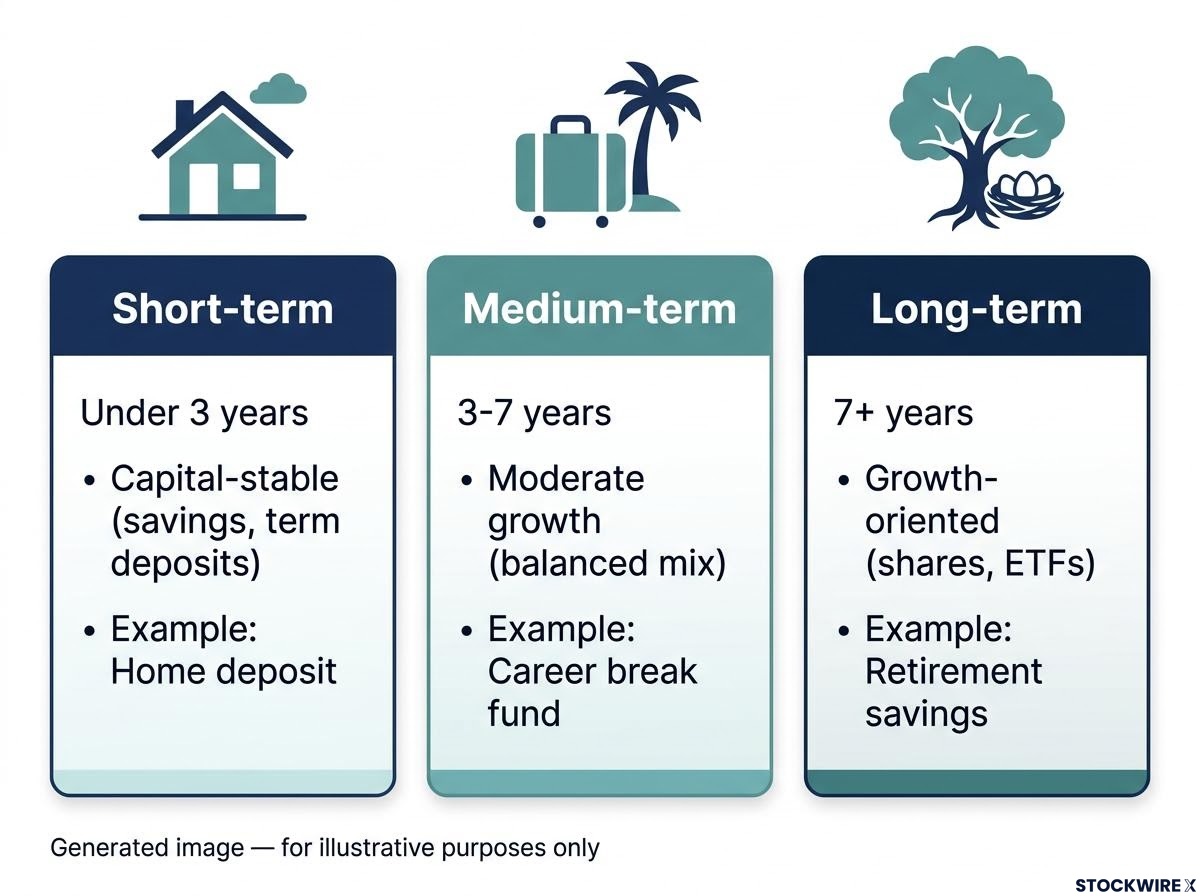
Three time-horizon buckets cover most situations:
| Time horizon | Duration | General approach | Example goal |
|---|---|---|---|
| Short-term | Under 3 years | Capital-stable (savings, term deposits) | Home deposit |
| Medium-term | 3-7 years | Moderate growth (balanced mix) | Career break fund |
| Long-term | 7+ years | Growth-oriented (shares, ETFs) | Retirement savings |
Write your goal down. It sounds simple, but written goals serve a second function: they give you a fixed reference point during periods of market volatility, when the temptation to abandon your plan is highest.
First Home Super Saver (FHSS) scheme: If your goal is a first home deposit, the FHSS scheme allows you to make voluntary superannuation contributions and later withdraw them, along with associated earnings, specifically toward a deposit. Eligibility criteria apply, so check the ATO’s current guidance before relying on this pathway.
Your time horizon is the single most important variable in deciding what to invest in. Determine it before you look at a single product.
Understanding risk tolerance: what it actually means and why it matters
Risk tolerance is not a personality quiz result. It is two separate questions, and most beginners only consider one of them.
The first is financial capacity: your practical ability to absorb losses given your income stability, existing debts, dependants, and how much buffer you have in savings. The second is psychological comfort: how you would actually respond to watching your portfolio fall significantly, not how you think you would respond while reading an article on a calm Monday morning.
Both dimensions matter because the consequences of getting this wrong are specific and measurable.
Selling during a market downturn converts a temporary decline into a permanent loss. The market may recover in full, but if you have already sold, that recovery happens without you.
Here is the honest version of the risk tolerance question: if your portfolio dropped 30% tomorrow and stayed down for 18 months, would you hold, or would you sell? Your answer to that, more than any other factor, determines which investments are right for you.
Risk tolerance is also not fixed. You should reassess it when your circumstances change materially:
- New employment or a significant income change
- Taking on dependants
- Purchasing property
- Approaching retirement
A mismatch between your investments and your actual risk tolerance is one of the most common causes of poor outcomes for new investors. Be honest with yourself at this stage. It costs nothing and prevents the most expensive behavioural mistake you can make.
Choosing the right account structure: super, brokerage, or both?
The account you use determines how your returns are taxed, when you can access your money, and which investments are available to you. These are not interchangeable decisions, and the right answer depends directly on the goal and timeline you defined earlier.
Inside superannuation
Superannuation is purpose-built for retirement. Investment earnings inside super are taxed at concessional rates, which supports compounding over decades. You can choose your fund’s investment option (conservative, balanced, or high growth) to match your risk tolerance.
The trade-off is access. Your money is generally locked away until you reach preservation age. If your goal requires access before retirement, super is not your primary vehicle.
Personal brokerage account
A personal brokerage account is the practical choice for goals that require flexibility: a home deposit, general wealth building, or any objective with a timeline shorter than retirement. You can buy ASX-listed shares and ETFs directly, and dividends and realised capital gains are taxed at your marginal tax rate.
One important tax feature: holdings you keep for more than 12 months generally qualify for the individual capital gains tax (CGT) discount, which reduces the taxable portion of your gain.
The 12-month CGT discount threshold is also relevant in the context of Australia’s capital gains tax changes taking effect from 1 July 2027, which replace the 50% discount with an inflation-indexation model and a 30% minimum rate floor, altering the after-tax return calculation for assets held across the transition date.
Using both at once
Most beginners end up using both structures simultaneously. Employer super contributions continue building your retirement balance in the background, while a personal brokerage account gives you direct access for medium-term goals. This is not an unusual arrangement; it is how the majority of Australian investors in 2026 are structured.
| Attribute | Superannuation | Brokerage account |
|---|---|---|
| Best suited goal | Retirement (long-term) | Pre-retirement goals (flexible) |
| Tax on earnings | Concessional rate | Marginal tax rate |
| Access to funds | Locked until preservation age | Accessible at any time |
| Flexibility | Limited to fund options | Full choice of ASX-listed securities |
For most readers investing for a goal other than retirement, or who want direct access to their investments, a personal brokerage account is the practical starting point.
What makes ETFs a strong fit for beginners investing on the ASX
If you have reached this stage, you know your goal, your timeline, your risk tolerance, and your account structure. The next question is: what do you actually buy? For most beginners, the answer is an exchange-traded fund, or ETF, a fund that holds a basket of investments and trades on the ASX like a single share.
Four features make ETFs well-suited to your situation:
- Instant diversification. A single ETF purchase gives you exposure across dozens or hundreds of companies, which reduces the risk of any one holding damaging your portfolio.
- Low fees. ETFs that passively track an index typically carry lower management expense ratios (MERs), the annual fee expressed as a percentage of your investment, than actively managed funds. Fee differences compound significantly over decades.
- Accessibility. ASX-listed ETFs can be purchased from $50-$200 through standard Australian platforms. There is no large minimum investment requirement.
- Transparency. You can see exactly what a given ETF holds at any time.
Three ETF types are most relevant to you as a beginner:
| ETF type | What it tracks or holds | Suited to | Main advantage |
|---|---|---|---|
| Broad Australian equity | An index such as the ASX 200 | Local market exposure | Simple, familiar companies |
| Broad global equity | International shares across markets | Diversification beyond Australia | Reduces single-country risk |
| Diversified multi-asset | Preset mix of shares and bonds | One-fund simplicity | Built-in asset allocation |
For a reader with a long time horizon and moderate to high risk tolerance, starting with one broad ASX 200 or global equity ETF and adding contributions consistently is a lower-complexity, lower-cost approach than picking individual shares. The long-run data on active versus passive fund performance supports that direction.
The structural difference between stocks vs ETFs goes beyond diversification: ETF in-kind creation and redemption mechanics give investors greater control over when taxable events occur, a feature that compounds in value the longer the holding period extends.
Before you buy any ETF, read its Product Disclosure Statement (PDS). This document tells you what the fund holds, what it costs, and what the risks are. Treat this as a non-negotiable pre-purchase step.
How to make your first investment: platform, account, and first trade
You know what you want to buy. Here is how to actually do it, in four steps you can complete this week.
- Choose an investing platform. Compare three things: brokerage fee per trade, ongoing account fees, and whether the platform is CHESS-sponsored or operates under a custodian model. CHESS sponsorship means your ownership of shares is registered directly with the ASX’s settlement system under your own name. A custodian model means the platform holds the shares on your behalf. Both are legitimate, but the distinction affects how your ownership is recorded. Common Australian platforms include CommSec, Stake, and SelfWealth, among others.
For readers wanting to compare platforms beyond the headline brokerage fee, our dedicated guide to brokerage platform costs covers how zero-fee and near-zero-fee Australian brokers generate revenue through cash interest retention, proprietary ETF fees, and FX margins, with a framework for calculating true total cost.
- Open and fund your account. Complete the online application, provide identification (driver’s licence or passport), and link your bank account. Transfer an initial amount you are comfortable seeing fluctuate in the short term. Even $50-$200 is a valid starting point. The objective is to begin the habit, not to deploy a large sum immediately.
- Place your first trade. Search for your chosen ETF by its ticker code on the platform. A market order buys at the prevailing price and is suitable if you intend to hold long term. A limit order lets you set a maximum price you are willing to pay. For a first purchase in a broad ETF you plan to hold for years, a market order is typically appropriate.
- Set up regular contributions.
Setting up regular contributions with dollar-cost averaging
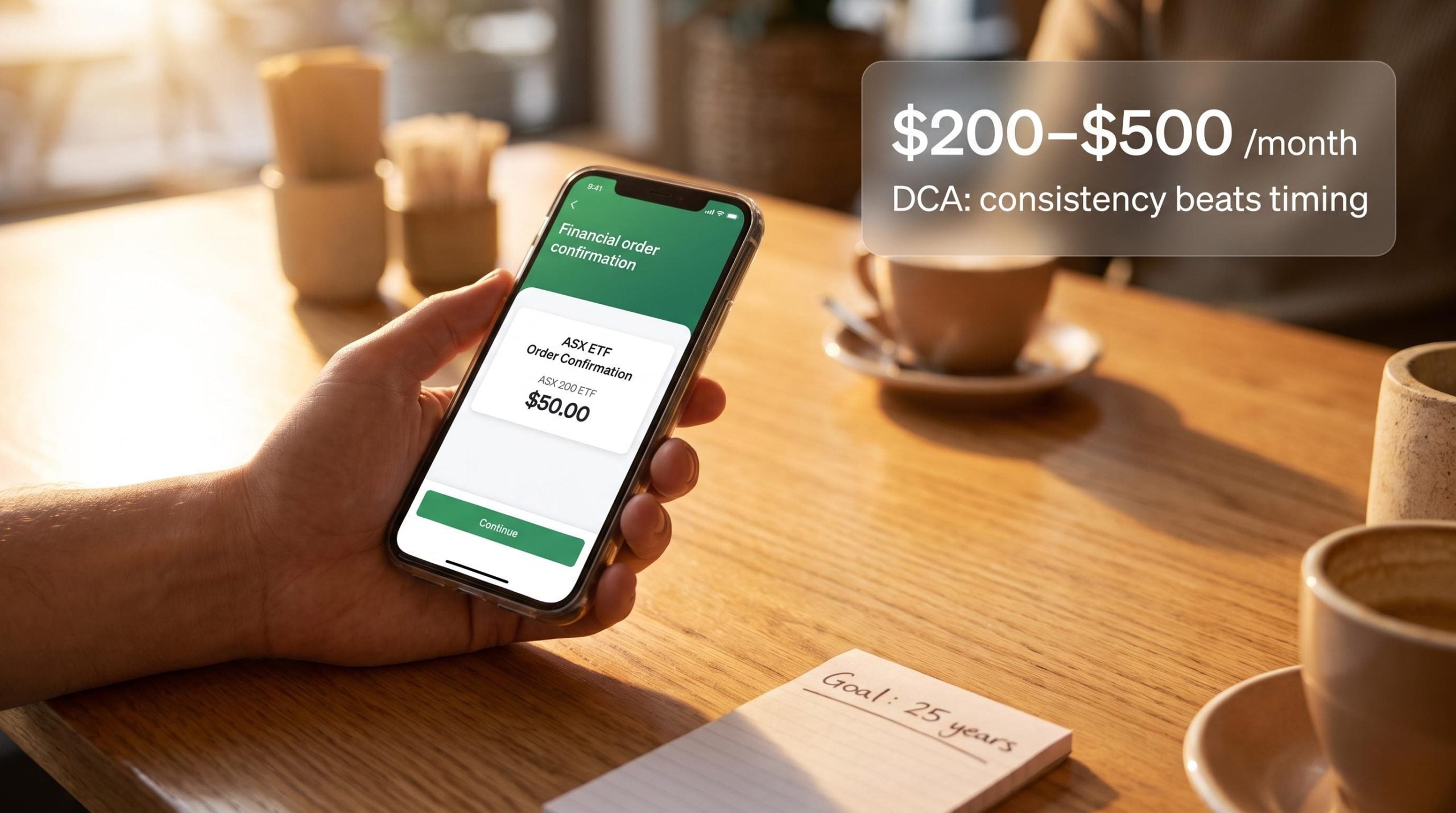
Dollar-cost averaging means investing a fixed dollar amount at regular intervals, regardless of what the market is doing. When prices are high, your fixed amount buys fewer units. When prices fall, it buys more. Over time, this smooths your average purchase price without requiring you to predict market direction.
A practical starting range is $200-$500 per month into the same ETF or ETFs. The dollar amount of your first investment matters far less than the act of making it. A $100 first purchase that leads to a consistent monthly contribution habit will compound into a more meaningful portfolio than a $5,000 lump sum invested once and never followed up.
Consistency beats timing. Attempting to identify the perfect entry point introduces timing risk that regular, automated contributions naturally reduce.
Once you have invested: keeping the habit without overcomplicating it
The first trade is done. What separates investors who build real wealth from those who abandon the process is what happens next, and it is simpler than most people expect.
Check your portfolio quarterly or semi-annually. That is enough. Daily monitoring does not improve outcomes. It increases the likelihood of emotion-driven decisions, selling after a drop or buying after a surge, that erode returns over time.
Three ongoing actions keep your investment plan on track:
- Reinvest your ETF distributions. When your ETF pays distributions (the equivalent of dividends), reinvesting them accelerates compounding. Most platforms offer a dividend reinvestment plan (DRP) that does this automatically. Unless you specifically need the cash income, turn it on.
- Keep tax records. Maintain records of all trades, distributions, and any DRP transactions. Your platform generates statements, but keeping your own backup is prudent. You will need this at tax time.
- Revisit your plan when life changes. Your investment strategy is not permanent. Reassess when significant events shift your circumstances.
Reassessment triggers include:
- New employment or a material income change
- Purchasing property
- Having children
- Approaching retirement
The investors who do best over the long run are rarely the ones checking prices most often. They are the ones who reviewed occasionally, reinvested their distributions, and stayed committed to their original plan even when markets moved against them.
Your next step depends on where you are in the sequence right now
The framework works because each stage prepares the conditions for the next one. Skipping stages creates the vulnerabilities this guide is designed to prevent. Here is the full sequence:
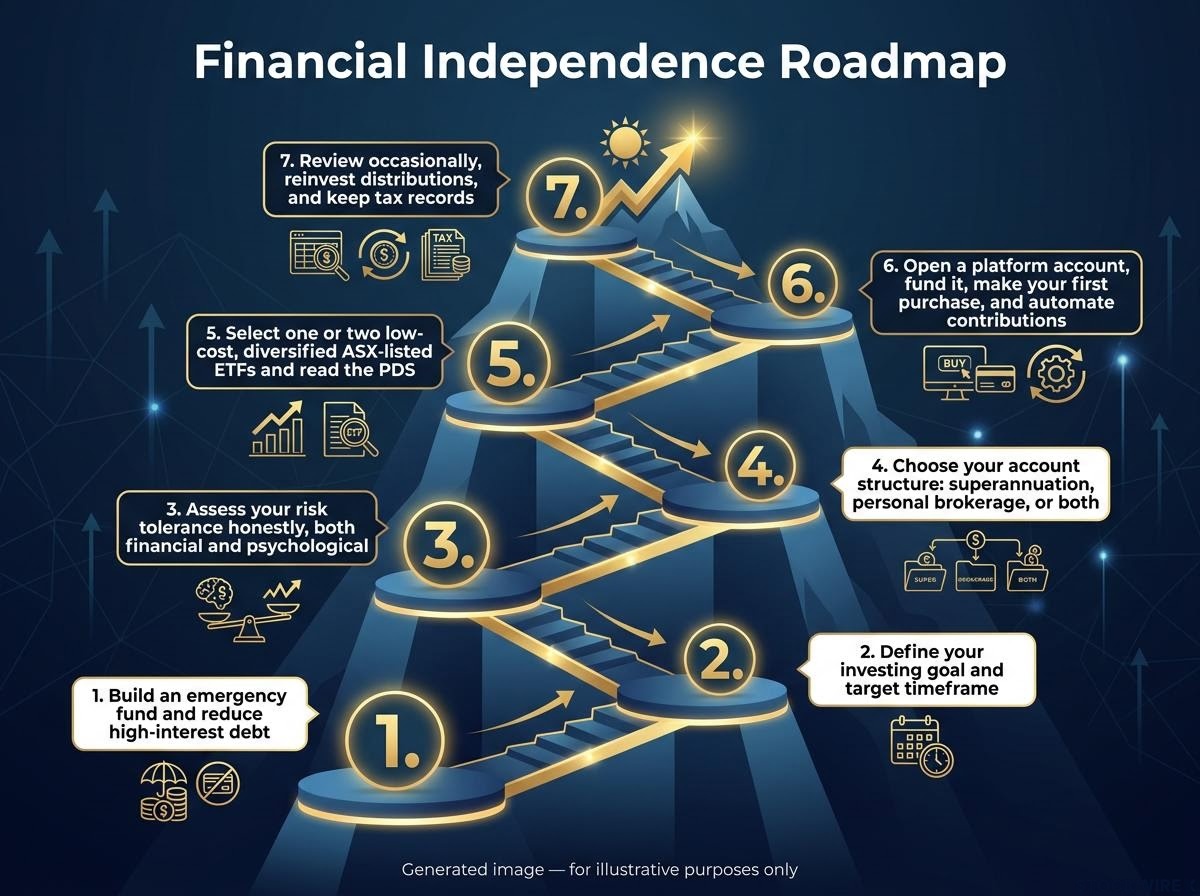
- Build an emergency fund and reduce high-interest debt
- Define your investing goal and target timeframe
- Assess your risk tolerance honestly, both financial and psychological
- Choose your account structure: superannuation, personal brokerage, or both
- Select one or two low-cost, diversified ASX-listed ETFs and read the PDS
- Open a platform account, fund it, make your first purchase, and automate contributions
- Review occasionally, reinvest distributions, and keep tax records
If you are not yet past stage one, your next step is the financial foundation. If you are ready to open a platform, compare brokerage fees and understand the CHESS versus custodian distinction. If you have already made your first purchase, the next step is automating your contributions and turning on distribution reinvestment.
This guide is general information only and does not take into account your individual objectives, financial situation, or needs. For complex circumstances or significant amounts, a licensed financial adviser is the appropriate resource for personalised guidance.