Most investors chasing AI exposure start and end with semiconductors. But the servers cannot be installed until someone builds the roads, lays the utilities, pours the concrete, and grades the land. Sterling Infrastructure is that someone.
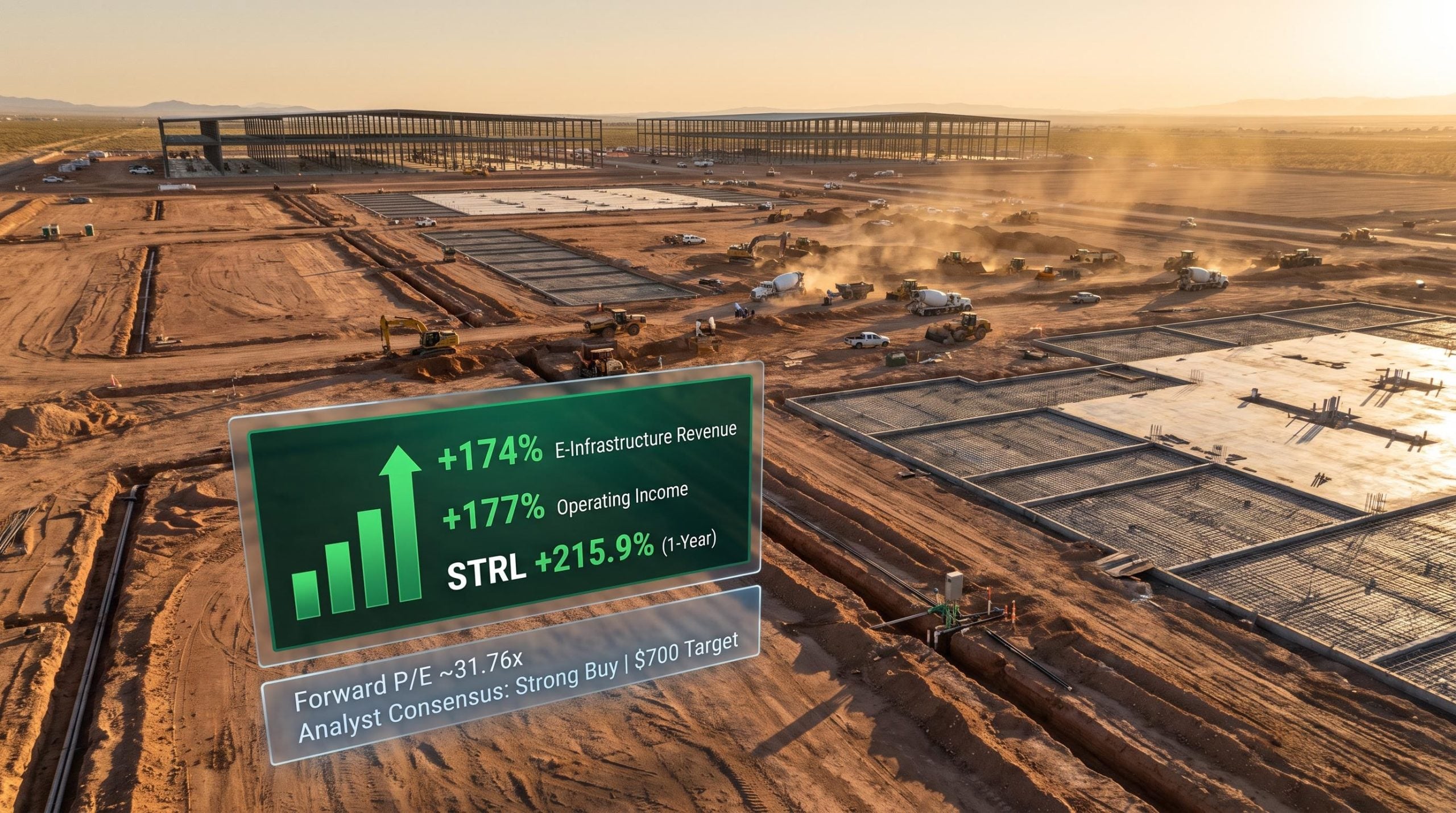
The AI buildout is frequently described as one of the most significant infrastructure expansion cycles in recent decades, yet the investment conversation remains fixated on chip companies and hyperscalers. Sterling Infrastructure (STRL), a civil engineering and site development company, has posted triple-digit earnings growth by sitting at the physical foundation of every major AI data centre campus being constructed in the United States. Its E-Infrastructure segment, which covers large-scale site development for data centres and mission-critical facilities, grew revenue 174% year over year in Q1 2026.
Here is the analytical groundwork for evaluating Sterling as an investment: what the company does, why its financial results are accelerating so dramatically, where the genuine valuation tensions lie, and what risks a potential buyer should weigh before acting. This is not a buy recommendation. It is the evidence and framework that make an informed decision possible.
Why AI’s most overlooked supply chain runs underground
Before a single rack of AI compute hardware can be powered on, someone has to build the site it sits on. Site preparation encompasses graded land, reinforced foundations, power delivery infrastructure, utility connections, and access roads, all of which must be in place as physical prerequisites well before any data centre becomes operational. Sterling Infrastructure captures this demand through one of its three business segments:
- E-Infrastructure Solutions: Large-scale site development for data centres, semiconductor manufacturing facilities, e-commerce distribution centres, and mission-critical projects. This is the segment directly exposed to AI infrastructure demand.
- Transportation Solutions: Construction and rehabilitation of highways, roads, bridges, airports, ports, rail, and storm drainage for government and transit authorities.
- Building Solutions: Concrete foundations and related structural work for residential and commercial buildings, including single-family and multi-family housing.
The E-Infrastructure segment is where the AI thesis lives. Analysts characterise Sterling as sitting “at the centre of several long-term infrastructure trends, including AI-driven data centres, semiconductor manufacturing and mission-critical construction.”
A bet on the buildout, not the winner
What makes Sterling structurally different from a chip company or a hyperscaler is that its revenue is driven by whether AI campuses are being constructed, not by which company’s chips or models dominate. Major cloud providers continue to expand their AI campus construction programmes across the United States and in international markets, generating a multi-year demand base that extends well beyond any single project pipeline. For investors who already hold semiconductor names, Sterling offers complementary exposure: a bet on the buildout itself continuing, regardless of which architecture wins.
Hyperscaler capex commitments reached $130 billion in Q1 2026 alone, with full-year 2026 combined guidance approaching $725 billion across Amazon, Microsoft, Alphabet, and Meta, a spending trajectory that flows directly into the site development contracts that constitute Sterling’s E-Infrastructure backlog.
When big ASX news breaks, our subscribers know first
The numbers behind the physical AI boom
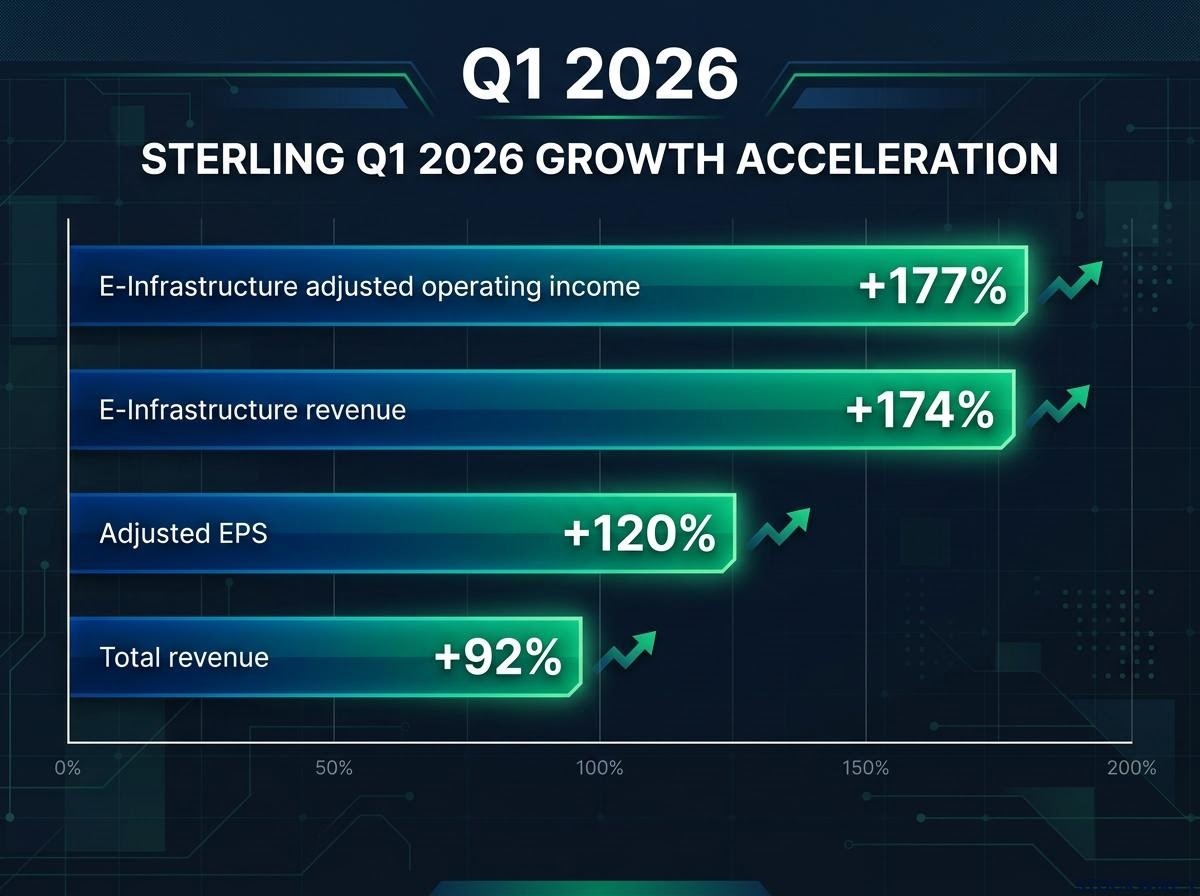
The financial acceleration at Sterling is not subtle. Q1 2026 delivered results that made the company’s earlier growth rates look modest by comparison, and the concentration of that growth in the E-Infrastructure segment confirms exactly where the demand is coming from.
| Metric | Q1 2026 figure | Year-over-year growth |
|---|---|---|
| Total revenue | Company-wide | +92% |
| E-Infrastructure revenue | Segment-level | +174% |
| E-Infrastructure adjusted operating income | Segment-level | +177% |
| Adjusted EPS | Company-wide | +120% |
E-Infrastructure revenue grew 174% year over year in Q1 2026, with adjusted operating income up 177%, driven by data centres and other mission-critical projects.
The margin profile is equally telling. Sterling’s operating and free cash flow margins sit in the mid-teens and are expanding, unusually strong for a civil construction business. That margin quality signals pricing power and project selection discipline, not just volume growth.
The stock has responded accordingly. Shares have surged approximately 215.9% over the past year, pushing the market capitalisation to roughly $19.9 billion at approximately $650 per share. When a civil construction company posts 174% segment revenue growth and 177% operating income growth in a single quarter, that is not a favourable comparison period or an accounting artefact. It signals genuine demand compression into the business, and what is driving it matters as much as the numbers themselves.
What the infrastructure buildout cycle history tells investors
Triple-digit quarterly growth invites a natural question: how long can this last? History offers some structural guidance.
Major infrastructure buildout cycles have historically sustained contractor demand for years, not quarters:
- The US interstate highway programme (1956-1970s): Civil engineering firms that won highway contracts benefited from over a decade of sustained federal spending, with demand peaking well after the programme’s launch.
- The telecom fibre buildout (late 1990s-early 2000s): Infrastructure contractors that laid fibre optic cable experienced several years of elevated demand before the cycle normalised.
- Data centre expansion (2010s-present): The first wave of hyperscale data centre construction created a multi-year demand cycle for site developers and civil contractors, with no definitive peak yet reached.
Analysts and industry observers characterise the current AI infrastructure expansion as belonging in this category: a structural cycle, not a one-off capex spike.
The current AI investment cycle has driven US IT hardware and software spending to a record 4.9% of GDP in Q1 2026, surpassing both the dot-com era peak and the cloud buildout peak, a structural scale that supports the multi-year duration argument for site development demand.
Backlog visibility as a multi-year signal
Construction backlog, the total value of contracted work not yet completed, functions as a leading indicator of revenue for the next 12-24 months. Sterling’s backlog reflects sustained data centre and mission-critical project commitments, providing revenue visibility that extends well beyond a single quarter.
If the current AI infrastructure cycle follows the duration pattern of prior major buildout cycles, the revenue and earnings trajectory investors are evaluating today may represent early-to-mid cycle rather than a peak. That distinction changes the risk calculus meaningfully for a long-duration position.
The valuation reality check every buyer needs
The business momentum is real. The question is whether the stock price already reflects it.
| Valuation metric | Sterling (STRL) | Industry average |
|---|---|---|
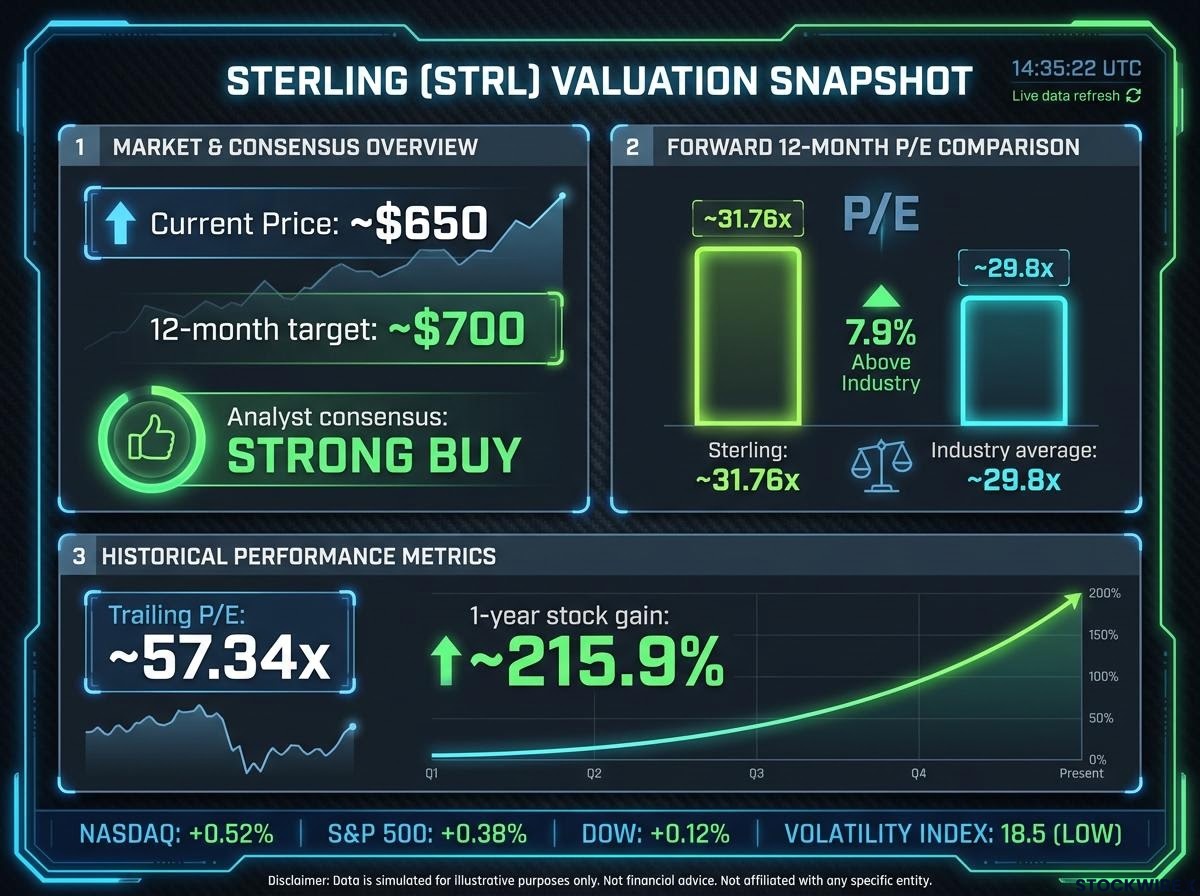
| Forward 12-month P/E | ~31.76x | ~29.8x |
| Trailing P/E | ~57.34x | Varies |
| 1-year stock gain | ~215.9% | N/A |
| Analyst consensus | Strong Buy | N/A |
| 12-month price target (consensus) | ~$700 | N/A |
The forward P/E of approximately 31.76x sits above the industry average of roughly 29.8x. That premium is modest in percentage terms, but it matters because construction companies rarely trade at these multiples. The trailing P/E of approximately 57.34x at current prices confirms the stock is priced for continued extraordinary growth, not historical earnings.
The analyst consensus remains Strong Buy with an approximately $700 12-month price target. At the same time, some valuation models, including Morningstar’s, indicate a very substantial premium to estimated intrinsic value, flagging the stock as expensive on a fundamental basis.
The gap between a Strong Buy consensus and a prominent valuation model’s intrinsic value concern is not a contradiction to dismiss. It tells you that the entire debate around Sterling is whether the growth rate justifies the multiple. Sterling’s valuation is elevated for a construction company, but its extraordinary earnings growth partially supports that premium. That debate is unresolved, and any honest analysis should leave it that way.
Five risks that could break the thesis
Growth stories invite conviction. Conviction without a risk register invites trouble. Here are the five specific mechanisms that could undermine the Sterling thesis:
- Multiple compression: Sterling’s forward P/E of approximately 32x is above the industry average, making it more vulnerable to a re-rating than a value-priced peer. If the growth rate decelerates even modestly from its current extraordinary pace, the premium valuation has little margin of safety to absorb the re-rating.
- Hyperscaler capex pullback: The E-Infrastructure segment now constitutes a large and growing share of total revenue. If major cloud providers delay, scale back, or cancel data centre campus construction, the revenue impact concentrates directly in Sterling’s highest-growth segment.
- Labour and materials cost inflation: Construction businesses are exposed to labour shortages and materials cost inflation, both of which can compress margins on fixed-price or lump-sum contracts. The margin expansion Sterling has delivered assumes continued pricing discipline; cost spikes could erode it.
- Execution risk at scale: Rapid growth in headcount, project complexity, and geographic scope creates operational risk. Managing a construction business through a scaling phase of this magnitude is not trivial, and project delays or cost overruns on large-scale data centre sites would hit results directly.
- Macro sensitivity: Interest rates, economic slowdowns, and permitting or regulatory delays all affect construction activity broadly. Sterling is not immune to cyclical forces even if its AI-specific demand remains strong.
The most immediate risk for a buyer entering at current prices is not business failure but multiple compression: the scenario where the business remains strong but the stock re-rates lower because the growth rate normalises.
What a position in Sterling actually means for your AI portfolio
Sterling is not a hidden gem. A stock that has surged approximately 215.9% in a year and carries a Strong Buy consensus with an approximately $700 price target is widely recognised. The more accurate framing is that it is less crowded than semiconductor names, but now firmly established as a data centre contractor.
The portfolio-level question is not whether Sterling’s business is strong. The Q1 2026 data confirms it is. The question is whether the current entry price appropriately reflects the risk that the growth rate eventually reverts toward the construction sector norm. That is a judgement only you can make based on your own time horizon and conviction.
Before taking a position, consider these factors:
- Valuation premium: You are paying above-industry multiples for a construction company, justified only if triple-digit growth persists.
- Portfolio concentration: If you already hold semiconductor or hyperscaler names, Sterling adds exposure to the same AI capex theme through a different mechanism. Understand the correlation.
- Time horizon: The multi-year buildout thesis requires patience. A short-term entry at elevated multiples carries different risk than a long-duration position.
- Existing AI exposure: Sterling complements, rather than replaces, chip and hyperscaler holdings. Size the position accordingly.
Broad US equity exposure has increasingly converged on the AI capex theme, with S&P 500 earnings growth forecasts disproportionately reliant on a small number of AI-exposed firms, which means adding Sterling to a portfolio that already holds semiconductor and hyperscaler names may increase concentration rather than diversify it.
This article is for informational purposes only and should not be considered financial advice. Investors should conduct their own research and consult with financial professionals before making investment decisions.
Sterling’s trajectory beyond the current AI cycle
The core tension running through Sterling’s investment case is straightforward: exceptional business momentum, an elevated valuation, and a thesis that depends on the AI buildout continuing at pace for multiple years. All three of those things are true simultaneously, and the honest analytical position is to hold them in productive tension rather than resolve them artificially.
Two factors provide some structural ballast. Sterling’s Transportation and Building Solutions segments generate revenue that is not tied to AI capex, offering partial buffer if data centre construction moderates. And the multi-year AI infrastructure buildout thesis is supported by cloud providers continuing to expand domestically and internationally, suggesting the demand wave has duration.
Industrial sector tailwinds including infrastructure investment and reshoring-driven capex operate independently of the AI cycle, providing a useful lens for evaluating whether Sterling’s Transportation and Building Solutions segments offer genuine ballast or simply lag the same macro forces driving E-Infrastructure demand.
To monitor this thesis going forward, watch three indicators:
- E-Infrastructure backlog growth: Sustained or accelerating backlog confirms the demand pipeline remains intact.
- Operating margin trajectory: Margin expansion signals pricing power; compression signals cost pressure or competitive erosion.
- Hyperscaler capex signals: Any indication from major cloud providers that AI data centre construction is slowing, pausing, or being re-phased changes the revenue outlook directly.
Investors who understand both the structural strength of the AI buildout thesis and the valuation risk already priced in are better positioned to hold through volatility than those who bought the momentum without examining the underlying mechanics.
Past performance does not guarantee future results. Financial projections are subject to market conditions and various risk factors.
—