
You have a stock you want to own, you know the price you would happily pay, and the market is not there yet. So what do you do with the cash you have set aside while you wait?
Most investors let that reserved capital sit in a money market account or a short-term Treasury, earning a modest yield and not much else. Cash-secured puts offer an alternative: you generate income on that same reserved capital while simultaneously creating an obligation to buy the stock at your chosen price. It is a structural alignment between patience and income, not a speculative overlay.
Here is a complete picture of how the strategy works, what you stand to gain in both outcomes, and where the real risks live, so you can assess whether it belongs in your approach before you consider placing a trade.
Getting paid to post a limit buy order
Think of a cash-secured put as a formal agreement to purchase a stock at a price you have already decided is attractive, where the other party compensates you for making that commitment and holding it open until a set date. That framing is not a simplification. It captures the economic reality of the trade.
When you sell a cash-secured put, you are giving the buyer the right to sell you 100 shares at the strike price before or at expiration. In return, you collect the premium upfront. The “cash-secured” part means you must set aside the full cost of those shares (strike price multiplied by 100) in cash or cash equivalents as collateral for the potential purchase.
Before you go further, you need to understand three variables:
- Strike price: The price at which you agree to buy the stock if the option is exercised.
- Premium: The income you collect upfront for taking on the obligation, quoted per share.
- Expiration date: The deadline by which the buyer must exercise their right or let it expire.
This strategy is structurally designed for investors who already have a conviction price in mind. If you are casting around for yield without an underlying ownership view, the risk profile that follows will not work in your favour.
When big ASX news breaks, our subscribers know first
What actually happens at expiration: the two outcomes
Every cash-secured put resolves in one of two ways. Understanding both removes the “what if” anxiety that keeps many investors from using options at all.
- Stock stays above the strike price. The put expires worthless because the buyer has no reason to sell you shares below the market price. You keep the full premium, your reserved cash is released, and you have no further obligation. You were paid to wait, and you can repeat the process if you choose.
- Stock falls below the strike price. The option is exercised (or assigned), and you purchase 100 shares at the strike price. Your effective cost basis, however, is lower than the strike because you already collected the premium. Using a $350 strike with a $4.00 premium per share as an illustration, your actual cost per share works out to $346, since the premium received offsets the purchase price.
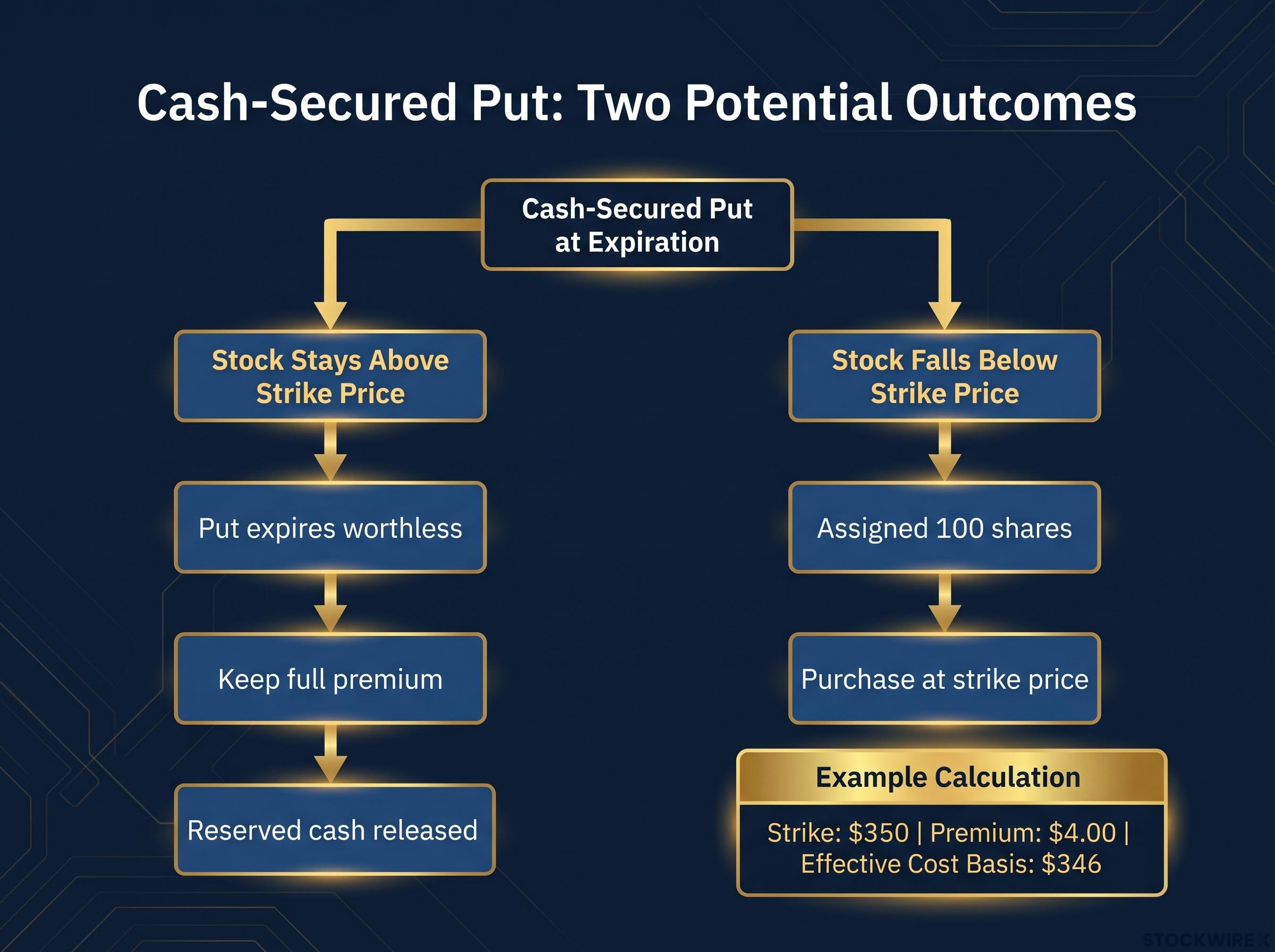
In both outcomes, the premium is yours to keep. That is the consistent income element regardless of which scenario plays out.
Effective cost basis = Strike price minus premium collected per share.
The key insight here is that neither outcome is “bad” if the stock is one you genuinely want to own at the strike price. The real risk only materialises when the strike price was never a level the investor had genuine conviction about in the first place, making it a failure of stock selection rather than a flaw in the strategy itself. Note that for U.S. tax purposes, the holding period for assigned shares begins on the date of assignment, not the date the put was sold.
Understanding the risks before you sell
The most underappreciated risk is also the most straightforward: if the stock collapses well below the strike, your loss profile is nearly identical to having simply bought the stock at the strike price on day one. The premium you collected provides only a small buffer. A cash-secured put does not reduce fundamental downside risk versus outright ownership. It adjusts the entry timing and adds an income layer, but it does not change the underlying equity exposure.
A cash-secured put’s downside risk mirrors outright stock ownership because assignment obligates you to take delivery at the strike price regardless of how far the stock has fallen — this equivalence is what separates the strategy from short-side instruments like naked puts or short selling, where loss potential is unbounded.
That equivalence is not a technicality. It is the single most important thing to internalise before you sell your first put.
Beyond that primary downside, four secondary risks shape the strategy’s full profile:
- Upside cap: If the stock rallies strongly above the strike before expiration, you do not participate in those gains. You keep only the premium.
- Capital tie-up: Your reserved cash is held as collateral and cannot be deployed elsewhere until the position closes or expires.
- Early assignment: American-style equity options can be exercised before expiration. The probability is low, but it rises around dividend dates when the exercise calculus shifts for the buyer.
- Implied volatility and premium quality: Higher premiums on high-volatility names reflect higher underlying risk, not free income. Chasing the largest premium without regard for the company’s fundamentals is a misuse of the strategy.
Secondary considerations before placing the trade
Position sizing matters here exactly as it does with any equity holding. Concentrating a large share of your portfolio in a single cash-secured put on one stock increases idiosyncratic risk in the same way a concentrated stock position would. Diversification across multiple names applies.
Position sizing in a cash-secured put program follows the same logic as any equity holding: concentrating too large a share of reserved capital in one name amplifies idiosyncratic risk in exactly the way a concentrated stock position would, and beta-weighted frameworks can help calibrate how much total market exposure each put commitment adds to a portfolio.
You will also need options trading approval from your broker before you can sell puts. The specific approval level depends on your broker and account type, and the distinction between a true cash-secured put (fully collateralised with cash) and a margin-backed put affects both your risk exposure and your approval requirements.
U.S. tax treatment of option premium income is generally short-term capital gains, though individual circumstances vary. Consulting a qualified tax professional before implementing the strategy is advisable.
This article is for informational purposes only and should not be considered financial advice. Investors should conduct their own research and consult with financial professionals before making investment decisions.
How the return math works, using a real Microsoft example
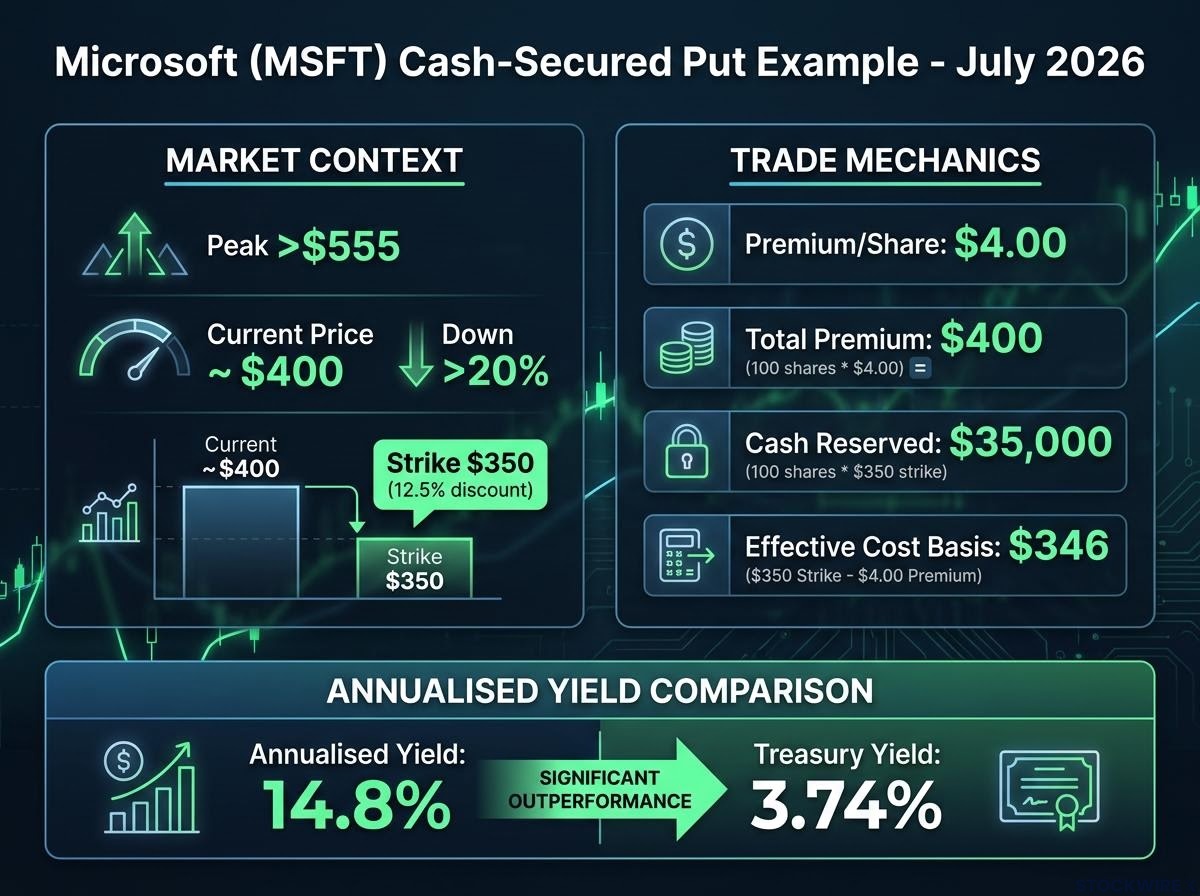
The numbers are where the strategy moves from concept to conviction. Here is a worked example using a real Microsoft (MSFT) contract, based on market conditions disclosed in July 2026.
| Contract Variable | Detail | Calculation | Result |
|---|---|---|---|
| Strike price | $350 | $350 × 100 shares | $35,000 reserved cash |
| Premium per share | $4.00 | $4.00 × 100 shares | $400 total premium collected |
| Effective cost basis if assigned | $350 − $4.00 | $346 per share | |
| Annualised yield | ($400 ÷ $35,000) × (365 ÷ days to expiration) | Simple annualisation | Approximately 14.8% |
Annualised Return = (Premium ÷ Cash Reserved) × (365 ÷ Days to Expiration). This is a simple annualisation. It does not compound or guarantee repeated deployment at the same yield.
The Microsoft trade illustrated here sits within a coherent analytical context. At the time of the analysis, MSFT had shed more than 20% of its value over the preceding twelve months, declining from a peak above $555 to around $400. The $350 strike therefore represented a further reduction of roughly 12.5% below the prevailing price, offering an entry point into a business whose core operations remained strong even as investors questioned the pace of returns on substantial AI infrastructure investment. Against a Treasury yield of approximately 3.74% available to the analyst at the time, the 14.8% annualised premium represents a meaningful step up in income, though that step up is not without cost. It is compensation for accepting equity risk in place of a risk-free return, and that distinction must be understood clearly before the trade is placed.
The annualised figure also varies with the number of days remaining; research sources note a figure of approximately 17%+ depending on the exact days-to-expiration input.
Past performance does not guarantee future results. Financial projections are subject to market conditions and various risk factors.
Selecting the right stock and strike: where the strategy succeeds or fails
Every cash-secured put ultimately depends on one prior judgement: whether you have done the work on the underlying company and arrived at a price you would genuinely welcome as an entry point. That judgement has to be grounded in analysis, not merely in a desire to earn premium.
The distinction matters more than it sounds. There is a meaningful difference between a strike price that reflects a well-researched view of fair value and one that simply feels acceptable in the moment. When those two positions are conflated, assignment tends to produce regret rather than satisfaction, and that regret is the most common failure mode for investors new to selling puts.
Four criteria should guide your strike selection:
- Genuine ownership conviction: You would be comfortable holding the stock for years at this price, not just accepting it reluctantly.
- Fundamentally sound underlying business: The company’s long-term trajectory supports your conviction, not just a recent price decline.
- Attractive entry, not arbitrary discount: The strike price represents a genuinely compelling entry point, not simply “lower than today.”
- Time horizon alignment: The expiration you choose matches your investment timeline and your willingness to have capital tied up as collateral.
The Microsoft example illustrates the positive case: a 20%+ decline from its high, strong underlying fundamentals, and a clear business rationale for why $350 would represent an attractive long-term entry. The strategy is designed for value-oriented or patient investors building positions in quality companies, not for generating income on stocks with deteriorating fundamentals.
Implied volatility also plays a role in stock selection. Higher premiums on high-volatility names are not evidence of better opportunity. They reflect the market’s assessment of higher risk in the underlying. Let the premium follow the conviction, not the other way around.
Rolling and closing the position early
You can close a cash-secured put before expiration by buying it back at a lower price (if the stock has risen), locking in a partial gain and releasing your reserved capital. This is active position management, not an emergency exit.
Rolling takes it a step further: you buy back the existing put and simultaneously sell a new one at a later expiration, a different strike, or both, extending or adjusting the position. Both actions are standard tools available on all major brokerages that offer options trading. Time decay (theta, the rate at which an option loses value as expiration approaches) accelerates in the final weeks before expiration, which is why some practitioners prefer rolling shorter-duration contracts rather than selling long-dated options.
Time decay (theta decay) accelerates in the final weeks before expiration, which is why practitioners who manage multiple options positions often prefer shorter-duration contracts rolled sequentially rather than single long-dated positions held to maturity.
Making the strategy work for your portfolio
The investor profile this strategy serves is specific: patient, value-oriented, with a stock you want to own at a price you have already identified. If you are looking for a yield product disconnected from underlying ownership intent, this is not the right tool.
Here is the decision sequence you should work through before placing a trade:
- Identify the stock. Choose a company you have researched and would be comfortable owning at a lower price.
- Determine your conviction price. Set the price at which you would be genuinely pleased to become a shareholder, not just willing.
- Check the available premium at that strike. Look at the premium being offered for puts at or near your conviction price.
- Calculate the annualised yield. Use the formula: (Premium ÷ Cash Reserved) × (365 ÷ Days to Expiration).
- Assess risk versus reward. Compare the annualised yield to your alternatives (Treasuries, money market) and weigh whether the income compensates adequately for the equity risk you are taking on.
The Microsoft case study follows this sequence cleanly: a 20%+ decline in a fundamentally strong company, $350 as a conviction price, 14.8% annualised yield assessed against a 3.74% Treasury alternative. The premium justified the equity exposure because the ownership conviction was there first.
Your first practical step is obtaining options trading approval from your broker. The account type and approval level determine whether your put is truly cash-secured versus margin-backed, and the distinction affects your risk. Many brokerages also offer paper trading features that let you practise the mechanics before committing real capital.
When patience and income converge: positioning cash-secured puts in a broader strategy
Cash-secured puts are a tool for a specific investor situation: cash on the sidelines, a conviction price identified, and a willingness to own. They are not a universal income strategy applicable to every portfolio in every market environment.
The strategy works best when implied volatility is moderate to high, because premiums need to compensate meaningfully for the equity risk you are taking on. In very low-volatility environments, the yield advantage over Treasuries may narrow to the point where the additional risk is not worth the incremental income. The comparison between a 3.74% Treasury yield and a 14.8% annualised options yield is most compelling when premium levels are elevated relative to risk-free rates, and you should periodically reassess whether the premium available still justifies the exposure.
Investors who prefer a packaged, income-oriented options exposure rather than managing individual puts can access covered call ETFs, though the structural differences between FLEX options funds and equity-linked note funds produce meaningfully different after-tax outcomes that are not visible from headline yield alone.
The real discipline in this approach, though, lies in the groundwork completed before the trade is ever placed. How carefully you have evaluated the underlying business and how honestly you have set your target price will drive your results far more than any decision made at the point of execution.
Sound risk management in a cash-secured put is largely complete before the order is entered: it lives in the rigour of your company research and the honesty of your target price, not in the mechanics of the option itself.
For investors who have identified a quality company and are waiting for a better entry, cash-secured puts transform idle cash into active yield without abandoning the patience the strategy requires. The attractiveness of this approach is dynamic, not permanent, and the same disciplined assessment of risk versus yield should be reapplied each time a new put is considered. Use the tool selectively, and it works for you. Use it reflexively, and it works against you.
These statements are speculative and subject to change based on market developments and company performance.