In six weeks, some South Korean retail investors lost more than 80% of their capital. They bought single-stock leveraged ETFs the same way they would buy a favourite stock, held them through a downturn, and watched daily rebalancing compound their losses at a pace most never anticipated.
The timing could not have been worse. An AI and semiconductor boom had propelled the KOSPI to rank among the top-performing major indices globally by June 2026, with Samsung Electronics and SK Hynix at the centre of that surge. The debut of single-stock leveraged ETFs arrived at the exact peak of that enthusiasm. The finance minister’s subsequent apology before parliament and the emergency regulatory sessions convened in the aftermath signal consequences that could reshape how these products are distributed across Asia-Pacific.
Here is what the mechanics of these instruments actually did once the market turned, why the losses were mathematically inevitable rather than accidental, and what the regulatory response signals for leveraged product oversight worldwide. If you hold any exposure to AI-sector equities through structured instruments, or you are tracking semiconductor volatility, this is the case study that matters most right now.
How a record rally created the perfect conditions for a retail trap
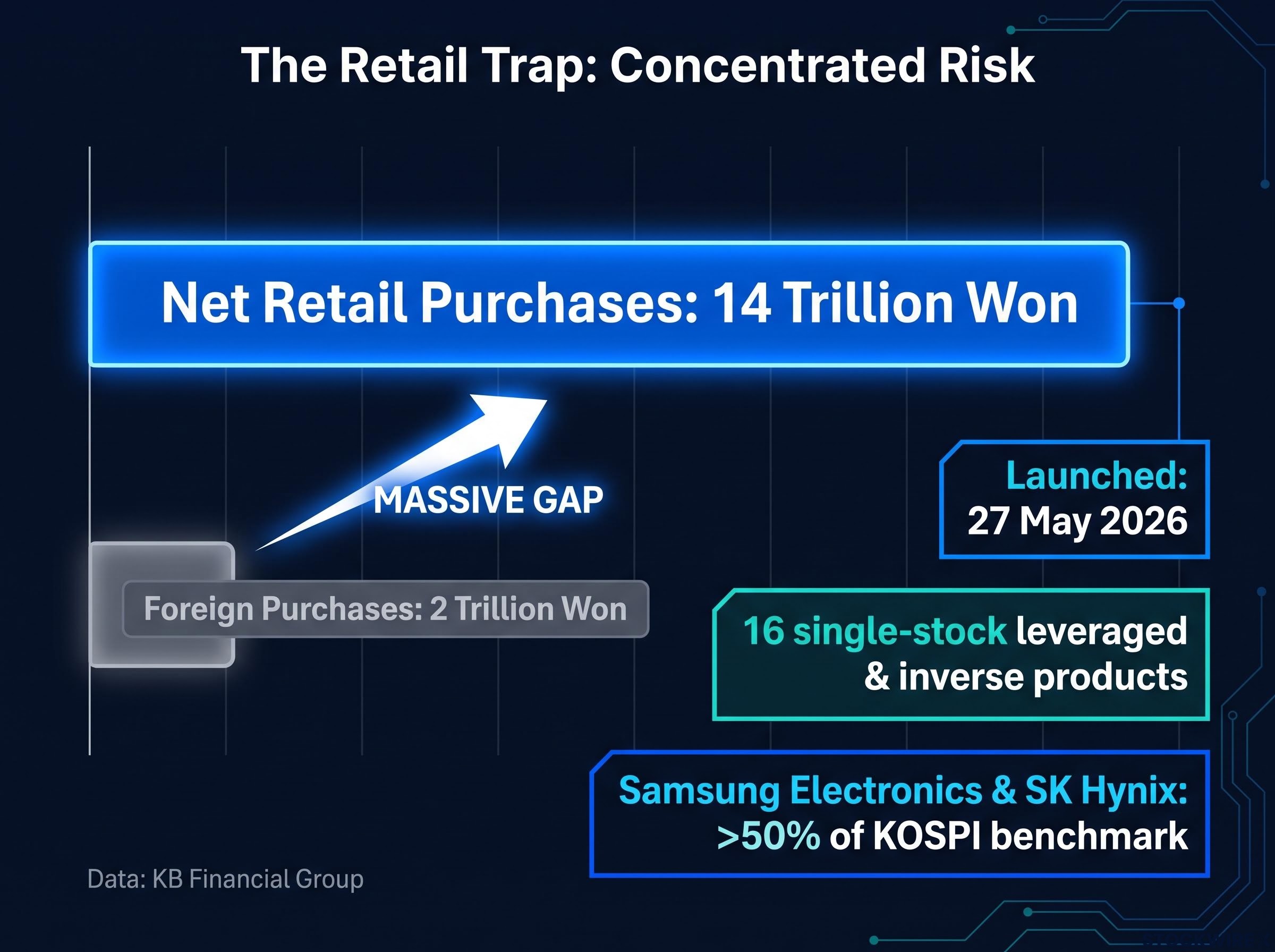
Samsung Electronics and SK Hynix together accounted for more than 50% of the KOSPI benchmark heading into mid-2026. That is an unusual market structure: AI-chip sentiment did not just influence the Korean index, it dominated it.
Retail investors, the so-called “ants,” had been amplifying exposure to chip stocks through margin and derivatives for months. This was not irrational behaviour in isolation; it was a continuation of an established pattern in Korean equity markets, where retail participation is culturally and structurally higher than in most developed markets. The AI-semiconductor rally gave that pattern its most compelling narrative yet.
Then, around 27 May 2026, 16 single-stock leveraged and inverse products tied to Samsung and SK Hynix listed on the main exchange. According to KB Financial Group, net retail purchases reached approximately 14 trillion won, versus roughly 2 trillion won from foreign investors.
Four structural conditions converged to set the trap:
- Market concentration: Two stocks representing more than half the benchmark
- Retail leverage culture: Margin and derivative amplification already embedded in investor behaviour
- AI-cycle timing: Products launched at the peak of a multi-quarter semiconductor rally
- Product launch timing: New instruments arriving precisely when enthusiasm was at its maximum
That 7:1 ratio of retail to foreign buying tells you that sophisticated institutional capital was not leading this trade. The risk was overwhelmingly concentrated in the hands of investors least equipped to manage the instrument they had purchased.
When big ASX news breaks, our subscribers know first
The mechanics that turned a dip into a disaster
The core feature that explains everything is this: these products are designed to deliver 2x the move recorded by the underlying stock on any given day, not 2x the return accumulated across weeks or months of holding. That single design characteristic is the direct source of the losses that followed.
When a leveraged ETF resets its exposure every day, it creates a compounding effect in volatile markets known as volatility decay (sometimes called negative compounding or beta slippage). In practical terms, when prices swing up and down repeatedly, a leveraged product loses ground faster than a simple “double the stock’s total move” calculation suggests. A 2x leveraged ETF can fail to recover its starting value even if the underlying stock returns to its prior level, because each day’s losses and gains compound against a shifting base.
Volatility drag operates silently on every leveraged ETF position: because percentage losses require proportionally larger gains to recover on a daily-resetting capital base, a product can bleed value even when the underlying stock finishes the week roughly where it started.
These products did not malfunction. They behaved exactly as specified. That makes the losses more instructive, not less, because the mechanism is built into every leveraged ETF globally.
What the numbers actually showed
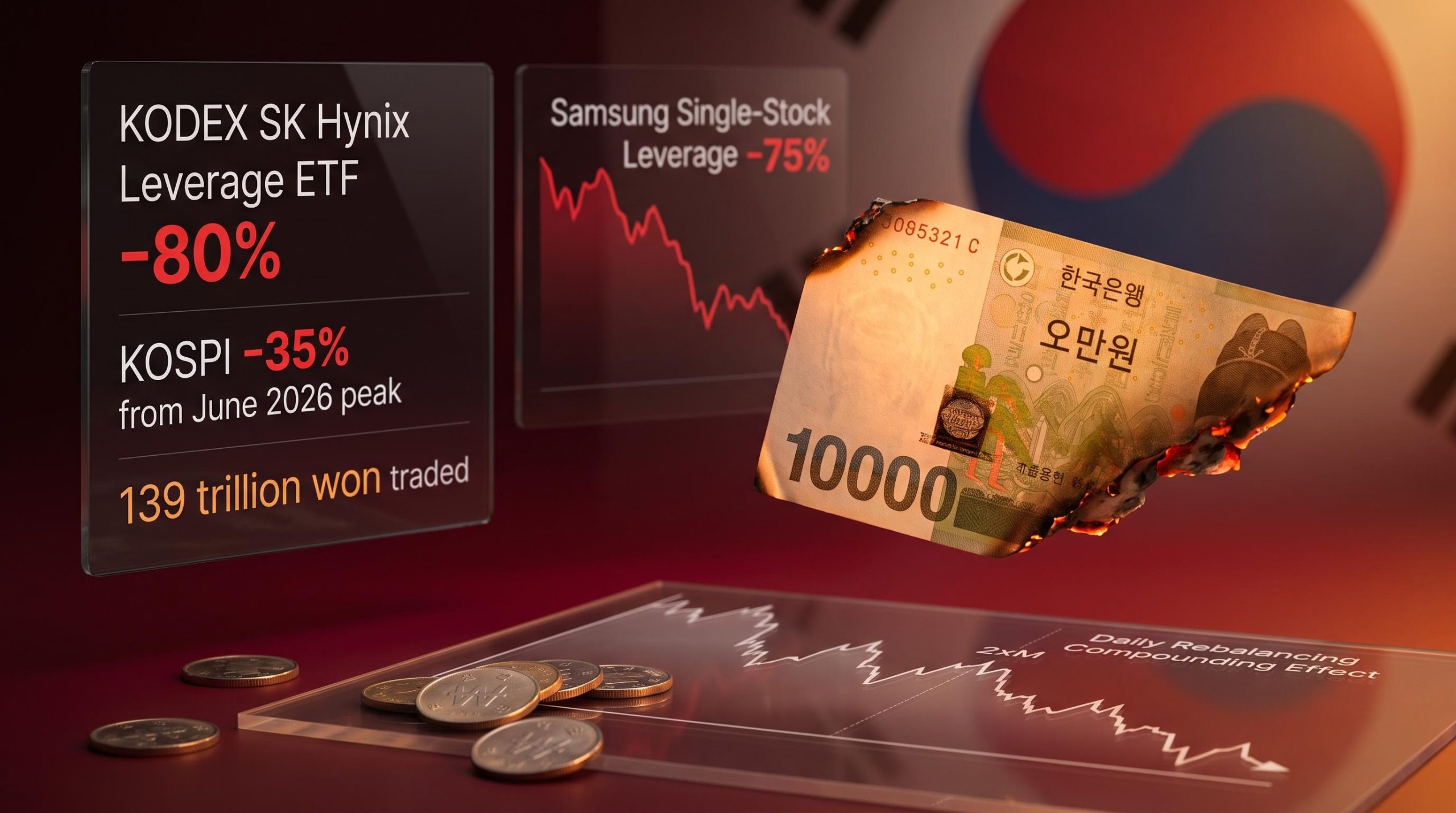
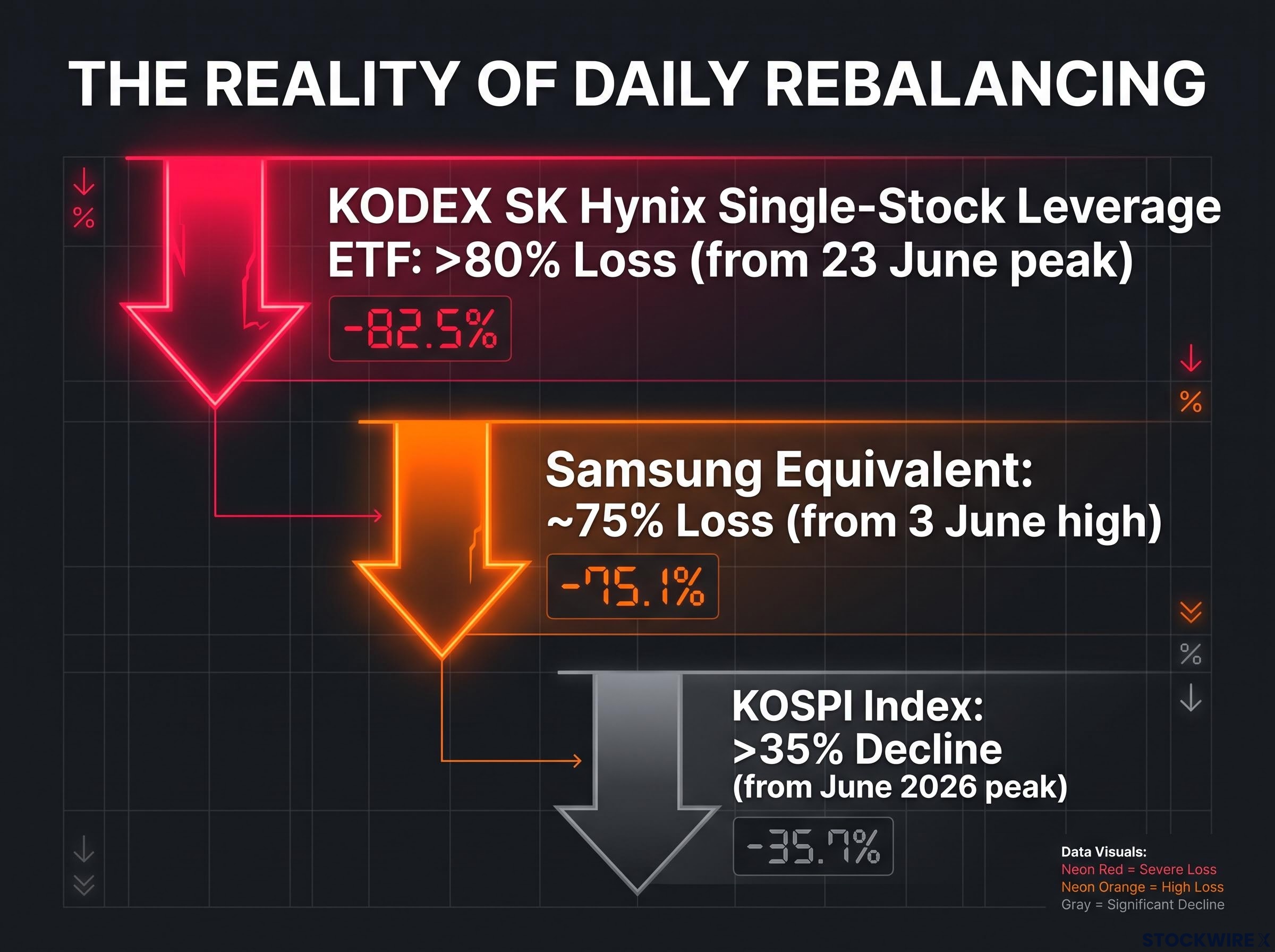
Per LSEG data cited by CNBC, the KODEX SK Hynix Single-Stock Leverage ETF shed more than 80% of its value measured from its 23 June peak.
The Samsung single-stock leverage equivalent recorded a loss of roughly 75% measured from its 3 June high. Earlier in the downturn, Bloomberg-compiled data showed Korea’s largest SK Hynix leveraged ETF had already lost approximately 45% in just weeks, with analysts warning that many retail holders were using it as long-term exposure.
One episode illustrated the compounding risk at its most extreme: an SK Hynix leveraged ETF fell by up to 40% in a single day despite a sharp rise in the underlying stock, driven by liquidity and pricing dislocation. Late buyers faced potential one-day losses near 50% once prices normalised toward fair value. That is leverage risk and liquidity risk layered on top of each other simultaneously.
The 80% loss figure only becomes legible once you understand daily rebalancing. Without that context, it looks like a product failure. With it, you can see a design feature operating in the worst possible environment.
Why these products amplified the KOSPI selloff itself
This was not just a personal finance story. The leveraged ETF crisis fed back into the market itself, turning a sharp correction into a systemic event.
The feedback loop worked as follows: as leveraged ETF prices fell, retail investors facing mark-to-market losses and margin pressure sold both the ETFs and the underlying stocks. Because Samsung and SK Hynix dominate the KOSPI, that selling pressure pushed the index further down, which triggered more losses in the leveraged products, which triggered more selling. The cycle reinforced itself.
| Metric | Figure | Comparison | Significance |
|---|---|---|---|
| KOSPI decline from June 2026 peak | More than 35% | Among the steepest corrections in KOSPI history | Concentrated index made it structurally vulnerable |
| Single-session fall on 29 July 2026 | Approximately 6% | Market-wide circuit breaker activated for the second day running | Automated halts could not absorb selling pressure |
| Cumulative trading value of two SK Hynix products | 139 trillion won | Exceeded all KOSDAQ trading over the same period | Two products outtrading an entire exchange segment |
| Single-stock leveraged ETF share of total ETF trading | 37-43% | On peak days | No longer niche instruments; systemically significant |
When a product category representing 37-43% of total ETF trading value is structurally forced to sell its underlying stocks in a downturn, it is no longer a passive bystander to market moves. It becomes a driver. That is the systemic argument regulators are now making.
Geared ETF systemic risk has crossed a threshold that makes it relevant beyond the holders of these products: US leveraged ETFs now generate 15-20% of all ETF trading volume while representing only around 2% of total ETF assets, a disproportion that forces mechanical selling into every significant downturn and changes price behaviour for passive equity investors who have never touched a leveraged product.
Three underlying fundamental catalysts compounded the structural amplification:
- SK Hynix reported quarterly earnings that fell short of investor expectations, reinforcing concern that AI-driven valuations across the sector had run ahead of fundamentals
- Anxiety mounted over the prospect of stiffer competition from Chinese chipmakers eroding market share
- Valuation stretch across the Korean chip sector after months of uninterrupted gains
What regulators announced, and what is still being decided
The speed of the political response conveys the severity better than any market metric.
At a parliamentary hearing, South Korea’s finance minister issued an apology over the way these leveraged single-stock products were brought to market.
A gathering of the country’s senior financial supervisory authorities took place on or around 29 July 2026. Senior supervisory officials acknowledged they “acted too quickly” and should have taken more care with products whose compounding effect can “wipe out an investor’s entire principal over a short period.”
Measures effective now:
- Minimum deposit to trade leveraged ETFs rising to 30 million won (approximately $20,300) from 10 million won, effective 5 August 2026
- Advertising and promotional activities for single-stock products suspended
- Cash-only purchase requirement, eliminating the ability to layer leverage on top of leverage
- Temporary halt on new single-stock leveraged ETF listings until market conditions stabilise
Measures under active review:
- A ceiling of 20% on the share of any single retail investor’s total assets that can be held in a single-stock leveraged ETF
- Limiting these products to professionally classified investors, which would close off access for the general retail market
- A formal legal mechanism granting regulators authority to step in and halt or curtail trading in specific ETFs when volatility reaches extreme levels
The proposed 20% portfolio cap, if enacted, effectively acknowledges that regulators cannot prevent these products from losing value. What they can do is structurally limit how much damage a total loss can inflict on any single investor’s wealth. That is a meaningful shift in regulatory philosophy, from policing product performance to engineering survivability.
The Financial Services Commission (FSC) is moving fast enough that the landscape for these products in Korea may look materially different by end of 2026. Investors and fund managers tracking Korean market access need to monitor FSC announcements closely.
These statements regarding future regulatory actions are based on publicly announced proposals from the FSC and finance ministry as of late July 2026 and are subject to change based on ongoing deliberations.
How Korea’s experience compares to other markets’ approach to single-stock leverage
South Korea is not an outlier in launching these products. It is becoming an outlier in the severity of the retail consequences.
The United States authorised single-stock leveraged ETFs beginning in 2022, with SEC commissioners at the time warning they were unsuitable for most retail investors on the same grounds now dominating the Korean debate: leverage, daily rebalancing, and volatility decay. Under European Union rules and European Securities and Markets Authority (ESMA) guidance, many leveraged products face strict leverage caps, mandatory risk-warning requirements, and distribution limits, with the most extreme structures effectively out of reach for typical retail investors.
| Market | Single-stock leveraged ETF status | Key restrictions | Retail access |
|---|---|---|---|
| South Korea (post-crisis) | Existing products trading; new listings halted | 30M won minimum deposit; cash-only; advertising ban; 20% cap proposed | Under review; may be restricted to professionals only |
| United States | Authorised since 2022 | Standard ETF disclosure; SEC commissioner warnings | Open to all retail investors |
| European Union | Available under ESMA restrictions | Leverage caps; risk-warning requirements; distribution limits | Limited for most retail investors |
The product design is not uniquely Korean and not new. What made Korea’s outcome far worse was the structural vulnerability of the market: unusually high retail participation, products launching at the peak of an AI-chip hype cycle, and a benchmark where two stocks represent more than half the index weight. That combination of variables is what other regulators should be examining now.
Korean market structure carries several features that amplified the crisis beyond what a similar product launch might have caused in other markets: chaebol concentration in the benchmark, a retail participation rate that exceeds most developed economies, and a 30% daily price limit that can temporarily block exits during volatile sessions are all characteristics that any investor building Korean equity exposure needs to account for.
What the Korean crisis changes for leveraged products globally
The structural lesson from Korea is not subtle: product innovation without aligned investor education and concentration controls creates a predictable mechanism for retail harm at scale. This was not an edge case.
What remains genuinely uncertain is whether the FSC’s proposed restrictions will be implemented in full, whether Korea’s market will recover its pre-crisis retail participation levels, and whether other regulators will act pre-emptively or wait for their own version of this episode.
Three variables are most worth monitoring from here:
- The FSC’s professional-investor restriction decision, which would determine whether these products remain available to general retail investors in Korea at all
- The trajectory of SK Hynix and Samsung earnings in the second half of 2026, which will test whether the underlying AI-semiconductor thesis holds despite the crisis of the instruments built on top of it
- Whether other Asia-Pacific markets with high retail participation follow Korea’s regulatory lead, or continue to permit broad retail access to single-stock leveraged structures
Investors who entered the AI-semiconductor trade before the peak still carry meaningful gains from 2025 and the first part of 2026, even after the recent selloff. The fundamental questions driving Samsung and SK Hynix valuations, including HBM demand, AI infrastructure cycles, and Chinese memory competition, remain open. That is a reminder that the crisis was amplified by timing and instrument choice, not by a collapse in the underlying technology thesis. How you position going forward depends on separating those two factors.
Foreign institutional re-entry into the KOSPI gathered pace in the same week regulators acted: overseas investors recorded the largest single-day net purchase in KOSPI history on 31 July 2026, channelling approximately 7.2 trillion won into Korean equities in a single session, a signal that professional capital distinguishes between the crisis of the instrument and the durability of the underlying market.
The regulatory and structural changes now underway in Korea will reshape how leveraged products are designed, distributed, and supervised across Asia-Pacific markets. For anyone building exposure to semiconductor or AI-sector equities through structured instruments, the Korean episode has permanently reset the benchmark for what regulators will and will not tolerate.
This article is for informational purposes only and should not be considered financial advice. Investors should conduct their own research and consult with financial professionals before making investment decisions. Past performance does not guarantee future results.