

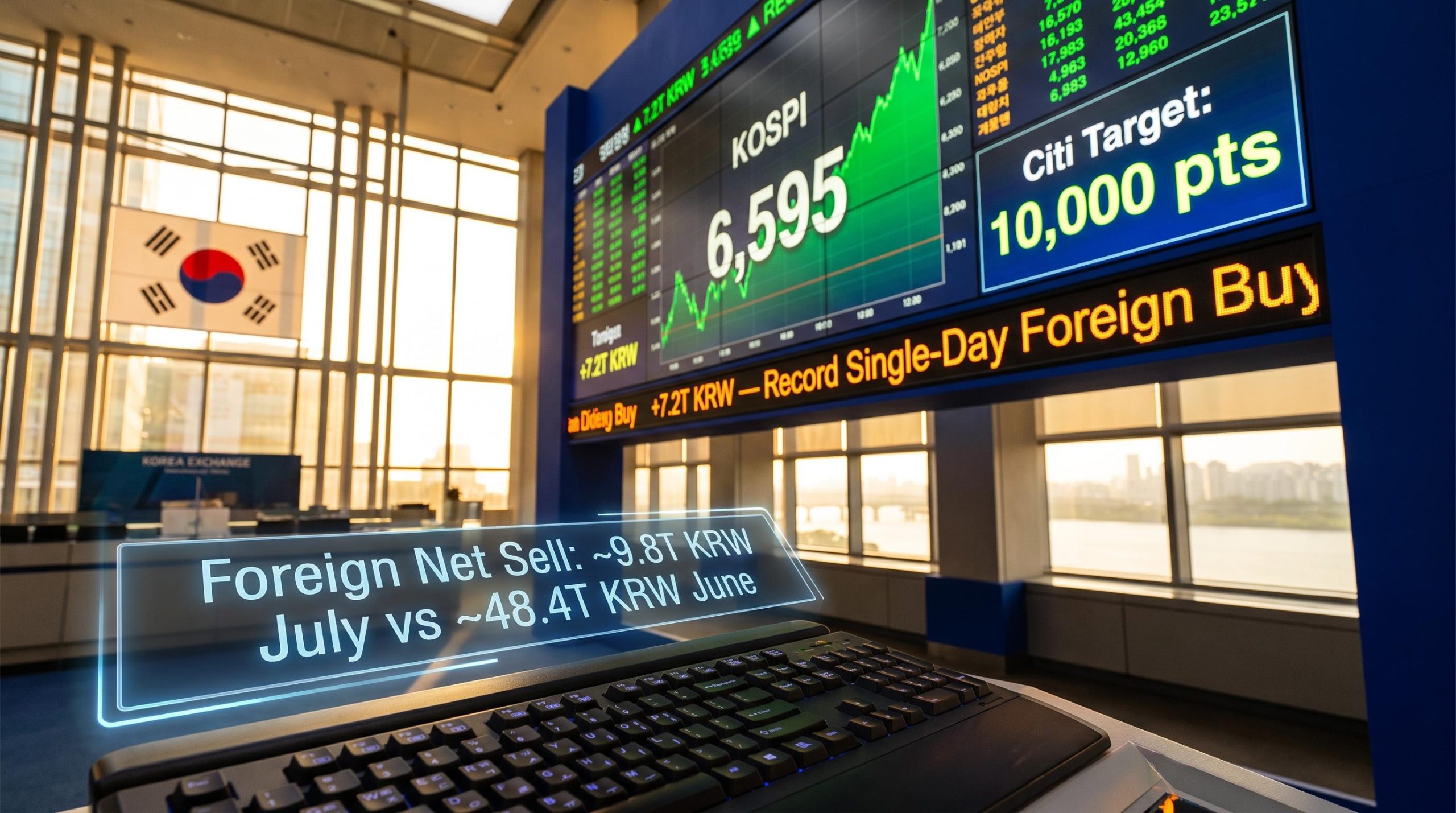
According to Citi’s equity research team, overseas investors channelled roughly 7.2 trillion Korean won into Kospi equities on 31 July 2026, a figure the bank described as the largest single-day net purchase ever recorded. Domestic retail traders sold more than 8 trillion won into the same session.
In a client note published that same day, Citi characterised this divergence as evidence of a fundamental shift in market structure rather than short-term noise. The bank’s view is that Korean equities have moved into a new phase defined by dip-buying behaviour, driven by three concurrent developments: record foreign capital inflows that continue to accelerate, a regulatory tightening on single-stock leveraged ETFs that has cut trading volumes by roughly half, and domestic pension funds swinging back to net purchases.
Each shift on its own would be worth tracking. Occurring together in July 2026, Citi argues they represent a durable change in the market’s behavioural architecture. Here is what the underlying data reveals about who is buying and why, what the bank’s 10,000-point Kospi target implies for the index at current levels, and which specific variables to monitor if you hold emerging market exposure that tracks Korean equities.
Foreign investors just made the biggest single-day Kospi bet on record
The 31 July record was not just large. It was a reversal.
Approximately 7.2 trillion won in a single session, the biggest single-day net purchase on record, per Citi.
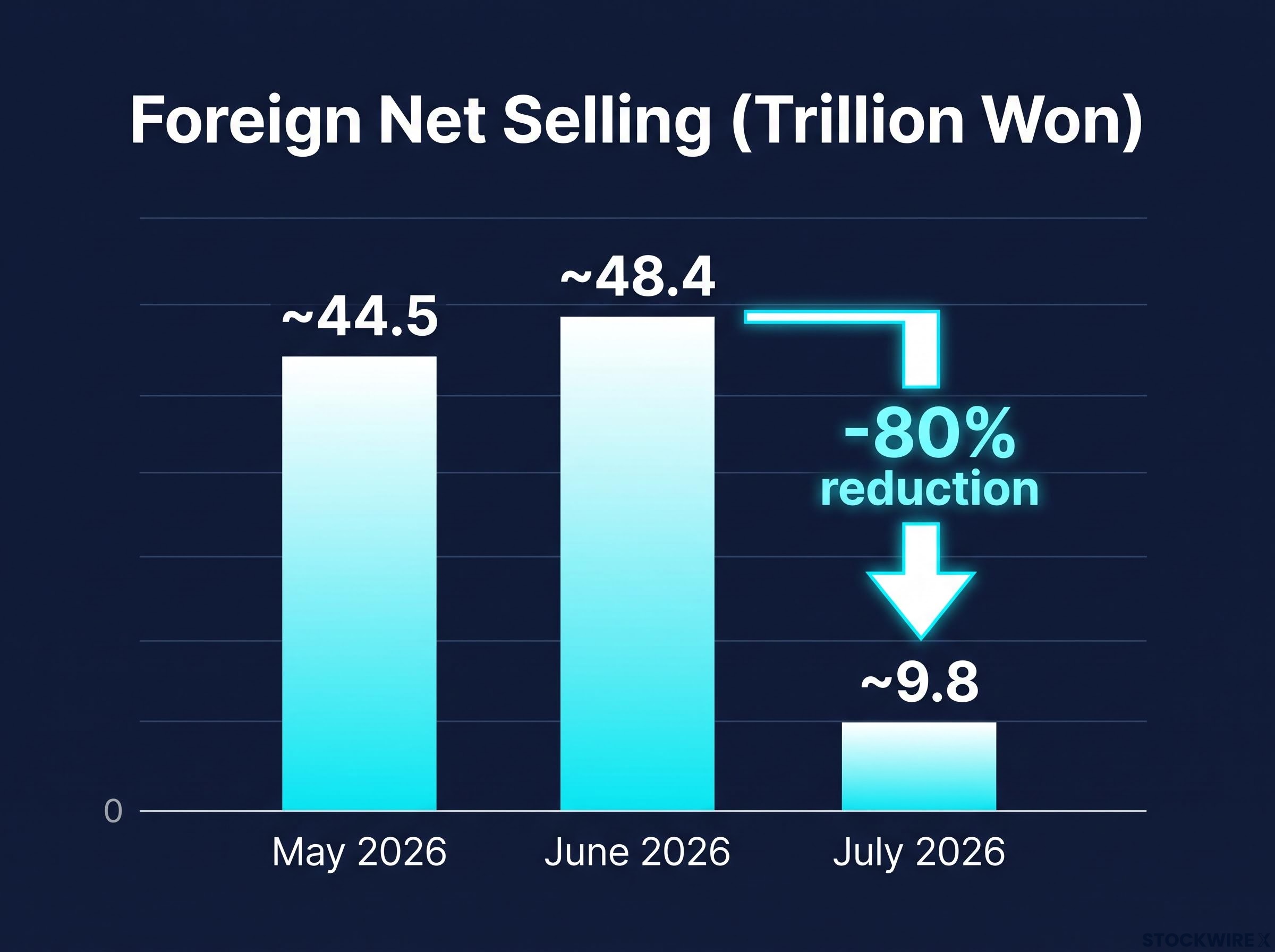
For most of 2026, overseas capital had been leaving. Net foreign selling had been running at enormous levels before pulling back dramatically across two months:
- May 2026: approximately 44.5 trillion won in net selling
- June 2026: approximately 48.4 trillion won
- July 2026: approximately 9.8 trillion won, an 80% reduction in two months
| Month | Foreign net selling (trillion won) | Change from prior month |
|---|---|---|
| May 2026 | ~44.5 | Baseline |
| June 2026 | ~48.4 | +8.8% |
| July 2026 | ~9.8 | -79.8% |
That compression, from roughly 50 trillion won in June to under 10 trillion won in July in a single month, is the kind of velocity that reflects institutional re-evaluation of the Korean equity opportunity, not incremental sentiment drift. Citi notes that capital flowing into Kospi-linked passive ETFs picked up pace from mid-July, pointing to systematic, index-tracking demand rather than speculative positioning.
For investors monitoring global equity sentiment, the speed of this reversal is the signal. A repositioning of this magnitude, concentrated in weeks rather than quarters, suggests active portfolio decisions are being made at the institutional level about Korean equity exposure.
Goldman Sachs was tracking contrarian positioning signals in Korean equities as recently as early July 2026, with its Korea Equity Risk Barometer hitting -1.5, a level the bank read as pointing toward better prospective returns even as foreign outflows were still running at pace before the July reversal accelerated.
When big ASX news breaks, our subscribers know first
What a buy-the-dip regime actually means for a stock market
A buy-the-dip regime is not a prediction that prices will rise in a straight line. It describes a market where the structural composition of participants has shifted in a way that makes disorderly, forced-selling cascades less likely when pullbacks occur.
In practical terms, the markers that separate a dip-buying regime from a short-lived sentiment bounce include:
- Institutional buyers stepping in on price weakness rather than selling accelerating into it
- Demand arriving through passive, systematic channels (ETFs, pension allocations) rather than leveraged speculation
- The buyer base shifting toward longer-horizon participants whose mandates are less sensitive to short-term volatility
- Forced-selling mechanisms (margin calls on leveraged products, for example) being structurally constrained
Why this matters for the Kospi specifically
The Kospi’s prior volatility profile was heavily influenced by intense retail participation in leveraged single-stock products and by the index’s concentration in memory semiconductor names like Samsung Electronics and SK Hynix. After what Citi characterised as a “brutal sell-off” earlier in 2026, the index closed at approximately 6,595 on 31 July. The question for investors with Asia-Pacific exposure is whether the recovery from that depressed level is durable or opportunistic. The regime framework provides a lens for evaluating that.
The Kospi’s prior volatility was not purely a function of retail leverage; semiconductor concentration risk, with Samsung Electronics and SK Hynix together representing roughly half of total index capitalisation, meant that a single negative headline on either name could transmit as a near-10% index decline before broader contagion took hold.
South Korea’s regulator just made high-risk retail ETFs dramatically harder to access
South Korea’s Financial Services Commission (FSC) introduced higher minimum deposit thresholds for retail investors seeking access to single-stock leveraged ETFs. These products provide amplified intraday exposure to individual stocks and had attracted intense retail speculation, contributing to large intraday swings in the broader index.
The sequence of cause and effect was immediate:
- The FSC raised deposit requirements, reportedly to approximately 30 million won in cash (this figure has been reported but not independently confirmed)
- Retail access to leveraged products dropped sharply
- According to Citi, turnover across major single-stock leveraged ETFs slid to around half their recent monthly average following the rule change
- Intraday volatility driven by leveraged retail positioning began to dampen
The FSC deposit requirement for leveraged products was set at 30 million won and its implementation date was brought forward to 31 July 2026 from an earlier August schedule, accelerating the withdrawal of retail access to amplified single-stock exposure.
Trading volumes in key single-stock leveraged ETFs dropped to approximately 50% of their recent monthly average following the FSC rule change, per Citi.
Reported figures for specific products show even steeper declines. The KODEX SK Hynix single-stock leveraged ETF reportedly saw turnover fall approximately 80% in two days, from over 5 trillion won to approximately 1.2 trillion won, though these product-level figures have not been independently confirmed.
The mechanism matters for the broader dip-buying thesis. Because leveraged ETFs amplify price moves in both directions, constraining their use removes one of the more unpredictable amplification mechanisms from the market’s architecture. Lower volatility makes pullbacks look more like entry opportunities and less like precursors to disorderly crashes, which is precisely the condition that encourages longer-horizon capital to step in.
Why pension funds returning to buying matters more than the headline number
The amount itself is modest: domestic pension funds in South Korea recorded net purchases of roughly 1.0 trillion won in Kospi equities across July 2026, returning to buying after a period of net outflows. Against foreign flows measured in the trillions per day, that figure could be easy to dismiss.
The direction is what matters. Pension funds had been net sellers of domestic equities in preceding months. Their return to net buying signals that the largest, most risk-averse domestic institutions have assessed current valuations as acceptable, a different quality of endorsement than speculative or short-term flows.
Citi estimates the NPS would only begin considering a gradual reduction in its domestic equity overweight if the Kospi climbs into the 9,000-10,000 range.
The National Pension Service (NPS), one of Asia’s largest institutional investors, sits at the centre of this dynamic. According to Citi, the NPS is expected to hold a domestic equity overweight for an extended period, partly because any significant trimming of Korean holdings would likely encounter considerable public and political pushback.
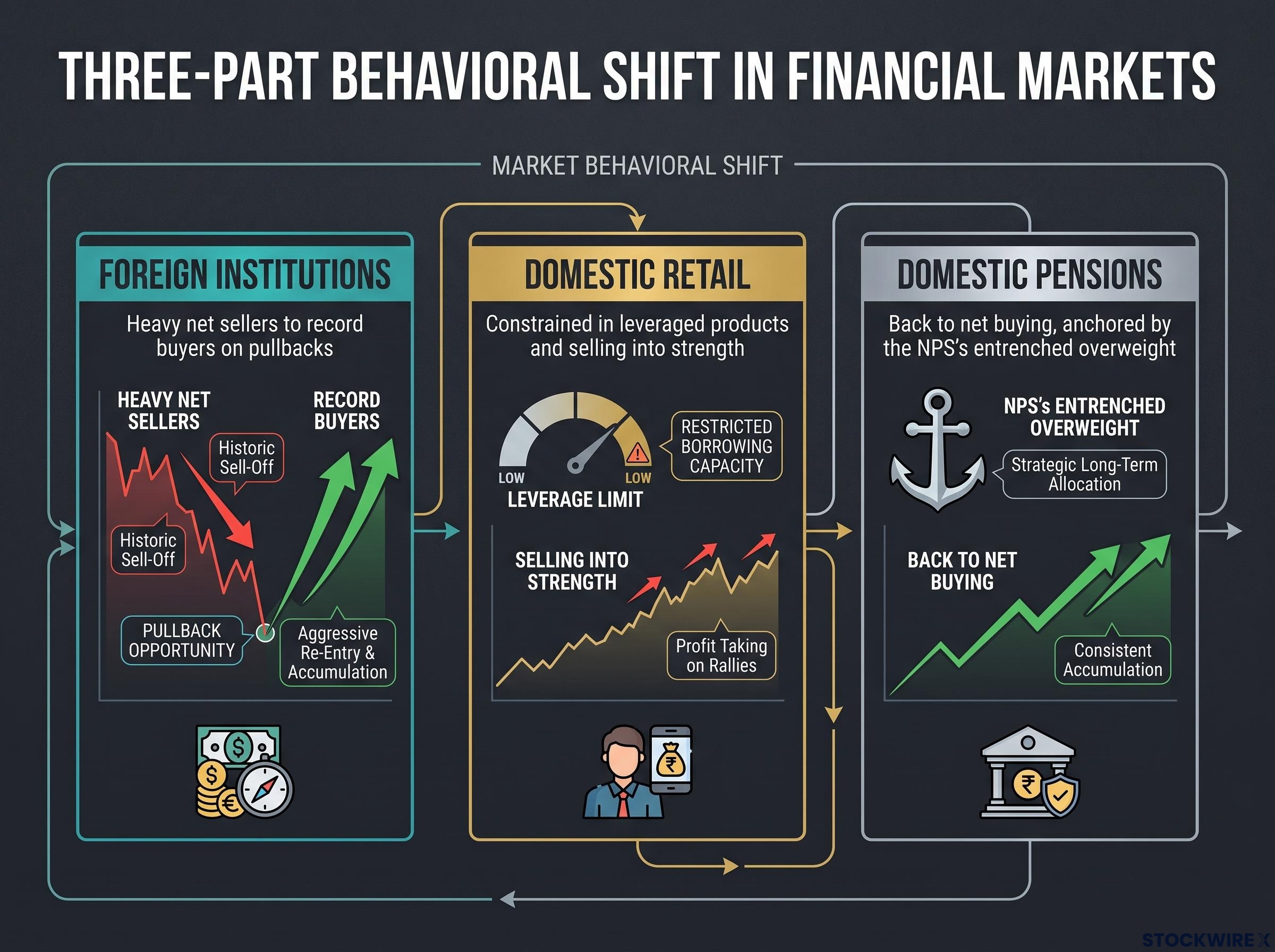
That creates a valuation floor. When the market weakens, pension buying can emerge as a stabilising force. The three-group behavioural shift now looks like this:
- Foreign institutions: transformed from heavy net sellers to record buyers on pullbacks
- Domestic retail: constrained in leveraged products and selling into strength rather than chasing bounces
- Domestic pensions: back to net buying, anchored by the NPS’s entrenched overweight
The NPS’s structural position means pension demand is more likely to show up on weakness than to add selling pressure, which is the foundation the dip-buying thesis requires.
Citi’s 10,000-point target and the case Kospi bears still need to answer
As of 31 July 2026, Citi’s equity research team reiterated a 10,000-point price objective for the Kospi. With the index closing at approximately 6,595 that day, the target implies roughly 51% upside.
The structural undervaluation that makes the Kospi’s current level compelling to foreign institutions has a longer history than the 2026 sell-off: the Korea Discount, driven by chaebol governance structures, weak payout culture, and a persistent geopolitical risk premium, has kept South Korean blue chips trading below 1.0 price-to-book relative to regional peers for years.
Citi maintained its 10,000-point Kospi price objective as of 31 July 2026, implying approximately 51% upside from the index’s close that day.
The bank’s thesis rests on two pillars, supplemented by a behavioural asymmetry that affects how investors price downside risk.
| Pillar | Driver | Current status | Risk to watch |
|---|---|---|---|
| Memory semiconductors | Demand recovery and earnings leverage | In progress, per Citi | Demand cycle reversal |
| Equity valuation | Depressed post sell-off | Supportive at current levels | Macro deterioration |
| Foreign flows | Record inflows on dips | Structurally positive | Reversal if global risk appetite falls |
| Pension support | NPS net buying resumed | Directionally positive | Political or regulatory change to NPS mandate |
Citi also notes that authorities retain the option of deploying a formal market-support mechanism, such as a Stock Market Stabilisation Fund, should conditions deteriorate significantly. Even if unused, such a mechanism affects risk-taking behaviour: investors perceive some downside asymmetry, which encourages more aggressive dip-buying at lower levels.
The 51% gap between current levels and the target tells you this is a medium-to-long horizon thesis. It requires the semiconductor demand recovery at Samsung Electronics and SK Hynix to materialise and foreign flows to sustain. Semiconductor demand data and the continuation of institutional inflows are the two most direct leading indicators of whether the thesis is tracking.
Memory semiconductor earnings represent the most direct fundamental lever beneath the Kospi re-rating thesis: Samsung Electronics and SK Hynix recorded year-on-year earnings growth exceeding 900% in Q1 2026 as DRAM contract prices surged 90-95% in the quarter, providing the earnings base that Citi’s valuation case requires to remain intact.
What the data signals, and what it does not
The three structural shifts Citi identifies, foreign institutions buying dips, leveraged retail volatility constrained by the FSC, pensions providing a medium-term anchor, collectively describe a changed market architecture. The probability of disorderly, forced-selling cascades has fallen. Demand is more likely to emerge on weakness than it was six months ago.
That is a meaningful change. It is not a removal of risk.
The variables that would challenge or reverse the thesis are specific and monitorable:
- A reversal in foreign institutional flows, particularly if global risk appetite deteriorates and emerging market capital rotates out
- Semiconductor demand disappointment, specifically weaker-than-expected earnings from Samsung Electronics or SK Hynix
- A significant shift in FSC regulatory posture that loosens leveraged ETF access before the structural transition is complete
- Broader macro deterioration that pulls capital from emerging markets regardless of Korea-specific fundamentals
Citi frames the Kospi as having entered a more resilient phase rather than experiencing a short-lived rebound. That framing is supported by the data, but it is descriptive of current conditions, not a guarantee against macro, policy, or geopolitical disruption.
If you hold Korean equity or broader emerging market exposure, treat the structural shifts as changing the risk-reward calculus on pullbacks, not as confirmation that the 10,000-point target is inevitable.
The structural case for Korean equities is stronger than it was six months ago; the distance to 10,000 is not
What has materially changed is the behavioural architecture. Three distinct investor groups are now positioned in ways that reduce disorderly selling risk, and the regulatory environment has removed one of the market’s most volatile amplification mechanisms.
What has not changed is the distance. The Kospi at approximately 6,595 remains roughly 51% below Citi’s 10,000 target, and closing that gap requires multiple conditions to converge: a semiconductor demand recovery, sustained foreign inflows, and pension continuity.
The practical takeaway is a monitoring framework, not a buy signal. Three specific observables will tell you whether the regime holds:
- Weekly KRX foreign flow data: the pace and direction of institutional positioning in real time
- Quarterly earnings revisions for Samsung Electronics and SK Hynix: the fundamental driver underpinning the index’s re-rating potential
- FSC announcements on leveraged ETF regulations: any loosening would reintroduce the volatility the current thesis depends on being constrained
The question is no longer whether the Kospi’s structural dynamics have improved. Citi’s data, drawn from the bank’s 31 July 2026 client note, suggests they have. The question is whether the fundamental and macro conditions will allow those improved dynamics to translate into the index level the bank is targeting.
This article is for informational purposes only and should not be considered financial advice. Investors should conduct their own research and consult with financial professionals before making investment decisions. Forward-looking statements, including Citi’s price target and structural regime assessment, are subject to change based on market developments and evolving conditions.






