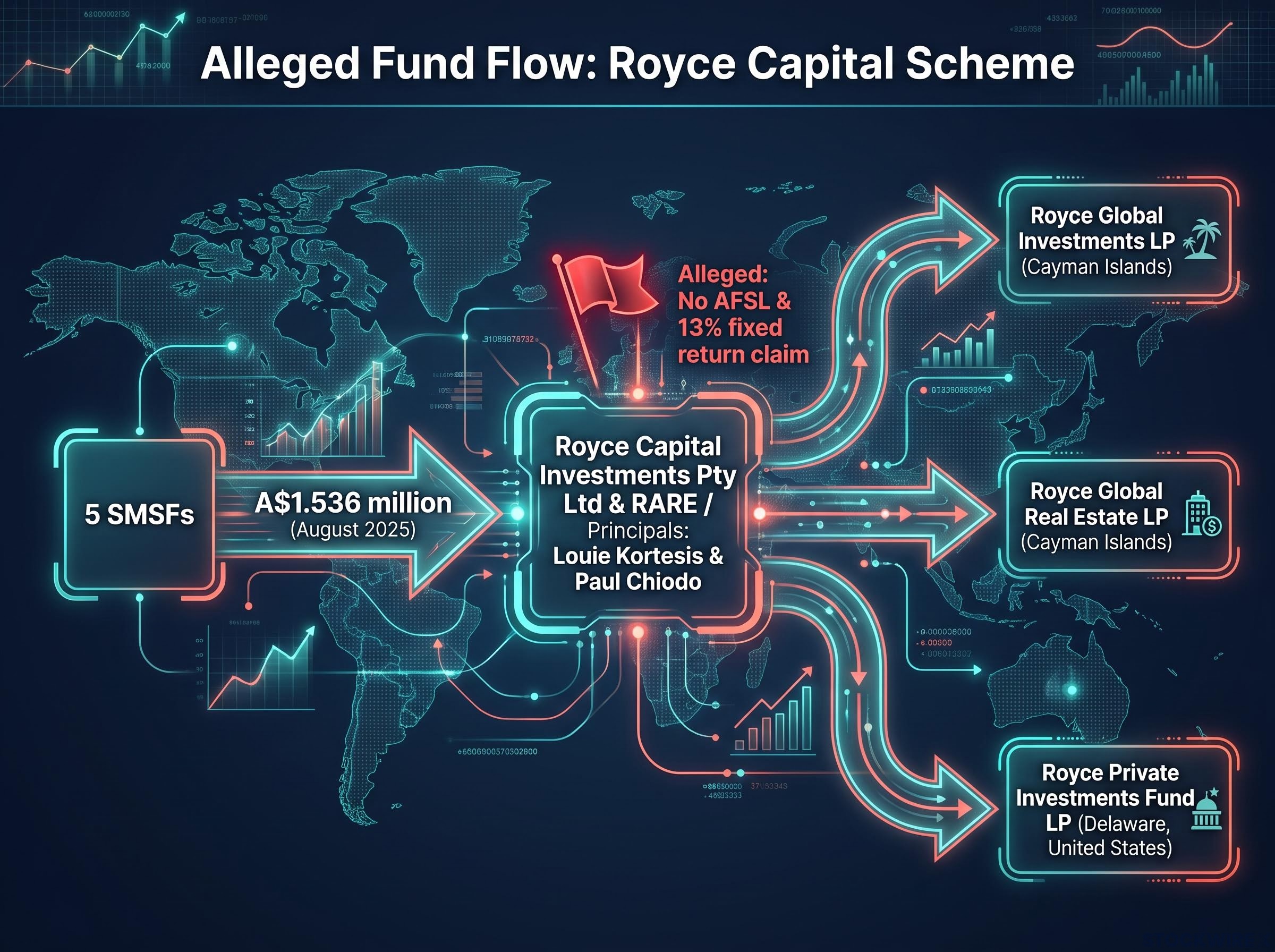
ASIC has lodged proceedings in the Federal Court of Australia seeking orders to restrain Royce Capital Investments Pty Ltd, its associated entity Royce (Aust) Real Estate Pty Ltd (RARE), and two named individuals from conducting further fundraising activity targeting Australian investors. The proceedings centre on allegations that five self-managed superannuation funds (SMSFs) had around A$1.536 million channelled into offshore limited partnerships during August 2025, with those funds purportedly raised by Royce Capital on their behalf.
This is not a concluded enforcement action. The Federal Court has not made findings, and all allegations remain unproven. ASIC’s case rests on claims that the entities operated financial services without holding an Australian Financial Services Licence (AFSL), a licence required by law to operate financial services in Australia, and that investors were shown promotional materials containing representations of a fixed 13% annual return, both of which ASIC characterises as breaches of Australian financial services law.
Here is what the case involves, how the offshore fund structure allegedly worked, what orders ASIC is seeking, and what every SMSF trustee should know about checking whether a provider is licensed before committing funds.
What ASIC alleges Royce Capital and its principals did
ASIC’s position is that Royce Capital Investments and RARE conducted financial services activity without the AFSL that Australian law requires any entity offering financial products or advice to hold. That alleged absence of licensing forms the central basis of the regulator’s application.
AFS licence cancellation is not a fine or a condition but the immediate termination of a firm’s legal right to operate, a distinction that matters because investors dealing with a cancelled or never-licensed entity lose access to the dispute resolution pathways that apply to regulated providers.
Two individuals are named alongside the corporate defendants. The regulator’s application identifies Louie Kortesis and Paul Chiodo as having each played a role in the unlicensed conduct attributed to Royce Capital. The decision to pursue individuals, not just the corporate entities, signals that ASIC is seeking personal accountability for the alleged conduct.
ASIC’s pursuit of individuals alongside corporate entities reflects a broader enforcement posture around personal accountability for financial misconduct, with the regulator increasingly seeking bans and penalties against named individuals rather than treating corporate structures as a shield.
ASIC’s court filings indicate that the five SMSFs contributed a combined A$1.536 million to Royce Capital across August 2025, with those monies allegedly funnelled into one or more of the offshore limited partnerships described below. All allegations remain subject to the Federal Court’s determination.
ASIC media releases document the regulator’s enforcement actions and proceedings in detail, providing the primary official record of applications lodged in the Federal Court, the entities named, and the specific orders sought against them.
| Item | Detail |
|---|---|
| Defendants | Royce Capital Investments Pty Ltd; RARE; Louie Kortesis; Paul Chiodo |
| Regulator | ASIC |
| Forum | Federal Court of Australia |
| Alleged breach | Providing financial services without an AFSL; misleading or deceptive representations |
| Investors affected | Five SMSFs |
| Amount raised | Approximately A$1.536 million |
| Timeframe | August 2025 |
When big ASX news breaks, our subscribers know first
How the offshore fund structure worked
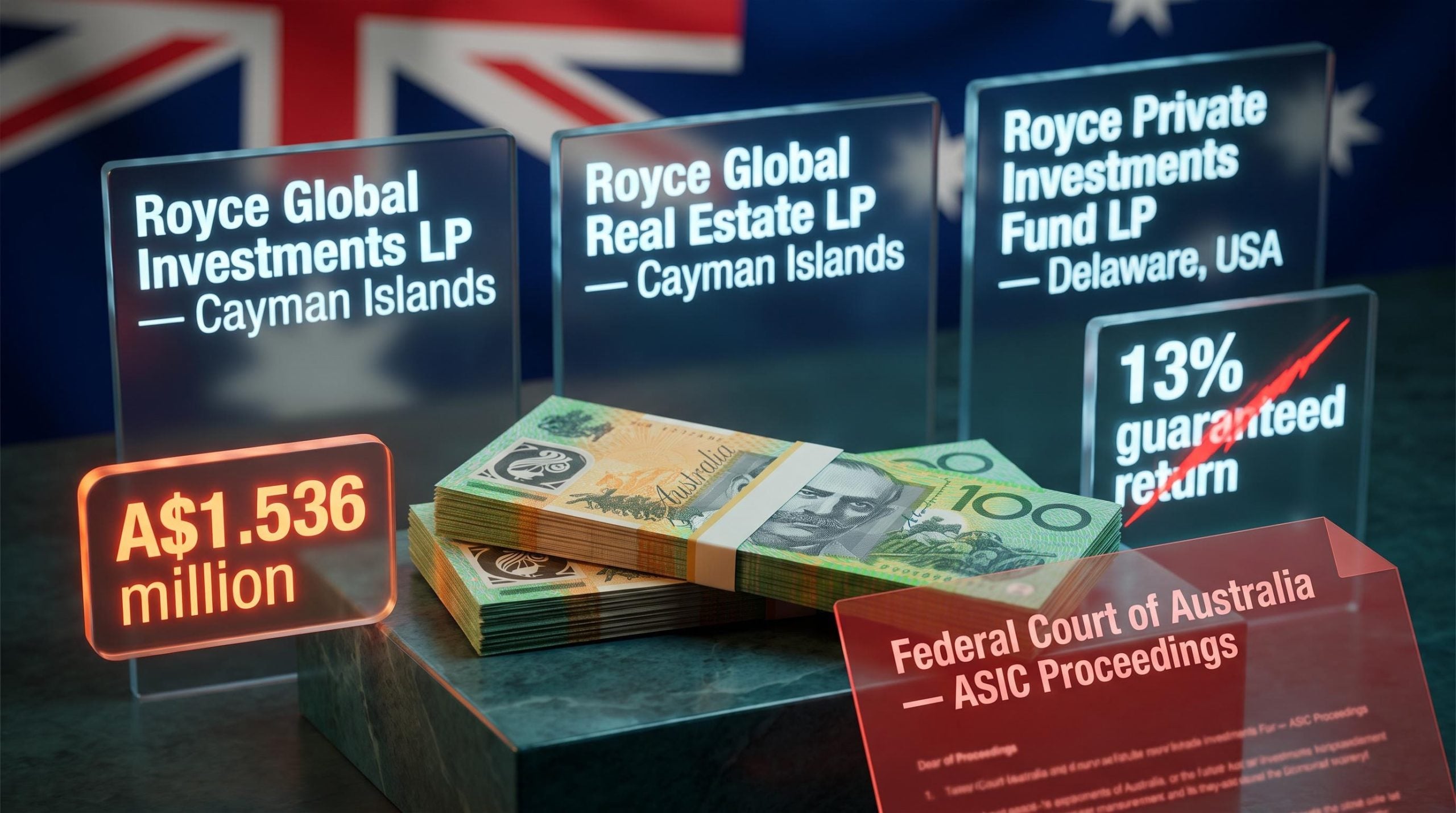
The money allegedly did not stay in Australia. ASIC’s application identifies three offshore limited partnerships into which investor funds were purportedly directed:
- Royce Global Investments LP, registered in the Cayman Islands
- Royce Global Real Estate LP, registered in the Cayman Islands
- Royce Private Investments Fund LP, registered in Delaware, United States
That is three separate vehicles across two foreign jurisdictions. For Australian SMSF investors, the practical implication is significant: if the scheme were ultimately found to be fraudulent, recovering funds held in Cayman Islands and Delaware structures would involve foreign legal processes well beyond ASIC’s direct enforcement reach. That is precisely why ASIC is seeking asset preservation orders now, before a final determination.
Asset preservation orders are a standard tool in ASIC’s early-action arsenal when funds may have moved offshore; in the Capital Guard case, ASIC similarly moved to restrain funds before a final court determination, reflecting a consistent regulatory approach to situations where delay risks rendering any eventual order meaningless.
According to ASIC’s application, marketing materials supplied by RARE to certain investors contained representations about the expected return on their money. Those materials allegedly stated investors would receive:
“A guaranteed or fixed return of 13% per annum.”
ASIC treats guaranteed return claims of this nature as a primary red flag for unlicensed or potentially fraudulent schemes.
What orders ASIC is asking the Federal Court to impose
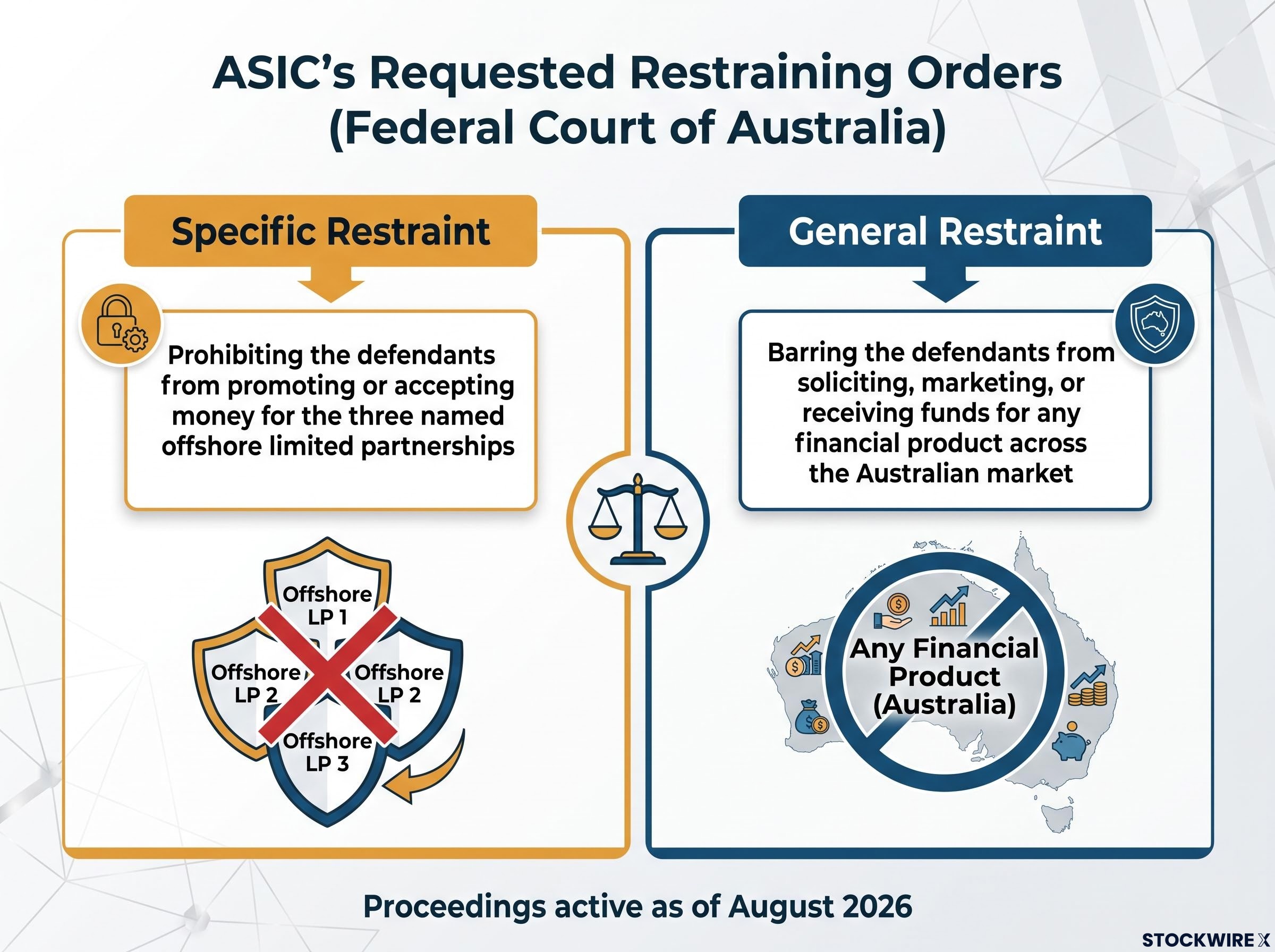
ASIC’s application seeks two tiers of restraining orders, and the distinction between them matters:
- Specific restraint: Prohibiting the defendants from promoting or accepting money for the three named offshore limited partnerships
- General restraint: Barring the defendants from soliciting, marketing, or receiving funds for any financial product across the Australian market
The breadth of that second order is the telling detail. ASIC is not treating this as a one-product problem. The general restraint, if granted, would prevent the defendants from operating in Australian financial markets through any future vehicle until the Court determines the matter.
No orders have been made yet. Proceedings remain active as of August 2026, and the defendants are entitled to contest ASIC’s application. What ASIC is asking for and what the Court ultimately decides are two different things, and that distinction is worth holding clearly.
Why SMSF investors are repeatedly targeted in unlicensed schemes
The Royce Capital case fits a recognisable pattern. SMSF trustees hold direct investment decision-making authority over their retirement savings. That autonomy is the fund’s strength and its vulnerability: it means there is no institutional gatekeeper between the trustee and an unlicensed operator offering a compelling pitch.
The Royce Capital case is one data point in a considerably larger national picture: investment scam losses across Australia reached $837.7 million in 2025, with Australians aged 55 and over accounting for 26.5% of Scamwatch losses, a figure that reflects deliberate targeting of higher-asset demographics including SMSF trustees.
ASIC’s standing guidance is direct on this point. Guaranteed high returns, particularly at rates like 13% per annum, are among the most common red flags for unlicensed or potentially fraudulent offerings. No legitimate, regulated investment can guarantee a fixed annual return at that level without bearing risk that contradicts the guarantee.
The single most practical step any SMSF trustee can take is a two-minute check before transferring funds to any provider:
- Search ASIC’s public AFSL register to confirm the provider holds a current licence
- Check ASIC’s investor alert list for any warnings against the entity or its principals
- Scrutinise any claim of guaranteed or fixed returns, particularly above prevailing term deposit rates
- Confirm the jurisdiction of the investment vehicle and understand your legal recourse if it sits offshore
The Royce Capital case illustrates exactly what the alternative looks like when these steps are skipped.
What the case outcome will depend on, and what investors should do now
Because proceedings are ongoing, all allegations against Royce Capital, RARE, Kortesis, and Chiodo remain unproven. The defendants are entitled to contest ASIC’s application, and the Federal Court’s determination will decide the outcome. No finding of wrongdoing has been made.
Regardless of how the Court ultimately rules, the conduct alleged in this case maps directly to the warning signs ASIC publishes for retail and SMSF investors. The regulator’s own resources remain the most relevant next step for anyone assessing a financial services provider:
- ASIC’s AFSL register: Verify whether any provider holds a current licence before committing funds
- ASIC’s investor alert list: Check for warnings against specific entities or individuals
- MoneySmart (moneysmart.gov.au): Review ASIC’s guidance on SMSF investment risks and common scam indicators
This article is for informational purposes only and should not be considered financial advice. Investors should conduct their own research and consult with financial professionals before making investment decisions.
These proceedings are ongoing. All allegations remain unproven and are subject to determination by the Federal Court of Australia.
—