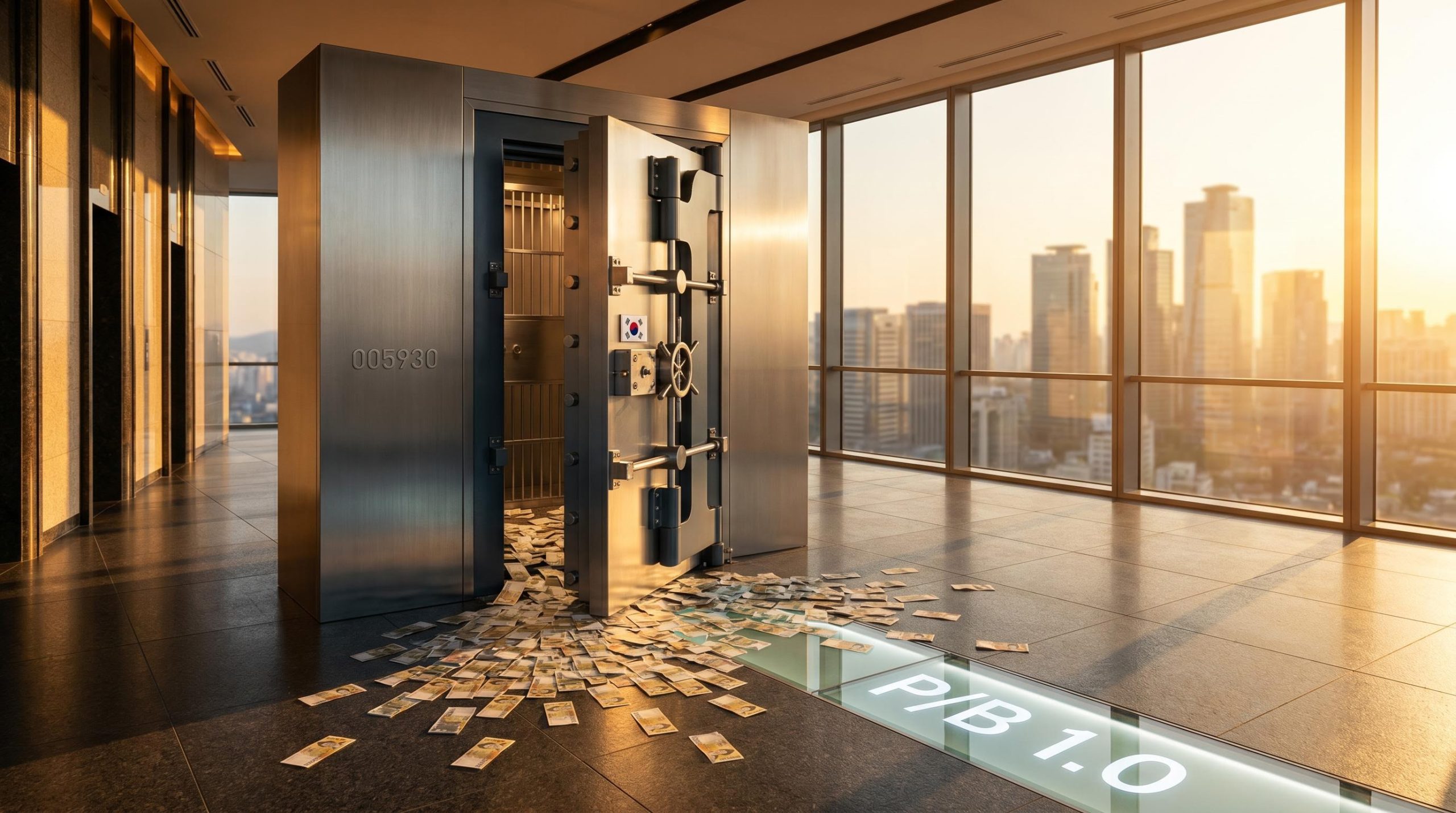
South Korean equities sit at the intersection of global technology leadership, structural undervaluation, and active government reform. Companies such as Samsung Electronics and Hyundai Motor dominate their industries worldwide, yet the broader market has traded at a persistent discount to regional peers for decades. The reason is not weak business performance but a specific set of governance and ownership structures that have suppressed shareholder returns and kept international capital at arm’s length. That discount is now the target of the Corporate Value-Up programme, launched in early 2024 and still evolving as of mid-2026, which is pressing listed companies to improve capital efficiency, raise dividends, and strengthen governance. For investors willing to learn the mechanics of this market, the setup combines value with a live catalyst. For those who enter without preparation, the governance complexity, unfamiliar trading rules, and currency exposure can produce unwelcome surprises. This guide covers everything a retail investor needs to understand before placing a first trade in South Korean equities: the origins of the discount, the reform programme, access routes, market structure, currency risk, and portfolio fit.
What the Korea Discount is and why it has lasted so long
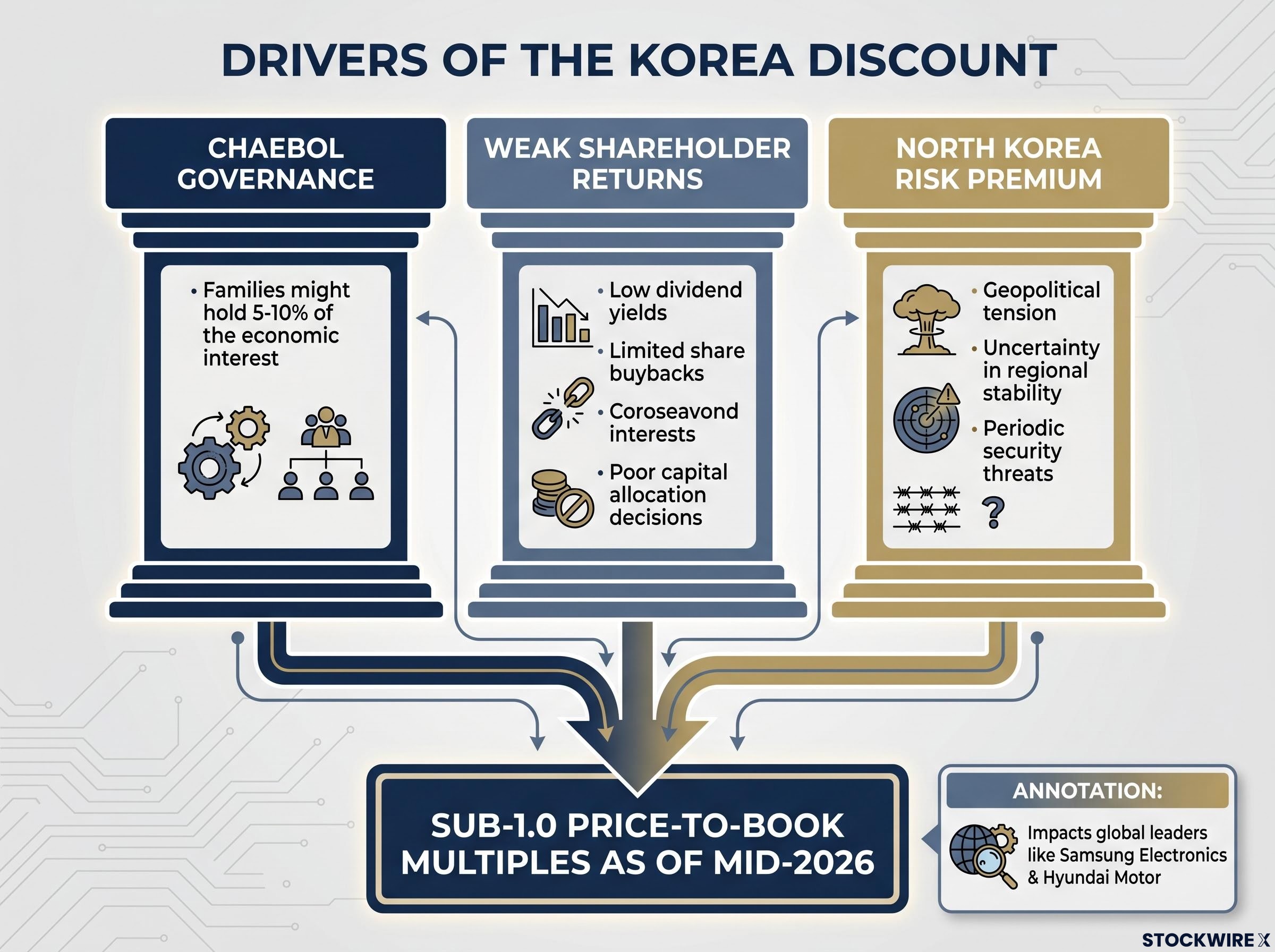
The Korea Discount is not a temporary anomaly or a pricing error waiting to correct itself. It is the predictable output of three structural features that have persisted for years, each reinforcing the others.
- Chaebol governance and cross-shareholding structures that concentrate control in founding families while diluting minority shareholder influence
- Weak shareholder returns, including historically lower dividends and fewer buybacks than comparable companies in Japan, Taiwan, or the United States
- A geopolitical risk premium tied to North Korea that adds event-driven volatility international investors consistently price into Korean assets
Together, these drivers explain why many Korean blue chips still trade at sub-1.0 price-to-book multiples as of mid-2026, despite operating businesses with global scale and competitive advantages.
The chaebol structure and its effect on minority investors
South Korea’s largest conglomerates, known as chaebols, use complex cross-shareholding pyramids that allow founding families to retain strategic control with relatively small economic stakes. A family might hold 5-10% of the economic interest in a group yet exercise effective control over capital allocation across dozens of subsidiaries.
The consequences for minority shareholders are direct. Capital tends to be hoarded on balance sheets rather than returned. Acquisitions are sometimes made to expand the family’s influence rather than to maximise returns. Return on equity remains lower than it would be if capital allocation were optimised for all shareholders equally.
Weak payout culture and the North Korea risk premium
Korean companies have historically paid lower dividends and conducted fewer buybacks than regional peers with similar earnings profiles. The payout gap has compounded over years into a persistent valuation discount, as income-oriented and total-return-focused investors allocate capital elsewhere.
The North Korea factor operates differently. It is not a constant drag but a periodic shock risk. Escalations on the Korean Peninsula can trigger sharp drawdowns unrelated to company fundamentals, and international investors price that tail risk into valuations at all times. The discount, in other words, is not mysterious. It is logical.
When big ASX news breaks, our subscribers know first
South Korea’s Corporate Value-Up Initiative
The investment thesis for Korean equities has shifted. The question is no longer simply whether the market is cheap; it is whether an active policy programme can compress the structural discount that has persisted for years. The Corporate Value-Up initiative, launched in early 2024 and still evolving as of mid-2026, represents the most concerted official effort to date.
The programme rests on three reinforcing pillars:
The FSC Corporate Value-Up programme establishes the official policy framework underpinning these reforms, setting out the regulatory expectations for listed companies to publish capital efficiency plans and the incentive structures tied to compliance.
- Corporate Value-Up plans: Listed companies with low valuations (often price-to-book below 1.0) are urged to publish medium-term plans targeting higher capital efficiency, increased dividends, and improved governance. Companies that commit receive regulatory recognition and incentive support.
- Commercial Code amendments: Recent changes strengthen board independence, tighten fiduciary duties for directors, and impose stricter rules around related-party transactions within chaebol groups.
- Tax incentives: Adjustments to corporate tax rules encourage higher dividend payouts, more transparent use of treasury shares (including mandatory cancellation in certain cases), and more shareholder-friendly capital allocation.
Evidence of behavioural change is emerging. Rising dividend payout ratios and more frequent buyback announcements have appeared at large and mid-cap firms, particularly those with high foreign ownership. More companies are explicitly referencing capital efficiency in their medium-term plans.
Global asset managers increasingly frame South Korea alongside Japan as a governance-reform story, where policy pressure is attempting to unlock value trapped inside listed companies by decades of structural underinvestment in shareholder returns.
Japan’s governance reform offers the closest historical parallel to what Korea’s Value-Up programme is attempting, with the Tokyo Stock Exchange’s capital efficiency push lifting average TOPIX price-to-book from 1.1x to 1.5x since 2023 and demonstrating that policy-driven multiple expansion is achievable when corporate behaviour actually shifts.
If valuations move even part of the way toward regional averages, the upside comes not from earnings growth alone but from multiple expansion, the compression of governance and capital-return risk premia that have weighed on Korean multiples for years. The reform programme does not guarantee that outcome, but it provides the most credible catalyst the market has had.
How retail investors can access the Korean market
Three routes exist, each suited to a different level of commitment and complexity. Presented here in ascending order, investors can self-select the entry point that matches their resources and objectives.
- Korea-focused ETFs and funds: Single-country ETFs tracking indices such as MSCI Korea provide diversified exposure without requiring any direct interaction with the Korea Exchange (KRX). Regional or emerging market funds often carry substantial Korea stakes in technology and autos, meaning an investor may already hold implicit Korean equity exposure in an existing portfolio.
- Direct trading through an international broker: Many global brokers offer KRX access within an existing account. The process involves completing KYC requirements, funding the account in a base currency and converting to KRW (or the broker’s settlement currency for Korean trades), and trading using six-digit numeric tickers. Samsung Electronics, for example, trades under ticker 005930.
- Open an account with a broker that supports Korean markets
- Complete any additional foreign market registration (typically handled by the broker)
- Fund in base currency and convert to KRW or the broker’s settlement currency
- Place orders using six-digit numeric tickers
- Note: some regional platforms (such as Singapore-based POEMS) settle Korean trades in SGD rather than KRW, adding an extra FX conversion layer
- Opening an account with a domestic Korean broker: This route may offer lower local commissions and deeper access to smaller KOSDAQ names but typically requires additional documentation, potential language barriers, and in some cases notarised identity verification.
| Access Route | Complexity | Cost | Flexibility |
|---|---|---|---|
| ETFs and funds | Low | Fund management fees; no direct FX costs | Broad market exposure only; no single-stock selection |
| International broker (direct KRX) | Moderate | Brokerage commissions plus FX conversion spreads | Full KOSPI and KOSDAQ access; single-stock selection |
| Domestic Korean broker | High | Potentially lower local commissions; higher setup cost | Deepest access; best for specialised or larger investors |
Most global retail investors assume Korean stocks are difficult to access. In practice, the simplest route requires nothing beyond an existing brokerage account or a single ETF purchase.
KRX market structure: what every investor needs to know before trading
The Korea Exchange operates differently from the US, European, or Australian markets most retail investors are familiar with. Understanding three specific features, the dual-board structure, trading hours, and daily price limits, removes the operational surprises that catch unprepared investors.
KOSPI vs. KOSDAQ: Key Differences
The KRX runs two distinct boards, each with a different character.
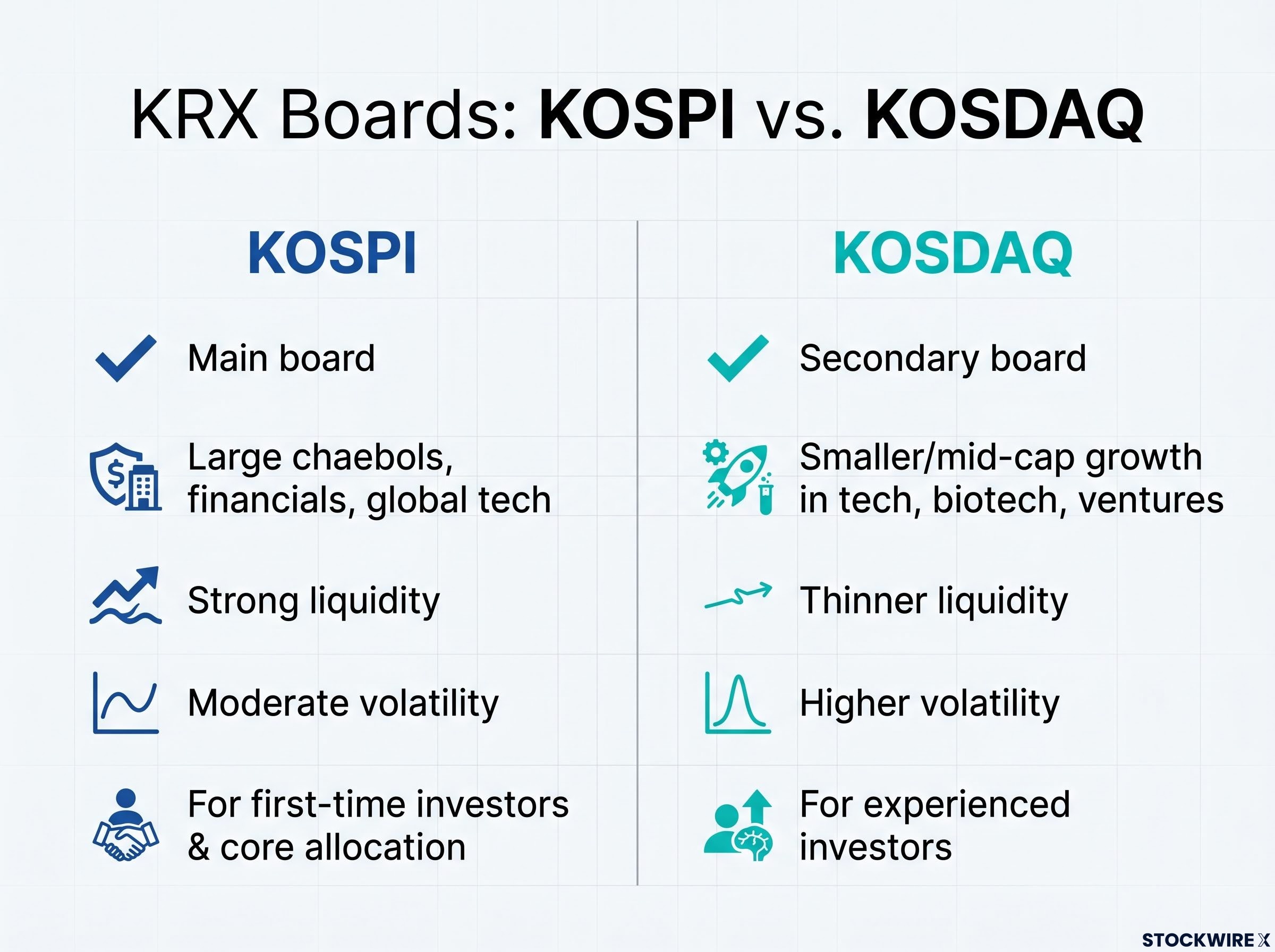
| Attribute | KOSPI | KOSDAQ |
|---|---|---|
| Board type | Main board | Secondary board |
| Company profile | Large, established chaebol names, financials, global tech leaders | Smaller and mid-cap growth companies in tech, biotech, ventures |
| Typical liquidity | Strong; tight bid-ask spreads for index heavyweights | Thinner; larger price impact when trading in size |
| Volatility level | Moderate | Higher; prone to sharp moves on news flow |
| Suitable for | First-time Korea investors; core allocation | Experienced investors comfortable with higher risk |
For a first position, KOSPI large caps or diversified vehicles offer the most manageable entry point. KOSDAQ names can offer higher upside but demand greater comfort with volatility and thinner liquidity.
The practical implications of the dual-board structure go deeper than the summary comparison above; KOSPI vs KOSDAQ allocation requires understanding how Samsung Electronics and SK Hynix together can represent over 40% of the main board benchmark, meaning a sell-off in either name transmits as a broad market decline through passive ETF redemption mechanics.
Trading hours, price limits, and circuit breakers
The Korea Exchange operates Monday through Friday, 9:00 AM to 3:30 PM Korean Standard Time (KST), corresponding to 8:00 AM to 2:30 PM Singapore Time (SGT). The full session falls within a normal Asian business day, making Korean equities particularly convenient for Southeast Asian-based investors who can monitor positions in real time during standard working hours.
The daily price movement limit is the mechanic most likely to surprise investors from Western markets. KRX imposes a limit of plus or minus 30% around the previous close on individual stocks, confirmed current as of mid-2026. Market-wide circuit breakers also exist during episodes of extreme volatility.
The practical implications are specific and worth internalising before trading:
- A stock can hit limit-up or limit-down on strong news, after which it may sit at the limit price with little or no liquidity available
- In a severe negative scenario, an investor may be unable to exit a position at any price until trading reopens within a new band on subsequent sessions
- This risk is heightened in smaller, illiquid KOSDAQ names, where a limit-down with queued sellers can effectively trap investors for multiple sessions
Understanding this mechanic in advance prevents panic and misjudged orders during volatile sessions.
Currency exposure and the Korean won
Currency is not a footnote in cross-border equity investing. It is a second return driver that can silently amplify or undermine equity gains.
Regardless of what currency a broker uses to settle the trade, the underlying exposure is always to KRW. Total return equals stock performance in KRW, plus or minus the change in KRW against the investor’s home currency over the holding period.
The Korean won is sensitive to global risk sentiment and US dollar moves. Korean equities can deliver strong KRW returns but weak home-currency returns in a risk-off period when the won depreciates against the dollar, euro, or Singapore dollar. The reverse also applies: won strength during risk-on periods can add a tailwind to equity gains.
Practical FX cost considerations deserve attention before committing capital:
- Broker FX spreads: Check what conversion spread the broker charges on KRW trades; wide spreads erode returns on frequent trading
- KRW sub-account availability: Holding a KRW sub-account reduces conversion friction for active traders
- SGD settlement layer: Platforms such as POEMS that settle Korean trades in SGD add an additional conversion between SGD and the underlying KRW exposure
- Hedging cost-benefit threshold: Hedging KRW exposure with FX forwards is possible but adds cost and complexity, and typically makes sense only for larger portfolios where the FX position is material
Currency risk is the most commonly underestimated variable in cross-border equity investing. Investors who ignore KRW exposure may find their equity returns dramatically altered by won movements in either direction.
The six risks every investor should assess before committing capital
Risk assessment done upfront, rather than after an adverse event, allows investors to size positions appropriately and set realistic expectations. The six risks below are ordered from structural to situational, reflecting the distinction between risks that affect the investment thesis itself and risks that create periodic volatility around it.
Structural and governance risks
- Governance and minority-shareholder risk: Despite reform progress, controlling shareholders still wield substantial influence across many listed companies. Enforcement of new governance rules will be uneven across companies and over time, meaning the discount may compress at different rates depending on individual corporate behaviour.
- Reform execution risk: Political change, corporate pushback, or shifting policy priorities could slow or dilute the Corporate Value-Up agenda. If the programme loses momentum, the portion of the discount that actually closes may be smaller than reform advocates anticipate.
These are slow-moving risks, but they are foundational. They determine whether the core investment thesis, value plus reform catalyst, ultimately delivers.
Operational, geopolitical, and regulatory risks
- Geopolitical shock risk: Periodic escalations with North Korea or broader regional tensions can cause sharp drawdowns unrelated to company fundamentals, creating short-term volatility that tests investor conviction.
- Currency risk (KRW): As outlined above, won movements can meaningfully amplify or offset equity returns, adding a second layer of volatility beyond stock price movement.
- Liquidity and price-limit risk: Smaller KOSDAQ names can be illiquid, and the plus or minus 30% daily price limit can delay price discovery and temporarily block exits during stressed conditions.
- Regulatory and tax risk: South Korea has a history of adjusting rules on short-selling, capital gains taxation, and foreign investor treatment. Such changes can affect both sentiment and net returns with limited advance warning.
Korean regulatory enforcement can move quickly and with significant consequences for listed companies, as illustrated when South Korea revoked Coupang’s corporate group exemption and subjected the U.S.-listed firm to strict antitrust frameworks around cross-shareholding, debt guarantees, and related-party transactions, the same categories of behaviour the Corporate Value-Up programme is pressing all listed groups to reform.
These risks are more event-driven and manageable with appropriate position sizing, broker selection, and awareness. None of them invalidates the investment case, but each requires conscious preparation.
Where Korean equities fit in a portfolio and a practical first-step checklist
Korean equities are best understood as a satellite allocation sitting around a diversified global or regional core. Global and emerging market indices already include South Korea, but often at a weight that does not fully reflect the potential upside from reform-driven multiple expansion.
The sector concentration reality matters for portfolio construction. Korean equities are heavily weighted toward:
- Semiconductors and electronics
- Automobiles and auto parts
- Cyclical exporters and industrials
Investors should check for overlap with existing global technology and industrial holdings before adding Korea-specific exposure. A mid-single-digit percentage of total equities serves as a practical starting point, adjusted for individual risk tolerance.
The following checklist converts this guide into an action sequence:
- Define the investment thesis: Determine whether the goal is broad Korean re-rating exposure, sector-specific positioning (such as semiconductors), or individual reform-winner selection.
- Choose the implementation vehicle: ETF, active fund, or direct stock selection, matched to the level of involvement and expertise available.
- Select a broker that offers KOSPI and KOSDAQ access with transparent FX and fee structures. If using a regional platform, confirm how it handles KRW settlement.
- Understand trading rules: Six-digit numeric tickers, trading hours (9:00-15:30 KST), daily price limits of plus or minus 30%, and available order types.
- Size Korea as a satellite position relative to total equity exposure, not as a dominant portfolio bet.
- Plan for FX and geopolitical volatility so that periodic drawdowns do not force a panicked exit at the worst possible moment.
- Revisit holdings periodically as reform milestones materialise and corporate behaviour evolves; the Corporate Value-Up programme is a multi-year process with outcomes that will emerge unevenly.
Korean equities offer real opportunity, but the entry conditions matter
South Korean equities are not simply cheap. They are cheap with a reform catalyst, and the combination of structural discount plus official policy pressure to close it creates a risk-reward profile not easily replicated elsewhere in global equity markets.
The risks are genuine. Governance enforcement will be uneven across companies. Geopolitical noise will create periodic volatility. Currency movements will add a second layer of return uncertainty. None of these risks are trivial, but all of them are manageable with appropriate position sizing, a well-chosen broker setup, and a time horizon that accommodates the multi-year nature of reform.
The Corporate Value-Up programme is still evolving as of mid-2026. Investors who do the structural work now, understanding the discount’s origins, the reform mechanics, the market’s operational features, and the currency dynamics, position themselves to benefit from milestones that have not yet fully materialised.
For investors who have decided to enter Korean equities and want to see how institutional risk management frameworks apply in practice, our deep-dive into Citigroup’s KOSPI position management examines how a major bank weighed overbought signals, record retail margin debt, and tightening global yields to close half a long position while preserving upside exposure through the remaining stake.
This article is for informational purposes only and should not be considered financial advice. Investors should conduct their own research and consult with financial professionals before making investment decisions. Past performance does not guarantee future results, and forward-looking statements regarding reform outcomes are subject to change based on political, corporate, and market developments.
—