Most Australian investors searching for Vanguard ETFs on the ASX expect to find one or two obvious choices. VTEK, VDAL, and VTS are all Vanguard products, all 100% equity, all available on the ASX, and yet they are built for fundamentally different jobs. Picking the wrong one for your situation is not a minor error.
The three funds differ across geographic focus, sector concentration, fee structure, domicile, and how much diversification they actually provide. VTEK tilts hard into global technology. VDAL puts your money to work across a portfolio of over 6,000 companies drawn from around 50 countries worldwide. VTS gives you the full US equity market at a fee of 0.03% per year. These are meaningfully different tools, and the right one depends on what your portfolio already contains and what role you need filled.
This guide maps out what each fund is actually built to do, where each one carries concentration risk, which investor situations each suits, and how they interact when combined. After reading, you will have a clear framework for deciding which of the three belongs in your portfolio, and whether any combination makes structural sense for your goals.
What makes these three Vanguard ETFs structurally different
All three are Vanguard. All three are 100% equity. All three trade on the ASX. That is where the similarity ends.
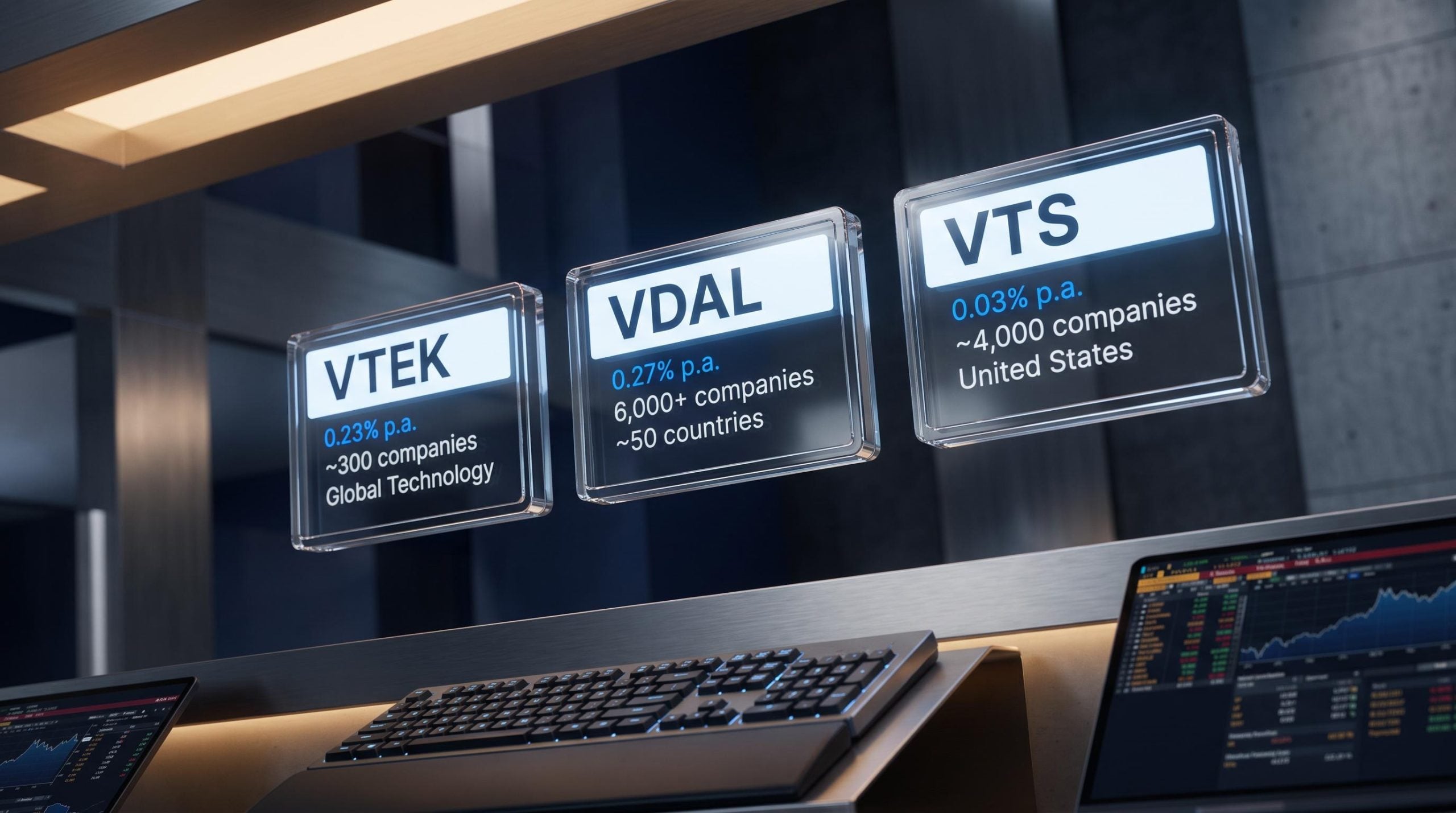
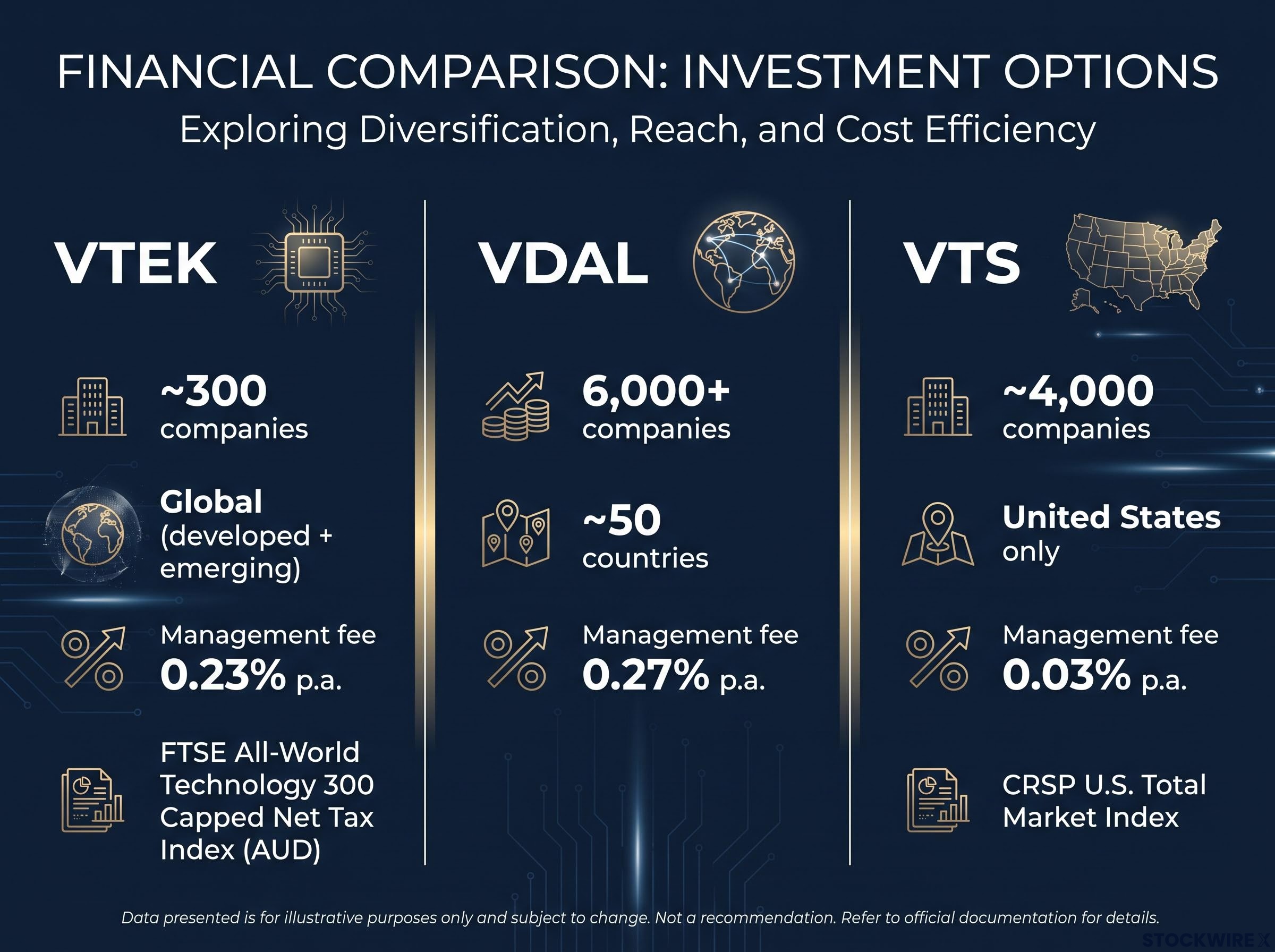
VTEK tracks an index of roughly 300 large and mid-cap technology firms drawn from both developed and emerging market economies. VDAL assembles a portfolio of more than 6,000 stocks spread across approximately 50 countries and every major sector. VTS holds approximately 4,000 US companies from mega-caps down to micro-caps. The number of holdings alone tells you these funds serve different purposes, but the real separation runs deeper: geographic scope, sector focus, and domicile each create distinct implications for your portfolio.
| Feature | VTEK | VDAL | VTS |
|---|---|---|---|
| Index tracked | FTSE All-World Technology 300 Capped Net Tax Index (AUD) | Strategic mix of Vanguard index funds/ETFs | CRSP U.S. Total Market Index |
| Geographic focus | Global (developed + emerging) | Global (~50 countries) | United States only |
| Approx. companies | ~300 | 6,000+ | ~4,000 |
| Management fee | 0.23% p.a. | 0.27% p.a. | 0.03% p.a. |
Choosing between these three is not a matter of preference. It is a question of what gap exists in your current portfolio and which fund is designed to fill it.
The CDI structure of VTS and why it matters
VTEK and VDAL are both Australian-domiciled ETFs. VTS is not. When you buy VTS on the ASX, you are purchasing a CHESS Depositary Interest (CDI), a type of security that represents an interest in a US-domiciled Vanguard fund. CDIs allow Australian investors to trade a foreign fund on the ASX through the standard CHESS settlement system.
This distinction matters because a US-domiciled structure can carry different tax and estate-planning implications compared to an Australian-domiciled ETF. If you are considering VTS, it is worth seeking specific financial or tax advice on how the CDI structure applies to your personal situation before investing.
When big ASX news breaks, our subscribers know first
How each fund handles concentration risk
Each of these funds concentrates your money differently, and that concentration is not accidental. It is built into the fund’s design. Your job is to understand which type of concentration you are comfortable accepting.
VTEK: sector concentration
- Your primary risk is the technology sector itself. If tech valuations compress or the sector sells off broadly, VTEK falls with it.
- A per-company weighting cap of 20% (applied at each semi-annual index review) limits the outsized influence of any single mega-cap, but it does nothing to cushion a sector-wide decline.
- The fund covers semiconductors, software, cloud computing, cybersecurity, hardware, and data infrastructure, all sitting within the same sector cycle and moving in broadly correlated ways.
- Returns are also subject to AUD currency movements against a basket of foreign currencies, since VTEK is unhedged.
VDAL: equity-only concentration
- Diversification across countries, sectors, and market caps means no single company, country, or sector can dominate your outcomes.
- Because the fund holds no bonds at all, a significant global equity downturn will still produce deep losses. Spreading across thousands of companies does not shield you when markets fall broadly.
- You are accepting the full volatility of global equities in exchange for the full return potential over the long term.
VTS: country concentration
- Highly diversified within the United States across company size, sector, and industry, but not diversified outside it. Your entire allocation sits in one economy.
- AUD/USD currency movements add a second layer of return variability. A strengthening Australian dollar can reduce your AUD-measured returns even when US markets perform well.
- VTS is a building block, not a complete portfolio.
Vanguard’s own positioning: VTEK is designed to be added to a diversified portfolio as a sector exposure, not used as a core holding on its own.
The concentration risk profile of the fund you choose is the risk you are buying into. Understanding which type of concentration you are comfortable accepting is the core decision this comparison requires.
Thematic overlap is one of the most common structural errors in multi-ETF portfolios: an investor who pairs VTEK with a broad global fund may believe they hold two separate positions while actually concentrating 30-40% of combined value into the same handful of US technology mega-caps.
Understanding the fund-of-funds structure inside VDAL
When you buy one unit of VDAL, you are not directly owning 6,000 individual shares. You are buying into a fund-of-funds, a structure where VDAL holds other Vanguard ETFs and managed funds as its underlying positions. Vanguard then sets and maintains the asset mix between those underlying funds.
The major underlying holdings, and what each contributes to your overall exposure, are:
- Vanguard Australian Shares Index ETF (VAS): Australian equity exposure
- Vanguard MSCI Index International Shares ETF (VGS): Developed-market international equity exposure (unhedged)
- Vanguard MSCI Index International Shares (Hedged) ETF (VGAD): Developed-market international equity exposure (hedged to AUD)
- Vanguard MSCI International Small Companies Index ETF (VISM): International small-cap coverage
- Vanguard Emerging Markets Shares Index Fund: Emerging-market equity exposure
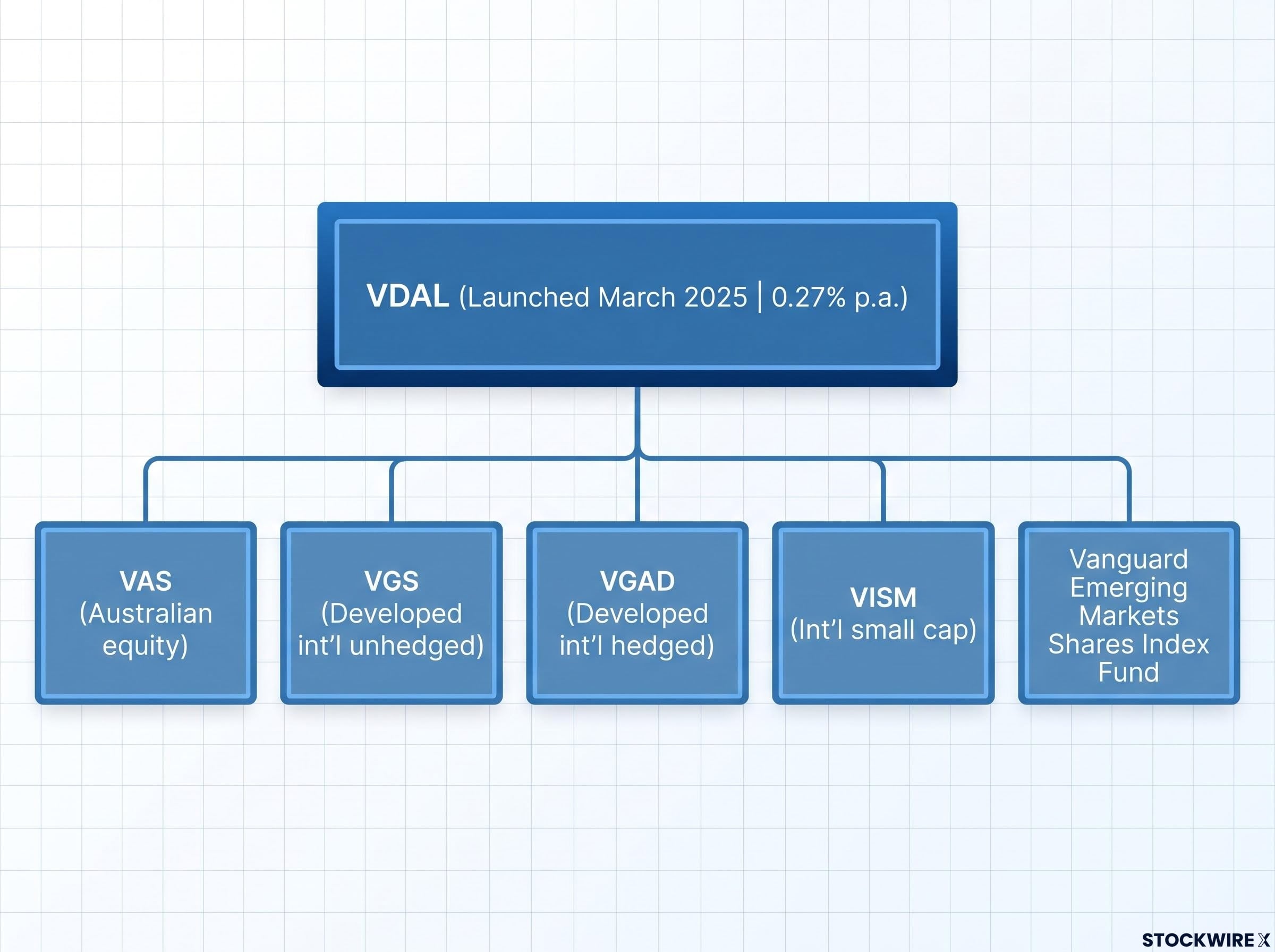
An important distinction: Vanguard is not stock-picking inside VDAL. Each underlying fund tracks its own index. Vanguard’s role at the VDAL level is setting the strategic allocation between these index-tracking funds and rebalancing periodically, so you do not have to manage the weights yourself. The management fee of 0.27% per year covers the ETF layer, with underlying fund costs built into the overall fee.
For investors who want broad global diversification without managing multiple ETFs themselves, VDAL’s fund-of-funds structure means Vanguard handles the rebalancing. But you must understand what you are trading for that convenience.
What VDAL’s short track record means for investors
VDAL launched in March 2025. That gives it roughly four months of live performance data as a listed ETF.
The underlying funds, including VAS, VGS, and VISM, have established track records stretching back years. But VDAL itself as a single listed product has minimal live data. Backtested index performance, the kind you may see in product materials, does not equal live ETF performance. Tracking error, fund flows, and real-world rebalancing can all create differences.
This is not a reason to avoid VDAL. It is a transparency point worth factoring into your assessment, particularly if you are comparing it against funds with longer observable histories.
Which investor type suits each fund
The fund characteristics above only become useful once you map them onto your own situation. Here is where each one fits.
VTEK suits you if you already hold a broadly diversified portfolio and want to deliberately overweight technology relative to its market-cap weight in a global index. It is a satellite position for investors with high risk tolerance and a long time horizon who understand and accept tech-sector valuation cycles. If VTEK is the only ETF in your portfolio, it is doing a job it was never designed to do.
VDAL suits you if you want one ASX ticker to deliver your entire global equity allocation. Your single holding encompasses upwards of 6,000 stocks from around 50 countries, with Vanguard overseeing the allocation mix and handling periodic rebalancing on your behalf. The trade-off is that 100% growth assets means no bond cushion, so you need to be comfortable with deep drawdowns in exchange for global equity return potential over the long term.
VTS suits you if you want a low-cost way into the full depth of the US equity market, reaching well past the S&P 500 to capture the roughly 4,000 companies that span small and micro-cap territory, at the lowest cost of the three (0.03% per year). You need to accept that your entire allocation sits in a single country, along with the associated AUD/USD currency exposure, and you should be aware of the CDI structure’s potential tax implications.
| Fund | Best suited to | Key condition |
|---|---|---|
| VTEK | Investors adding a deliberate tech-sector tilt | Must already hold a diversified core portfolio |
| VDAL | Investors wanting one-fund global equity exposure | Must accept 100% equity volatility with no bond cushion |
| VTS | Investors building low-cost US market exposure | Must accept country concentration and AUD/USD currency risk |
Your current portfolio composition is the most important input here. VTEK and VTS are both portfolio additions that work best alongside other holdings. VDAL is designed to work as the whole equity allocation on its own.
For investors evaluating VDAL against the broader one-fund solution category, our full explainer on ASX diversified ETF alternatives covers how BetaShares DHHF and the new VanEck active range compare on cost, asset class coverage, and performance track record.
How VTEK, VDAL, and VTS interact when combined
Holding two Vanguard ETFs together does not automatically improve diversification. In some combinations, it amplifies concentration. Here are the three logical pairings, ordered from lowest to highest concentration risk.
- VDAL plus VTEK: global core with a technology overweight. VDAL already holds global technology companies at their market-cap weight through underlying funds like VGS. Adding VTEK increases your tech sector exposure above that weight. This is the intended outcome if you hold a conviction view on long-term tech sector outperformance. You are keeping the global core intact and deliberately tilting one sector heavier.
- VTS plus VDAL: global base with a US tilt. VDAL already includes US exposure through its underlying funds. Adding VTS concentrates more of your combined portfolio toward the US market and USD currency movements. This combination suits you if you want global diversification as a foundation but believe US equities specifically warrant a heavier allocation.
- VTS plus VTEK: high-growth, high-concentration. This is the most concentrated combination of the three. VTS gives you single-country exposure to the United States. VTEK gives you global technology exposure, which itself carries significant US weight given US technology companies’ dominance in global tech indices. The overlap between these two funds is substantial, producing a portfolio that concentrates in both US equities and the technology sector simultaneously.
Pairing VTEK with VTS is a case study in hidden concentration risk: both funds carry heavy exposure to US technology mega-caps, meaning two separate ETF positions can effectively function as a single, amplified sector bet rather than two independent sources of return.
The key caution: VTS plus VTEK amplifies risk rather than diversifying it. If you choose this combination, you are doing so with intentional concentration, not because you believe two funds are inherently safer than one.
Every combination strategy here either increases concentration in a specific country or sector, or both. There is no combination of these three funds that reduces risk relative to holding VDAL alone. The decision to combine should be driven by deliberate conviction rather than diversification logic.
Making the right call for your portfolio
Before choosing, answer three questions about what you already hold:
- What geographic exposure does your existing portfolio give you? If you are already heavily weighted to the US (through other ETFs, super, or direct holdings), adding VTS doubles down on that concentration.
- Do you want to manage multiple ETFs yourself, or would you prefer Vanguard to handle the diversification and rebalancing? That choice is the core trade-off between VTS and VDAL.
- Are you adding a satellite tilt to an existing portfolio, or building a core holding from scratch? The answer determines whether VTEK or VDAL is the right starting point.
The fee difference is worth stating plainly. VTS at 0.03% per year is substantially cheaper than VDAL at 0.27% or VTEK at 0.23%. Over a long investment horizon, that gap compounds meaningfully. But the right fee to pay depends on whether you want Vanguard managing the diversification for you or whether you are prepared to do it yourself across multiple holdings.
The fee difference between VTS at 0.03% and VDAL at 0.27% appears small in any single year, but fee compounding over time turns that gap into a meaningful divergence in terminal wealth across a long investment horizon.
Before investing in any of these funds, keep the following in mind:
- Each ETF has a Product Disclosure Statement (PDS) and Target Market Determination (TMD) that you should read before investing
- Consider your personal objectives, financial situation, and individual needs
- A licensed Australian financial adviser can provide guidance tailored to your specific circumstances
This article is for informational purposes only and should not be considered financial advice. Investors should conduct their own research and consult with financial professionals before making investment decisions.