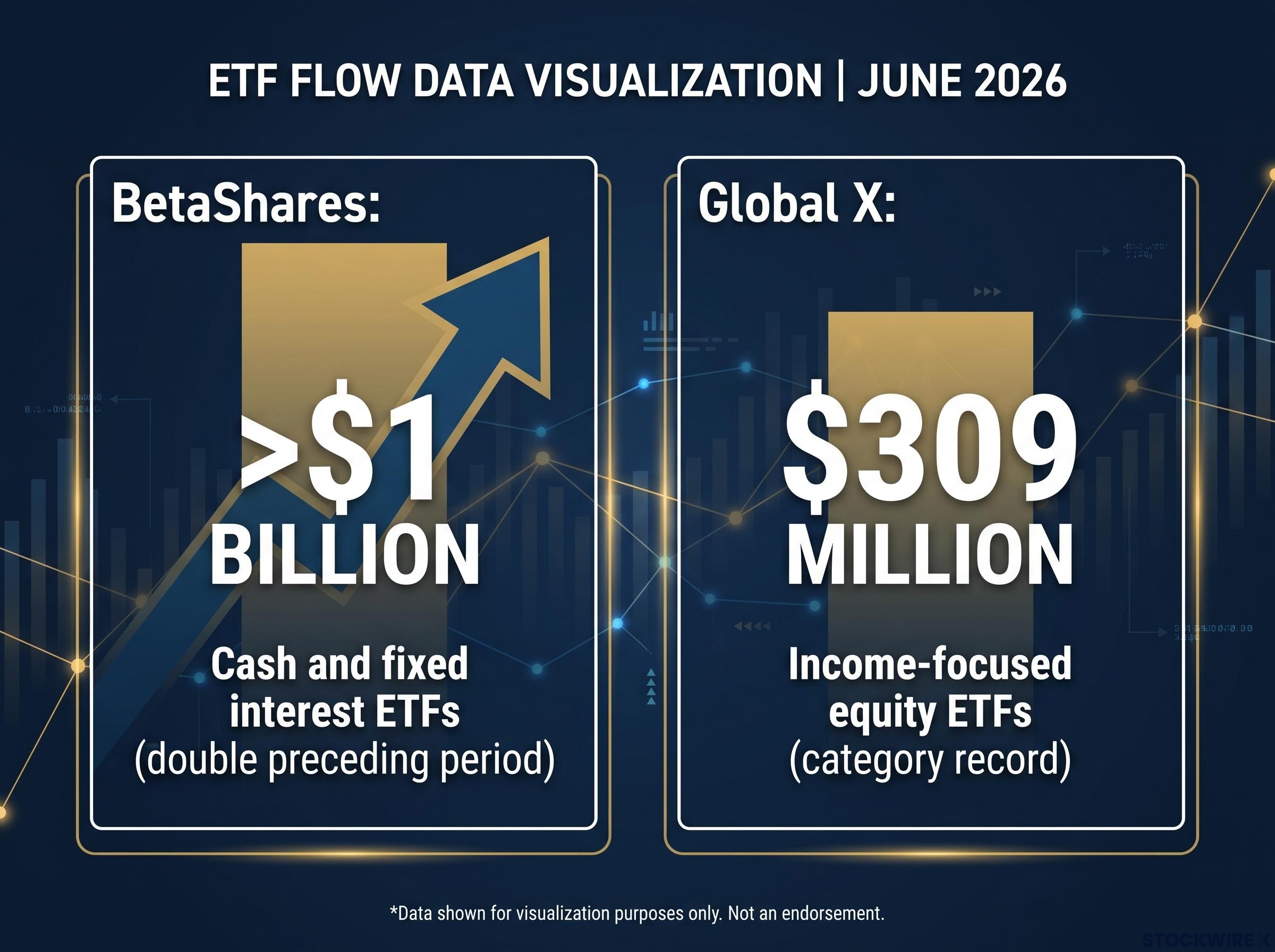
In June 2026, BetaShares data showed cash and fixed interest ETFs drawing in excess of $1 billion from Australian investors, representing twice the volume of the preceding period. Separately, Global X recorded a category-high $309 million entering income-focused equity ETFs over the same month. The numbers are startling. They are also 12 months early.
The capital gains tax reforms driving this behaviour are real and legislated under the Treasury Laws Amendment (Tax Reform No.1) Bill 2026. But their cash impact on investors does not begin until 1 July 2027, and even then, only on gains accruing from that date. The gap between a law on the books and a law in your tax return is where rational strategy and emotional reaction tend to diverge.
Here is the framework for working out which side of that line the current market moves fall on, and which camp your own instincts might belong to. The numbers, the mechanics, and the trade-offs that follow give you enough to make that call for yourself.
A billion dollars shifted in one month: what June’s ETF flows actually reveal
The scale is worth sitting with for a moment.
- $309 million was recorded entering income-focused equity ETFs across June 2026, a figure Global X described as a category record for that month
- $1 billion was directed into cash and fixed interest ETFs over the same period, a figure BetaShares reported as double the prior month’s total
$1 billion into cash and fixed interest ETFs in a single month. That is not a gradual tilt. That is a cohort of investors who have already concluded the CGT changes require action, and who are acting on that conclusion a full year before the new rules take effect.
Those figures tell you something real about sentiment. A significant number of Australian investors have decided that the reformed CGT environment favours income and capital preservation over growth. The direction is understandable. The timing is the detail that should give every reader pause.
Global X ETFs June 2026 flow data records that index-based equity income ETFs attracted $309 million in June, described as a monthly inflow record for the category, within an overall month that saw Australians direct $3.5 billion into ETFs across all types.
The Treasury Laws Amendment (Tax Reform No.1) Bill 2026 is legislated, but its provisions commence on 1 July 2027. These flows are anticipatory, not reactive to an actual tax bill. One month of ETF data reveals where investors are moving. It cannot confirm whether those moves will generate better after-tax outcomes over the next decade. That distinction matters before anyone treats aggregate flow data as a signal for their own portfolio.
When big ASX news breaks, our subscribers know first
What the new CGT rules actually change from 1 July 2027
The most familiar feature disappearing is the 50% CGT discount. Since 1999, individuals, trusts, and partnerships have been able to halve the taxable capital gain on assets held for more than 12 months. From 1 July 2027, that discount is abolished.
In its place, the government is reinstating cost-base indexation. Under this mechanism, the cost base of an asset is adjusted upward using the Consumer Price Index (CPI), so that only the real, inflation-adjusted gain is taxed. That is a different form of concession, not the absence of one.
A minimum 30% tax rate will apply to those real capital gains for affected taxpayers, regardless of their marginal rate. And assets acquired before 20 September 1985, currently exempt from CGT entirely, will be assigned a cost base equal to their 1 July 2027 market value, with gains from that point forward becoming taxable.
| Element | Current rule | New rule (from 1 July 2027) |
|---|---|---|
| CGT discount (assets held >12 months) | 50% discount on nominal gain | Abolished; replaced by CPI indexation of cost base |
| Tax rate on capital gains | Marginal rate (after 50% discount) | Minimum 30% on real (indexed) gains |
| Pre-CGT assets (acquired before 20 Sept 1985) | Fully exempt | Cost base reset to 1 July 2027 market value; gains from that date taxable |
The transitional rule that changes the urgency calculation
This is the detail most coverage buries, and it materially changes the calculus around timing.
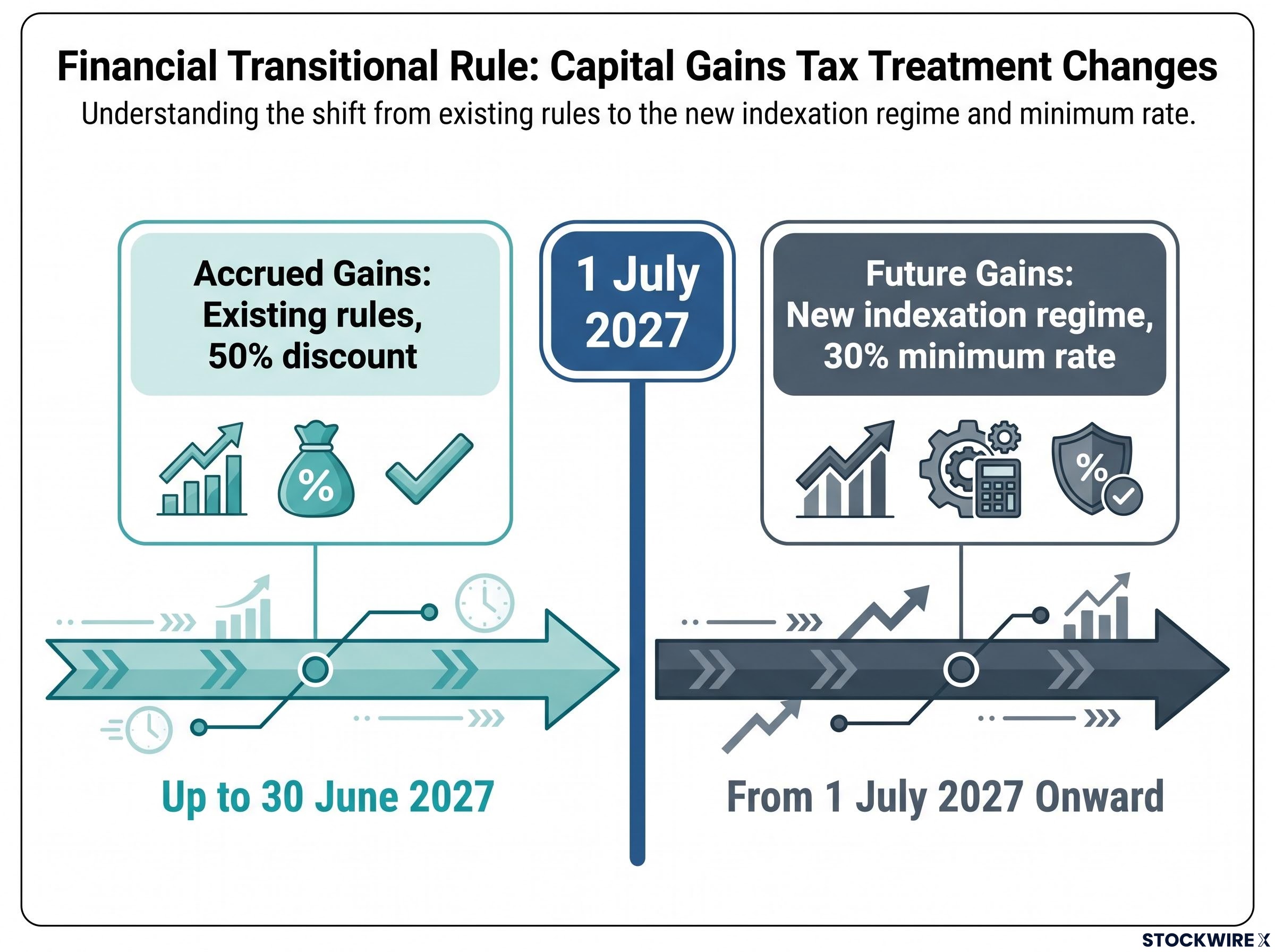
For any asset held before 1 July 2027 and sold after that date, the gain is split. The portion accrued up to 30 June 2027 is taxed under the existing rules, including the 50% discount. Only the portion accruing from 1 July 2027 onward falls under the new indexation regime and the 30% minimum rate.
That means gains you have already built are not at risk from the new rules, regardless of when you eventually sell. Selling before 1 July 2027 to “lock in” the old rates is not necessary, and doing so could itself trigger a taxable event that would not otherwise have occurred. The urgency the headline coverage implies is, for most investors, significantly overstated.
Why income and franked dividends now look more attractive for some investors
The arithmetic that explains the June flow data starts with two numbers sitting side by side.
Under the new rules, real capital gains face a minimum 30% tax rate. Meanwhile, franked dividends from most listed Australian companies carry a 30% franking credit, which offsets the company tax already paid on that income. For investors in tax brackets below 30%, the effective tax rate on franked dividends can be well below that threshold. For eligible low-income investors and certain retirees, excess franking credits are refundable, meaning the effective rate can approach zero.
For retirees and low-income investors, the franking credit entitlement calculation matters more under the new CGT regime than it did before, because the gap between a near-zero effective rate on fully franked dividends and the 30% minimum rate on capital gains is what drives the income-shift logic visible in the June ETF flows.
For eligible low-income investors, the effective tax on fully franked dividends can be close to zero. That makes franked income genuinely tax-superior to capital gains taxed at a minimum 30% rate under the new regime.
The contrast sharpens for specific cohorts:
- Capital gains (from 1 July 2027): Only real gains taxed, but at a minimum 30% rate. For investors currently below 30% marginal rate, this is a clear increase in CGT cost. For investors at the 45% top marginal rate (plus Medicare levy), gains remain concessional relative to ordinary income, but less generous than the current 50% discount.
- Franked dividends: Taxed at marginal rate with 30% franking credit offset. Refundable for eligible investors. Effective rate can be substantially lower than the new CGT minimum for moderate-income and retired investors.
Whether the income shift visible in the ETF data represents smart positioning depends almost entirely on where a given investor sits in the tax bracket distribution. The aggregate flow data cannot answer that question for any individual.
When chasing income becomes a wealth trap
The directional logic is understandable. The government has increased the price of capital gains at the margin. But it has not neutralised them.
A 30% rate on real gains is still tax-preferred relative to ordinary income taxed at up to 45% plus Medicare levy for high-bracket investors. Growth assets still compound. Capital appreciation still constitutes a substantial portion of historical total returns from equity portfolios. That has not changed.
The wealth trap emerges when an investor, motivated by headline CGT changes, shifts aggressively into income or cash products and ends up with a lower total return, even after tax, over a decade. The tax bill is smaller. The portfolio is also smaller. A higher absolute after-tax return at a somewhat higher CGT rate beats a lower return at a lower tax bill. That arithmetic is straightforward, but it is easy to lose sight of when the policy change feels urgent.
Reactive switching costs in superannuation have been documented across multiple market cycles, with members who moved to cash during the April 2025 sell-off positioned to miss a roughly 5.8% single-month recovery, a dynamic that mirrors the behavioural pattern the June income-ETF flows may be replicating in a CGT context.
Mark LaMonica, CFA, Director of Personal Finance at Morningstar Australia, has argued that behavioural discipline, specifically the willingness to remain patient and resist acting without clear cause, contributes more to long-term investment outcomes than the capacity to identify the best available opportunity.
For any reader currently tempted to shift heavily toward income or cash, the concrete check is this: does the projected after-tax total return from the new allocation actually exceed the after-tax total return from the current one? If you have not modelled that comparison, the move is a guess, not a strategy.
What strategic repositioning looks like versus what the data shows investors are doing
The two approaches can look similar on the surface. The distinction is in the process behind them.
Strategic repositioning:
- Reviewing whether your portfolio is over-reliant on capital gains relative to your specific tax bracket and life stage
- Reducing unnecessary turnover so that fewer gains are crystallised under the new rules
- Considering asset location (where you hold assets) rather than changing asset types
- Modestly tilting toward income where it genuinely improves after-tax outcomes without undermining long-term growth
Reactive behaviour:
- Acting on the impulse to “do something” after a policy announcement
- Extrapolating from one month of ETF flow data as though it reveals a durable trend
- Replicating what the market appears to be doing without testing it against your own circumstances
The commencement date of 1 July 2027 is itself the structural reason why there is time to plan rather than react. And the transitional rule means pre-2027 gains are not at risk regardless of when an asset is eventually sold. Mark LaMonica of Morningstar Australia has consistently made the case that slowing down decision-making and focusing on personal circumstances rather than external noise is the most valuable discipline investors can cultivate during periods of regulatory change.
If your current thinking about portfolio changes is driven by what the June ETF flow data shows other investors doing, rather than by your own tax bracket, holding period, and income needs, that is a signal to pause and seek modelling before acting.
Why superannuation changes the calculation
Superannuation is subject to lower CGT rates than assets held outside super. In the accumulation phase, a one-third discount applies to assets held for more than 12 months, producing an effective rate of around 10%. That means asset location, moving assets into super where eligible, can address much of the CGT efficiency concern without requiring a shift from growth to income assets at all.
ASFA’s submission on the CGT discount confirms that complying superannuation funds access a one-third reduction in most circumstances where an asset is held for more than 12 months, producing an effective CGT rate of around 10% in the accumulation phase.
For many investors, reviewing asset location within super is a more proportionate first response than changing asset class exposure entirely.
Super and ETF combinations that direct salary sacrifice into the concessional cap while holding growth assets outside super give investors access to two distinct tax environments simultaneously, a structure that addresses the asset location question the CGT reform raises without requiring a wholesale shift away from equity growth.
What investors who get this right will likely have in common
The investors most likely to navigate the reformed CGT environment well will probably share three characteristics:
- They understand the mechanics. The 1 July 2027 start date, the transitional protection for pre-2027 gains, and the continued tax preference for capital gains over ordinary income all inform their decisions.
- They make personal decisions, not market-driven ones. A retiree in drawdown, a mid-career accumulator, and a high-income professional with a large discretionary portfolio face very different effective tax rates and cash-flow needs. The right move is deeply personal.
- They model before they move. Professional advice has particularly high value in this environment given the interaction of the new rules with superannuation, property, and existing holdings.
For investors wanting to compare the new indexation regime against the old discount across different holding periods and return assumptions, our deep-dive into CGT indexation modelling shows that the gap between the two approaches widens significantly for high-growth assets held over 20-year horizons.
Unlike many regulatory transitions, this one gives investors a 12-month runway before the rules take effect. That gap is an advantage to deploy, not a countdown to beat. Using it to review, seek advice, and make deliberate changes is itself the strategic move.
LaMonica has consistently pointed to controllable factors, including contributions, diversification, fees, and holding periods, as the levers with the greatest influence on long-term wealth outcomes, arguing that these matter more than adjusting a portfolio in response to modest shifts in tax settings. Building financial independence is still a realistic objective for investors who approach change with care rather than urgency.
The rules are set; the strategy is still yours to make
The CGT changes are real and the legislation is clear. The investor response visible in June’s ETF flows is directionally logical: income and capital-preservation products do carry relative appeal for a meaningful cohort of investors under the new regime. Even so, the pace and magnitude of those shifts, occurring a full 12 months before the rules take effect, invite serious scrutiny as to whether the underlying decisions will prove financially sound for the individuals concerned.
The transitional rules protect gains already accrued. The 12-month lead time provides room to plan. Capital gains remain tax-preferred over ordinary income even under the new regime. All of this argues for deliberate planning rather than reactive restructuring.
The most productive move for most investors right now is to model, not move. If you are considering significant changes, this is an environment where professional advice is unusually valuable, given the personal variables involved.
This article is for informational purposes only and should not be considered financial advice. Investors should conduct their own research and consult with financial professionals before making investment decisions. The CGT reform details discussed are based on legislated provisions; individual outcomes will depend on personal circumstances, and professional tax advice is recommended before acting on any of the information presented here.
—