Anthropic is one of the most talked-about companies in artificial intelligence, and its shares are almost impossible to buy. The company has not filed for an IPO, does not trade on any exchange, and actively blocks most secondary market transactions at the board level.
For retail investors looking to gain exposure before any public listing, the path forward is indirect but real. It runs through exchange-traded funds, closed-end fund structures, venture-style vehicles, and the large-cap technology companies that hold substantial equity stakes while simultaneously serving as Anthropic’s cloud and hardware vendors.
This guide maps each of those options with current allocation percentages and the structural tradeoffs that come with them, so you can identify which route fits your liquidity preferences, risk tolerance, and concentration goals rather than settling for whatever you stumble across first.
Why retail investors cannot buy Anthropic shares today
The barrier is not just financial. It is structural.
Anthropic remains privately held with no SEC registration filing and no exchange listing as of 31 July 2026. Even platforms that specialise in pre-IPO shares cannot help you here. Forge Global and Hiive each publish informational pages covering Anthropic, yet both sites make clear that the stock is simply not on offer. The situation is quite different for rival OpenAI, whose shares are actively traded across both platforms.
Three factors combine to create the block:
- No public listing or SEC registration. Anthropic has not filed any registration statement that would allow public share sales.
- Board-level transfer approval required. Anthropic’s own policies require board sign-off on any share transfer, and that consent is not being extended to secondary market activity.
- No active secondary market availability. Even accredited investors, those whose net worth clears $1 million or whose annual earnings reach $200,000 as individuals (or $300,000 as a couple), cannot execute purchases because none are being facilitated.
Anthropic has warned on its official website that purported third-party sales of its shares may not be legitimate. If you encounter an unsolicited offer to buy Anthropic shares directly, treat it with significant scepticism.
The practical implication is clear: even investors who meet every accredited threshold face a structural wall, not just a financial one. The indirect routes in the rest of this guide are not workarounds for impatience. They are the only real options available.
When big ASX news breaks, our subscribers know first
Exchange-traded funds with direct Anthropic stakes
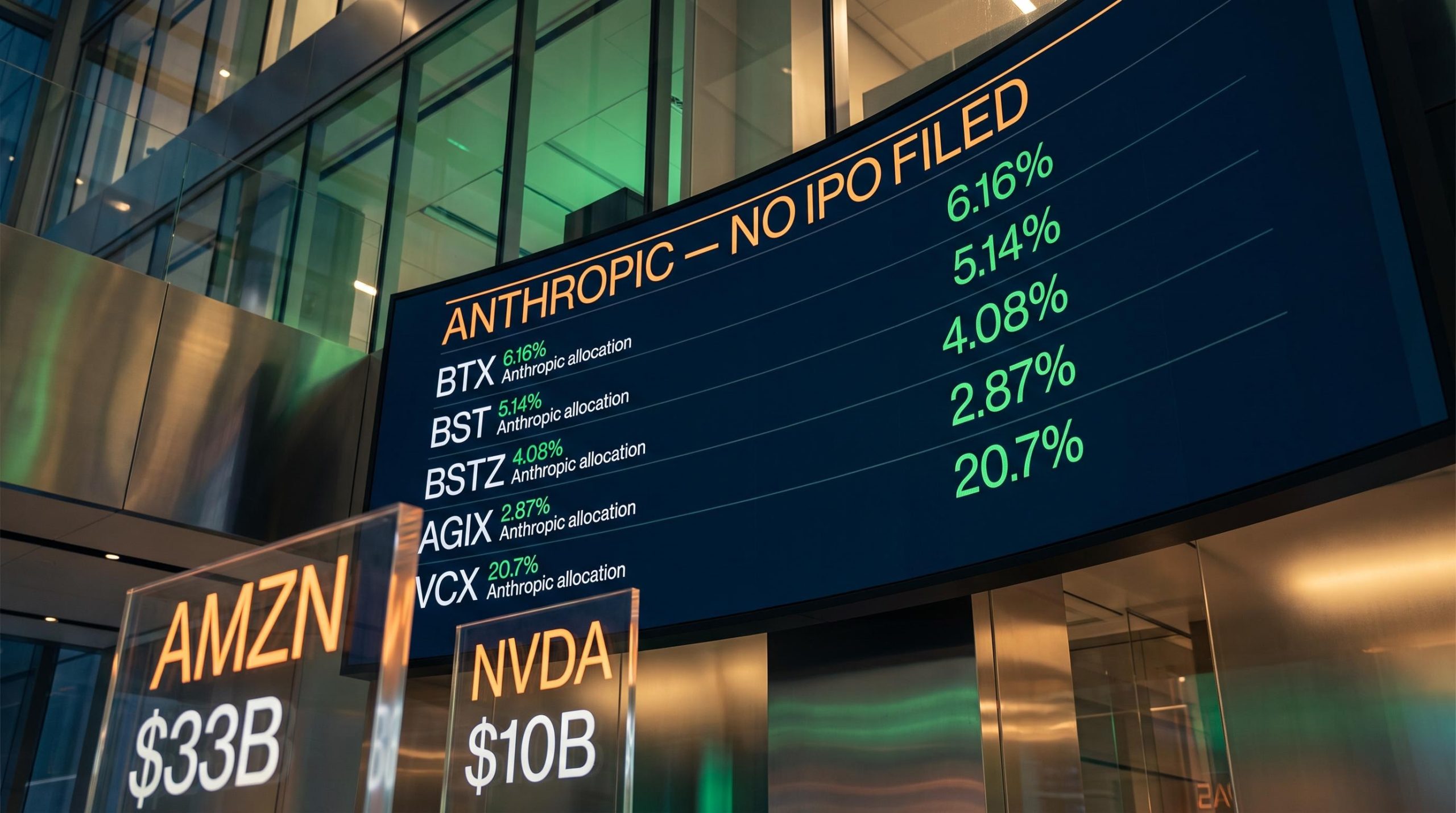
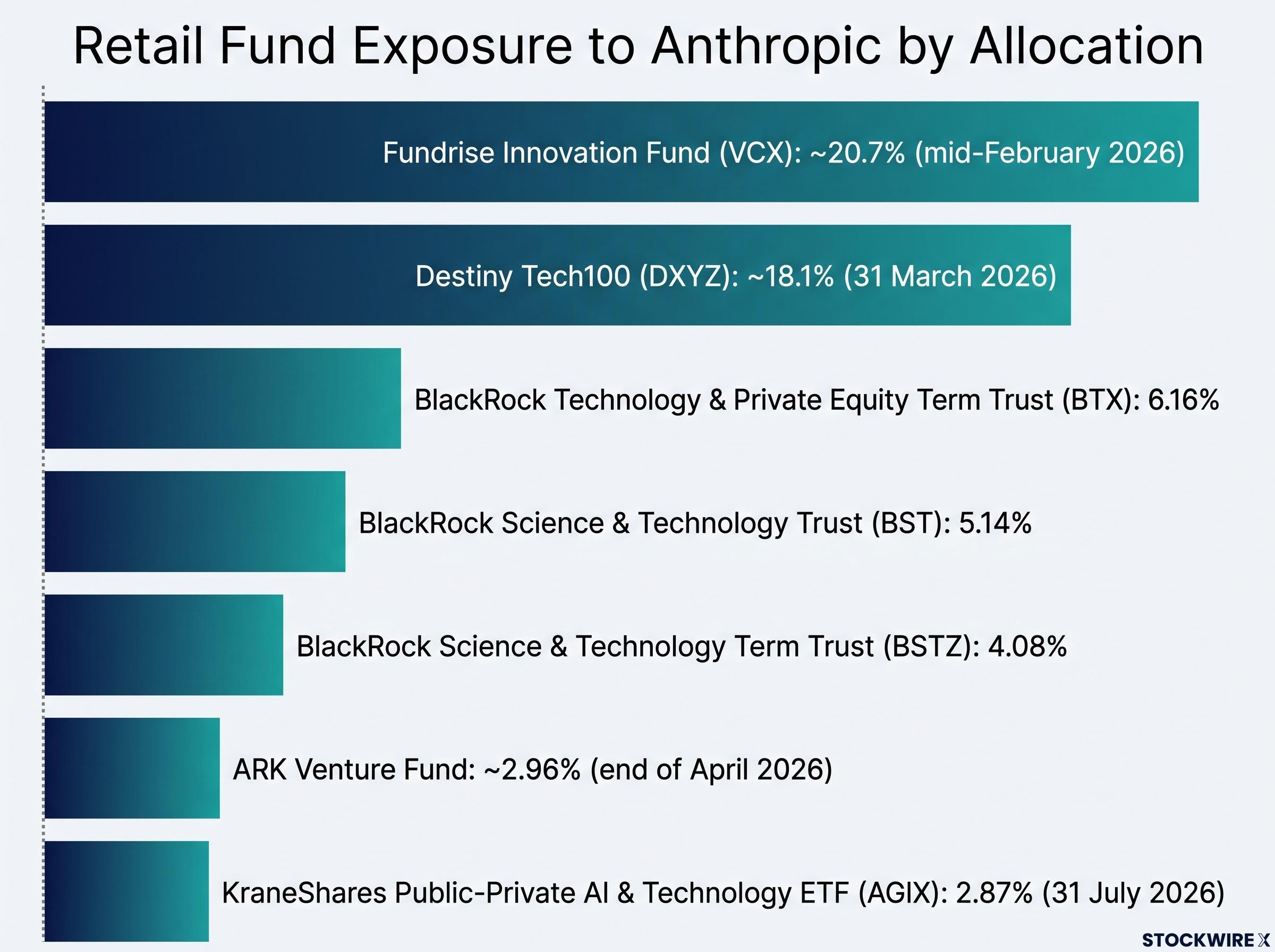
Four exchange-listed funds currently hold direct Anthropic equity positions, and their allocations cluster between roughly 3% and 6% of assets. That range tells you something useful upfront: through these vehicles, you are buying diversified AI portfolios with Anthropic as a meaningful but not dominant component.
The ETF route: AGIX
The KraneShares Public-Private AI and Technology ETF (AGIX) is currently the only traditional ETF with a direct Anthropic equity position. As of 31 July 2026, Anthropic represented approximately 2.87% of fund assets, according to KraneShares disclosures.
AGIX also holds major public AI names including Microsoft, Alphabet, Amazon, and Nvidia, so you get both layers of Anthropic-related exposure in a single vehicle. The constraint worth knowing: under SEC Rule 22e-4, open-end ETFs may hold no more than 15% of assets in illiquid investments, which caps how large any single private position like Anthropic can grow inside the fund.
Because Anthropic is privately valued, its position inside AGIX is marked via periodic valuations rather than continuous market pricing. That means the ETF’s net asset value (NAV), which is the total value of all its underlying holdings divided by the number of shares, may lag changes in Anthropic’s actual value.
ETF closure mechanics matter specifically for niche vehicles like AGIX, where a small assets-under-management base and a single illiquid private position create viability risk that standard ETF investors rarely price into their decision.
The closed-end fund route: BSTZ, BTX, and BST
Three BlackRock closed-end funds hold larger direct Anthropic positions. Closed-end funds differ from ETFs in one important way: their market price can trade at a premium (above) or discount (below) the underlying NAV, adding a second pricing variable beyond Anthropic’s own valuation.
| Fund Name | Ticker | Structure | Anthropic Allocation (%) | Key Structural Note |
|---|---|---|---|---|
| KraneShares Public-Private AI & Technology ETF | AGIX | Open-end ETF | 2.87% | 15% illiquid asset cap (SEC Rule 22e-4) |
| BlackRock Science & Technology Term Trust | BSTZ | Closed-end term trust | 4.08% | Planned wind-down date; premium/discount to NAV |
| BlackRock Science & Technology Trust | BST | Closed-end fund | 5.14% | Premium/discount to NAV |
| BlackRock Technology & Private Equity Term Trust | BTX | Closed-end term trust | 6.16% | Planned wind-down date; premium/discount to NAV |
BSTZ and BTX are term trusts with planned wind-down dates, which means their assets may be liquidated before Anthropic reaches an IPO or other exit event. That duration mismatch is worth factoring into your decision.
The real variable across all four funds is whether you prefer an ETF structure with continuous NAV-based pricing or a closed-end structure where market price can diverge from underlying value, sometimes meaningfully.
What the Fundrise and ARK Venture funds offer if you want higher concentration
If your goal is for Anthropic to be a significant portion of what you own rather than an incidental slice, two venture-style vehicles deserve your attention. The tradeoff is direct: more concentration costs you intraday liquidity and brokerage simplicity.
The Fundrise Innovation Fund (VCX) held Anthropic as its single largest position at approximately 20.7% of fund assets as of mid-February 2026, per Fundrise disclosures. That is the highest Anthropic concentration available through any regulated vehicle accessible to retail investors.
Highest retail-accessible Anthropic concentration: VCX’s approximately 20.7% allocation as of mid-February 2026 exceeds every exchange-listed fund by a wide margin.
The ARK Venture Fund, managed by ARK Invest, held approximately 2.96% in Anthropic as of end of April 2026, making it the fund’s 7th-largest position.
Neither fund trades intraday like an ETF. Both use subscription and redemption models, and the key differences break down as follows:
- Anthropic allocation: VCX at approximately 20.7% versus ARK Venture Fund at approximately 2.96%
- Access platform: VCX through Fundrise; ARK Venture Fund through ARK Invest’s platform
- Intraday liquidity: Neither offers it; both operate more like private fund structures
- Investor eligibility: VCX is available to non-accredited investors under its Reg A+ structure; ARK Venture Fund is similarly accessible to retail investors
Accepting VCX’s concentration means accepting a fund experience closer to private equity than to a stock purchase. If that fits your risk profile, it is the clearest path to substantial Anthropic exposure available today.
How Amazon, Alphabet, Nvidia, Microsoft, and AMD create embedded Anthropic exposure
The dual-role dynamic explained
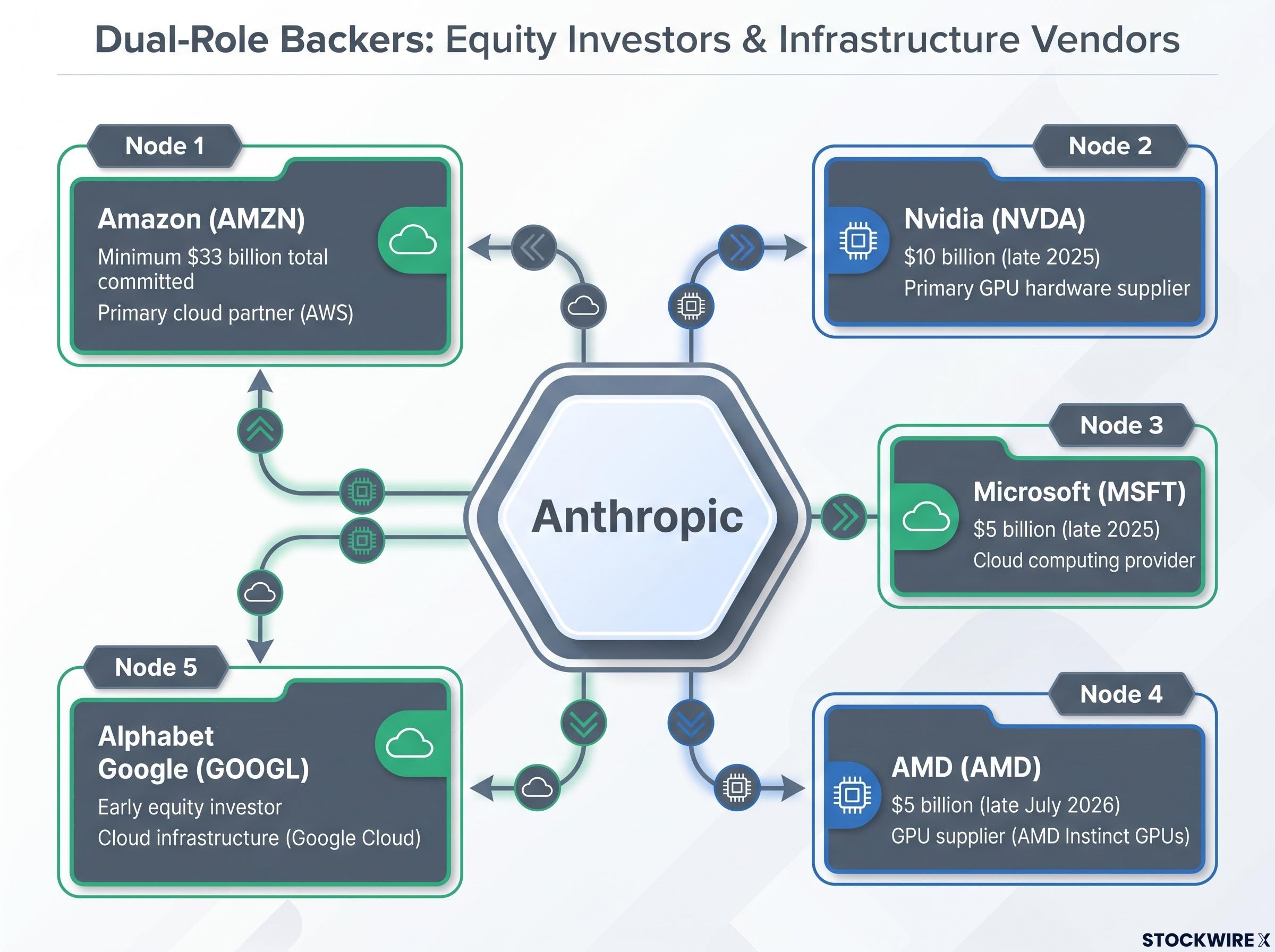
Five large-cap technology companies hold direct equity stakes in Anthropic. What makes their exposure different from a pure financial investment is that each of these companies simultaneously serves as a vendor to Anthropic, providing the cloud computing or GPU hardware that Anthropic needs to train and run its AI models.
This dual role, as both equity investor and infrastructure vendor, creates a compounding relationship. Take Amazon as the clearest example: as Anthropic scales its compute usage, Amazon benefits from rising equity value in its Anthropic stake and from the growing cloud infrastructure revenue that Anthropic pays to Amazon Web Services (AWS). The incentives are aligned on both sides.
That compounding is the structural reason this route differs from the fund options. A fund simply holds equity. These companies hold equity and earn revenue from Anthropic’s growth simultaneously. If Anthropic’s compute spending doubles, these companies benefit twice.
The five major stakeholders at a glance
| Company | Ticker | Investment in Anthropic | Vendor Role | Key Competitive Note |
|---|---|---|---|---|
| Amazon | AMZN | Minimum $33 billion total committed | Primary cloud partner (AWS) | Largest single corporate investor in Anthropic |
| Alphabet / Google | GOOGL | Early equity investor | Cloud infrastructure (Google Cloud) | Also competes via Google DeepMind |
| Nvidia | NVDA | $10 billion (late 2025) | Primary GPU hardware supplier | Hardware supply ties across AI industry |
| Microsoft | MSFT | $5 billion (late 2025) | Cloud computing provider | Primary AI narrative centres on OpenAI |
| AMD | AMD | $5 billion (late July 2026) | GPU supplier (AMD Instinct GPUs) | Most recent strategic investor |
AMD’s investment was announced in late July 2026, making it the most recent addition to this group. The deal pairs the equity stake with a strategic agreement to deploy AMD Instinct GPUs at Anthropic, mirroring the dual-role structure already in place with the other four companies.
The dilution reality is worth stating plainly: Anthropic’s contribution to any of these companies’ share prices is modest relative to their overall market capitalisation and diversified business operations. You are buying world-class technology businesses that happen to carry Anthropic exposure, not Anthropic proxies.
Index concentration risk compounds for investors who choose Amazon, Alphabet, Microsoft, or Nvidia as their Anthropic proxy route: all four are already among the five largest S&P 500 components, meaning a standard index fund holding plus a direct position in any of these names creates a layered overweight that most investors do not explicitly intend.
DXYZ: The high-weighting outlier and what its SPV structure means
Destiny Tech100 (DXYZ) holds approximately 18.1% of its assets in Anthropic as of 31 March 2026, making it the exchange-listed closed-end fund with the highest Anthropic weighting you can access through a standard brokerage account.
The weighting is the headline. The structure underneath it is what you need to understand before buying.
DXYZ does not hold Anthropic equity directly. Its exposure is routed via a special purpose vehicle (SPV), an entity created solely to hold a specific investment, called Magnitude ANC III. The ownership chain works like this:
- You buy DXYZ shares on a public exchange.
- DXYZ holds a position in the Magnitude ANC III SPV.
- The SPV describes its interest as economic exposure to Anthropic PBC Series B Preferred Shares, per Destiny Tech100’s own disclosures.
That “economic exposure” framing is a meaningful qualifier, not a technicality. It falls short of direct equity ownership, and the gap matters: the SPV’s value may not move in lockstep with Anthropic’s actual equity, introducing a layer of tracking uncertainty between what you hold and what Anthropic is worth.
That three-layer chain is meaningfully different from owning a fund like AGIX or BSTZ that holds Anthropic equity directly. The SPV introduces an additional structural intermediary, and as a closed-end fund, DXYZ’s market price can also diverge significantly from its NAV. You are layering two structural variables on top of Anthropic’s own private valuation, and that combination requires a more informed read before investing.
Key risks to weigh before choosing a route
Not every risk applies equally to every vehicle. The most useful way to think about these is as a filter matched to the specific route you are considering.
- Valuation and illiquidity risk (all fund vehicles). Private Anthropic holdings inside AGIX, BSTZ, BTX, BST, DXYZ, VCX, and the ARK Venture Fund are marked via periodic model-based valuations, not live market pricing. Those marks can revise significantly when new funding rounds occur.
- Premium and discount to NAV risk (closed-end funds: BSTZ, BTX, BST, DXYZ). The market price you pay for these funds can sit well above or well below the underlying value of their holdings, adding a second pricing variable independent of Anthropic’s valuation.
- Term trust duration risk (BSTZ and BTX specifically). Their planned wind-down dates may force liquidation before Anthropic reaches an IPO or other exit event, which could mean crystallising your exposure at an unfavourable moment.
- Concentration risk (VCX and DXYZ). Higher Anthropic weighting amplifies company-specific downside as well as upside. If Anthropic’s private valuation is revised downward, these vehicles absorb the largest impact.
- SPV basis risk (DXYZ specifically). The Magnitude ANC III SPV describes its interest as economic exposure to Anthropic shares rather than holding direct equity, adding a structural layer that can cause a divergence between what DXYZ reports and what Anthropic’s equity is actually worth.
- Fraud and scam risk (direct share offers). Anthropic has published an official warning that unverified third-party offers to sell its shares may be illegitimate. Any unsolicited approach offering Anthropic shares outside of regulated vehicles warrants serious scepticism.
The SEC investor alert on pre-IPO scams documents the specific tactics used in unregistered securities offerings, including unsolicited outreach and fabricated share transfer mechanisms, patterns that align directly with the illegitimate Anthropic share offers Anthropic itself has warned about.
The progression from “which option has the most Anthropic exposure” to “which option’s risk profile matches what I am actually willing to accept” is the more useful question. That is where the next section lands.
The AI valuation risks at IPO are worth mapping before settling on any route: the gap between Anthropic’s confirmed $965 billion private-round valuation and reported IPO targets of up to $1.8 trillion implies a set of revenue assumptions that would need to land simultaneously for the listing price to hold.
This article is for informational purposes only and should not be considered financial advice. Investors should conduct their own research and consult with financial professionals before making investment decisions.
Matching the right route to your investment goals before any IPO arrives
No IPO registration statement had been filed with the SEC as of 31 July 2026. Potential timing remains uncertain, with available reporting suggesting late 2026 or beyond. That means the indirect routes covered here are not a temporary placeholder but the medium-term reality for most investors, and you have time to select the route that fits rather than feeling pressure to act immediately.
OpenAI’s IPO timeline offers a useful reference point for thinking about Anthropic’s own path: Goldman Sachs and Morgan Stanley are lead underwriters on a $1 trillion target listing that leadership is steering toward 2027 rather than a rushed late-2026 debut, suggesting frontier AI public listings may take longer to mature than initial filings imply.
Three decision pathways cover the range:
- Maximum Anthropic concentration. If your primary goal is the highest possible Anthropic weighting in a single vehicle, the Fundrise Innovation Fund (VCX) at approximately 20.7% or DXYZ at approximately 18.1% are your options. The condition: you accept reduced liquidity (VCX) or SPV structural complexity (DXYZ) as the cost of that concentration.
- Liquid, diversified AI exposure with direct Anthropic positions. If you want Anthropic as a meaningful component inside a broader AI portfolio you can trade through any standard brokerage, AGIX is the clearest ETF option. BSTZ, BTX, and BST offer larger Anthropic slices within BlackRock closed-end structures. The condition: Anthropic exposure stays between 3% and 6% of your holding, and closed-end structures may trade at a premium or discount to NAV.
- Large-cap embedded exposure with maximum liquidity. If you are comfortable with Anthropic as a secondary thesis woven into technology holdings you would own regardless, Amazon, Alphabet, Nvidia, Microsoft, and AMD provide the dual equity-and-vendor dynamic. The condition: Anthropic’s specific contribution to these stocks’ returns is heavily diluted by their broader businesses.
Before investing in any fund vehicle, review its current prospectus and SEC filings. The allocation percentages cited in this guide reflect specific reporting dates and will shift over time. Consider consulting a registered financial adviser to determine which route aligns with your individual circumstances.
Past performance does not guarantee future results. Financial projections are subject to market conditions and various risk factors.