At approximately 8:07 PM ET on June 17, 2026, S&P 500 futures jumped 0.8%, Nasdaq 100 futures surged 1.4%, and Brent crude fell sharply. The moves came within minutes of President Trump confirming a preliminary US-Iran ceasefire from Versailles, where he was midway through a state visit to France. The agreement, signed remotely by Trump and Iranian President Masoud Pezeshkian, ends roughly four months of open conflict that had threatened the Strait of Hormuz, the chokepoint through which about 20% of globally traded oil and gas flows. The signing marks the most significant de-escalation in US-Iran relations in years, but it comes with a 60-day negotiation window still ahead. What follows explains exactly what was agreed, why markets moved the way they did across equities and crude, and what investors should watch over the coming weeks as the preliminary deal either hardens into a settlement or frays.
What Trump and Pezeshkian actually agreed to
Trump confirmed the signing directly to reporters in Versailles, and the deal was subsequently reported by Axios, the BBC, and CBS. The agreement covers three core provisions:
- An immediate halt to hostilities, including in Lebanon
- The reopening of the Strait of Hormuz to commercial shipping
- The removal of the US naval blockade on Iran
Each provision addresses one of the conflict’s most disruptive dimensions. Together they amount to a genuine step toward normalisation after approximately four months of open hostilities.
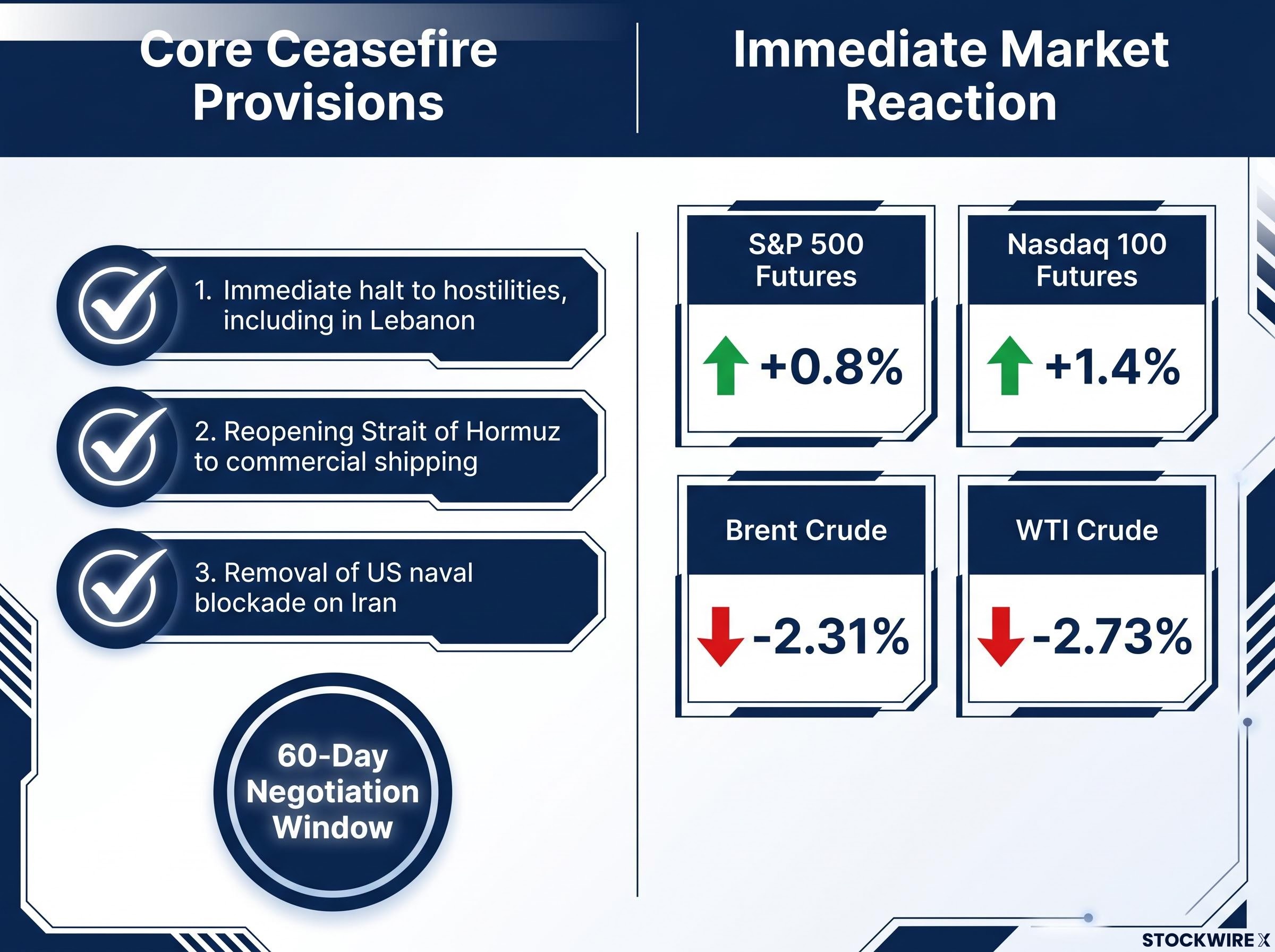
The word that matters most, however, is “preliminary.” The agreement explicitly requires a follow-on 60-day structured negotiation period to resolve the hardest outstanding issues, with Iran’s nuclear programme at the centre. Trump issued a direct warning that military operations could be reinstated if Tehran fails to honour the ceasefire’s terms. Nothing about the nuclear question has been settled; the ceasefire buys time to negotiate it.
When big ASX news breaks, our subscribers know first
How the Strait of Hormuz became the central market risk
The Strait of Hormuz is a narrow waterway between Iran and Oman, barely 33 kilometres wide at its shipping lanes, connecting the Persian Gulf to the open ocean.
Roughly 20% of all globally traded oil and gas passes through the Strait of Hormuz, making it the single most consequential chokepoint in global energy supply.
There is no comparable alternative route for the volume of crude that transits this corridor daily. When the four-month conflict introduced threats of closure, a naval blockade, and active hostilities in the vicinity, the market responded by embedding a substantial geopolitical risk premium into crude prices. Brent and WTI rose well above their prewar levels as traders priced in the possibility, however partial, of a sustained supply disruption affecting one-fifth of the world’s traded hydrocarbons.
EIA data on Hormuz oil flows confirms that in 2024 approximately 20 million barrels per day transited the strait, equivalent to about 20% of global petroleum liquids consumption, a figure that frames the scale of supply risk markets were pricing during the four months of open hostilities.
A ceasefire that credibly reduces the probability of closure is what mechanically triggers the unwinding of that premium. That is precisely what happened on the evening of June 17: as the signing was confirmed, crude futures began repricing the lower tail risk. On June 18, Brent settled at $77.71 (down approximately 2.31%) and WTI at $74.69 (down approximately 2.73%), both at multi-month lows but still above where they traded before the conflict began.
Geopolitical risk premiums in crude futures do not move linearly with diplomatic news; intraday swings of nearly $2 per barrel occurred even during periods when physical Hormuz transit remained technically open, driven by the gap between official statements and actual vessel movements, and by the speed with which war-risk insurance pricing incorporates new information.
The market reaction in numbers: futures, oil, and the VIX
The after-hours equity futures surge told one story. The regular-session dynamics told another.
Within minutes of the Versailles confirmation, futures across all three major US indices climbed. The Nasdaq 100’s 1.4% gain was the largest, consistent with long-duration growth stocks’ sensitivity to falling geopolitical risk premia. The S&P 500 added 0.8% and the Dow Jones 0.6%.
Then came the regular session on June 18. The VIX rose 12.37% to 18.44, a move that sits uncomfortably alongside a relief rally in futures.
The VIX’s 12.37% rise during a session shaped by geopolitical relief signals that markets are pricing residual uncertainty, not a resolved situation.
The gap between implied versus realised volatility in 2026 is the clearest lens through which to read the VIX’s 12.37% rise: with implied volatility running roughly 10 percentage points above realised volatility for much of the year, a VIX at 18.44 reflects structural risk perception rather than actual daily price movement severity.
The split is not contradictory. Futures rallied on the ceasefire headline; the VIX reflected the Federal Reserve’s still-hawkish posture and the 60-day negotiation window that leaves the deal’s durability an open question.
| Asset | Price / Level | Move | Direction |
|---|---|---|---|
| S&P 500 Futures | 5,556.75 | +0.8% | Up |
| Nasdaq 100 Futures | 30,400.50 | +1.4% | Up |
| WTI Crude | $74.69 | -2.73% | Down |
| Brent Crude | $77.71 | -2.31% | Down |
| VIX | 18.44 | +12.37% | Up |
| US 10-Year Yield | 4.439% | -0.40% | Down |
| Gold Futures | $4,340.30 | -0.94% | Down |
The dollar index edged up 0.16% to 100.025, while gold and silver both fell modestly, consistent with a partial unwinding of safe-haven positioning.
Which equity sectors gain and which face pressure
The Nasdaq 100’s 1.4% after-hours gain, the largest of the three major index futures, points directly to where the ceasefire’s relief is most concentrated.
- Growth and technology stocks benefit because falling geopolitical risk premia reduce the discount rates applied to long-duration earnings. When the probability of a worst-case energy shock drops, the present value of future cash flows rises, and that effect is most pronounced for companies whose value sits furthest in the future.
- Energy-intensive and trade-exposed sectors, including airlines, shipping, autos, chemicals, and parts of consumer discretionary, gain from lower input costs and the restoration of Gulf trade routes. Emerging-market net oil importers and European manufacturers also stand to benefit, framing the US relief in a broader global context.
- Energy producers face a mixed picture. Upstream companies lose some pricing power as crude retreats from crisis highs, which can pressure near-term cash flows. Midstream operators and refiners, by contrast, benefit from greater volume certainty and potentially improved crack spreads once product flows through the strait normalise.
The cross-asset repricing from the Hormuz blockade extended well beyond crude futures: ECB rate signals, Asian equity market declines, and China’s weakening import demand all contributed to a stagflationary undercurrent that a US-centric analysis of the ceasefire only partially captures.
The distinction matters for portfolio positioning. The ceasefire is not uniformly bullish; it redistributes the risk premium across sectors rather than simply removing it.
Why oil is unlikely to return to prewar prices anytime soon
A ceasefire is a direction signal, not an overnight price reset. Brent at $77.71 sits roughly $10 above prewar levels according to Morningstar’s analysis, despite having fallen sharply from mid-crisis highs. The gap reflects logistical friction that diplomacy alone cannot resolve.
Physical normalisation of Strait of Hormuz traffic faces concrete obstacles independent of diplomatic progress. Mine clearance or verification of the strait’s safety, restoration of shipping insurance coverage, and the working through of a vessel backlog built over four months of disruption all take time. Capital Economics and other analysts estimate that oil production and exports may take 2-3 months to reach approximately 80% of prewar levels, with full normalisation stretching further still.
Three scenarios for crude over the next 60 days
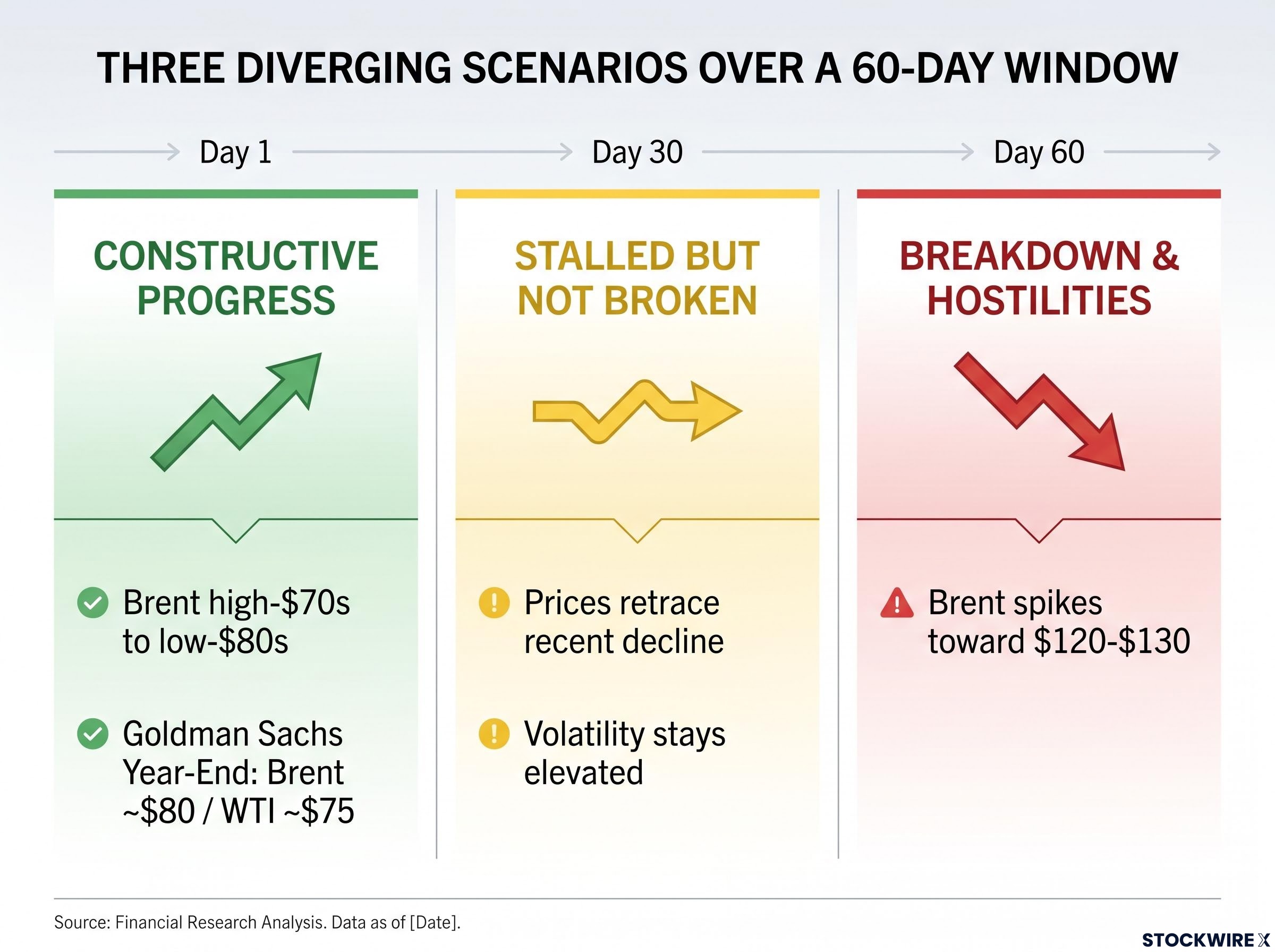
- Constructive progress: Visible compliance with ceasefire terms, rising tanker traffic, and coherent nuclear-framework talks. Brent drifts toward the high-$70s to low-$80s as Gulf exports gradually normalise. Goldman Sachs analysts project Brent near $80 and WTI near $75 at year-end, broadly consistent with current pricing.
- Stalled but not broken: Fitful progress, implementation delays, heated rhetoric without large military escalation. Prices retrace some of their recent decline as traders reinsert a partial Hormuz premium. Volatility stays elevated.
- Breakdown and renewed hostilities: A collapse of the ceasefire or visible non-compliance. Brent could spike back toward $120-$130 if transit is heavily disrupted and inventories tighten, according to analyst projections.
Past performance does not guarantee future results. These projections are subject to market conditions and various risk factors.
The deals that will determine whether this ceasefire holds
The next 60 days will move markets from trading a ceasefire headline to either pricing a durable settlement or repricing renewed risk. Three categories of leading indicators will signal which direction is forming:
- Physical and logistical signals
- Tanker traffic volumes and loading rates in the Gulf
- Evidence of mine clearance or security guarantees for commercial shipping
- Changes in maritime insurance premia for Hormuz-transiting vessels
- Diplomatic indicators
- Progress reports on the 60-day nuclear negotiations
- Statements from Washington, Tehran, and regional actors including Saudi Arabia, the UAE, and Israel
- Any visible non-compliance or ceasefire violations
- Macro data
- Inflation prints as lower energy costs begin filtering through supply chains
- Federal Reserve commentary on the inflation outlook
- Corporate earnings guidance from energy-sensitive sectors
Federal Reserve policy constraints from energy inflation shaped the backdrop for this ceasefire in ways that go beyond monetary mechanics: with US headline inflation already running above 3% driven by gasoline costs and the Fed in a static holding pattern, the geopolitical relief in crude directly affects how much room policymakers have to respond to the next growth shock.
The Fed’s stance remains a parallel constraint independent of geopolitical progress. The 10-Year Treasury yield at 4.439% and the 10-2 Year spread at 31.32 basis points on June 18 reflect ongoing monetary policy pressure that limits how far the geopolitical relief rally can extend. That is the clearest explanation for why the VIX rose 12.37% even as futures climbed: the ceasefire removed one source of uncertainty, but left the other intact.
A ceasefire trade, not yet a peace dividend
The Versailles signing has removed a major tail risk from global markets, but the split between the futures rally and the VIX’s rise captures exactly where positioning stands: relieved, not convinced. Oil remains above prewar levels. The 60-day negotiation window, with Iran’s nuclear programme at its centre, is where the remaining risk concentrates.
Investors tracking this story should watch three things: tanker traffic and Hormuz logistics for physical confirmation, nuclear negotiation progress for diplomatic confirmation, and inflation-sensitive macro data for the feed-through into monetary policy. The next two months will determine whether this ceasefire trade becomes a durable peace dividend, and both oil and equity positioning should reflect that conditionality.
This article is for informational purposes only and should not be considered financial advice. Investors should conduct their own research and consult with financial professionals before making investment decisions.