Not all AI spending is created equal. When four of the world’s largest technology companies reported Q1 2026 earnings in the final days of April 2026, each disclosed rising capital expenditure on artificial intelligence. Yet markets delivered starkly different verdicts. Alphabet surged nearly 10% in after-hours trading while Meta shed close to the same amount. Amazon edged higher; Microsoft drifted lower despite a cloud beat. The divergence landed in the same week that Australian inflation came in above forecasts and the Reserve Bank of Australia raised rates on 5 May 2026, sharpening local investor focus on which offshore equity positions are genuinely earning their keep. Big Tech earnings have become a live referendum on whether AI investment is converting into revenue or merely accumulating on balance sheets. What follows unpacks why Alphabet and Amazon were rewarded, why Microsoft and Meta were not, and what the split signals for Australian investors evaluating global tech exposure.
The market split that defined this earnings season
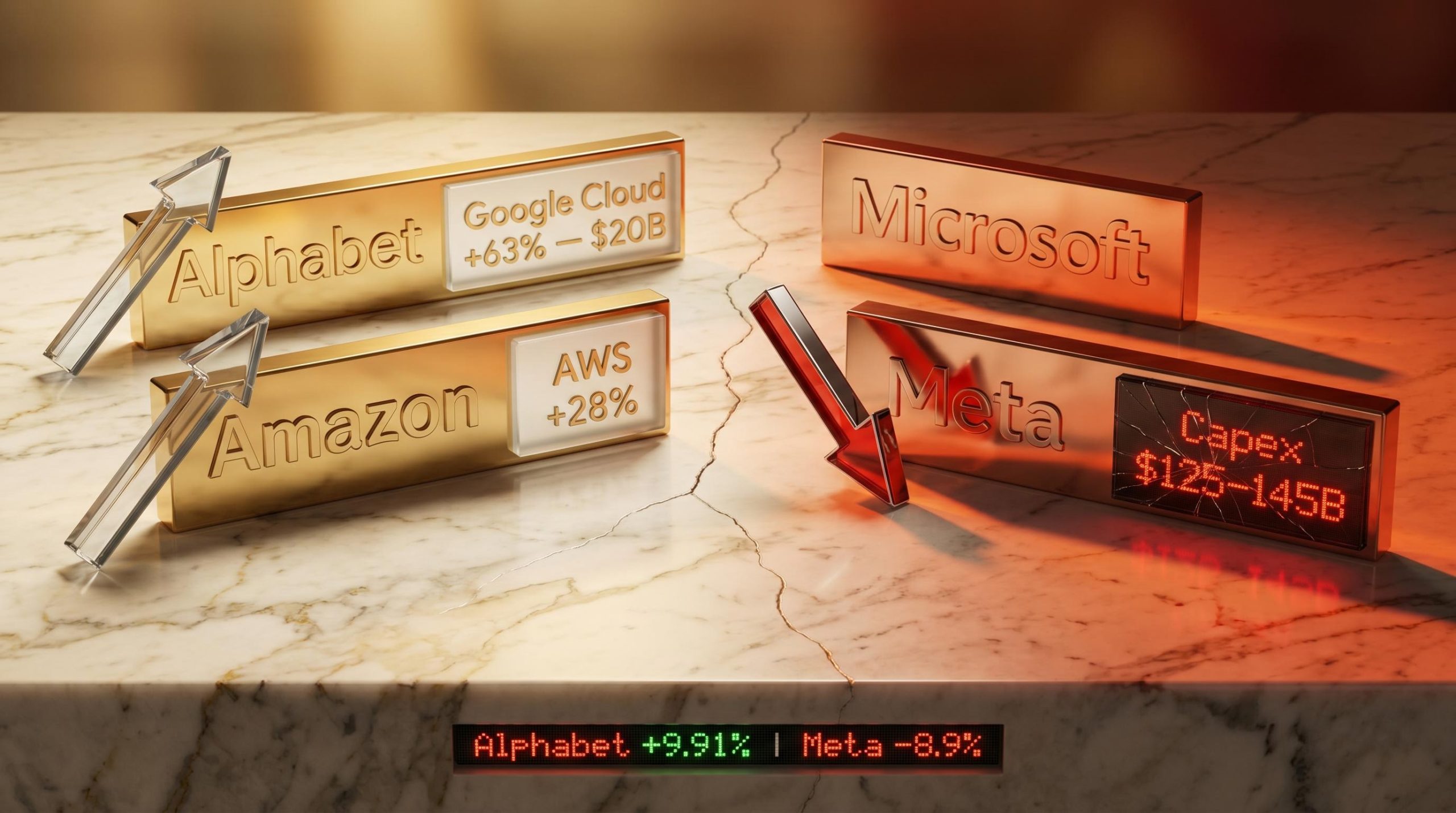
Alphabet gained approximately 9.91-10% after hours. Meta fell approximately 8.9-10%. Between those two reactions sits a nearly 20-percentage-point gap, and it did not come from revenue misses.
All four companies beat or met headline estimates. All four disclosed increasing AI capital expenditure. The market’s verdict was not about top-line performance; it was about which companies could show AI spending translating into visible returns.
All four hyperscalers beat or met consensus revenue estimates. The divergence in share price reactions reflects a market now applying a returns-evidence filter, not a revenue filter, to AI spending.
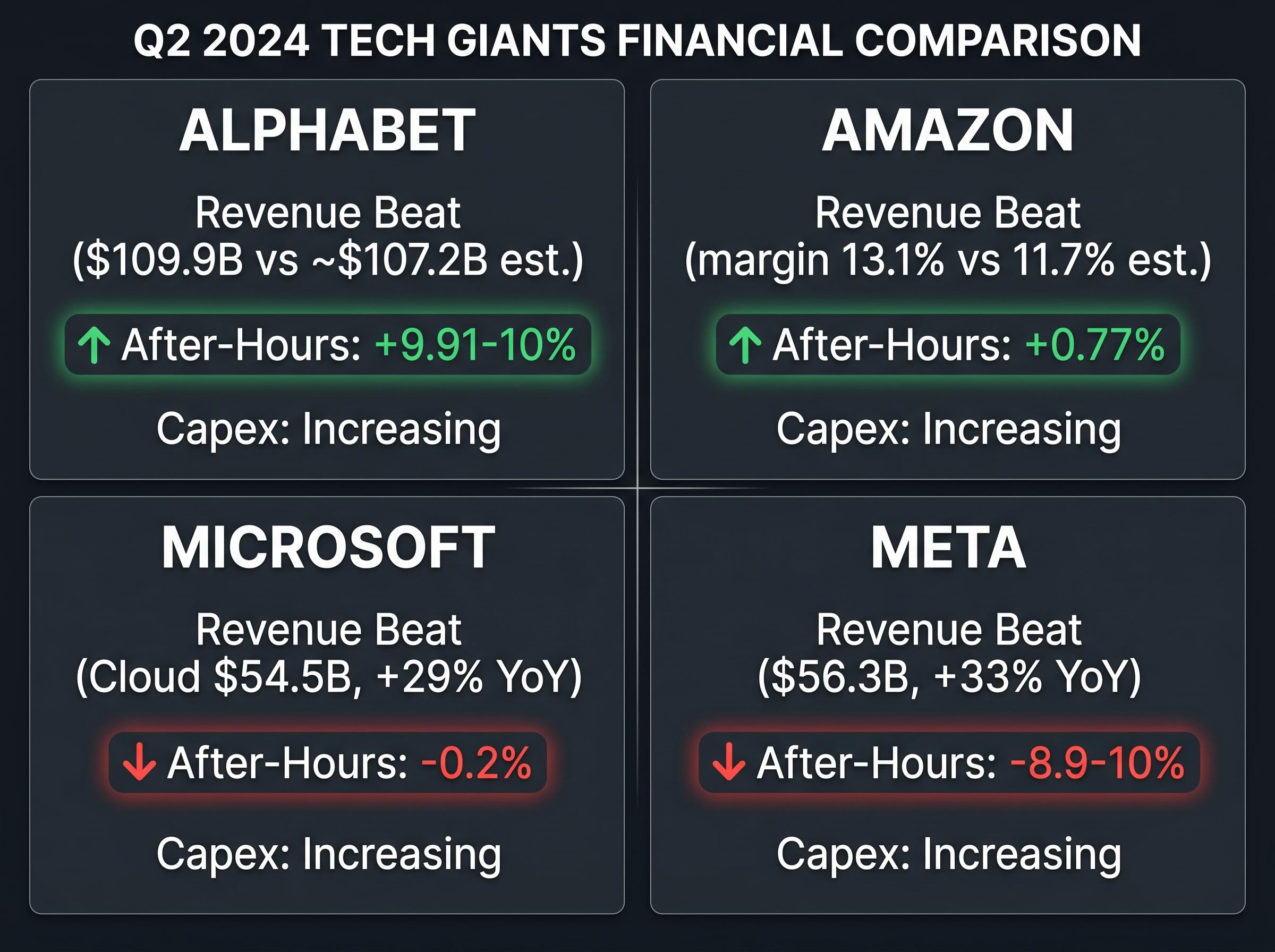
| Company | Q1 Revenue Result | After-Hours Price Move | AI Capex Direction |
|---|---|---|---|
| Alphabet | Beat ($109.9B vs ~$107.2B est.) | +9.91-10% | Increasing |
| Amazon | Beat (operating margin 13.1% vs 11.7% est.) | +0.77% | Increasing |
| Microsoft | Beat (Cloud $54.5B, +29% YoY) | -0.2% | Increasing |
| Meta | Beat ($56.3B, +33% YoY) | -8.9-10% | Increasing |
The puzzle this earnings season posed was straightforward: if everyone beat, why did only half get rewarded?
When big ASX news breaks, our subscribers know first
Why Alphabet and Amazon passed the market’s new test
The answer sat inside the cloud revenue lines. Both Alphabet and Amazon delivered AI spending that was already converting into measurable revenue growth, within this quarter, not deferred to a future reporting period.
Alphabet’s cloud moment
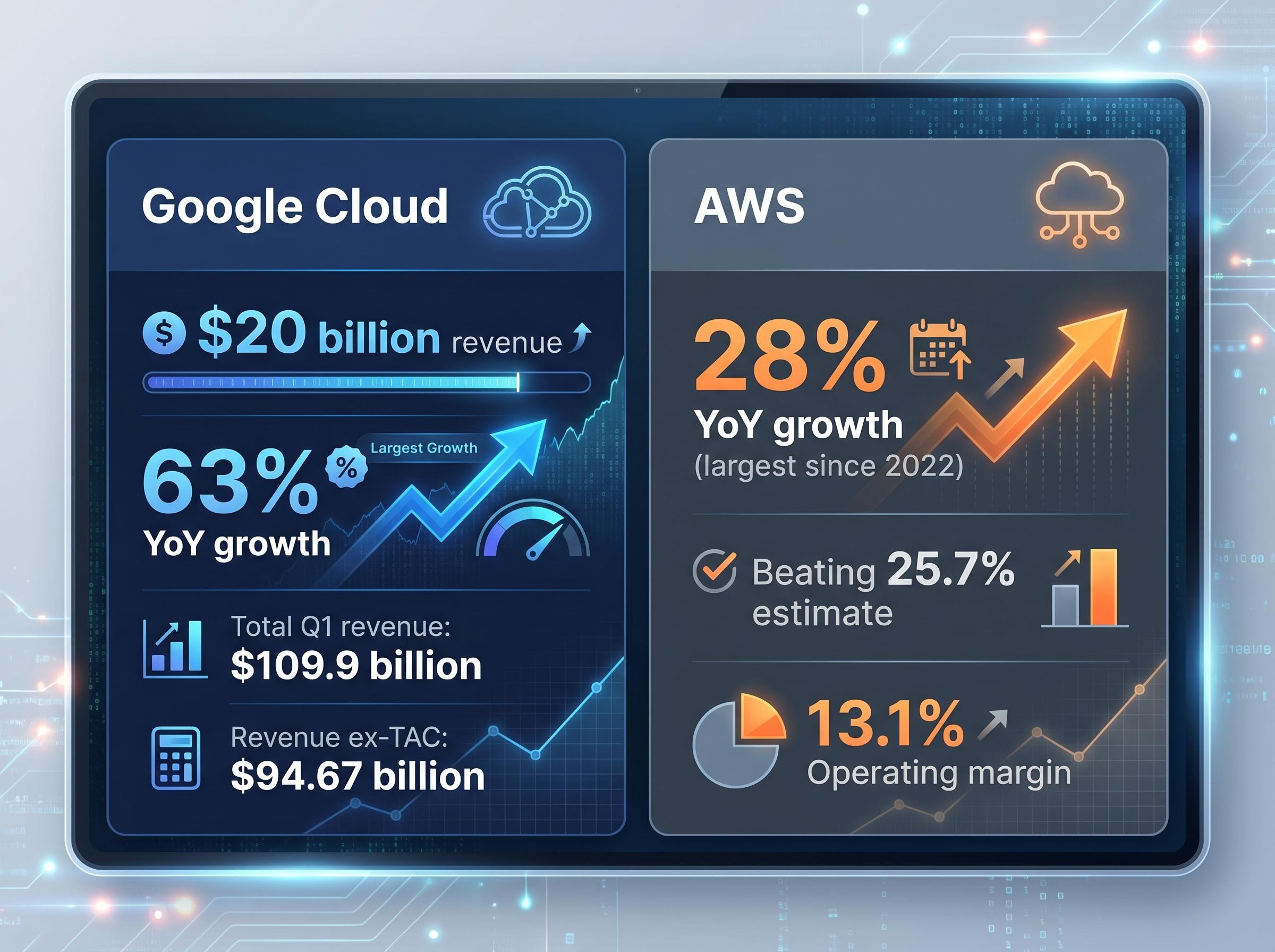
Google Cloud revenue grew 63% to $20 billion, the strongest cloud growth since the AI boom began. That figure did the persuasive work on its own.
- Google Cloud revenue: $20 billion, up 63% year-over-year
- Total Q1 revenue: $109.9 billion versus a street estimate of approximately $107.2 billion
- Revenue ex-TAC: $94.67 billion versus an estimate of $91.57 billion, indicating a broad-based beat rather than one driven by a single segment
Enterprise AI spending powered the result. The beat was not confined to cloud; it extended across the business, reinforcing the argument that Alphabet’s AI investment is generating returns at scale.
Amazon’s AWS acceleration
AWS cloud revenue rose 28% year-over-year, beating the consensus estimate of 25.7% and marking the largest growth since 2022. Operating margin came in at 13.1% versus a forecast of 11.7%.
- AWS growth of 28% tied directly to deals with Anthropic and OpenAI
- Operating margin beat of 1.4 percentage points above consensus
The partnership layer mattered. Where Alphabet demonstrated organic enterprise demand, Amazon showed deal-making with the leading AI model developers translating into measurable cloud revenue. Both companies provided evidence of capex-to-revenue conversion within a visible timeframe, not a promise.
What AI spending looks like as a foundation, not a formula
The market’s reward for Alphabet and Amazon rested on a specific mechanism that Australian investors can apply to every future earnings cycle: cloud infrastructure has become the primary channel through which AI capital expenditure converts into visible revenue.
When a hyperscaler spends billions on data centres, chips, and networking equipment, the revenue signal investors look for is growth in the cloud business that sits on top of that infrastructure. If a company’s cloud unit is growing faster than expected, the market reads that as evidence the spending is working. If the cloud unit is growing at or below expectations despite rising capex, the market reads the spending as accumulating without a clear return path.
Bloomberg coverage from 29-30 April 2026 captured the investor mood: markets now require “something coming out of the other side” of AI spending.
Early AI spending gains are beginning to extend beyond technology companies. Caterpillar has captured demand-side benefits from AI infrastructure construction, illustrating that the investment thesis has downstream effects in industrials and utilities.
The hardware supply chain sits at the intersection of both the rewarded and penalised earnings stories from this quarter: semiconductor equities capturing hyperscaler procurement budgets have delivered material year-to-date gains regardless of whether the end hyperscaler itself passed the market’s returns-evidence filter, illustrating that the AI investment thesis distributes unevenly across the tech ecosystem.
Two phases now define how the market evaluates AI capex:
- Conversion mode: AI spending is producing visible revenue growth within the current reporting period. Google Cloud at $20 billion (up 63%) and AWS at 28% growth are the reference points.
- Accumulation mode: AI spending is rising but revenue conversion remains unclear or deferred. Capex guidance increases without accompanying near-term return signals fall into this category.
Understanding the distinction helps Australian investors move beyond surface-level earnings headlines and assess whether a tech holding’s AI spending is generating returns or still building towards them.
The AI infrastructure investment cycle now demands that investors separate operating cash margins from capex headlines; Wall Street’s working expectation as of Q1 2026 is that companies must demonstrate concrete monetisation within a twelve-month window, a threshold that Alphabet and Amazon cleared this quarter and that Microsoft and Meta did not.
The case against Microsoft and Meta this quarter
Neither Microsoft nor Meta delivered a bad quarter in absolute terms. The issue was a gap between what the results showed and what the market now demands.
Microsoft’s cloud beat that was not enough
Microsoft Cloud revenue reached $54.5 billion, up 29% year-over-year (25% in constant currency). By any prior standard, that is a strong result, and it beat estimates.
- Cloud revenue of $54.5 billion represented a genuine beat against consensus
- Shares still closed down approximately 0.2%
- Analysts raised concerns about the pace at which Microsoft’s broader AI strategy is capitalising on demand
- Capacity constraints around the OpenAI partnership were flagged as a specific friction point limiting near-term monetisation speed
The cloud number alone would have been celebrated a year ago. In Q1 2026, investors treated it as insufficient because the broader AI investment narrative lacked the near-term return clarity that Alphabet and Amazon provided.
Meta’s capex hike without a return roadmap
Meta reported Q1 revenue of $56.311 billion, up 33% year-over-year. The headline beat did not matter.
- Full-year 2026 capex guidance was raised to $125-145 billion, up from a prior range of $115-135 billion
- No near-term ROI signals accompanied the guidance increase
- EU and US regulatory warnings on youth safety added a compounding drag on sentiment
- Shares fell approximately 8.9-10% post-earnings
The capex increase without an accompanying return roadmap was the specific trigger. Investor patience for deferred AI returns is eroding; a strong revenue quarter no longer provides cover for an AI spending strategy that lacks near-term return visibility.
The sustainability question now hanging over all four companies
The Q1 results exposed a structural tension that extends beyond any single company’s quarter. The scale of planned AI infrastructure spending across the hyperscalers is enormous, and the market’s willingness to fund it without visible returns is narrowing.
Meta’s confirmed guidance of $125-145 billion for 2026 is the clearest data point. Analyst estimates based on Q1 trends suggest Amazon’s 2026 capex could approach approximately $200 billion, though no official guidance range has been confirmed. Microsoft and Alphabet did not disclose specific full-year figures.
| Company | 2026 Capex Figure | Guidance Status |
|---|---|---|
| Meta | $125-145 billion | Confirmed guidance |
| Amazon | ~$200 billion | Analyst estimate (unconfirmed) |
| Microsoft / Alphabet | Not disclosed | No full-year figure provided |
No confirmed consensus aggregate 2026 capex figure across all four companies has been published. The absence of a clear total itself reflects the opacity that is driving investor concern.
Bloomberg coverage from 29-30 April 2026 noted resolute underlying demand but flagged growing investor pressure for tangible outcomes. The divergence seen this quarter is not a one-off. It marks the beginning of a sustained market discipline applied to hyperscaler AI spending, where opacity about returns will be penalised and visibility rewarded.
What Australian investors should take from this earnings split
The AI returns debate is not an abstract US story. Australian superannuation funds and exchange-traded funds with global equity mandates hold these companies. The market’s new returns-evidence filter directly affects the valuations within those portfolios.
The domestic backdrop raises the stakes. The RBA raised rates on 5 May 2026, a decision broadly anticipated after inflation data released the prior week came in above forecasts. In a higher-rate environment, the opportunity cost of holding offshore equity positions rises, making it more consequential to distinguish between AI spending that is converting and AI spending that is accumulating.
Market concentration risk compounds the returns question for Australian ETF holders: advanced computing stocks account for approximately 13% of US equity valuations in April 2026, surpassing dot-com era levels, which means a sector-wide repricing of AI capex expectations would transmit through broad index products rather than staying contained within individual stock positions.
The RBA’s May 2026 monetary policy decision confirmed the increase in the cash rate target to 4.35 per cent, citing above-forecast inflation as a key factor, a move that raised the opportunity cost of holding offshore equity positions across Australian superannuation and ETF portfolios.
Vesna Peroska of Morningstar Australia has observed that investor attention remains concentrated on the AI investment narrative as a driver of equity market support, underscoring how closely Australian portfolio outcomes are tied to whether that narrative delivers.
Three steps can help Australian investors evaluate global tech holdings through the lens this earnings season established:
- Identify the company’s primary AI revenue channel. For hyperscalers, this is typically the cloud business unit.
- Check whether recent results show growth in that channel ahead of estimates. A beat signals conversion; a miss or in-line result amid rising capex signals accumulation.
- Assess whether capex guidance is accompanied by near-term return signals. Rising spending without a visible return roadmap is the pattern the market penalised this quarter.
The split between Alphabet and Amazon on one side, and Microsoft and Meta on the other, serves as the practical case study for applying this framework.
Returns, not spending, are what this AI cycle will be judged on
Q1 2026 earnings established that markets are no longer treating AI capital expenditure as uniformly positive. Evidence of conversion is now the price of admission for a premium valuation. The divergence between Alphabet and Amazon on one side, and Microsoft and Meta on the other, could narrow or widen depending on what Q2 2026 results reveal.
The AI spending story is entering a more demanding phase. Companies that demonstrate visible returns from their infrastructure investment will be rewarded; those that cannot will face growing scepticism regardless of headline revenue performance. Morningstar’s broader coverage of global tech valuations and the AI infrastructure investment theme offers ongoing analysis for investors tracking this shift.
Investors wanting to stress-test whether the market’s new returns-evidence filter represents rational repricing or the beginning of a broader correction will find our deep-dive into AI stock bubble frameworks, which applies Minsky, Kindleberger, Sharma’s four O’s, and the Shiller CAPE ratio to the current AI spending cycle, with the CAPE standing at 40.11 as of 1 May 2026 and the four frameworks delivering split verdicts on whether a bubble has formed.
This article is for informational purposes only and should not be considered financial advice. Investors should conduct their own research and consult with financial professionals before making investment decisions. Past performance does not guarantee future results. Financial projections are subject to market conditions and various risk factors.