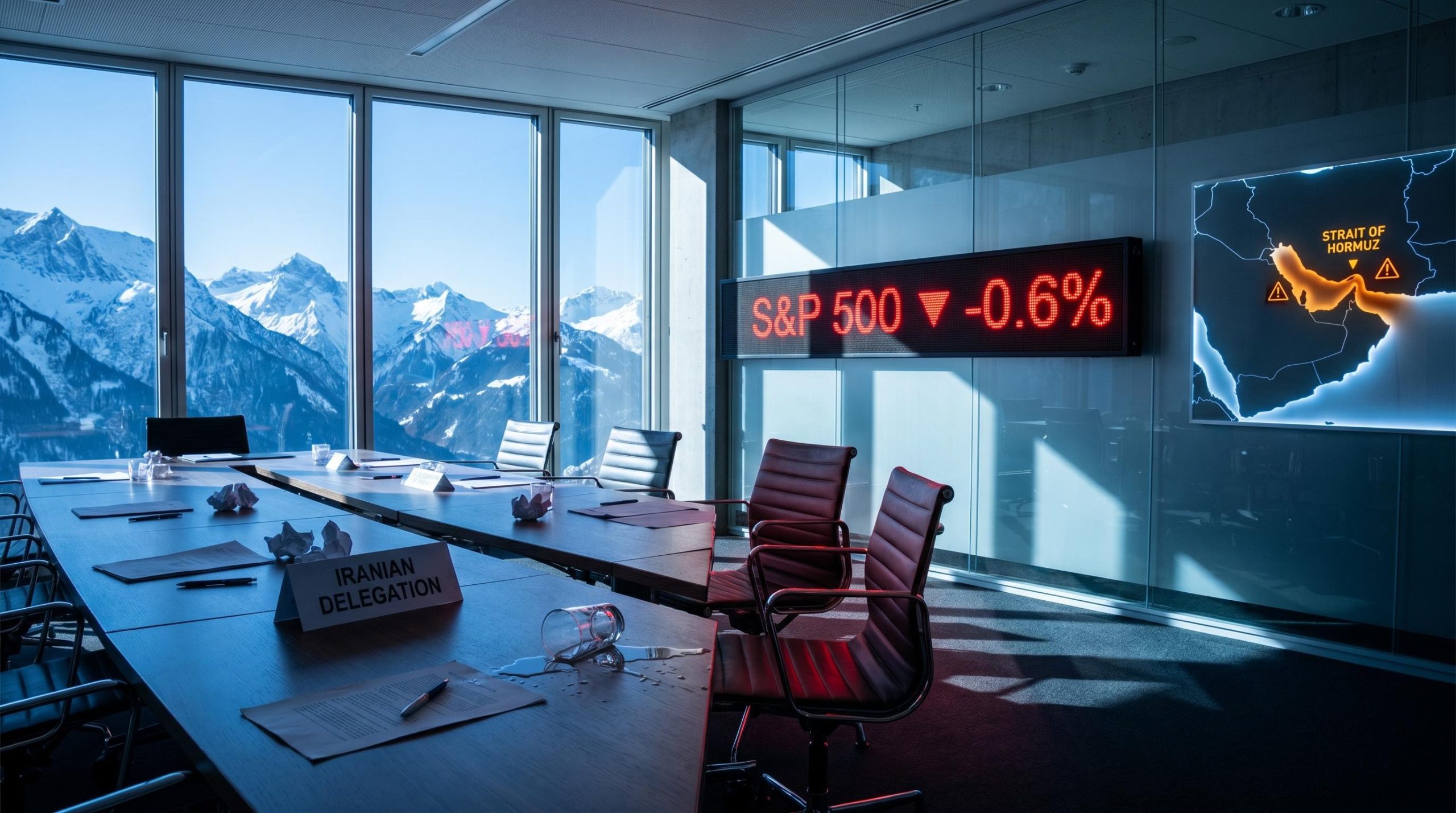
S&P 500 futures were down 0.6% at 7,523.50, Nasdaq 100 futures eased 0.1% to 30,410.0, and Dow Jones futures retreated 0.37% to 51,814.0 by 19:34 ET on Sunday, 21 June 2026. Less than 48 hours earlier, US stock futures had climbed on optimism that Washington and Tehran were closing in on a durable peace framework. That optimism lasted until President Trump issued fresh warnings against Iran on Sunday, prompting the Iranian delegation to walk out of negotiations in Switzerland.
The catalyst was specific: Trump demanded Iran halt support for Hezbollah while US and Iranian representatives were still at the table. The market had been pricing in progress on a mid-June accord between the two countries, a 14-point framework that set out terms for winding down hostilities and restoring transit through the Strait of Hormuz. That pricing is now under pressure.
What follows breaks down the diplomatic collapse, the terms of the deal now in question, the oil price transmission mechanism that connects Hormuz to your portfolio, and the specific signals worth watching as this week opens.
Friday’s rally gave way to Sunday’s retreat as Trump’s Iran warnings hit futures
Equity markets finished Friday’s session in positive territory. Gains were driven by progress on the US-Iran diplomatic track and a strong performance from chipmakers, with broader market indices closing higher on the day. The S&P 500 had been trading in the 7,500-7,576 range, the Dow near or above 52,000, and the Nasdaq 100 in the 30,000-30,800 corridor.
The earlier Nasdaq reaction to a preliminary US-Iran framework in late May, with futures up 1.4% and Brent breaking below $100 for the first time since Hormuz closure began, established the directional template investors are now watching in reverse: growth equities priced the disinflation benefit most aggressively on the upside, making them the most exposed when talks fragment.
By Sunday evening, the picture had shifted.
| Index Futures | Level (19:34 ET, 21 June) | Change |
|---|---|---|
| S&P 500 | 7,523.50 | -0.6% |
| Dow Jones | 51,814.0 | -0.37% |
| Nasdaq 100 | 30,410.0 | -0.1% |
What triggered the reversal
Geopolitical headlines were not the only factor at play; rates expectations, earnings positioning, and broader macro data all feed into daily futures moves. But the timing of this reversal, arriving within hours of Trump’s public warnings, tells you something about Friday’s rally: it was built on diplomatic optimism that had not yet been stress-tested. A single day’s headlines were enough to unwind a meaningful portion of that positioning.
When big ASX news breaks, our subscribers know first
What Trump said, and why Iran’s delegation walked out of Switzerland
The sequence moved fast. On Sunday, 21 June, President Trump publicly warned that Iran needed to rein in Hezbollah, the Lebanese group Tehran backs, which Trump said was “causing trouble,” even as negotiators from both countries were seated at the Swiss table working through a framework agreement.
Iran’s response came through action, not a press conference. Iran’s Tasnim news agency reported that Tehran’s envoys chose not to re-enter the quadrilateral talks after Trump’s public statements. Major English-language wire services have covered the broader Swiss diplomatic channel, though the specific walkout sequencing reported by Tasnim has not been independently confirmed with the same granularity.
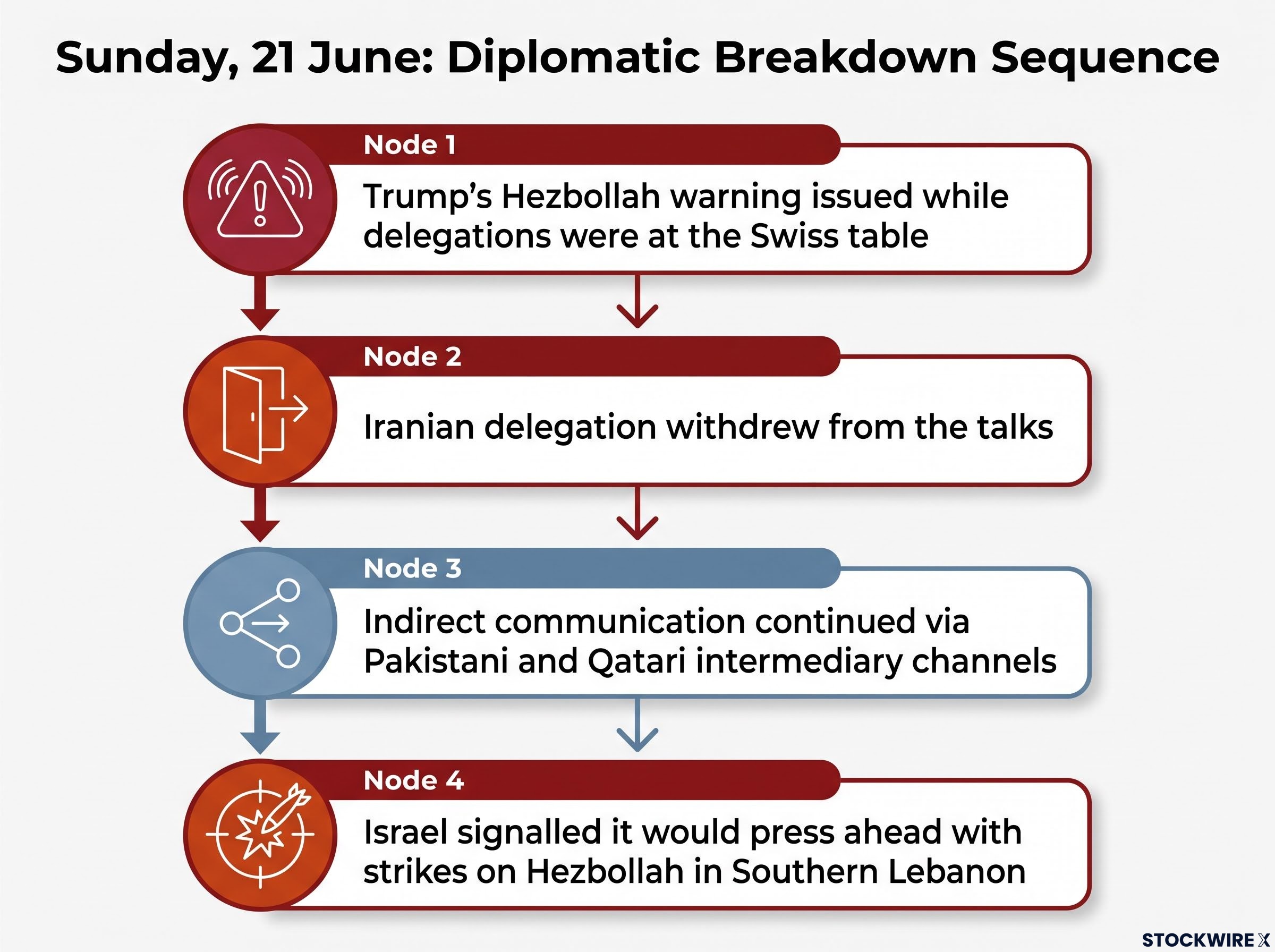
The key events, in order:
- Trump’s Hezbollah warning issued while delegations were at the Swiss table
- Iranian delegation withdrew from the talks
- Indirect communication continued via Pakistani and Qatari intermediary channels
- Israel signalled it would press ahead with strikes on Hezbollah in Southern Lebanon, which Iran said amounted to a violation of the terms both sides had agreed
For investors, the diplomatic protocol matters less than the signal. Both sides are still talking through intermediaries, which means the breakdown is serious but not yet terminal. That distinction will drive how markets reprice risk through the week.
What the US-Iran memorandum of understanding actually committed both sides to
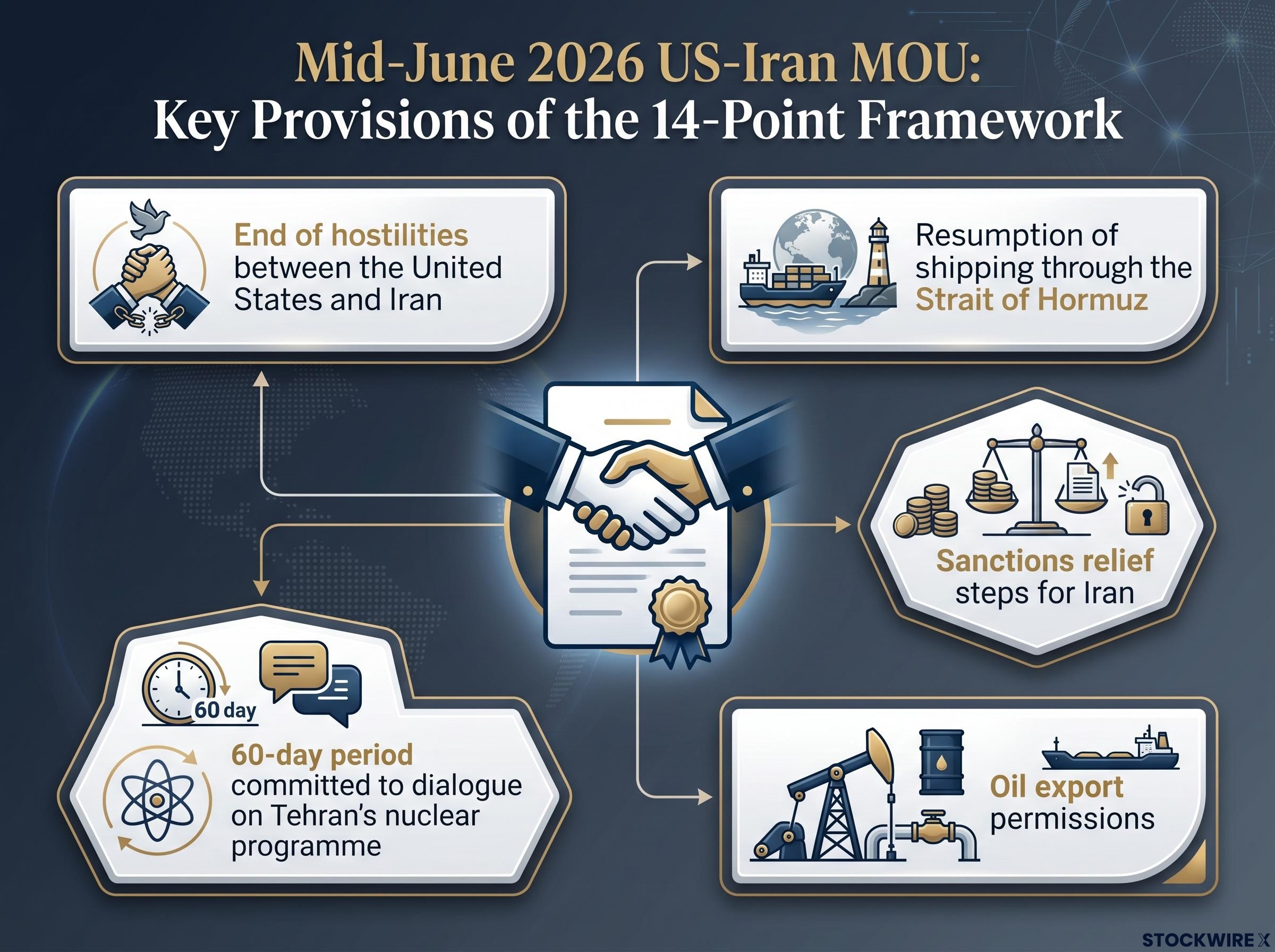
The deal now under pressure is a 14-point framework covering an end to hostilities and the reopening of the Strait of Hormuz, signed or announced in mid-June 2026. The original source treats the 14-point structure as established, while broader wire-service reporting has characterised the agreement more generally as a “deal” or “understanding.”
The key provisions:
- End of hostilities between the United States and Iran
- Resumption of shipping through the Strait of Hormuz under terms acceptable to both parties
- Sanctions relief steps for Iran
- Oil export permissions
- A 60-day period committed to dialogue on Tehran’s nuclear programme, with scope to extend toward a broader final agreement
The OFAC Iran sanctions program governs the specific executive orders and general licenses that define what sanctions relief for Tehran would actually mean in practice, including the conditions under which Iranian oil exports could resume at scale.
The Swiss follow-up discussions that collapsed on Sunday were part of this planned sequencing. Every diplomatic setback shortens the effective runway before markets have to reprice the probability of this framework surviving to a final agreement.
The triple lock mechanism that constrained Hormuz throughput at its peak, combining US naval blockade operations, Iranian toll enforcement, and the withdrawal of commercial war-risk insurance, means that even partial diplomatic progress does not automatically restore shipping, because insurers require a sustained incident-free period before reinstating coverage regardless of what any political framework commits to.
Barron’s noted that S&P 500 futures rose approximately 0.9% when the original Hormuz deal was announced, with oil prices falling at that stage, establishing the directional relationship now at risk of reversal.
Knowing the specific terms helps you distinguish between a total collapse, which would represent a major repricing event, and a pause in negotiations, which markets have historically absorbed more quickly.
Why the Strait of Hormuz is the variable that connects Iran tensions to your portfolio
The Strait of Hormuz is widely described as one of the world’s most strategically important energy transit points. It is the chokepoint through which US-Iran tensions translate into oil prices, which feed into inflation expectations, which in turn affect the growth assumptions underpinning equity valuations. That is the transmission chain.
When the MOU was announced, positive diplomatic signals pushed Brent crude toward the $79-80 area. Stocks rose and oil fell, a directional relationship Barron’s and Bloomberg both flagged during Friday’s session.
When the Hormuz deal was announced, stocks rose and oil fell. That directional relationship is the one investors are now watching in reverse.
What current strait restrictions signal for energy prices
Reporting over the 21 June weekend indicated that Tehran had moved to close the Strait of Hormuz again, reversing a brief period last week during which limited vessel movements had been permitted. This is the first concrete evidence of implementation fragility.
Sustained restrictions risk reversing the Brent crude moves seen on peace optimism, feeding directly into inflation-sensitive equity sectors. Shipping and insurance cost signals around the strait provide a real-economy indicator that does not depend on parsing political statements, giving you a concrete data point to watch alongside headline futures moves.
The Hezbollah dimension: why this conflict keeps complicating US-Iran diplomacy
Hezbollah is not a peripheral subplot. It is the structural fault line that has repeatedly prevented this diplomatic track from closing, and Sunday was a manifestation of a durable tension rather than an isolated incident.
The overlapping pressure points:
- Hezbollah and the Lebanon front: The fighting between Hezbollah and Israel in Southern Lebanon has remained a live and unresolved thread running through the broader US-Iran negotiations
- Israeli military posture: Israel has indicated it intends to press on with military action targeting Hezbollah in Southern Lebanon
- Iran’s characterisation: Tehran has accused the US and Israel of breaching the terms of the existing arrangement through the ongoing Lebanon strikes
Trump’s Hezbollah warning fits a recurring pattern. Bloomberg, Reuters, and Barron’s have all noted that US equity markets and futures have repeatedly swung on Trump’s Iran strategy, including threats, pauses in strikes, and deal announcements. The Hezbollah demand was not a new tactic; it was the latest iteration of public pressure applied alongside active negotiations.
The persistence of this issue tells you that even if Sunday’s walkout is resolved, the underlying structural tension that produced it has not been addressed. The diplomatic path to a final agreement is longer and more fragile than a single MOU signing suggests.
What investors should be watching as this week opens
The Sunday futures move was a market verdict on the MOU’s near-term resilience. Here is what to monitor as the situation develops:
- Strait of Hormuz restriction status: Whether Tehran eases or maintains the reinstated restrictions is the most direct real-economy signal available
- 60-day MOU window progress: The clock started running in mid-June 2026; every day of stalled negotiations shortens the effective runway
- Brent crude direction: Moves toward the $79-80 area signal diplomatic optimism; moves above signal renewed supply concern
- Diplomatic intermediary signals: Indirect channels via Pakistan and Qatar remained active as of 21 June, keeping a resolution pathway open
- Israeli military posture updates: Any escalation or de-escalation on the Lebanon front directly affects the conditions under which Iran will return to the table
The indirect channels remaining open is the single most important detail to hold onto. It means the situation is active, not frozen, and that a positive surprise in the coming days is as plausible as further deterioration.
The pattern of headline-driven volatility around Trump’s Iran strategy is a recurring feature of this period, making real-time monitoring a practical necessity rather than optional vigilance.
The durability of the deal is the question markets are now pricing
Sunday evening’s futures retreat was not a reaction to a breakdown in the deal itself. It was a reaction to the growing evidence that the deal’s architecture, a 14-point framework, a 60-day window, a phased Hormuz reopening, may not be resilient enough to survive the structural tensions that produced it. The Hezbollah fault line remains unresolved. The strait restrictions have been reimposed. The Swiss talks are paused.
Both sides have structural incentives to return to the table, and both sides have structural incentives to use public pressure. That tension defines the investment environment for the weeks ahead. Oil price signals, not diplomatic statements, remain the most reliable real-time indicator of where the situation actually stands.
Policy-driven market risk mapping across three major diplomatic events from January to May 2026 shows that the size of a market move is determined less by headline severity than by which specific portfolios carry the first-order exposure, with geographic concentration and sector-level trade-flow sensitivity producing moves up to 2.75 times larger than broad index moves on the same session.
The next signal, whether from Swiss channels, intermediary communications, or Trump’s next public statement, will likely drive the next futures move.
This article is for informational purposes only and should not be considered financial advice. Investors should conduct their own research and consult with financial professionals before making investment decisions. These statements regarding diplomatic outcomes and market direction are speculative and subject to change based on market developments and geopolitical conditions.