While American investors slept through Memorial Day, equity markets from Frankfurt to Tokyo were repricing a world where one-fifth of global oil supply might soon flow freely again. On 25 May 2026, reports of a preliminary US-Iran diplomatic framework triggered a broad risk-on move across global markets. European equities climbed toward levels last seen in early March 2026, US index futures pointed sharply higher despite Wall Street being closed for the holiday, and Brent crude fell below $100 per barrel for the first time since the Strait of Hormuz closure began weeks earlier. What follows breaks down exactly what moved, why it moved, what remains unresolved in the diplomatic framework, and what the still-elevated oil price signals about the fragility of this rally.
Markets moved before Wall Street opened
The rally’s geography matters as much as its magnitude. Wall Street was dark for Memorial Day. The United Kingdom was observing its own public holiday. That left continental European exchanges carrying the reaction in thinned volumes, with US futures markets providing the only real-time read on American sentiment.
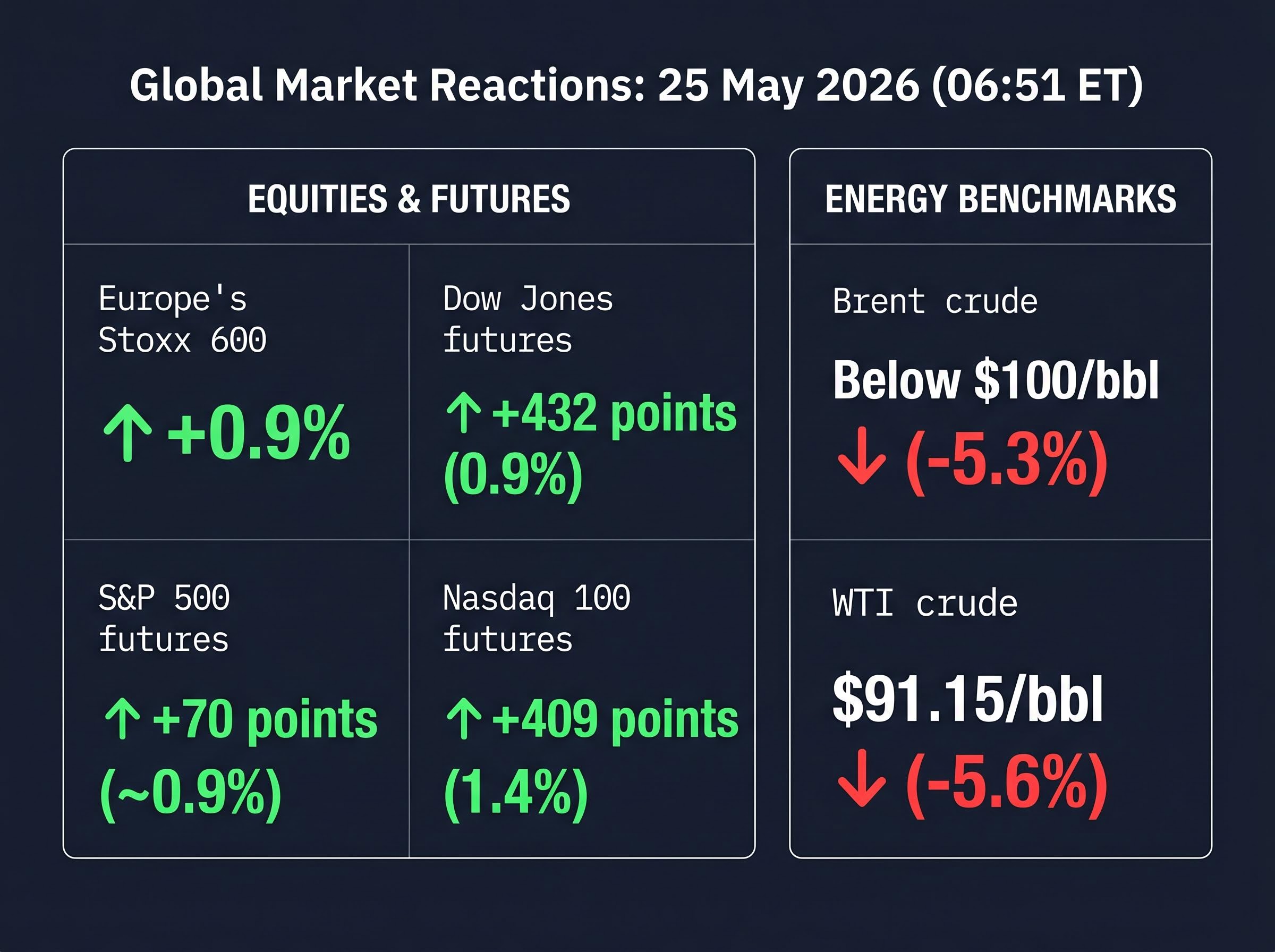
According to Investing.com market data as of 06:51 ET, the moves were uniform in direction but uneven in scale.
| Instrument | Move | Time of Data |
|---|---|---|
| Europe’s Stoxx 600 | +0.9% | 25 May 2026 session |
| Dow Jones futures | +432 points (0.9%) | 06:51 ET |
| S&P 500 futures | +70 points (~0.9%) | 06:51 ET |
| Nasdaq 100 futures | +409 points (1.4%) | 06:51 ET |
Standout performer: Nasdaq 100 futures led the session with a 1.4% advance, suggesting growth and technology equities were pricing in a disinflation benefit from lower oil more aggressively than the broader market.
German and French indices also advanced, approaching highs not seen since early March. Yet holiday-thinned liquidity in both Europe and the US means these percentage moves may overstate underlying conviction. Futures on a closed exchange, traded in reduced volume, are a directional signal, not a verdict.
When big ASX news breaks, our subscribers know first
What the preliminary framework actually says
Reports emerging on 25 May 2026 described a preliminary US-Iran diplomatic framework, but the distance between “preliminary” and “concluded” is where the risk lives.
The 25 May framework did not emerge from a standing negotiation but from a recovery attempt: a nuclear talks collapse on 23 May had sent Brent down 4.48% to $98.90 just two days earlier, with four structural disputes over sanctions sequencing, IAEA access, centrifuge dismantlement, and ballistic missiles still unresolved at that point.
What is reportedly agreed
A senior White House official, cited in media reports, confirmed that a preliminary framework had been established. According to available reporting, the framework covers:
- Provisions for reopening the Strait of Hormuz to commercial tanker traffic
- Iran’s commitment to forgo nuclear weapons development
- A framework for future negotiations on uranium enrichment
- Iran’s clarification that it would not impose tolls on strait-transiting vessels, walking back a prior threat, though fees for navigation services would apply
What remains contested
The agreement’s gaps are specific and substantial:
- Iran has broadly resisted US demands to surrender its enriched uranium stockpile, the single most contentious element of the negotiations
- An Iranian foreign ministry spokesperson, cited by Reuters, stated that while both sides have converged on a range of issues, a final accord cannot be characterised as imminent
- President Trump stated via social media that he had directed his negotiating team not to rush, and confirmed that US port blockades on Iran remain in place until a deal is formally concluded and verified
- Secretary of State Rubio indicated that diplomatic options would be exhausted, but that other measures remain on the table
The conflict itself, which also involved Israel, began in late February 2026 following a joint US-Israeli military operation targeting Iran. That origin point matters: the diplomatic gap being bridged is not a trade disagreement but an active military confrontation with weeks of accumulated infrastructure disruption.
Why the Strait of Hormuz is the chokepoint that moves global markets
Approximately one-fifth of global oil supply transits the Strait of Hormuz, the narrow waterway off Iran’s southern coast separating the Persian Gulf from the open ocean.
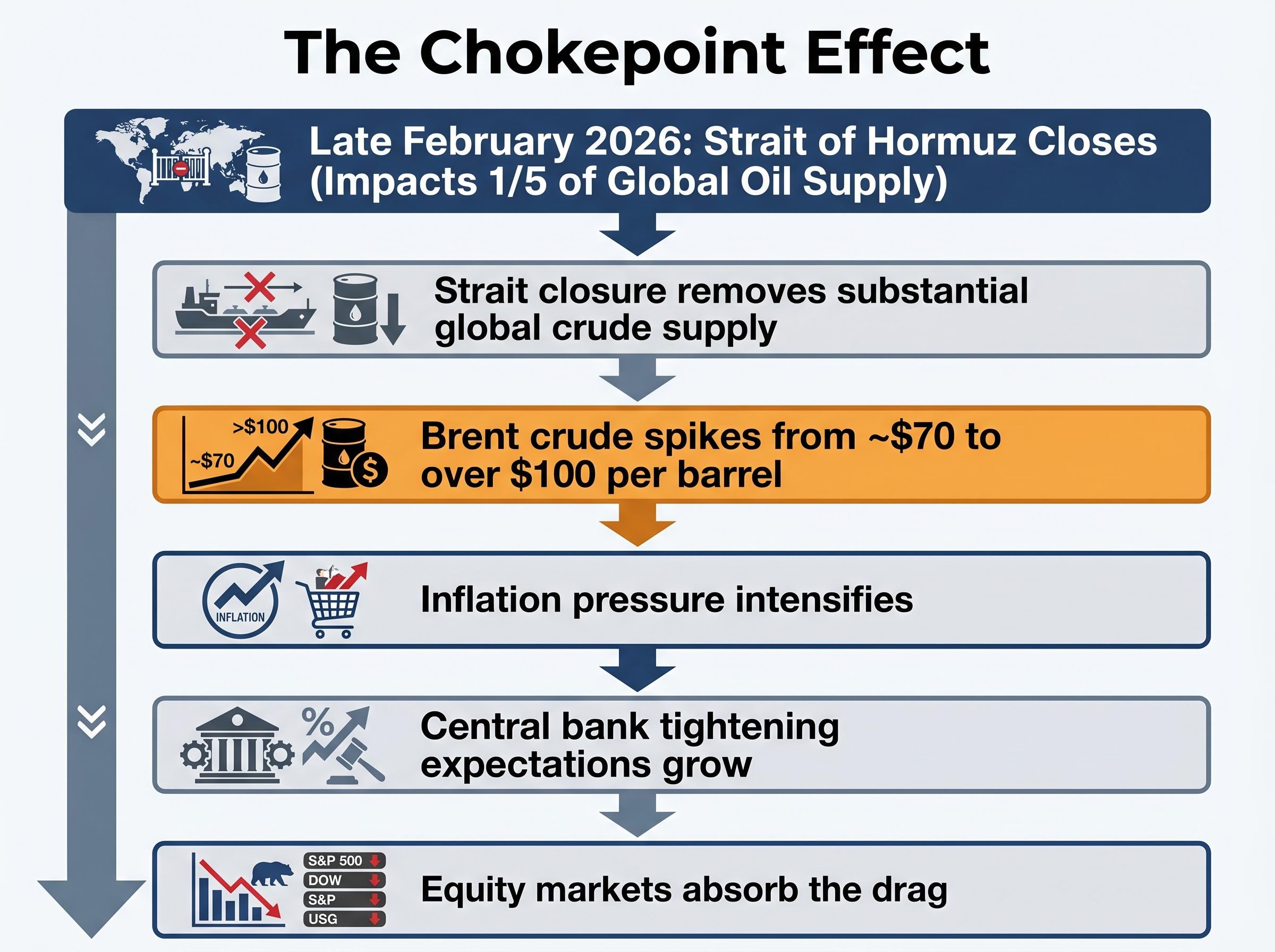
When that passage closed to tanker traffic in late February, the effect radiated outward through a chain that connects geography to portfolio returns. The strait had been largely closed for several weeks prior to 25 May 2026, and the transmission ran in a direct sequence:
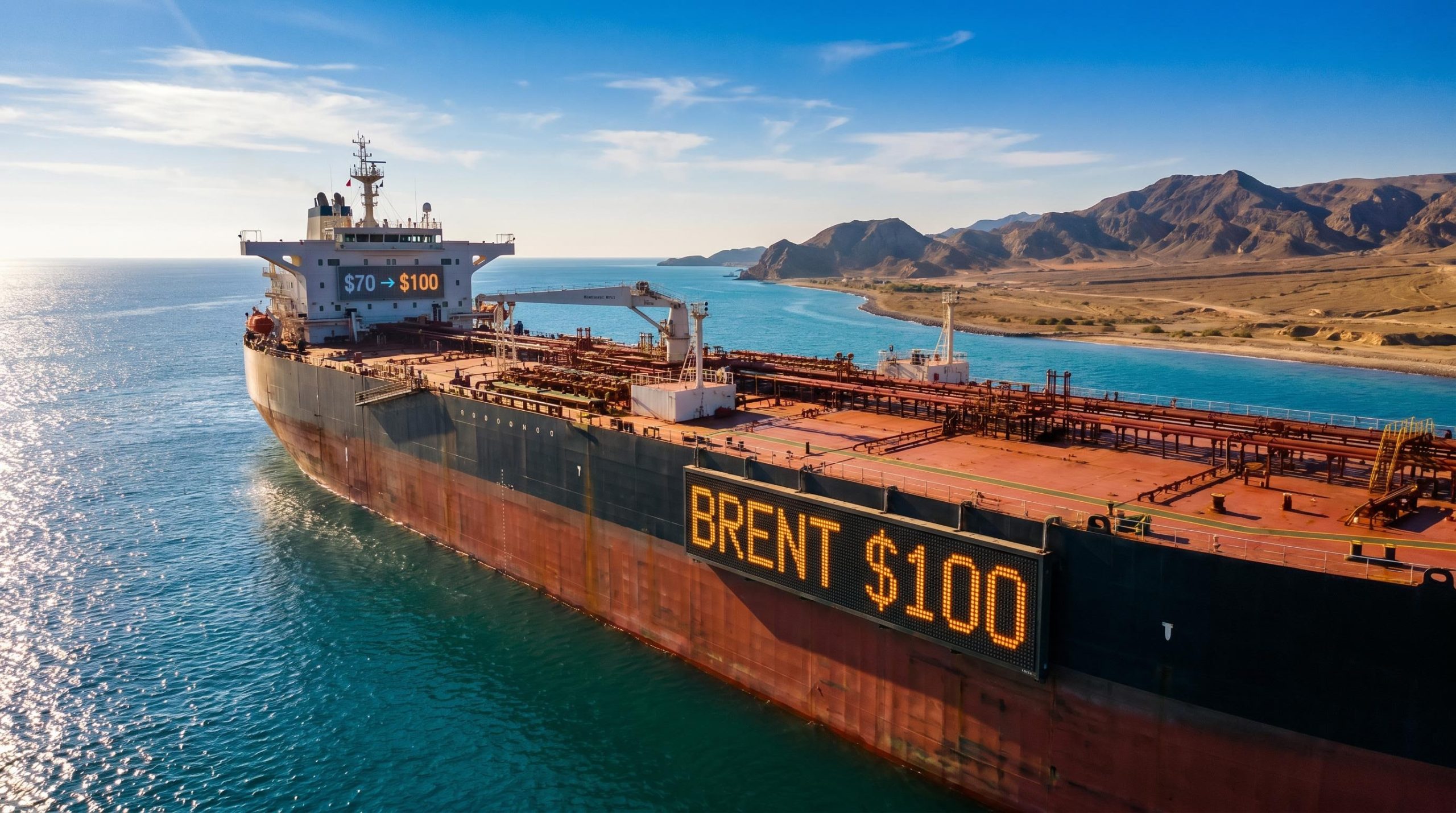
The Strait of Hormuz’s effective closure since late February 2026 produced a 57% oil price surge, carrying Brent from approximately $70 per barrel to above $110 before the diplomatic headlines of 25 May began pulling prices back toward three-figure territory.
- Strait closure removed a substantial share of global crude supply from the market
- Oil prices spiked, with Brent crude rising from a pre-conflict level of approximately $70 per barrel to sustained levels above $100
- Inflation pressure intensified as energy costs fed through to transport, manufacturing, and consumer goods
- Central bank tightening expectations grew, as policymakers faced pressure to respond to supply-driven price increases
- Equity markets absorbed the drag, particularly rate-sensitive growth and technology stocks
The reverse of each link explains why a single diplomatic headline in the Gulf moves a Nasdaq futures contract in New York. A reopening would ease supply, compress oil prices, relieve inflation pressure, soften rate expectations, and remove a headwind from equities. That chain is why Brent’s fall below $100 and the Nasdaq’s 1.4% futures surge arrived in the same session.
Oil’s sharp drop tells only half the story
Brent crude fell below $100 per barrel on 25 May 2026, a decline of approximately 5.3% on the day, according to Investing.com data. WTI crude dropped to $91.15, a fall of approximately 5.6%.
Those are large single-session moves. They are also incomplete.
Brent at just under $100 remains roughly 43% above the pre-conflict baseline of approximately $70 per barrel. The market has not priced resolution. It has priced a shift in probability.
| Benchmark | Pre-Conflict Level | Current Level | Day Change |
|---|---|---|---|
| Brent crude | ~$70/bbl | Below $100/bbl | -5.3% |
| WTI crude | — | $91.15/bbl | -5.6% |
ING analysts noted in a client note that optimism surrounding the diplomatic situation appeared to have moderated, and that resolution of differences over Iran’s nuclear activities remains a major outstanding uncertainty.
ING crude oil market analysis published ahead of the 25 May session identified this whipsaw dynamic explicitly, noting that crude prices were swinging sharply as market participants attempted to price the probability of new Iranian supply returning to global markets.
That residual $30 gap between current Brent and its pre-conflict level is not noise. It is the market’s embedded risk premium for deal failure, a real-time indicator of how traders are collectively assessing the probability that diplomacy succeeds.
The Hormuz risk premium embedded in current Brent prices reflects more than just physical supply disruption; the near-total withdrawal of commercial war-risk insurance has made the strait effectively closed to standard tanker traffic even during periods when physical passage was technically possible, a structural factor that does not dissolve on a diplomatic headline.
What a deal, or a collapse, means for investors from here
The preliminary framework creates a binary forward picture. Each branch carries distinct implications across asset classes.
If a deal is concluded and verified
- Brent crude would be expected to trend toward the pre-conflict $70 baseline as strait traffic normalises
- The equity rally signalled by today’s futures moves could extend, particularly in rate-sensitive growth and technology names
- Central bank tightening pressure would ease as supply-driven inflation subsides
- Safe-haven positioning in gold and government bonds would likely unwind
If talks stall or collapse
- Oil prices would likely rebound above $100, potentially retesting or exceeding prior highs
- Equity futures gains from today’s session would face reversal pressure when US markets reopen
- Inflation expectations would re-intensify, restoring central bank hawkishness
- Secretary of State Rubio’s reference to “other measures” remaining on the table raises the prospect of further escalation
One data point sharpens the sector read: the Nasdaq 100 futures’ 1.4% gain outpaced the S&P 500’s 0.9% move. That spread implies technology and growth equities are pricing a disinflation benefit from lower oil more aggressively than the broader market. If the deal collapses, that same outperformance becomes vulnerability.
The condition that gates the next phase is specific and observable: President Trump confirmed that US blockades remain in place until a deal is formally concluded and verified. Until that trigger is met, the market cannot fully price resolution.
This article is for informational purposes only and should not be considered financial advice. Investors should conduct their own research and consult with financial professionals before making investment decisions. These forward-looking statements regarding potential deal outcomes are speculative and subject to change based on diplomatic developments and market conditions.
A rally built on a framework, not a finished deal
Markets moved on 25 May 2026 as if probability had shifted meaningfully: the Stoxx 600 gained 0.9%, Nasdaq futures surged 1.4%, and Brent crude fell below $100 for the first time since the strait’s closure. Every named actor on both sides, however, has explicitly preserved the space for failure.
Iran’s foreign ministry stated a final accord is not imminent. President Trump directed his team not to rush. US blockades remain.
“Both sides have converged on a range of issues, but a final accord cannot be characterised as imminent.” — Iranian foreign ministry spokesperson, cited by Reuters
The one number that carries the story forward is Brent crude’s distance from the pre-conflict $70 level. That gap, still roughly $30 wide, is the market’s running probability estimate on whether diplomacy delivers. Until the blockades lift, this rally is built on a framework, not a finished deal.
For investors who want to move from reading the diplomatic signals to acting on them, our comprehensive walkthrough of geopolitical portfolio positioning covers the five-component resilience framework recommended by BlackRock and Vanguard, including strategic gold allocation targets, bond duration adjustments, and defence sector exposure metrics that apply specifically to binary-outcome geopolitical events like this one.