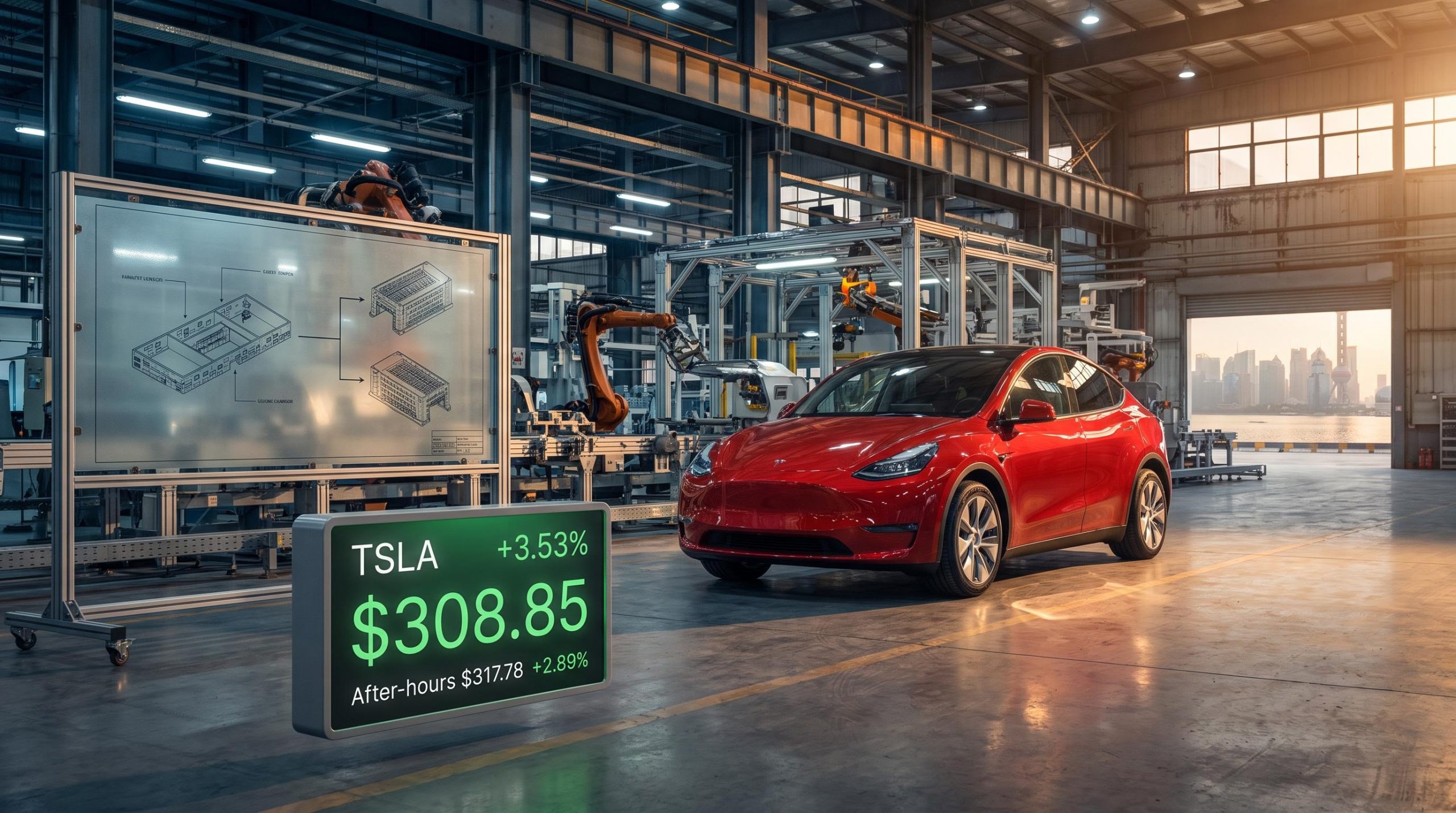
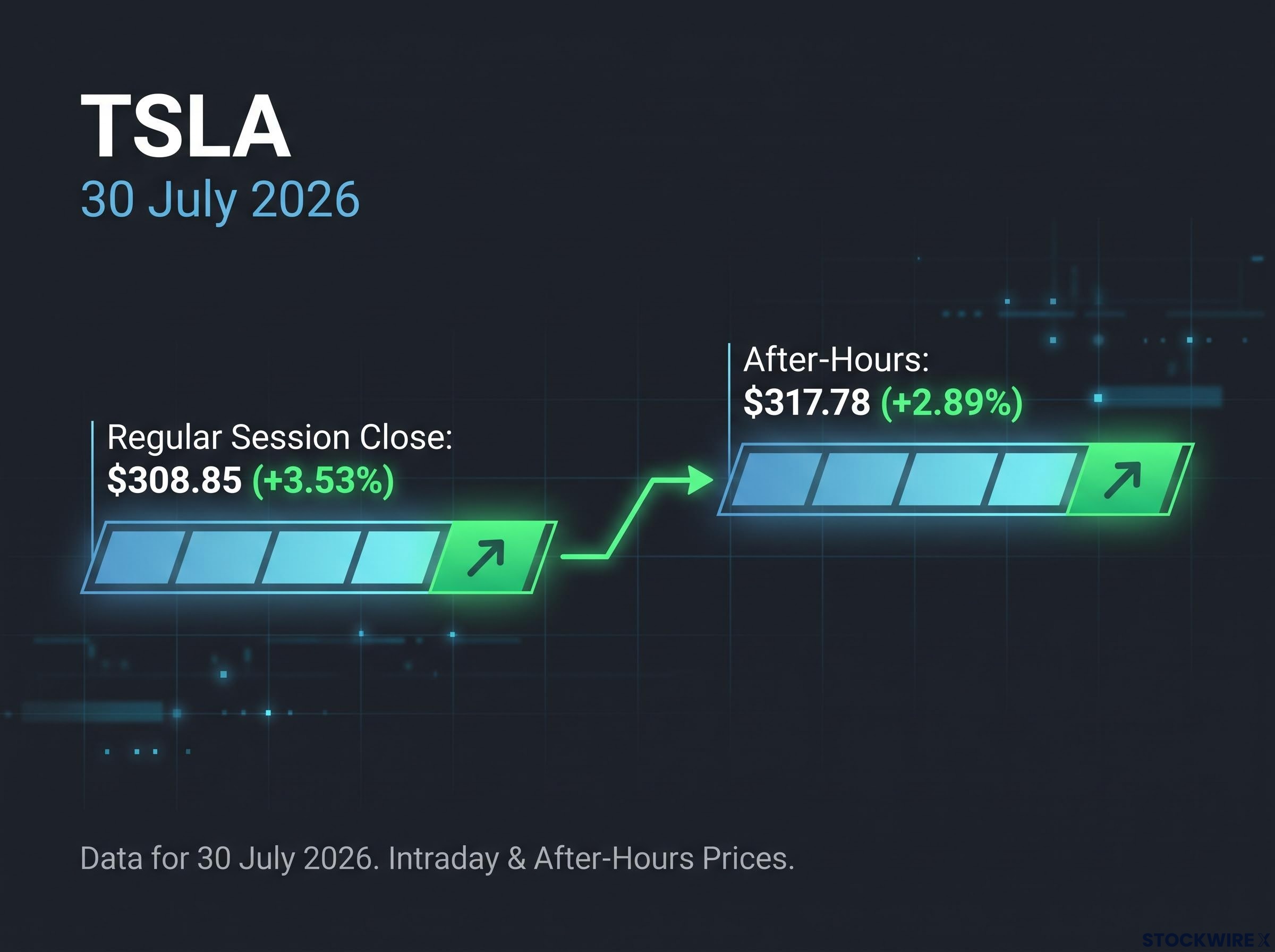
Tesla shares surged on 30 July 2026 after the Wall Street Journal reported that Elon Musk has instructed executives to prepare for a possible separation of the company’s China business. TSLA closed up 3.53% at $308.85 and climbed a further 2.89% to $317.78 in after-hours trading, pricing in a scenario most investors would instinctively read as negative.
The reaction only makes sense once you understand the scale of what is at stake. Tesla’s China operations are not a regional sales office. Gigafactory Shanghai is the company’s highest-volume production facility, its lowest-cost manufacturing base, and an export hub serving Europe and beyond. China is simultaneously Tesla’s most strategically valuable international asset and its most concentrated source of geopolitical risk.
Here is what each proposed separation structure would actually mean for a TSLA position, what the SpaceX merger angle changes about the calculus, and the three specific signals worth tracking before any of this moves from internal discussion to corporate reality.
Why Tesla’s shares jumped on a story about losing its biggest factory
The market’s first instinct was to buy, not sell, and that tells you something about how investors currently frame Tesla’s China exposure.
TSLA closed at $308.85 on 30 July 2026, up 3.53% on the session. After-hours trading extended the move to $317.78, a further 2.89% gain, according to the Wall Street Journal report citing individuals familiar with the matter.
The logic is straightforward once you strip it back. Tesla’s China business carries a geopolitical risk premium that weighs on the entire stock. Ring-fencing that exposure into a separate structure would, in theory, let the core Tesla entity trade without the discount investors currently apply for U.S.-China tension.
The second driver is the reported Tesla-SpaceX merger. SpaceX is deeply embedded in U.S. national security and defence contracts. A combined entity that also operates factories in China would face severe regulatory scrutiny. Removing that obstacle before a merger attempt simplifies the single most complex approval pathway the deal would face.
The reaction tells you that investors currently view Tesla’s China exposure more as a liability to be priced in than a growth asset to be prized. That framing shapes how every separation scenario should be evaluated.
When big ASX news breaks, our subscribers know first
What Tesla actually built in China, and what separating it would mean
Before weighing any scenario, it is worth understanding what Gigafactory Shanghai actually does. This is not an assembly outpost.
The facility has annual production capacity exceeding 950,000 vehicles, making it Tesla’s highest-volume plant globally. It serves three distinct strategic functions:
Tesla’s Q2 2026 delivery beat of 480,126 vehicles against a consensus of roughly 402,776 units establishes the production baseline that any China separation would need to account for, with Shanghai’s contribution central to understanding what volume would need to be replaced or restructured.
- Domestic production hub: supplying China, Tesla’s second-largest market by sales
- Global export facility: shipping vehicles to Europe and other international markets
- Low-cost manufacturing base: benefiting from China’s dense EV supply chain and local supplier ecosystem, giving it a structural cost advantage over Tesla’s U.S. and European plants
Beyond the hardware, Tesla’s China operations are tightly integrated into global software systems, data infrastructure, and product planning. This is not a subsidiary that can be carved out with a clean line on an org chart. Separating it means untangling shared intellectual property, software platforms, and supply chain arrangements that span continents.
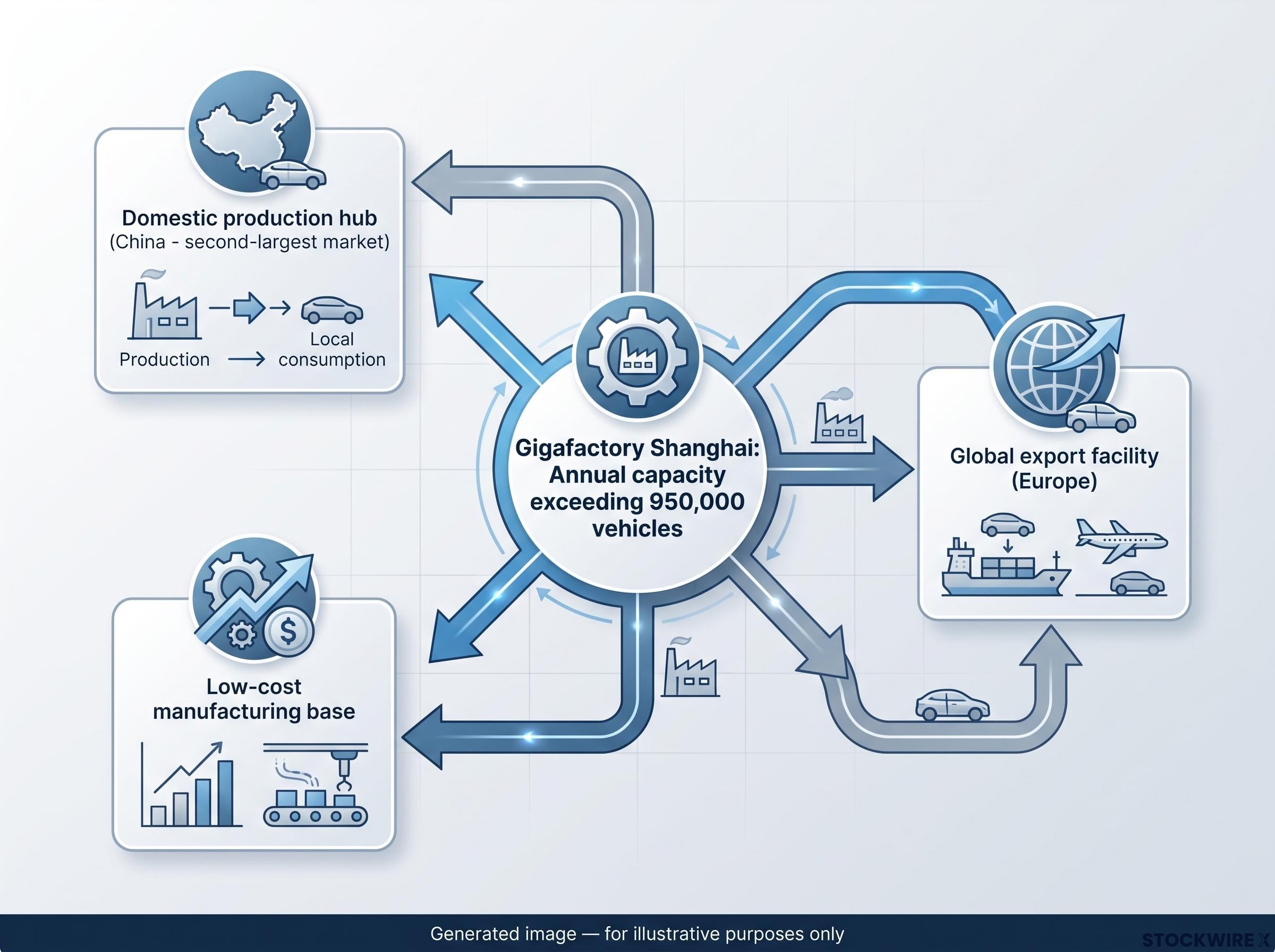
The integration depth is precisely why the scenario you find most plausible matters. A spinoff preserves most of this value. A sale transfers it. A closure destroys a substantial portion of it.
Three paths forward: spinoff, sale, or shutdown
The Wall Street Journal reports that advisers have discussed three options. Each carries a meaningfully different outcome for TSLA shareholders.
| Scenario | What it involves | Key investor upside | Key risk |
|---|---|---|---|
| Spinoff | Tesla creates an independent, likely listed China entity; shares distributed to TSLA holders or sold via IPO | Retains economic exposure; potential valuation uplift if China unit is priced attractively as a standalone | Complex cross-border regulation; Chinese capital controls alongside U.S. securities requirements; loss of operational synergies |
| Sale | Tesla sells China operations outright, likely to a domestic Chinese automaker or state-linked entity | Large cash inflow; cleaner geopolitical profile; simpler structure for any Tesla-SpaceX merger | Political sensitivity of state-affiliated buyers; risk of a discounted deal; permanent loss of low-cost production base |
| Closure | Tesla winds down China manufacturing and exits the market | Maximum geopolitical risk removal; full strategic focus on other regions | Most value-destructive path; loss of capacity, supply chains, and China market exposure; significant earnings impact |
The WSJ notes that the timeline for any spinoff or sale remains uncertain, and that the entire process remains subject to change with no deal guaranteed. The current share price reaction assumes one of the first two paths materialises. Whether that assumption proves prescient or premature depends entirely on which scenario plays out, making scenario literacy the most practical analytical tool you have right now.
For investors wanting a structured method to assign probability weights to the spinoff, sale, and closure outcomes, our dedicated guide to scenario analysis valuation uses Tesla’s live forward P/E as a worked case study and walks through how to build bull, base, and bear frameworks with entry-price discipline.
The SpaceX angle that makes this more than a China story
This is where the story expands beyond a standard geopolitical restructuring.
Both the Wall Street Journal and Reuters cite the Tesla-SpaceX merger as a driver of the China separation planning, attributing the connection to unnamed sources familiar with internal discussions.
SpaceX’s deep involvement in U.S. national security, from classified satellite launches to defence contracts, makes a combined entity with Chinese factory operations a near-certain regulatory obstacle. Removing China from the structure before pursuing a merger is, in that framing, a prerequisite rather than a preference.
Neither Tesla nor SpaceX has publicly commented on merger discussions as of 31 July 2026, and no confirmed timeline or deal structure has been reported. That matters. A Tesla-SpaceX combination could command a fundamentally different valuation multiple than either company carries alone. But a merger of that scale would face its own governance, regulatory, and structural complexity independent of the China question.
Wolfe Research has identified four concrete Tesla-SpaceX merger obstacles — including dilution risk, stacked capital intensity, overlapping regulatory exposure, and conflicts of interest — and places the earliest realistic completion at mid-2027, well beyond the timeline implied by the current share price reaction.
If the SpaceX merger is the real end-game behind China separation planning, then the investment question is not just what China is worth but what a combined Tesla-SpaceX entity might be. That is an entirely different valuation exercise.
What could derail the plan before it starts
The optimism embedded in the 30 July share move deserves a clear-eyed counterweight. These are early-stage internal discussions, not a boardroom resolution. The WSJ makes clear that the situation remains fluid, with no certainty that any transaction will materialise.
Four distinct risk categories are worth monitoring:
- Execution uncertainty: no official Tesla communication, no SEC filing, no confirmed timeline. Everything reported comes from unnamed sources.
- Chinese regulatory approval: Beijing has historically taken an active role in approving or shaping large-scale foreign asset transactions. A hostile or cautious signal from Chinese regulators could close off the spinoff and sale paths simultaneously.
- U.S. national security review: particularly relevant if the SpaceX merger is in play, since the Committee on Foreign Investment in the United States (CFIUS), the federal body that reviews transactions for national security implications, would likely scrutinise any structure involving technology transfers.
- Operational disentanglement: separating shared software, data infrastructure, IP, and supply chain arrangements is considerably harder than a standard corporate carveout.
CFIUS national security review authority, grounded in Section 721 of the Defense Production Act, gives the committee broad jurisdiction to scrutinise transactions involving critical technologies and defence-adjacent entities, precisely the profile a combined Tesla-SpaceX structure with Chinese manufacturing operations would present.
There is also a competitive consequence. Tesla’s China sales declined in 2025, and the company has already implemented job cuts and experienced margin pressure as domestic competition, led by BYD, intensified. Any reduction in Tesla’s China presence hands market share to rivals who are already gaining ground.
These risks are not peripheral concerns. They are the primary variables that determine whether the scenario that excited markets yesterday is achievable at the price and speed the reaction implies.
This article is for informational purposes only and should not be considered financial advice. Investors should conduct their own research and consult with financial professionals before making investment decisions. These statements are speculative and subject to change based on market developments and company performance.
Three signals worth watching before drawing conclusions
Rather than waiting passively, there are three specific markers that would shift this story from speculation to something worth repositioning around.
- Official Tesla disclosure. Any SEC filing, earnings call commentary, or investor relations statement that references a formal strategic review of China operations. The shift from unnamed-source reporting to company-initiated disclosure is the single most important escalation marker.
- Beijing’s posture. Indications from Chinese state media or regulatory bodies about the government’s stance toward large-scale foreign asset restructuring. If Beijing signals resistance, the spinoff and sale paths narrow simultaneously.
- SpaceX merger progress. Further reporting on timeline or structure for a Tesla-SpaceX combination. The research indicates these two threads are linked; progress on one is likely a proxy for progress on the other.
None of these signals have fired yet as of 31 July 2026. The WSJ report remains the primary source, with Reuters corroborating the SpaceX merger link but adding no confirmed structural detail. The current share price move is pricing in possibility rather than probability, and that distinction should anchor how much portfolio weight you attach to this narrative today.
What the separation debate actually tells you about Tesla’s direction
Whether or not a China separation happens, the fact that Tesla is reportedly preparing for one signals something about where leadership’s priorities sit. Geopolitical risk containment and the SpaceX merger path are, at least internally, being treated as higher strategic priorities than maximising Chinese market share in the near term.
Tesla’s situation is a case study in geopolitical fragmentation risk at the company level: the same industrial policy divergence and regional bloc formation that the IMF warns could reduce global GDP by up to 7-8% long term is the direct force compelling a company to consider carving out its most productive factory.
That signal lands differently depending on your TSLA thesis. If your position is built around AI, autonomy, and domestic U.S. growth, this strategic direction broadly aligns with your view. If your thesis depends heavily on China volume and Shanghai’s cost advantages, the picture is more complex and may warrant reassessment regardless of which specific path is chosen.
The market’s positive reaction on 30 July is a reasonable first response to a risk-reduction signal. But a first response is not a verdict. The regulatory obstacles, operational complexity, and competitive consequences outlined above are real, and they will determine whether the optimism holds or fades. Tesla’s China story has entered a period of genuine strategic uncertainty. Positions sized for a stable, integrated China operation may need to be re-evaluated.
—