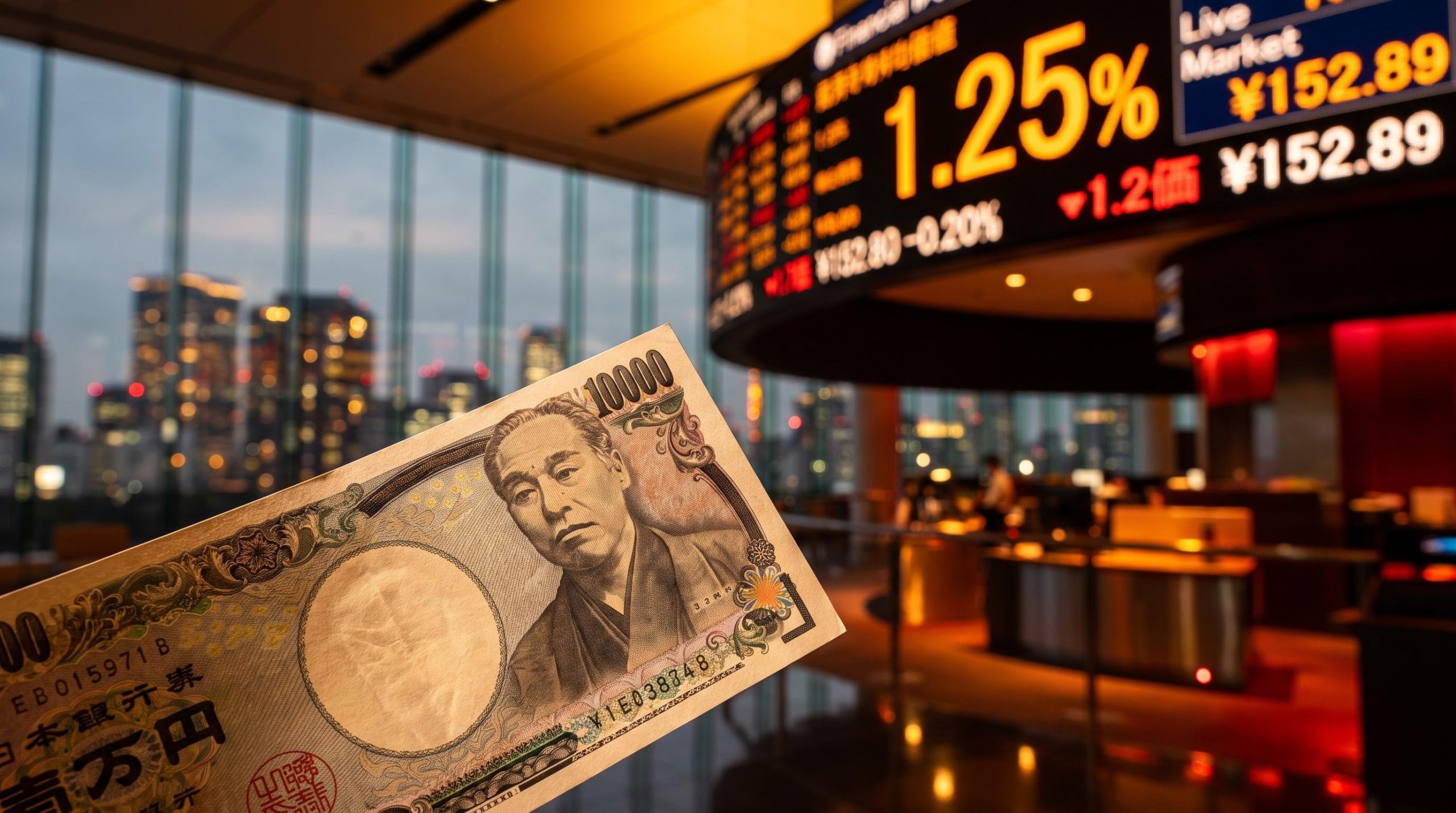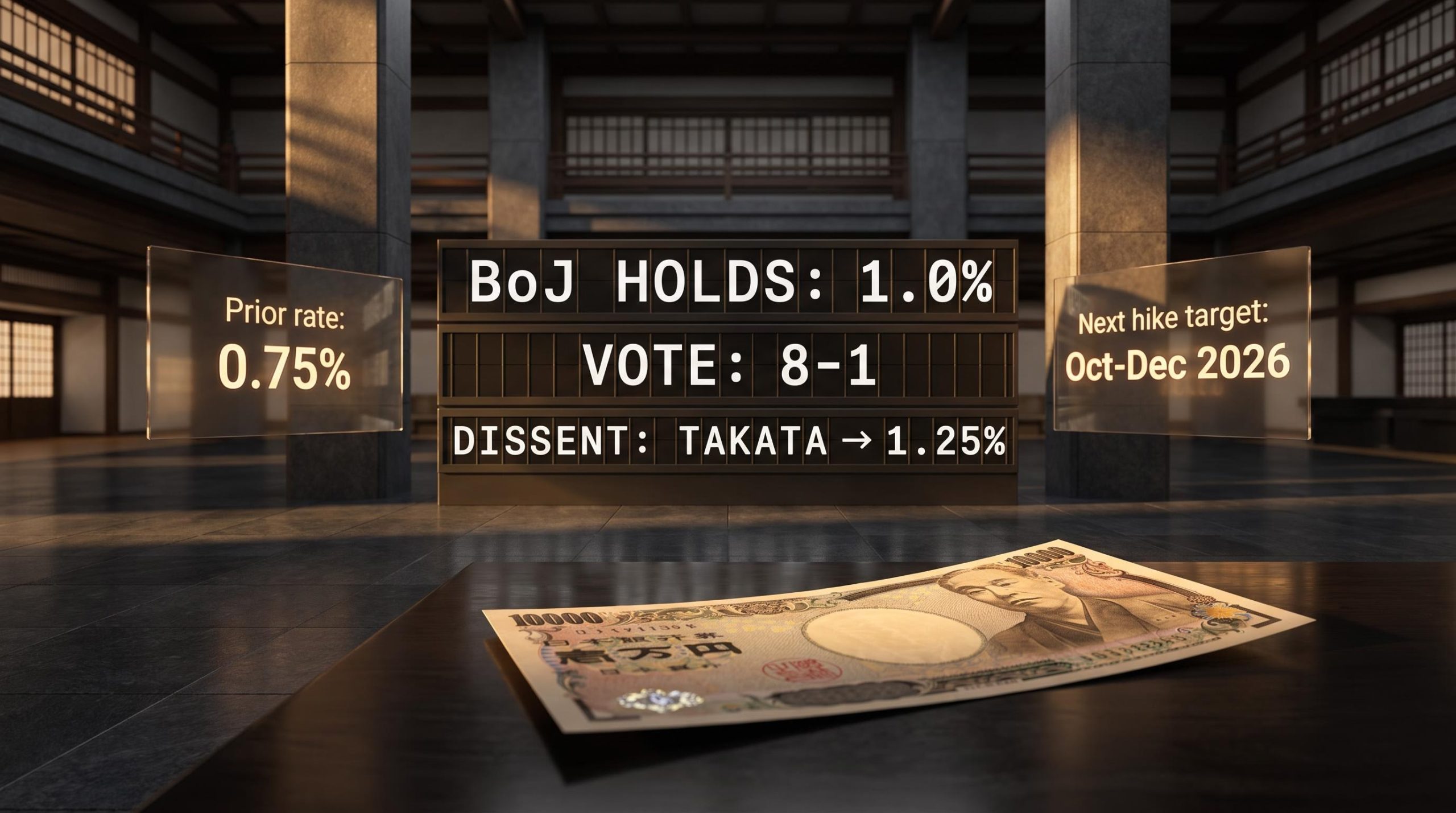
The Bank of Japan kept its benchmark interest rate at 1.0% on 31 July 2026, with the announcement arriving against a backdrop of a yen still recovering from multi-decade lows, a formal U.S. Treasury rate check already on the books, and a board member pushing for a rate rise without delay. This is not a quiet hold.
The decision lands at a moment when Japanese monetary policy has moved from global macro footnote to front-page signal. The yen functions as the world’s most-watched funding currency. Japanese institutional investors hold significant positions in U.S. Treasuries and global bonds. Every BoJ signal now carries weight well beyond Tokyo. The July meeting also came packaged with a downward revision to near-term inflation and an upward revision to growth, a combination that complicates the policy path in ways markets are still processing.
Here is what actually drove this decision, what the yen intervention episode reveals about the diplomatic and market dynamics now surrounding the currency, and which three triggers will determine when and how fast Japan raises rates next.
An 8-1 vote that describes more than just a hold
The headline: the BoJ voted 8-1 to hold at 1.0%, the highest policy rate since the mid-1990s, following a 25 basis point hike from 0.75% implemented in June.
The June 2026 hike that preceded this hold was itself a significant inflection point: delivered via a 7-1 vote alongside a structured JGB tapering schedule, it set the stage for the gradualist tightening path the board majority is now defending.
The detail that reframes it: board member Hajime Takata was the sole dissenter. Rather than raising reservations or urging caution, he cast his vote in favour of lifting the rate to 1.25% without delay.
On the record: At the July meeting, Hajime Takata cast the single dissenting vote in the 8-1 outcome, pressing for the policy rate to be lifted to 1.25%.
That distinction matters. A named board member advocating a specific higher rate in a published vote record signals to markets that the hawkish option has institutional backing. It shortens the perceived distance to the next hike.
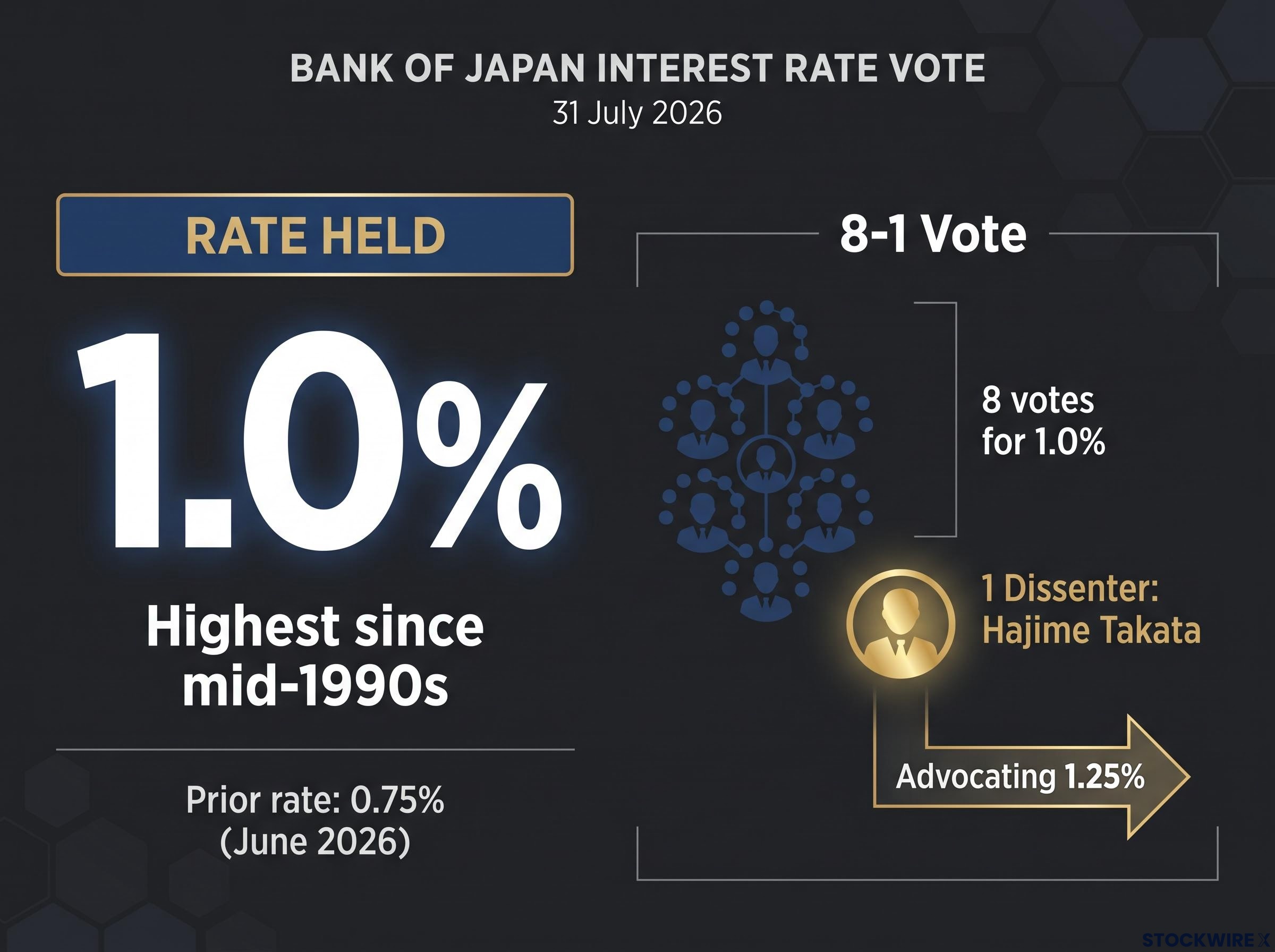
- Rate held: 1.0%
- Vote: 8-1
- Prior rate (before June 2026 hike): 0.75%
- Dissenter: Hajime Takata, advocating 1.25%
- Context: Highest policy rate since mid-1990s
The majority framed the hold not as a dovish signal but as a deliberate pause, time to assess the impact of June’s hike before moving again. Anyone reading the headline “BoJ holds” as a signal of hesitation is misreading the vote structure. The board is moving. The question is timing, not direction.
When big ASX news breaks, our subscribers know first
How the yen went from 40-year lows to a policy flashpoint
Prior to the meeting, the yen had been changing hands around the mid-160s per dollar, a level representing roughly a 40-year trough for the currency. That kind of depreciation, sustained over months, turned a domestic monetary policy issue into a multilateral concern.
Japan’s Ministry of Finance (MoF) stepped into currency markets directly, deploying a tool it has historically reached for when yen weakness becomes disorderly. Through that operation, the yen was able to claw back ground from those generational lows in a meaningful way.
The scale and persistence of yen intervention limits become clearer in the context of Japan’s record-breaking 2026 campaign: even after deploying over $72 billion, USD/JPY still reached 162.40 by late June, confirming that unilateral MoF operations can arrest disorderly moves but cannot close the structural gap created by the BoJ-Fed rate differential.
But the MoF was not acting alone.
- MoF direct intervention: Japan’s finance ministry bought yen in the open market, a direct operation designed to arrest disorderly weakness.
- U.S. Treasury rate check: The U.S. Treasury conducted a rate check on the yen, a formal signalling tool used when a major currency move warrants closer monitoring. It is a step above informal commentary and a step below coordinated intervention.
Why Washington is watching yen weakness
In a Fox Business interview, U.S. Treasury Secretary Scott Bessent stated that the yen looked to him like a currency that was carrying substantial undervaluation. A senior U.S. official publicly labelling a G7 currency as significantly undervalued is a diplomatic signal with precedent in trade and currency policy negotiations.
The combination of a formal U.S. Treasury rate check and a cabinet-level official putting yen undervaluation on the record in a broadcast interview together indicate that the United States is growing less comfortable with the currency’s extended weakness. That adds geopolitical pressure to Japan’s domestic policy calculus.
The yen is no longer moving purely on BoJ policy and rate differentials. It is now subject to bilateral FX diplomacy that can shift its trajectory independent of any BoJ meeting outcome.
What CPI down and GDP up actually means for the rate path
The BoJ’s revised forecasts create a puzzle at first glance. The central bank trimmed its outlook for near-term core CPI while marking up its projection for GDP growth. Lower inflation and stronger growth might suggest the BoJ can afford to wait.
The reality is more complicated.
The upward GDP revision reflects private-sector growth drivers, specifically a 7.1% surge in export volumes and resilient business investment, rather than government stimulus spending, which contributed only 0.3 percentage points of the Q1 2026 headline figure and cannot be relied upon to sustain the expansion through the tightening cycle.
| Metric | BoJ revision | Driver | Policy implication |
|---|---|---|---|
| Near-term core CPI | Downward | Government energy subsidies (effect through late 2026) | Measured inflation suppressed by fiscal policy, not structurally absent |
| GDP growth | Upward | Resilient domestic demand, corporate sentiment, AI-related capex | Economy can absorb higher rates over time |
The CPI revision was driven by government energy subsidies, fiscal measures that mechanically suppress measured inflation. This is policy-engineered disinflation: inflation that is masked by subsidy, not structurally absent. The subsidies are expected to influence measured inflation through late 2026. When they fade, the underlying price pressures they are concealing will re-emerge.
Medium- to long-term inflation expectations remain at or above 2%, supporting the BoJ’s continued tightening bias even as the near-term headline number looks softer.
If subsidies are masking true underlying inflation, their eventual removal could force the BoJ to raise rates faster than the current gradual path implies. Markets pricing a smooth, predictable tightening cycle may be underestimating late-cycle risk.
Three channels through which this reshapes global markets
Japan’s exit from near-zero rates is not a local story. It transmits through three distinct channels into global portfolios.
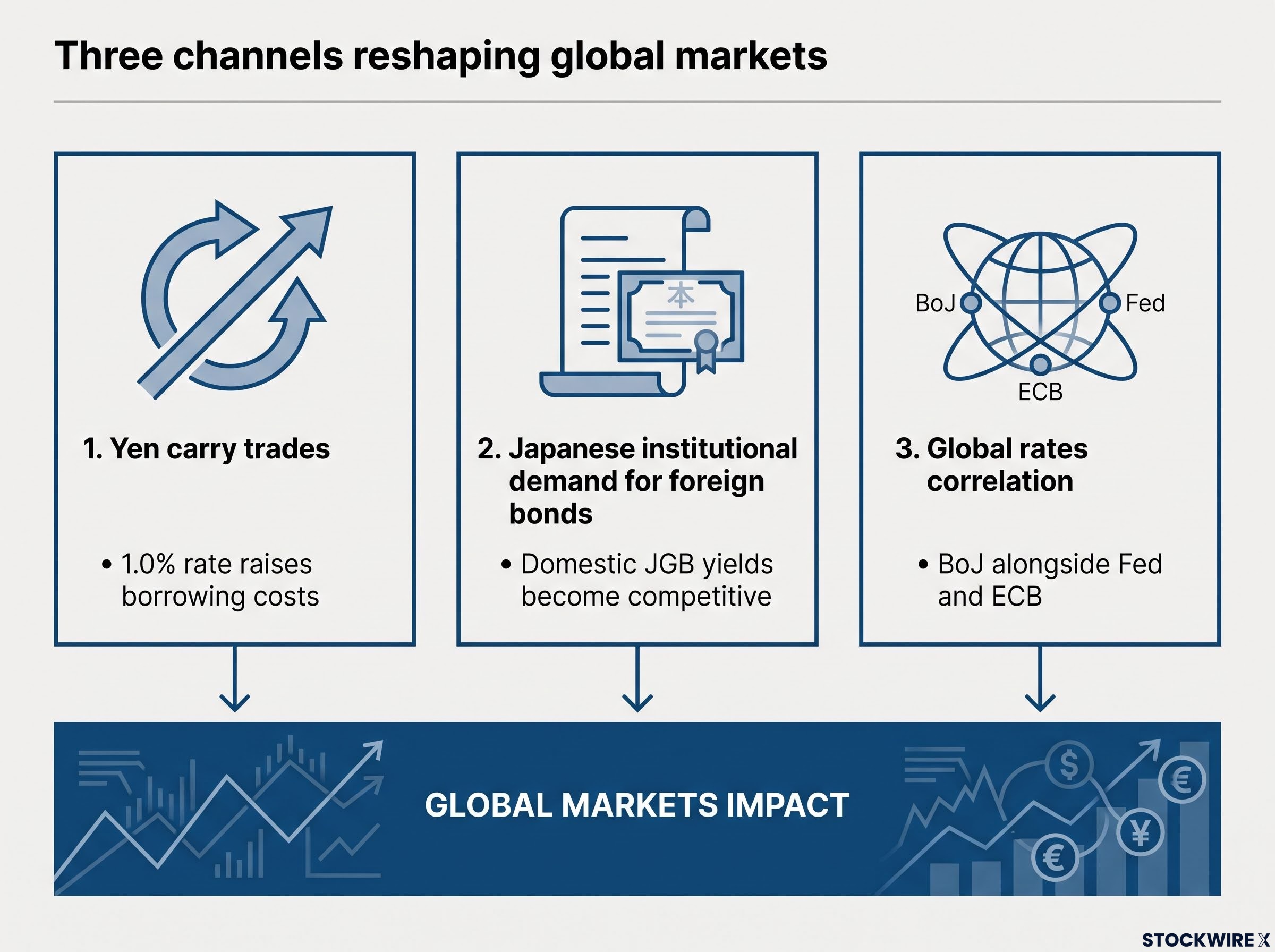
- Yen carry trades. For over a decade, near-zero Japanese rates made the yen the world’s premier funding currency. A 1.0% rate raises the cost of borrowing in yen materially, reducing the raw carry appeal of strategies that fund in JPY to buy higher-yielding emerging-market FX, credit, or alternative assets. The risk of abrupt carry unwind is elevated.
- Japanese institutional demand for foreign bonds. Japanese life insurers, pension funds, and banks are major holders of U.S. Treasuries and global sovereign and credit assets. As domestic JGB yields become more competitive and FX hedging costs rise (linked to short-term rate differentials), the relative attractiveness of hedged foreign bonds diminishes. The gradual rebalancing toward domestic bonds puts marginal upward pressure on global yields.
- Global rates correlation. The BoJ, alongside the Fed and ECB, now represents a third major central bank with an explicit tightening bias anchored in inflation-overshoot concern. That removes the structural floor that near-zero Japanese rates previously provided to global yields.
Japan is no longer a structural anchor of low global yields. Its policy can now reinforce global tightening when inflation shocks are shared across economies.
For any investor with emerging-market exposure, foreign bond holdings, or leveraged macro positions, the BoJ’s gradual tightening is not a distant development. It is a structural shift in the funding environment that changes position sizing, risk premia, and hedge cost calculations.
What the BoJ’s hold actually teaches us about carry trade risk
A carry trade works in three steps:
- Borrow in a currency with low interest rates (the funding currency).
- Invest the proceeds in a higher-yielding asset, such as emerging-market bonds, high-beta equities, or other higher-return instruments, and pocket the interest rate differential.
- Unwind triggers occur when the funding currency strengthens suddenly or the rate differential narrows, forcing leveraged positions to close rapidly and often at a loss.
Near-zero Japanese rates made the yen the dominant funding currency for this strategy for over a decade. At 1.0%, the cost floor for yen funding has shifted materially. The asset classes most exposed to a yen-driven unwind include emerging-market FX, local-currency debt, high-beta equities, and crypto.
Why the August 2024 yen shock is the reference case
In August 2024, the BoJ surprised markets with a rate hike. The yen surged. Leveraged yen-funded positions unwound rapidly. Global equities sold off in sympathy. The mechanism was straightforward: sudden yen strength forced de-leveraging across asset classes that had been funded cheaply in JPY.
Current conditions are not identical. But the mechanism is the same, and the 8-1 vote structure shows the hawkish acceleration scenario has a named advocate in Takata. The BoJ’s predictable gradualism is what is protecting leveraged strategies from a repeat. Any deviation from that gradualism restarts the risk clock.
Three triggers that will tell you when Japan moves next
The BoJ framed July explicitly as a pause to assess June’s hike, not as a signal the tightening cycle is over. Market consensus currently points to the next 25 bps hike in the October-December 2026 window, which would take the rate to 1.25%.
Forward reference: Market consensus and futures pricing currently point to the next BoJ hike in the October-December 2026 window, targeting 1.25%.
Three triggers will determine whether that timeline holds, accelerates, or delays:
- Inflation data and subsidy fade. Core CPI surprises to the upside, or evidence that subsidies are merely masking underlying inflation, would strengthen the hawkish camp and bring the next hike forward. The government energy subsidy effect runs through late 2026; its removal is a latent inflation risk.
- Yen behaviour and FX diplomacy. Renewed yen weakness toward or beyond the mid-160s would prompt escalated MoF intervention and increase pressure on the BoJ to hike. Intensifying U.S.-Japan dialogue on FX, already active, would signal diminishing tolerance for extreme yen undervaluation.
- Growth resilience after June’s hike. If subsequent data confirm the June hike did not materially slow activity, and AI-related capex and corporate sentiment hold firm, the case for another 25 bps move remains strong.
The October-December window is not a guarantee. It is a conditional baseline, and these three triggers are the conditions that will either confirm it or shift it. Monitoring all three is more valuable than tracking any single data point.
What the correction changes, and what it does not
The July hold does not change the direction of Japanese monetary policy. It changes only the pace. The 8-1 vote structure and Takata’s specific advocacy for 1.25% make clear the next move is a question of when, not if.
The global implications are already in motion. Yen-funded carry trades, Japanese institutional demand for foreign bonds, and global yield correlations will all remain in transition as Japan continues its exit from near-zero rates through 2026-2027. The consensus rate path points to 1.25% by the end of 2026, with further hikes dependent on the three triggers outlined above.
The BoJ has reclaimed its position alongside the Fed and ECB as a co-architect of the global rate environment, a status it lost during the era of ultra-accommodation.
For investors wanting to translate the BoJ’s tightening path into equity positioning, our full explainer on Japan’s equity market outlook examines how institutional investors from Morgan Stanley, UBS, and BlackRock are navigating the gap between bearish sentiment and Japan’s leading MSCI World performance in 2026.
For global investors, the BoJ is now a source of both risk and analytical opportunity. Its decisions are increasingly market-moving, its signals increasingly legible, and its future path conditional enough that informed readers have a genuine informational edge over those treating Japan as a footnote.
This article is for informational purposes only and should not be considered financial advice. Investors should conduct their own research and consult with financial professionals before making investment decisions. Forward-looking statements regarding rate paths and market outcomes are subject to change based on evolving economic conditions and policy decisions.