Tesla shares dropped more than 5% on the day SpaceX priced its initial public offering, a reaction that caught many TSLA bulls off guard. The event institutional investors had spent months anticipating, a public listing that would crystallise SpaceX’s value and theoretically validate a future Tesla-SpaceX combination, arrived and triggered a sell-off instead. According to Wolfe Research analyst Emmanuel Rosner, a prospective SpaceX-Tesla merger has moved from fringe speculation to a mainstream institutional thesis, with some money managers now citing it as their primary reason for holding TSLA. SpaceX prices on 11 June 2026 and begins trading 12 June on Nasdaq under the ticker SPCX. What follows unpacks why the merger narrative has taken hold, what the structural logic behind it actually is, what the real obstacles are, and what the IPO means for TSLA holders right now.
Why institutional investors are treating TSLA as a bet on a Musk mega-merger
Emmanuel Rosner’s recent conversations with institutional investors revealed something that would have sounded improbable two years ago: a SpaceX-Tesla combination is no longer a retail fantasy. It is a thesis that professional allocators are actively modelling, and for some, it is the dominant reason they hold the stock.
The logic runs as follows. Tesla’s core automotive and energy business accounts for only a minor share of its total market valuation. The dominant portion reflects investor confidence in robotaxi deployment, Optimus humanoid robots, and AI-related optionality. For institutions treating TSLA as an AI and infrastructure play rather than an EV maker, attaching SpaceX’s Starlink, Starship, and orbital compute ambitions to that thesis expands the addressable opportunity by an order of magnitude.
Starlink’s financial profile, which the S-1 disclosed as approximately $8.2 billion in revenue and more than $7 billion in adjusted EBITDA for 2025, is the primary reason institutional investors treat SpaceX as a credible anchor for a multi-trillion-dollar merger valuation rather than a purely speculative space infrastructure play.
Some analysts have framed the potential merged entity as a “Berkshire Hathaway of AI,” a diversified holding company whose edge is controlling data and compute infrastructure rather than any single product line.
Musk has informally discussed combining the companies with colleagues, though no formal proposal exists as of 9 June 2026. The institutional shift matters because it explains why TSLA price movements increasingly appear disconnected from quarterly automotive results.
When big ASX news breaks, our subscribers know first
What the SpaceX IPO filing actually signals about a future deal
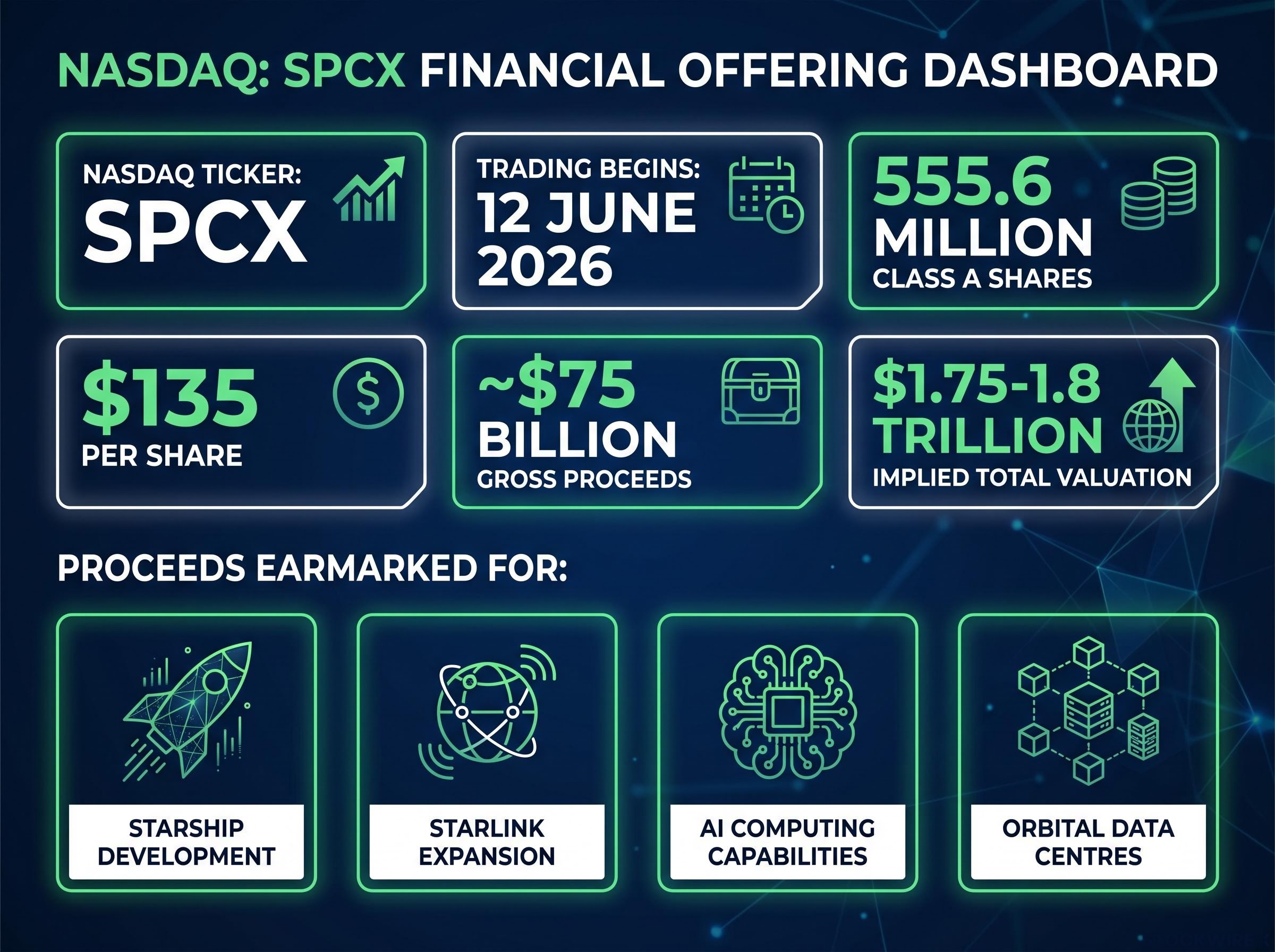
The numbers alone are striking. SpaceX plans to issue approximately 555.6 million Class A shares at $135 each, raising roughly $75 billion in gross proceeds. When all share classes and internal valuations are included, the implied total company valuation sits at approximately $1.75-1.8 trillion. Trading begins 12 June 2026 on Nasdaq under SPCX.
The fine print is where professional investors have focused their attention. The IPO filing includes specific language stating that SpaceX:
“May issue a significant amount of equity in connection with future transactions.”
That phrasing is the kind of legal wording a company includes when management wants maximum flexibility for a future equity-funded merger. Analysts have read it as deliberate, not boilerplate, particularly given the scale of equity SpaceX could deploy at a $1.75 trillion valuation.
Proceeds from the offering are earmarked for four areas:
- Starship development and launch infrastructure
- Starlink satellite constellation expansion
- AI computing capabilities
- Orbital data centres
The operational signals preceded the filing. In March 2026, SpaceX and Tesla announced a collaboration on the Terafab semiconductor initiative, a concrete pre-IPO move toward integration between the two companies. Retail investors reading IPO headlines may miss these details. The equity-issuance language and the Terafab signal are two reasons why the merger thesis carries institutional weight rather than being purely speculative.
The control motive: how a merger could give Musk what he currently lacks at Tesla
The most structurally concrete incentive for a merger is not AI synergy. It is voting control.
Under a hypothetical all-stock transaction, Wolfe Research estimates that Elon Musk’s voting stake in the combined entity could exceed 50%, a threshold he currently does not hold at Tesla alone. For a founder who has publicly clashed with his own board and faced proxy battles over compensation, majority voting control of a multi-trillion-dollar conglomerate would represent a fundamentally different governance position.
The AI and infrastructure synergies pull in the same direction. Tesla contributes real-world autonomous driving data and robotics capabilities accumulated across its vehicle fleet. SpaceX contributes Starlink, Starship, and ambitions to build AI compute capacity through space-adjacent infrastructure. Musk is already integrating xAI with SpaceX, reinforcing the trajectory toward a unified AI and compute ecosystem.
The gap between verified SpaceX fundamentals and the AI optionality embedded in the $1.75 trillion valuation is where the merger arithmetic becomes most contested: Aswath Damodaran’s March 2026 analysis estimated current intrinsic value at $100-200 billion based on existing financials, implying roughly $1.5 trillion in priced-in optionality that any combined entity would need to justify.
Wolfe Research puts the earliest plausible completion of any merger at no earlier than mid-2027, reinforcing that this remains a medium-to-long-term thesis rather than a near-term catalyst. The convergence of personal governance incentives and strategic logic is precisely what makes serious analysts unwilling to dismiss the scenario outright.
The obstacles Wall Street is not ignoring
The merger thesis has structural appeal, but it also faces four specific barriers that Wolfe Research has identified, each capable of delaying, repricing, or terminating a deal.
- Acquisition premium and shareholder dilution: Executing a transaction at current valuations would require payment of a substantial acquisition premium, meaning very large amounts of new equity issuance. Existing SpaceX shareholders have been flagged as a source of potential resistance.
- Capital intensity stacking: Both companies face enormous capital expenditure requirements for factories, rockets, satellites, data centres, and AI clusters. Combining these needs into a single entity could strain cash flow and balance sheet resilience.
- Conflicts of interest: Musk would effectively be negotiating with himself across two public companies. Boards and minority shareholders would demand independent committees and fairness opinions, making the process complex and contentious.
- Regulatory and geopolitical risk: SpaceX operates as a defence-adjacent contractor subject to ITAR and national security regimes. Tesla’s Shanghai Gigafactory is fully operational, and tighter integration with a U.S. aerospace and satellite company could prompt political friction from Beijing, which retains leverage over Tesla’s Chinese operations.
SpaceX’s capital structure compounds the merger obstacle further: the company posted a $4.28 billion net loss on $4.69 billion in Q1 2026 revenue, and Starlink remains the only profitable segment, meaning any combined entity would inherit a loss-making AI infrastructure and orbital compute operation at the precise moment it also absorbs Tesla’s negative free cash flow guidance.
The ITAR regulations administered by the DDTC govern the export and transfer of defense-related articles and services, and any structural integration of SpaceX with a company holding significant Chinese manufacturing operations would require careful navigation of those controls, given Washington’s authority to impose conditions or block transactions on national security grounds.
| Obstacle | Why it matters |
|---|---|
| Acquisition premium and dilution | Large equity issuance could dilute existing shareholders at both companies, with SpaceX investors potentially resisting unfavourable terms |
| Capital intensity | Stacking capex for Starship, Starlink, Gigafactories, and AI clusters into one entity creates balance sheet concentration risk |
| Conflicts of interest | Musk negotiating across two public companies requires independent board processes and fairness opinions that add complexity and time |
| Regulatory and geopolitical risk | SpaceX’s ITAR status and Tesla’s China exposure create overlapping national security concerns for both Washington and Beijing |
Why TSLA fell on the day SpaceX went public
The apparent paradox resolves once the near-term market mechanics are visible. Three dynamics drove selling pressure:
- Proxy rotation: Investors who previously held TSLA partly as indirect exposure to Musk’s space ambitions can now buy SPCX directly, removing one pillar of the TSLA thesis and triggering position rebalancing.
- Fundamentals re-scrutiny: With SpaceX standing alone as a high-growth story, investors began scrutinising Tesla’s slowing earnings, margin pressure, and execution risk more harshly.
- Merger probability recalibration: Once SpaceX has its own public shareholder base and governance structures, any merger becomes both mechanically easier (public shares exist for a stock deal) and politically harder (more stakeholders to approve). Some investors updated their near-term probability assumptions downward.
Wolfe Research characterised merger anticipation as offering “downside protection” for Tesla’s share price, while cautioning that upward momentum still requires tangible progress on robotaxi, Optimus, and AI monetisation.
The distinction matters. The SpaceX IPO did not invalidate the merger thesis. It separated the long-term structural plausibility from the near-term positioning dynamics, and on 12 June, the positioning dynamics won the day.
What investors should actually take away from the merger narrative
The analytical hierarchy is straightforward. Tesla’s standalone fundamentals and AI roadmap are the primary valuation driver. Any future Musk mega-merger is an additional option embedded in the share price, not the core investment case.
Wall Street is pricing a Tesla-SpaceX merger as optionality, not as a base case. TSLA already embeds substantial AI, autonomy, and automation assumptions in its current valuation. The merger story adds a speculative layer on top of expectations that are already aggressive. Treating a combination as inevitable is not supported by current facts: no formal proposal exists as of 9 June 2026, and Wolfe Research places the earliest realistic completion at mid-2027.
Tesla’s standalone valuation already prices in autonomous driving, Optimus, and AI outcomes at a 188x forward P/E, which means any merger premium would be layered on top of expectations the automotive business has not yet demonstrated it can meet, creating a compounding execution risk that neither set of existing shareholders can diversify away.
The more analytically sound approach is to evaluate Tesla on its operational execution, robotaxi timeline, Optimus progress, and margin trajectory, treating the merger scenario as a bonus option rather than the central pillar of a position.
This article is for informational purposes only and should not be considered financial advice. Investors should conduct their own research and consult with financial professionals before making investment decisions. These statements are speculative and subject to change based on market developments and company performance.
The SpaceX IPO sets a clock, not a guarantee
The SpaceX IPO simultaneously makes a merger structurally more plausible and more complicated. Public shares now exist for a stock-based transaction, but so do additional stakeholders, governance requirements, and regulatory scrutiny that did not apply when SpaceX was private.
What a resolution of the merger question actually depends on has not changed: Tesla’s execution on robotaxi and Optimus, Musk’s governance choices in the months following the IPO, and whether independent board processes at both companies would support a transaction. SPCX begins trading on 12 June 2026. No near-term announcement is expected. Wolfe Research sees mid-2027 as the earliest realistic window for completion, and Musk has discussed the idea informally but made no formal proposal. The IPO started a clock. It did not provide an answer.