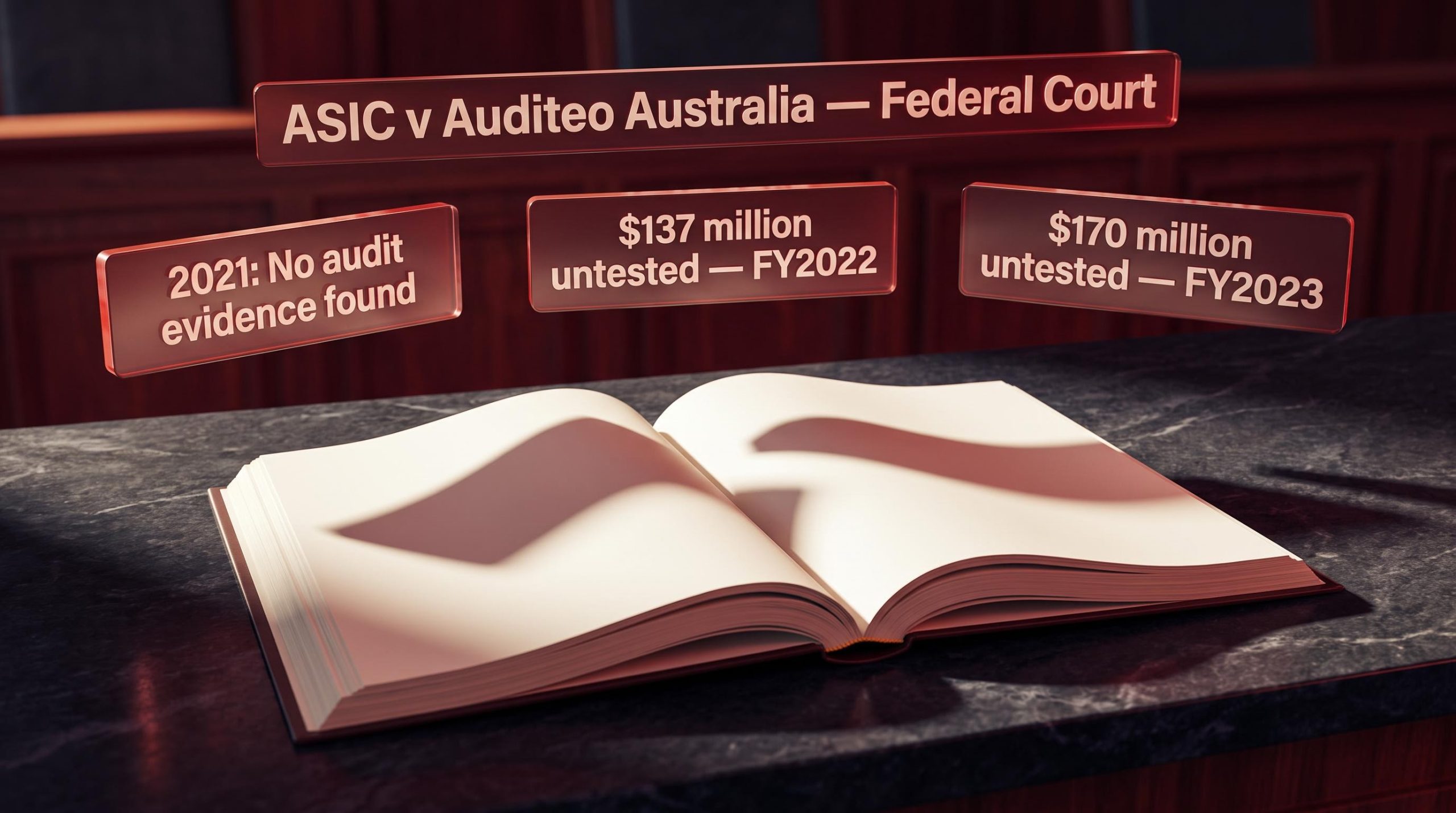
ASIC has taken audit firm Auditeo Australia Pty Ltd and two of its auditors to the Federal Court, alleging that for one full financial year there is no evidence a required audit of the First Guardian Master Fund was actually conducted at all, and that in the two years that followed, hundreds of millions of dollars in fund assets were left entirely untested.
The civil penalty proceedings target Auditeo, lead financial auditor Ajm Didarul Islam Khan, and compliance plan auditor Brian Robert Taylor over their alleged failures in auditing First Guardian across the 2020 to 2024 financial years. The action extends ASIC’s already substantial enforcement programme into a part of the accountability chain that has not previously been the subject of formal action in this matter: the auditors whose unqualified opinions were meant to provide independent assurance over the fund’s finances and compliance.
Here is exactly what ASIC alleges, what dollars are involved, what the regulator is asking the court to do, and what this enforcement step means for anyone who relies on audit opinions as a signal that fund assets have been properly scrutinised.
No evidence, hundreds of millions untested: the core allegations against Auditeo and its auditors
The most striking allegation comes first chronologically. For the 2021 financial year, ASIC claims the documentation held in Auditeo’s audit files offers nothing to show any financial statement audit took place, even though a signed audit report was ultimately issued for that year.
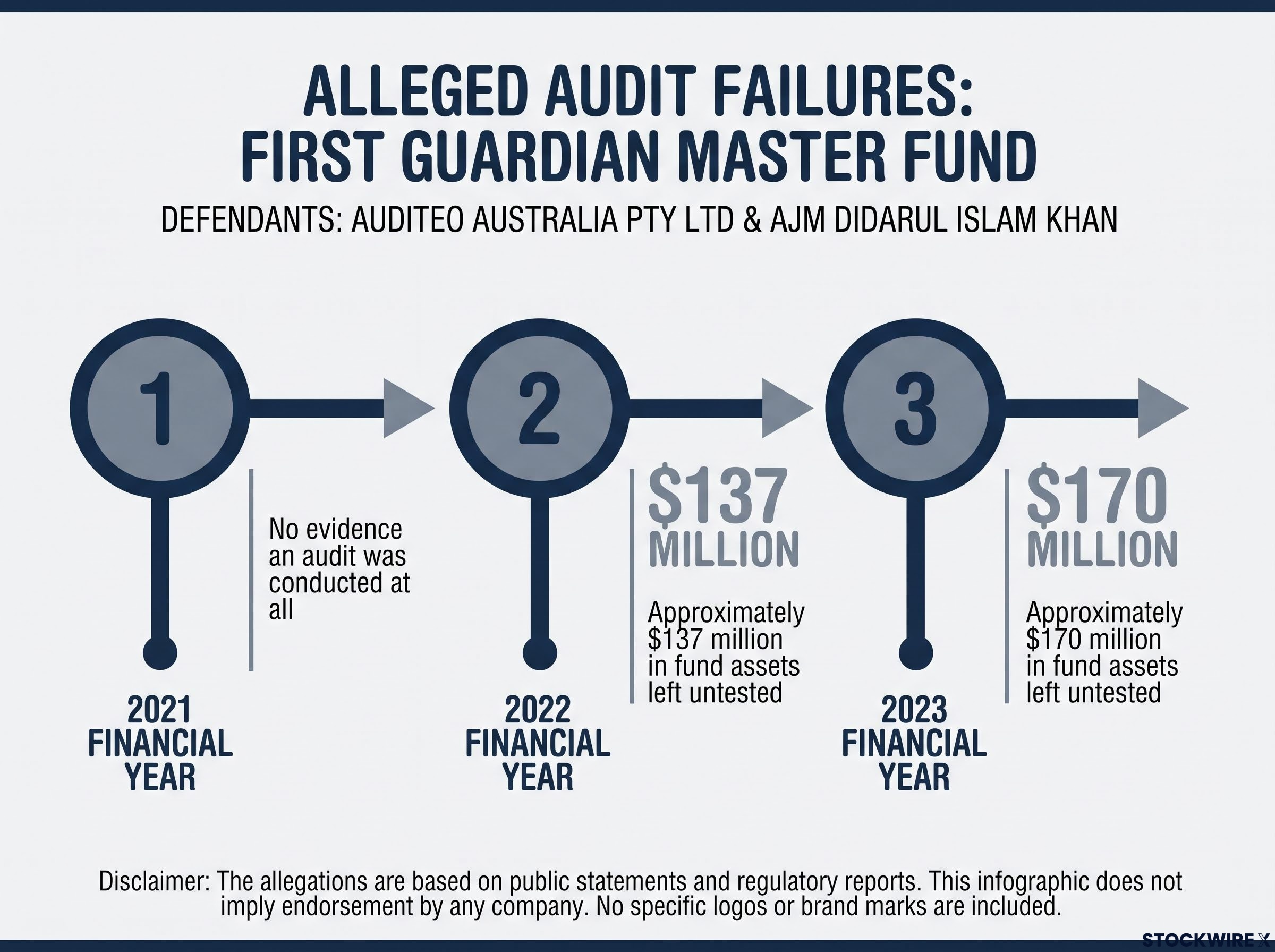
2021 financial year: According to ASIC, the audit files provide no record that a financial statement audit was carried out for this period, yet an unqualified audit report was issued and signed off regardless.
The picture worsens in the years that follow. For the 2022 financial year, ASIC alleges Mr Khan left approximately $137 million of reported fund assets sitting entirely outside the scope of testing. By the 2023 financial year, that unexamined figure had grown to roughly $170 million in fund assets that were never subjected to audit procedures.
| Financial Year | Defendant | Alleged Failure |
|---|---|---|
| 2021 | Auditeo Australia Pty Ltd | No evidence an audit was conducted at all |
| 2022 | Ajm Didarul Islam Khan | Approximately $137 million in fund assets left untested |
| 2023 | Ajm Didarul Islam Khan | Approximately $170 million in fund assets left untested |
The cumulative picture is what matters. A year with no audit evidence, followed by two consecutive years where hundreds of millions of dollars in reported assets went untested. If the allegations are proven, the audit opinions issued across this period provided no meaningful protection for the investors and trustees relying on them.
When big ASX news breaks, our subscribers know first
Who are the defendants, and what did each one do?
The governance arrangement at Auditeo is central to understanding how the alleged failures could persist across multiple years. Ajm Didarul Islam Khan is not just the lead financial auditor. He holds both the sole directorship and sole ownership of Auditeo. One person controlled the firm, owned the firm, and conducted the audit work. There was no internal counterweight.
- Auditeo Australia Pty Ltd: The audit firm responsible for both financial statement and compliance plan audits of First Guardian across the period.
- Ajm Didarul Islam Khan: Sole director, sole shareholder, and lead auditor on the financial statement audits. The individual at the centre of the financial audit allegations.
- Brian Robert Taylor: Lead compliance plan auditor engaged by Auditeo. His alleged failures relate specifically to compliance plan audit methodology.
Compliance plan audit failures: why using the wrong plan matters
A compliance plan audit is meant to confirm that a fund’s responsible entity is meeting its obligations under the fund’s own compliance plan, the document that sets out how the fund operates within its licensed parameters.
ASIC alleges Mr Taylor audited against a compliance plan that was not the one actually in force, covering part of 2022 and the full year of 2023. Auditing against a different plan than the one actually in force means the assurance produced does not map to the fund’s real obligations. The audit opinion becomes structurally meaningless regardless of how carefully the underlying work was performed.
What ASIC is asking the Federal Court to do
ASIC is not treating this as a historical accountability exercise. The remedies it is seeking are forward-looking as well as backward-looking, and the combination signals how seriously the regulator views the alleged conduct.
The four categories of relief ASIC is pursuing:
- Declarations of contravention against Auditeo, Mr Khan, and Mr Taylor
- Civil financial penalties
- Injunctions to restrain certain conduct
- Orders restricting the defendants from carrying out specified categories of audit work in future
The forward-looking injunctive relief is the most telling element. ASIC is actively seeking to prevent these defendants from continuing audit work while the case is resolved. For finance professionals and investors, that tells you the regulator is calibrating the risk that further audit work by the defendants could expose other investors to similar harm before a court ruling is reached.
No court findings have been made. The allegations remain to be tested through the litigation process.
The Auditeo proceedings arrive in the same enforcement cycle as ASIC’s broader civil penalty escalation, a period in which Australian courts ordered a record $830 million in penalties connected to ASIC’s work in FY2025-26 without any increase in the number of cases filed.
First Guardian’s collapse and the $1.1 billion investor loss context
The Auditeo proceedings do not exist in isolation. They sit inside one of the largest retail investor protection failures in recent Australian financial history.
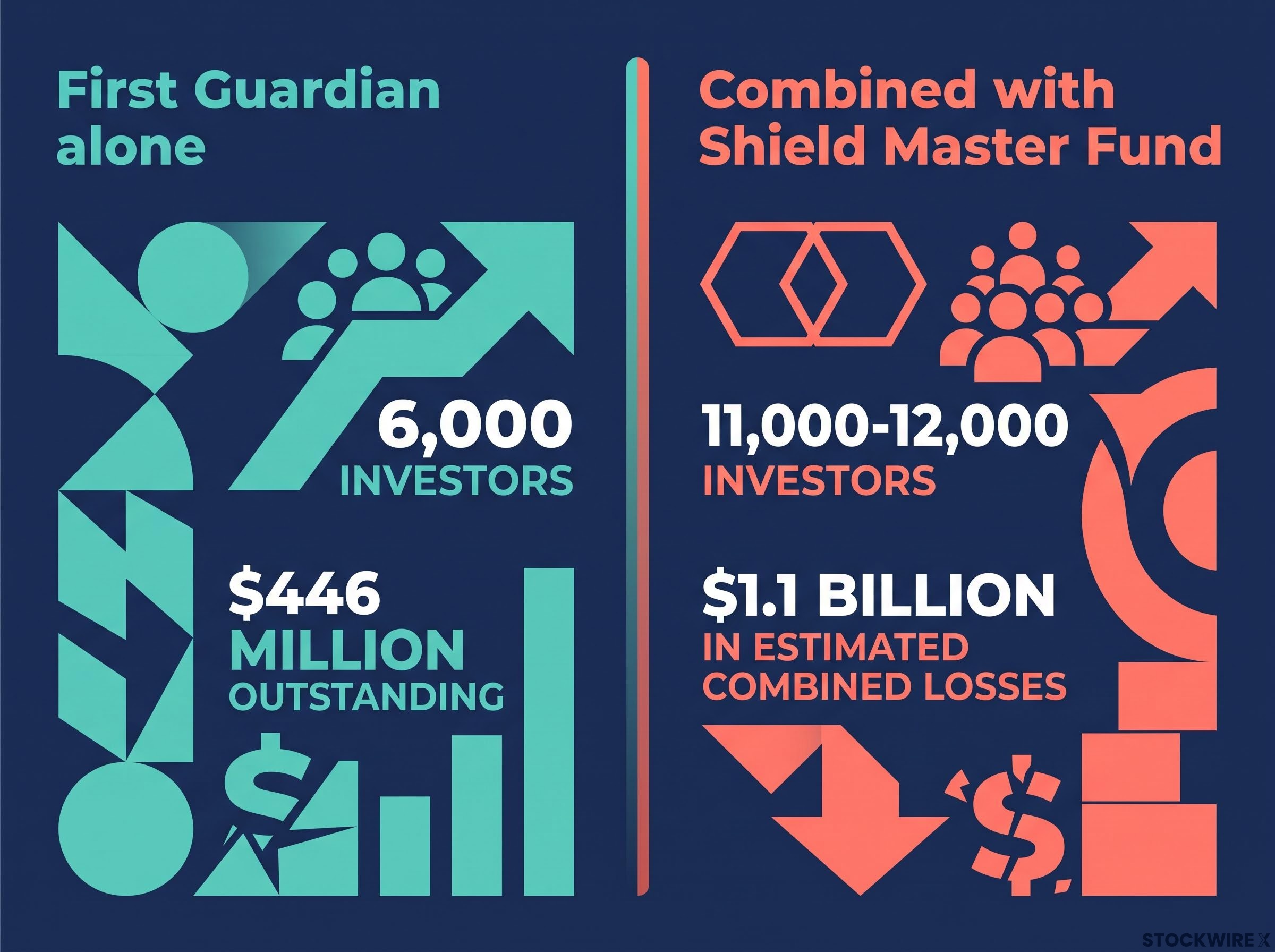
Approximately $1.1 billion in estimated combined losses across the First Guardian and Shield Master Funds, affecting an estimated 11,000-12,000 investors.
Approximately 6,000 investors had money in First Guardian alone at the time of collapse, with around $446 million outstanding. Combined with the related Shield Master Fund, the scale of investor losses expands to the $1.1 billion figure.
The Shield Master Fund proceedings against Equity Trustees Superannuation Limited rest on a parallel allegation: that foundational documents including audited financial statements and a compliance plan audit were absent when the trustee approved three investment classes, a factual circumstance that now reads differently given what ASIC alleges about the audit work itself.
Liquidators were appointed to First Guardian in April 2025. Since then, ASIC has built a broad enforcement programme spanning multiple categories of defendant:
- Superannuation trustees: Proceedings against Equity Trustees Superannuation Limited over alleged due diligence and member best-interest obligation failures
- Licensees and advisers: Proceedings against Interprac Financial Planning for alleged advice failures
- Directors and compliance committee members: Proceedings against individuals associated with Shield
- Responsible entities: Actions against Falcon Capital Limited
As of mid-2026, ASIC has commenced approximately 13-14 civil cases against 25-26 defendants across the broader programme. The Auditeo proceedings mark the first time the regulator has extended this programme to audit quality and assurance specifically.
What an audit is actually supposed to do, and why these allegations cut to the core of it
An unqualified audit opinion (sometimes called a “clean” opinion) is a formal statement by an independent auditor that a fund’s financial statements present a true and fair view of its financial position, and that the key balances have been independently tested against evidence. Investors, trustees, and regulators rely on it as confirmation that someone independent has checked the numbers.
Australian auditing standards require sufficient and appropriate audit evidence before any opinion can be issued. The allegations against Auditeo directly contradict that foundational requirement: a year with no evidence of audit work, followed by two years where the largest asset balances were allegedly never tested. If proven, those opinions were signed documentation carrying the appearance of assurance without the substance.
Financial reporting enforcement in 2026 has extended well beyond major institutions: ASIC has pursued ASX companies for multi-year failures to lodge audited annual reports, treating non-lodgement as a discrete enforcement priority running in parallel with the larger fund misconduct programme.
ASIC’s harder line on registered company auditors
The action arrives against a backdrop where ASIC’s own auditor oversight has faced scrutiny. An Auditor-General report previously found ASIC’s regulation of auditors was only “partly effective,” identifying gaps in how the regulator targeted and followed up audit quality risks.
The Auditor-General found ASIC’s past regulation of auditors was only “partly effective”, including gaps in targeting and follow-up of audit quality risks.
ASIC Chair Sarah Court has publicly described dozens of active investigations and court actions linked to First Guardian and Shield. The Auditeo proceedings sit within that broader posture: a regulator demonstrating that audit quality enforcement in high-risk, high-impact cases is now firmly within its active programme.
ASIC’s audit file surveillance programme for FY2026-27, which includes reviewing 25 audit files and publicly tracking whether firms implement previously committed remedial measures, sits alongside enforcement actions like the Auditeo proceedings as part of a two-track approach to lifting audit quality across the market.
What the Auditeo case establishes for the rest of the enforcement programme
The extension of enforcement to auditors completes a chain. ASIC’s accountability sweep has progressively moved from advisers and licensees, through trustees and directors, to the independent assurance function itself. Every category of professional who was meant to protect investors in these fund structures is now the subject of formal enforcement action.
The case remains live. No findings have been made, and the defendants will have the opportunity to respond to the allegations through the court process.
The forward-looking question for anyone in managed investment or superannuation structures is whether the remedies ASIC is seeking, including activity restrictions, will be granted. If they are, the signal is clear: audit quality in complex fund environments carries real professional and legal consequences, and the era of auditor oversight sitting at the margins of enforcement attention is over.
This article is for informational purposes only and should not be considered financial advice. Investors should conduct their own research and consult with financial professionals before making investment decisions. These proceedings are at an early stage; all allegations remain untested and are subject to the court process.