SK Hynix just posted the largest quarterly operating profit in its history. Shares fell on the news.
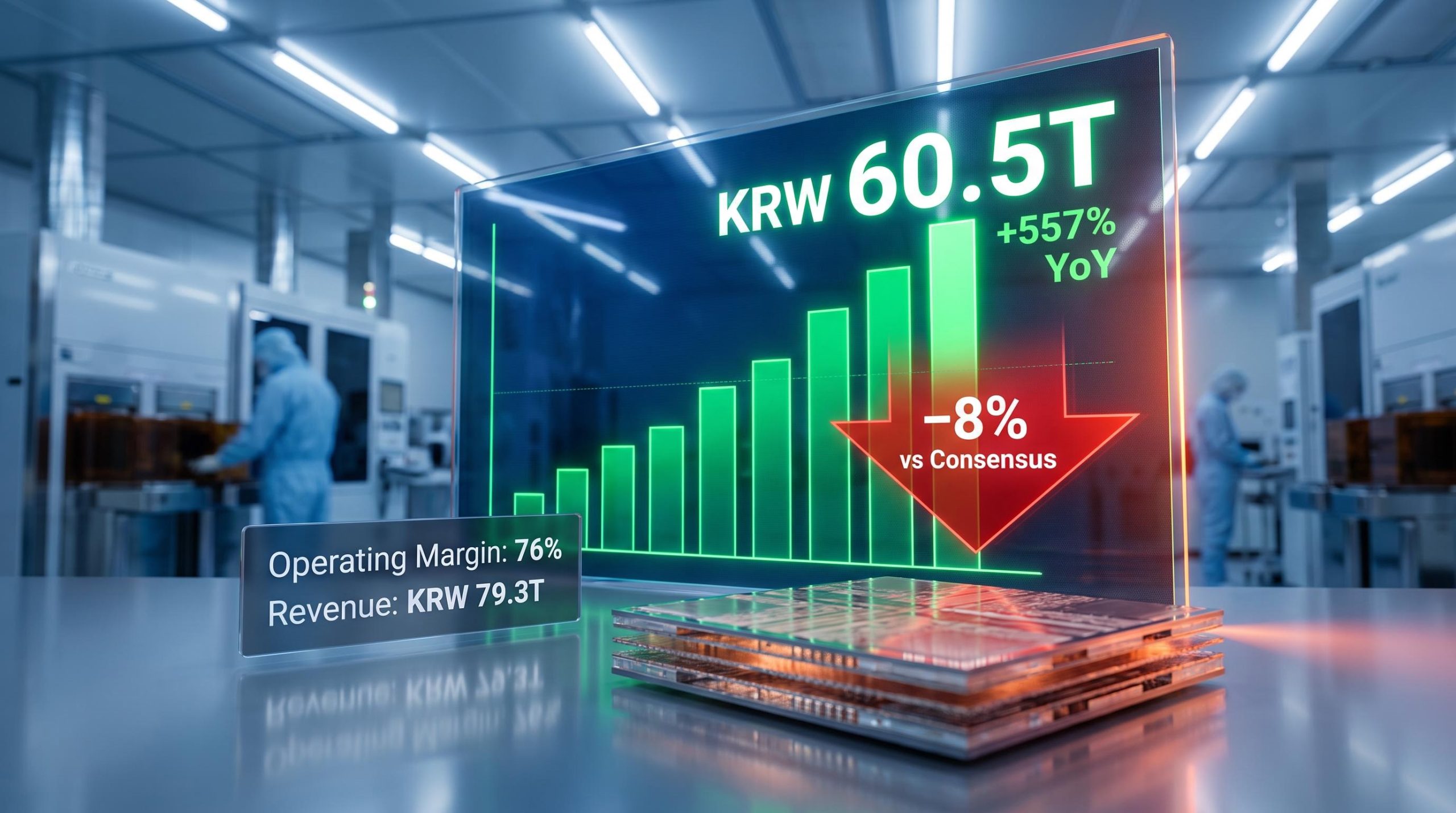
That contradiction sits at the centre of Q2 2026 earnings for the world’s most AI-concentrated memory chipmaker. SK Hynix delivered KRW 60.5 trillion in operating profit, a 557% year-over-year surge, yet missed the consensus forecast by roughly 8%. The result is not a story about a company in trouble. It is a story about what happens when expectations for AI-leveraged businesses run so far ahead that record-breaking quarters still disappoint.
Here is the clearest explanation available of why this happened, what product mix has to do with it, and what it tells you about how to read AI semiconductor earnings from here.
Record profits, falling share price: what actually happened in Q2 2026
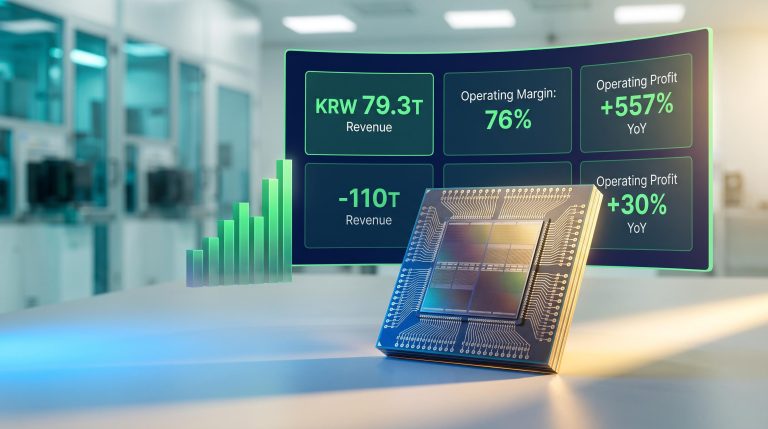
The headline figures are staggering by any measure. SK Hynix reported Q2 2026 revenue of KRW 79.3 trillion, up 257% year over year and 51% quarter over quarter. Operating profit reached KRW 60.5 trillion (approximately $41.62 billion), a 557% jump from the KRW 9.2 trillion posted in Q2 2025. The operating margin hit 76%, an all-time record. EBITDA margin reached 81%.
557% year-over-year operating profit growth: a sixfold increase from the Q2 2025 base, representing the largest quarterly profit in SK Hynix’s history.
Net profit came in at KRW 93.9 trillion, reflecting a 118% net margin boosted by non-operating gains from foreign exchange and investment assets.
None of it was enough. The LSEG SmartEstimate, a consensus forecast weighted toward analysts with the strongest accuracy track records, had pegged operating profit at KRW 64 trillion. Local Korean securities estimates projected revenue of approximately KRW 82.8 trillion. SK Hynix missed both: operating profit fell roughly 8% short of the SmartEstimate, and revenue came in approximately 4% below the local consensus.
| Metric | Q2 2026 Actual | Consensus Forecast | Variance | YoY Change |
|---|---|---|---|---|
| Revenue | KRW 79.3 trillion | KRW 82.8 trillion (local) | ~4% miss | +257% |
| Operating Profit | KRW 60.5 trillion | KRW 64 trillion (LSEG SmartEstimate) | ~8% miss | +557% |
| Operating Margin | 76% | N/A | Record high | N/A |
Shares fell on the day of the results release. An 8% miss against the SmartEstimate, the forecast built from analysts with the best track records, tells you that even the most informed institutional expectations had run too far ahead of reality. Consensus for AI-exposed memory suppliers had become stretched, and this quarter is the proof.
The expectations gap mechanics behind post-earnings share price declines are well-documented across S&P 500 history: with 84% of companies beating estimates in Q1 2026, the market had already learned to anticipate beats, compressing the reward for delivering them and raising the cost of any miss.
When big ASX news breaks, our subscribers know first
What is HBM and why does SK Hynix’s product mix matter here
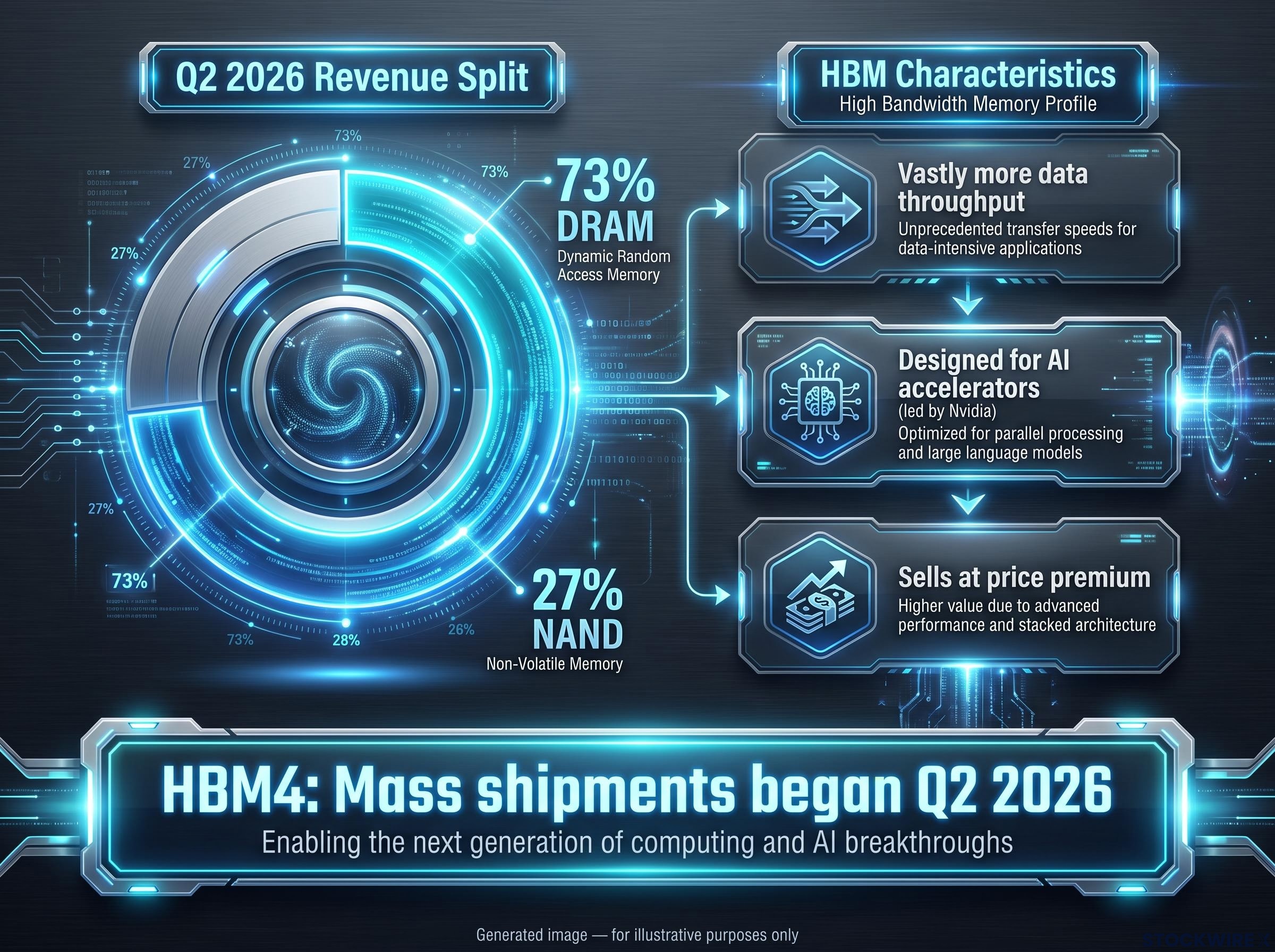
You have likely heard that AI chips are expensive and that memory sits inside them. Here is the specific mechanic that matters. High-bandwidth memory, or HBM, is a type of DRAM engineered to sit directly alongside AI accelerator chips, such as those made by Nvidia. It transfers data at far higher speeds than standard DRAM, which is what makes it indispensable for training and running large AI models.
HBM commands a steep price premium over conventional DRAM. The key characteristics that set it apart:
- Bandwidth: HBM delivers vastly more data throughput than standard DRAM modules
- Application: It is designed specifically for AI accelerators, high-performance computing, and data-centre GPUs
- Price premium: HBM sells at multiples of conventional DRAM pricing per unit
- Primary customers: AI accelerator manufacturers, led by Nvidia, are the dominant buyers
SK Hynix is one of the world’s leading HBM suppliers, including to Nvidia, according to Reuters reporting. Its Q2 2026 revenue split was 73% DRAM and 27% NAND, but within that DRAM figure, the company’s mix skews heavily toward premium AI-oriented products relative to rivals with larger conventional PC, smartphone, and general-purpose server memory businesses.
For anyone tracking AI supply chain stocks, that concentration is the critical detail. SK Hynix‘s earnings are more tightly coupled to AI infrastructure spending cycles than to the broader commodity memory market. That coupling creates outperformance potential in AI-driven quarters, but it also creates the specific miss dynamic that played out here.
HBM4 and the race to the next generation
SK Hynix began mass shipments of HBM4, its latest-generation high-bandwidth memory, in Q2 2026. HBM4 represents a step-change in speed and capacity over prior generations, and the start of volume production reinforces SK Hynix‘s position at the leading edge of AI memory supply.
HBM4 supplier qualification for Nvidia’s Vera Rubin platform was confirmed across all three major memory producers in June 2026, with SK Hynix estimated to hold 60-70% of volume allocations, reflecting its established lead position and earlier entry into the certification process.
Why a conventional memory rally left SK Hynix behind on forecasts
The miss did not come from AI demand softening. It came from the other side of the memory market.
Q2 2026 saw a sharp rebound in conventional DRAM and NAND pricing. The prior downturn in standard memory for PCs, smartphones, and general-purpose servers eased, and prices recovered across the board. SK Hynix itself attributed its margin strength to “DRAM and NAND price increase and cost improvement” across both premium and standard products. The pricing tailwind was real and broad.
DRAM contract pricing surged 90-95% in Q1 2026 and a further 58-63% in Q2 2026 according to TrendForce and Goldman Sachs projections, with HBM capacity sold out through 2026-2027 across major producers, setting the industry-wide pricing backdrop against which SK Hynix’s record margins should be read.
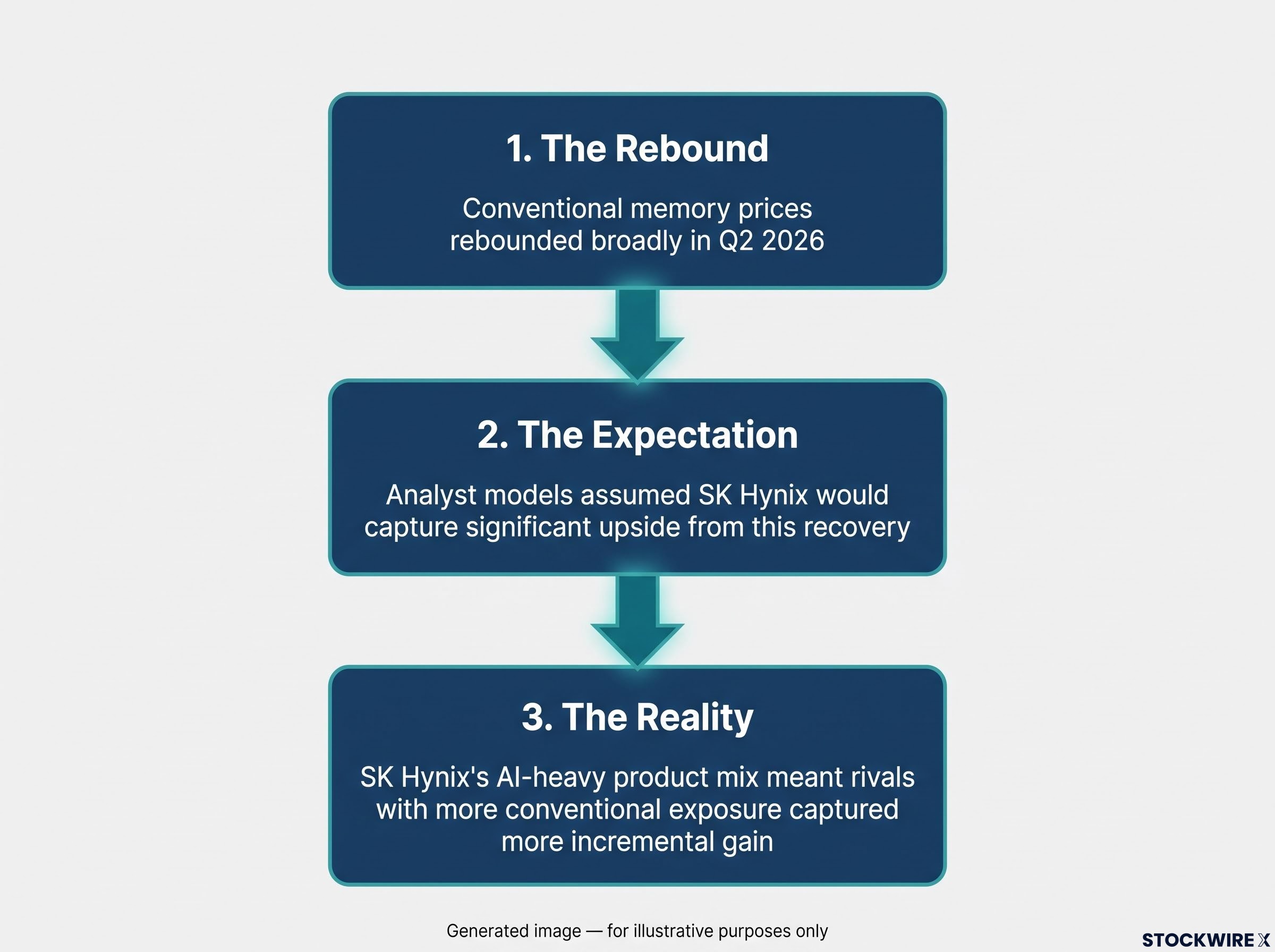
The problem was how analyst models allocated the gains. Here is the three-step logic that opened the gap between record results and even higher expectations:
- Conventional memory prices rebounded broadly in Q2 2026. Standard DRAM and NAND pricing recovered from a prior downturn, lifting earnings across the entire memory sector.
- Analyst models assumed SK Hynix would capture significant upside from this recovery. Consensus forecasts had built in strong gains from both AI-driven premium demand and the conventional cyclical rebound.
- SK Hynix’s AI-heavy product mix meant rivals with more conventional exposure captured more of that incremental gain. Companies with larger standard DRAM and NAND portfolios were better positioned to ride the cyclical recovery, while SK Hynix‘s premium tilt limited its leverage to that specific upswing.
The core paradox: the same strategic concentration that drives SK Hynix‘s AI-cycle outperformance reduced its capture of the conventional memory recovery, producing record absolute results that still missed relative expectations.
For anyone comparing SK Hynix against memory rivals with more balanced portfolios, this quarter illustrates a specific dynamic. When the whole memory market rallies simultaneously, a premium-only strategy can paradoxically underperform consensus even while generating record profits. Understanding that mechanism is what separates a useful reading of these results from a misleading one.
AI demand as the structural foundation: what the numbers actually confirm
The miss was relative. The structural AI demand story is not.
Reuters identified the Q2 profit jump as driven by “robust demand for advanced memory chips as big technology firms ramped up spending on AI data centres.” Hyperscalers and cloud providers are expanding AI data-centre capacity at pace, and that expansion is the primary engine behind SK Hynix‘s earnings power.
FactSet data on hyperscaler AI capex projects combined spending by Alphabet, Amazon, Meta, Microsoft, and Oracle exceeding $690 billion in FY26, directed primarily at AI compute and data-centre infrastructure, with HBM chip costs identified as a significant driver of component price inflation.
76% operating margin: the clearest measure of how strongly AI-driven premium pricing is translating into returns, well above what a commoditised semiconductor business could achieve.
The margin quality confirms that pricing power in AI memory remains firmly intact despite the consensus miss. Key AI demand drivers underpinning the result:
- Hyperscaler capex expansion: Large technology firms continue to scale AI data-centre infrastructure, sustaining demand for high-performance memory
- HBM demand from AI accelerator manufacturers: Nvidia and other chipmakers require growing volumes of high-bandwidth memory for next-generation AI systems
- Data-centre DRAM and NAND pricing premium: Premium memory products designed for AI server applications led pricing gains during the quarter, outpacing conventional memory chip price movements
The net profit figure of KRW 93.9 trillion (118% net margin) was inflated by large non-operating gains from foreign exchange and investment assets. Operating profit remains the cleaner measure of underlying business performance, and at KRW 60.5 trillion with a 76% margin, it confirms that the structural AI demand case is intact. The quarterly miss was about where the incremental dollar came from, not about whether AI spending is slowing.
What SK Hynix’s quarter reveals about investing in the AI memory supply chain
This quarter works as a case study for a broader pattern. AI concentration produces spectacular absolute results, but it creates vulnerability to consensus misses when cyclical memory recovery also factors into analyst models and the AI-focused company captures less of it.
The beat-and-raise pattern that characterised early AI infrastructure cycles is maturing. As consensus models become more sophisticated in integrating both AI demand and memory cyclicality, the nature of earnings surprises is shifting. The era of large positive surprises driven purely by underappreciated AI growth may be giving way to a phase where product mix and execution determine relative performance.
Three considerations for anyone positioning around AI memory exposure:
- Absolute versus relative performance framing: A 557% operating profit increase is extraordinary by any standard, but markets price stocks on whether they beat expectations, not on whether the numbers are large. Understanding which framing drives the share price response matters more than the headline figure alone.
- Product mix as a cyclical variable, not just a structural one: SK Hynix‘s AI concentration is a structural advantage when AI demand dominates. When conventional memory simultaneously recovers, that same concentration becomes a relative headwind against consensus.
- How maturing consensus models change earnings surprises: As analysts better integrate both AI demand and memory cyclicality into their forecasts, the margin for positive surprise narrows even when underlying business performance remains strong.
This article is for informational purposes only and should not be considered financial advice. Investors should conduct their own research and consult with financial professionals before making investment decisions.
The variables that will define SK Hynix’s next chapters
Three specific variables will shape how this story develops across the second half of 2026, ordered by their likely impact on near-term relative performance:
- Conventional DRAM and NAND pricing trajectory: If the price recovery in standard memory continues, the product-mix gap against consensus will persist for SK Hynix while favouring rivals with broader conventional exposure. This is the most actionable near-term signal to watch.
- HBM4 execution and AI-specific demand: Mass shipments began in Q2 2026. The pace of HBM4 ramp-up will determine whether SK Hynix can widen its premium pricing advantage enough to offset any ongoing conventional memory underweight.
- Analyst consensus model evolution: As forecasters refine how they integrate AI demand alongside memory cyclicality, the nature of future earnings surprises will depend more on mix accuracy and less on whether AI growth itself is adequately priced in.
HBM pricing trajectory into 2027 carries direct implications for SK Hynix’s margin outlook: Bernstein projects 2-2.5x contract price increases for 2027, with those cost increases amplifying approximately fourfold at the hyperscaler purchase level as GPU vendors apply margin preservation, creating a structural earnings tailwind that extends well beyond the current cycle.
These preliminary results, released on 29 July 2026, are pending final audit review. SK Hynix frames the quarter as part of a continuing earnings upcycle.
The broader point holds: in the AI hardware era, a company can set all-time profit records and still disappoint, because expectations for AI-leveraged businesses are themselves at record levels. That paradox is not going away.