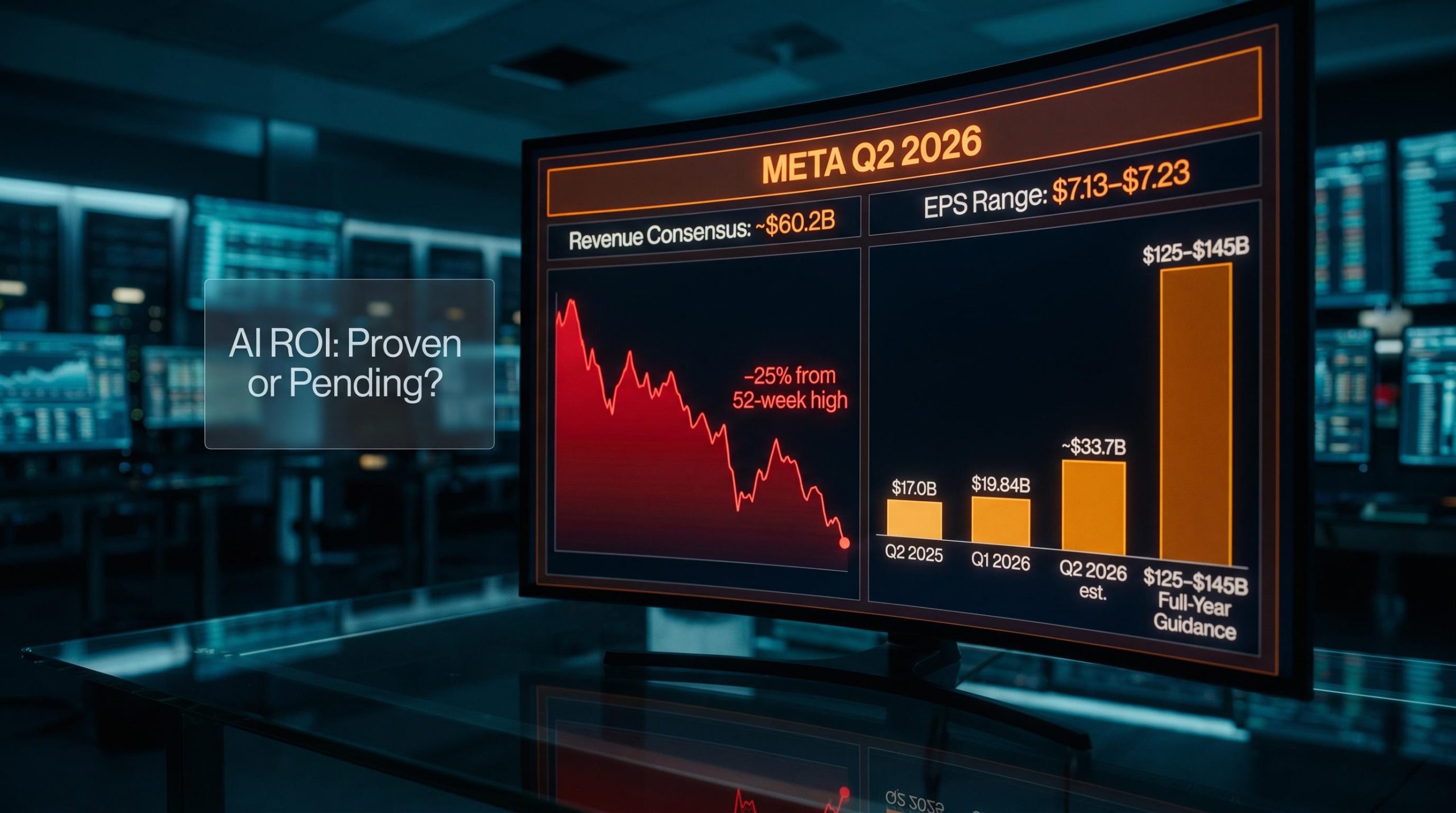
Meta Platforms reports Q2 2026 results after market close today, and Wall Street is not really debating whether the numbers will be strong; the debate is whether a $125-$145 billion AI capital expenditure programme is producing returns fast enough to justify the cost.
The commercial stakes are sharp. The stock has shed roughly 25% from its 52-week peak even as revenue growth has remained firmly in double digits, a divergence that signals investors have already factored in the earnings beat and are instead applying a discount for the uncertainty around spending. The Q1 dynamic framed the problem precisely: a 33% revenue beat followed by a share price decline, because management raised capex guidance. That is the lens investors are carrying into tonight’s print.
Here is what the consensus numbers say, what the market is actually watching beneath those numbers, and how to read the post-earnings reaction without being misled by the headline EPS figure. The six specific data points that will determine the stock’s direction tonight are more useful than any single forecast.
What analysts actually expect from Meta today
Consensus revenue for Q2 sits at approximately $60.2 billion, implying roughly 26.6% year-over-year growth. That figure lands near the top of Meta’s own guidance range of $58-$61 billion, which assumes approximately a 2% foreign exchange tailwind.
The revenue breakdown by segment tells you where the money is coming from:
- Family of Apps revenue is expected at approximately $59.6 billion
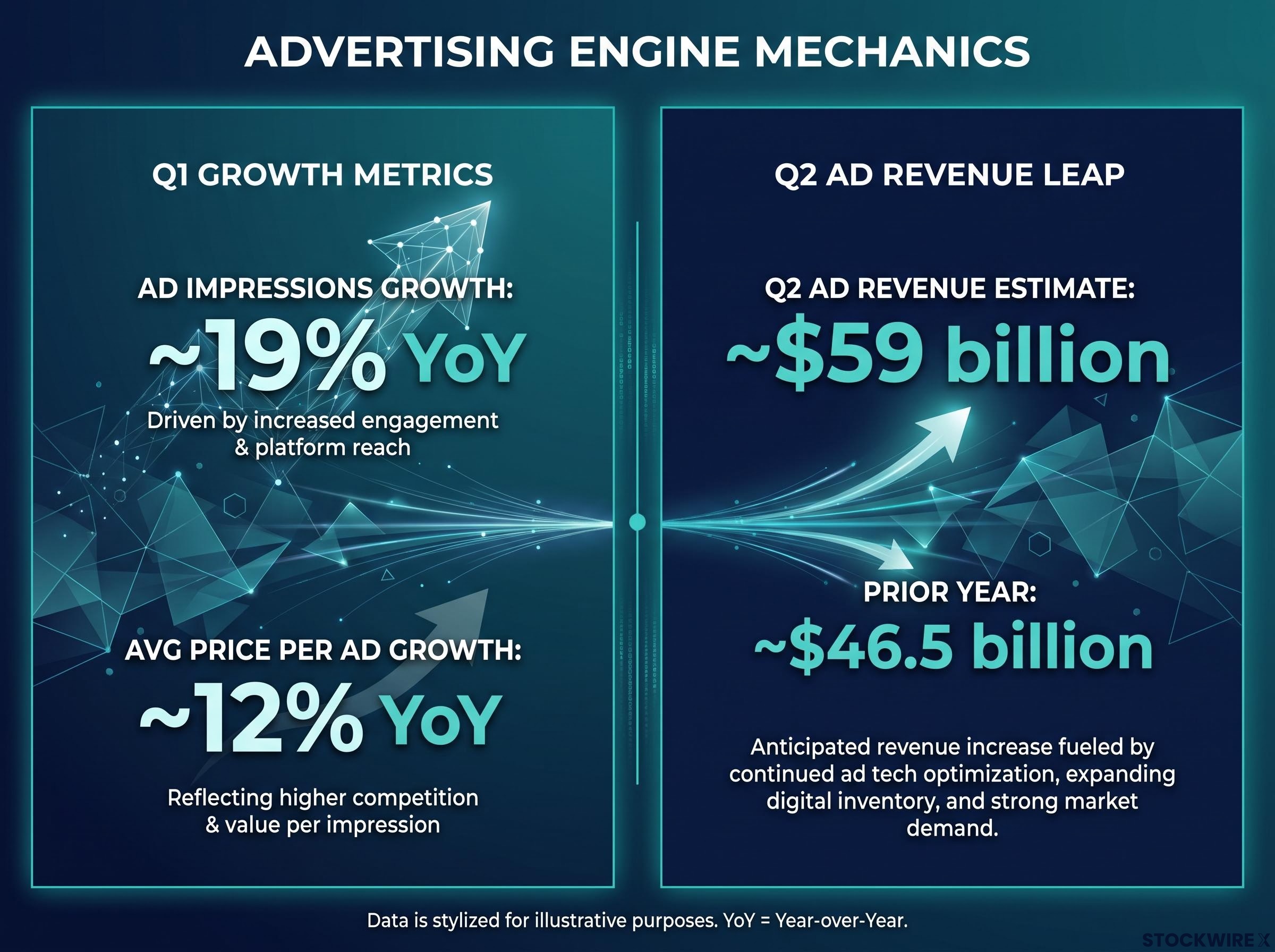
- Advertising revenue is modelled at approximately $59 billion, up from approximately $46.5 billion a year ago
- Reality Labs revenue remains small at approximately $440 million
On the earnings line, adjusted EPS consensus sits in the $7.13-$7.23 range, with a central estimate around $7.17-$7.18. Bank of America models a more bullish $7.50, which anchors the bull case.
| Metric | Consensus | Bank of America |
|---|---|---|
| Q2 Revenue | ~$60.2B | ~$60.6B |
| Adjusted EPS | $7.13-$7.23 | ~$7.50 |
| Rating / Price Target | — | Buy / $835 |
Now carry one number out of this section: revenue growth of 27% against EPS growth of roughly 1%. That gap is not an anomaly. It is a direct reflection of rising investment spending compressing margins in real time, and it is the central arithmetic problem the market is grading tonight.
When big ASX news breaks, our subscribers know first
Q1 2026 set the bar high and then complicated the picture
Q1 was genuinely strong on its own terms. The financial results were not the problem.
- Revenue: $56.31 billion, up 33% year-over-year, exceeding the approximately $55.5 billion consensus estimate
- Adjusted EPS: $7.31, surpassing analyst forecasts
- GAAP EPS: $10.44, though this was inflated by an $8.03 billion one-time tax benefit and should not be mistaken for operating performance
- Ad impressions growth: approximately 19% year-over-year
- Average price per ad growth: approximately 12% year-over-year
- Q1 capex: approximately $19.84 billion
Meta has now beaten EPS consensus in four consecutive quarters. The numbers were not the issue. What happened next was.
The Q1 reaction established that the market’s primary mechanism for evaluating Meta right now is free cash flow repricing: revised analyst estimates cut 2026 free cash flow from approximately $35 billion to $25 billion after the capex raise, a compression that explains why a 33% revenue beat still produced a 9% share price decline.
The Q1 beat was not enough to support the share price: after results landed, the stock fell as management lifted the full-year capex forecast to $125-$145 billion, a move that told the market AI spending was still gathering pace rather than levelling off.
That reaction tells you something important heading into tonight. The market is not rewarding Meta for beating earnings. It is grading the company on its investment thesis. The most important number tonight may not appear on the income statement at all.
Understanding the $125-$145 billion AI bet Meta is making
Capital expenditure, or capex, is the money a company spends on long-term assets like data centres, servers, and infrastructure. In Meta’s case, the capex programme is directed at AI infrastructure supporting ad targeting, content recommendations, and operational efficiency. The scale is extraordinary even by mega-cap tech standards.
Meta’s $125-145 billion programme sits within a broader hyperscaler capex cycle that reached $130 billion in combined spending across Amazon, Microsoft, Alphabet, and Meta in Q1 2026 alone, a sector-wide commitment that makes any single company’s guidance revision read as a data point in a much larger structural story.
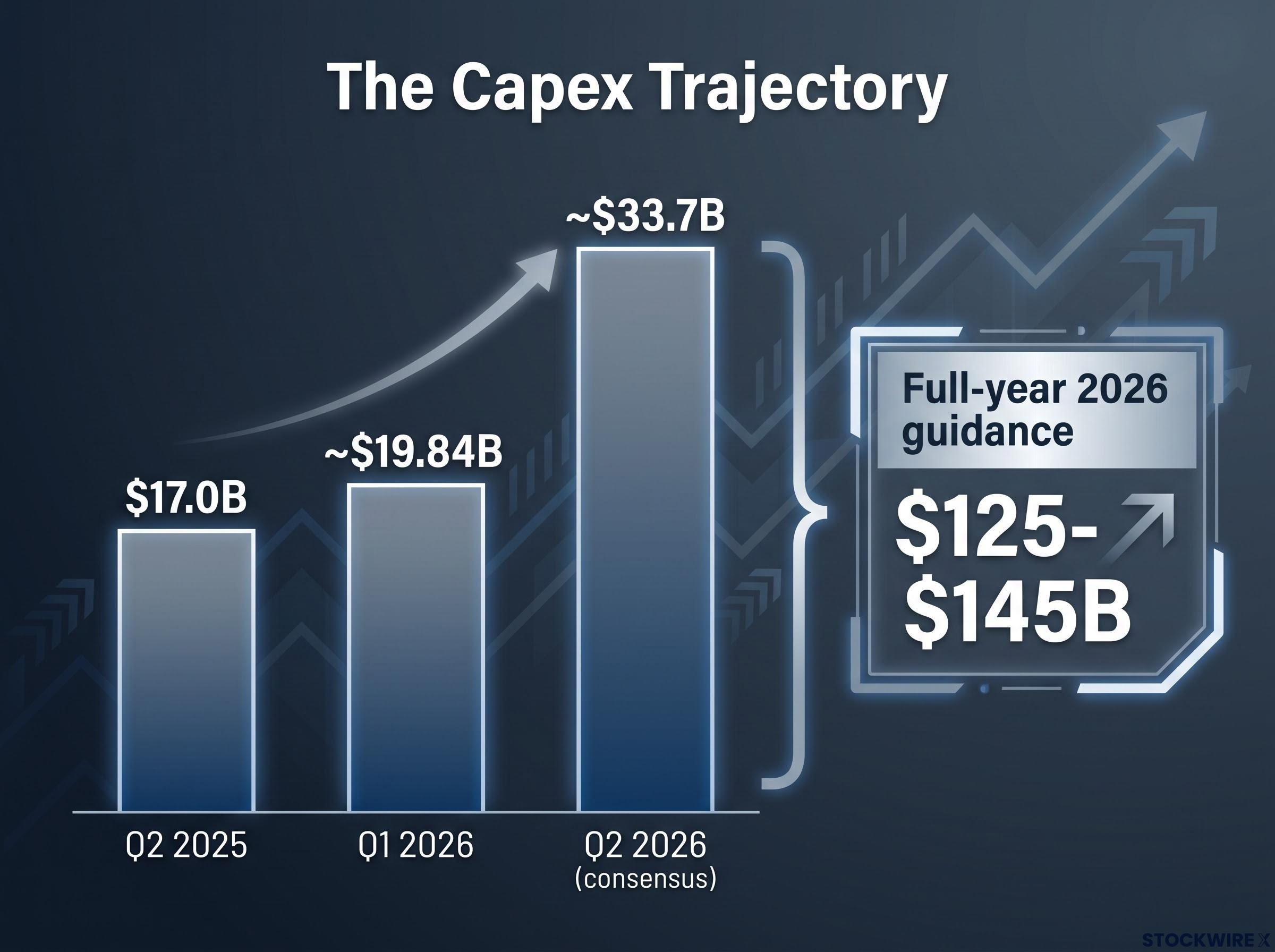
The trajectory makes the acceleration visible:
| Period | Capex |
|---|---|
| Q2 2025 | $17.0B |
| Q1 2026 | ~$19.84B |
| Q2 2026 (consensus estimate) | ~$33.7B |
| Full-year 2026 guidance | $125-$145B |
The jump from $19.84 billion in Q1 to a consensus estimate of $33.7 billion in Q2 implies aggressive front-loading. Meta is not just spending big; it is accelerating the pace quarter over quarter, which means the return-on-investment question becomes more urgent, not less, as time passes.
The concern is not affordability. Meta’s advertising engine generates substantial cash. The concern is timeline. When Alphabet raised its own capex guidance the week prior, its shares sold off sharply, demonstrating that the broader market is now demanding more rigorous justification for AI infrastructure commitments across the sector. Meta shares trading 25% below their 52-week high despite strong revenue growth is further evidence that capex concern is already suppressing valuation.
What the market actually needs to see
Investors want evidence the spending is translating into measurable ad performance gains, not just infrastructure ownership. AI-driven tools like Advantage+ are already cited by analysts as contributing to Q1’s impressions and pricing growth, but the question is whether management quantifies this link tonight.
The four things investors are looking for: concrete AI return-on-investment evidence, a stable or narrowed capex range, phasing commentary signalling 2026 as the peak spending year, and clear linkage between AI tools and ad performance metrics.
Why Meta’s advertising engine is not the concern tonight
The advertising business is the uncontested foundation. Consensus across analyst previews is that the ad engine is in very good shape, and this is not where tonight’s risk lies.
The growth mechanics are straightforward. Q1 showed 19% growth in ad impressions alongside 12% growth in average price per ad, demonstrating both volume expansion and pricing power. Multiple analyst previews attribute part of this strength to AI-driven ad tools that help advertisers optimise campaigns and improve returns on ad spend.
The key advertising metrics heading into tonight:
- Q2 ad revenue estimate: approximately $59 billion, up from approximately $46.5 billion a year ago
- Year-over-year growth in the mid-to-high 20s percentage range
- Q1 impressions and pricing data serving as leading indicators for continued momentum
Bank of America holds a Buy rating on Meta with a price target of $835, underpinned by its view that the advertising business remains robust and that operating efficiency has improved in the wake of recent workforce reductions.
Here is the tension that matters for anyone sizing a position. Meta is ramping AI spend from a position of strength, not defence. The advertising business could not be healthier. But strong top-line growth is not translating proportionally into EPS because capex and related depreciation are absorbing the gains. A reader who understands that ad revenue is strong yet EPS growth is only 1% knows the debate tonight is not about Meta’s business model. It is about what Meta’s shareholders are willing to accept as the cost of building the next version of it.
The six numbers and signals that will move the stock tonight
This section is not a prediction. It is a post-earnings interpretation guide. These are the variables that will determine the stock’s direction, and knowing how to read each one before the results land is more useful than any single price target.
One potential resolution to the return-on-investment question arrived on 1 July 2026, when Bloomberg reported that Meta is building Meta Compute, a cloud division to sell spare AI capacity externally, a move that would convert internal infrastructure cost into a direct revenue line and meaningfully change the capex narrative the market is scrutinising tonight.
- Revenue vs. consensus: Does Q2 land at or above the $60.2 billion consensus, and does it skew toward the top of the $58-$61 billion guidance band?
- EPS quality: Does adjusted EPS clear the $7.13-$7.23 range, and how much of any beat comes from operating efficiency versus lower-than-feared spending?
- Capex guidance update: Any revision to the $125-$145 billion range. A stable or narrowed range is more market-friendly than another upward revision.
- Q3 revenue guidance: Analyst expectations for Q3 sit at approximately $60.5-$63.5 billion (up approximately 18-24% year-over-year). A strong guide would signal durable advertising momentum.
The signal that matters most tonight
- AI return-on-investment evidence: This is the highest-stakes watch point because it determines whether the capex programme is perceived as value-creating or dilutive. The specific metrics to listen for in management commentary include:
- Ad performance improvements: click-through rates, conversion rates, return on ad spend
- User engagement gains attributable to improved content recommendations
- Internal productivity or cost savings from AI deployment
Vague language about AI potential will not satisfy the market at this stage. Concrete, quantified examples in the earnings call commentary are what will shift sentiment.
- Reality Labs: Updates on losses and spending remain symbolically important for the long-term vision versus near-term profitability framing, even with estimated Q2 revenue of approximately $440 million.
If you arrive at the post-earnings announcement with this checklist in hand, you are equipped to distinguish between a headline beat that the market sells anyway and a genuine signal, which is the difference between a reactive and an informed investment decision.
Reading tonight’s result without being misled by the headline
The earnings beat alone is not the signal. The market already expects it. Four consecutive quarters of EPS beats mean consensus is not a low bar; it is a bar the market is already positioned for Meta to clear. What moves the stock tonight is the capex language and the AI return-on-investment evidence.
For anyone who followed the Q1 dynamic, tonight’s report follows a familiar template. If Meta raises capex guidance again, that will likely dominate the reaction regardless of how strong the revenue print is. The Q1 playbook showed this clearly: a 33% revenue beat was not enough to overcome the spending narrative.
Strong revenue growth from advertising does not automatically translate to earnings expansion when capex is compressing margins at this scale. That is the single most important frame for interpreting tonight’s numbers.
For investors who want a structured framework for navigating the full earnings release tonight, our dedicated guide to interpreting earnings reports explains why 84% of S&P 500 companies beating estimates in Q1 2026 still produced negative post-earnings reactions, with a step-by-step process for separating guidance-driven repricing from genuine fundamental deterioration.
The secondary signal is Q3 guidance. Analyst expectations centre around $60.5-$63.5 billion in Q3 revenue, representing 18-24% year-over-year growth. A strong guide would indicate that advertising momentum is durable enough to sustain confidence through the investment cycle, giving the market a reason to look past near-term margin compression.
The stock’s 25% discount to its 52-week high already reflects spending uncertainty. That means the upside scenario tonight is less about the numbers and more about a narrative shift on AI returns. If that shift comes, it will arrive in the earnings call commentary, not the income statement.
This article is for informational purposes only and should not be considered financial advice. Investors should conduct their own research and consult with financial professionals before making investment decisions. Past performance does not guarantee future results. Financial projections are subject to market conditions and various risk factors.