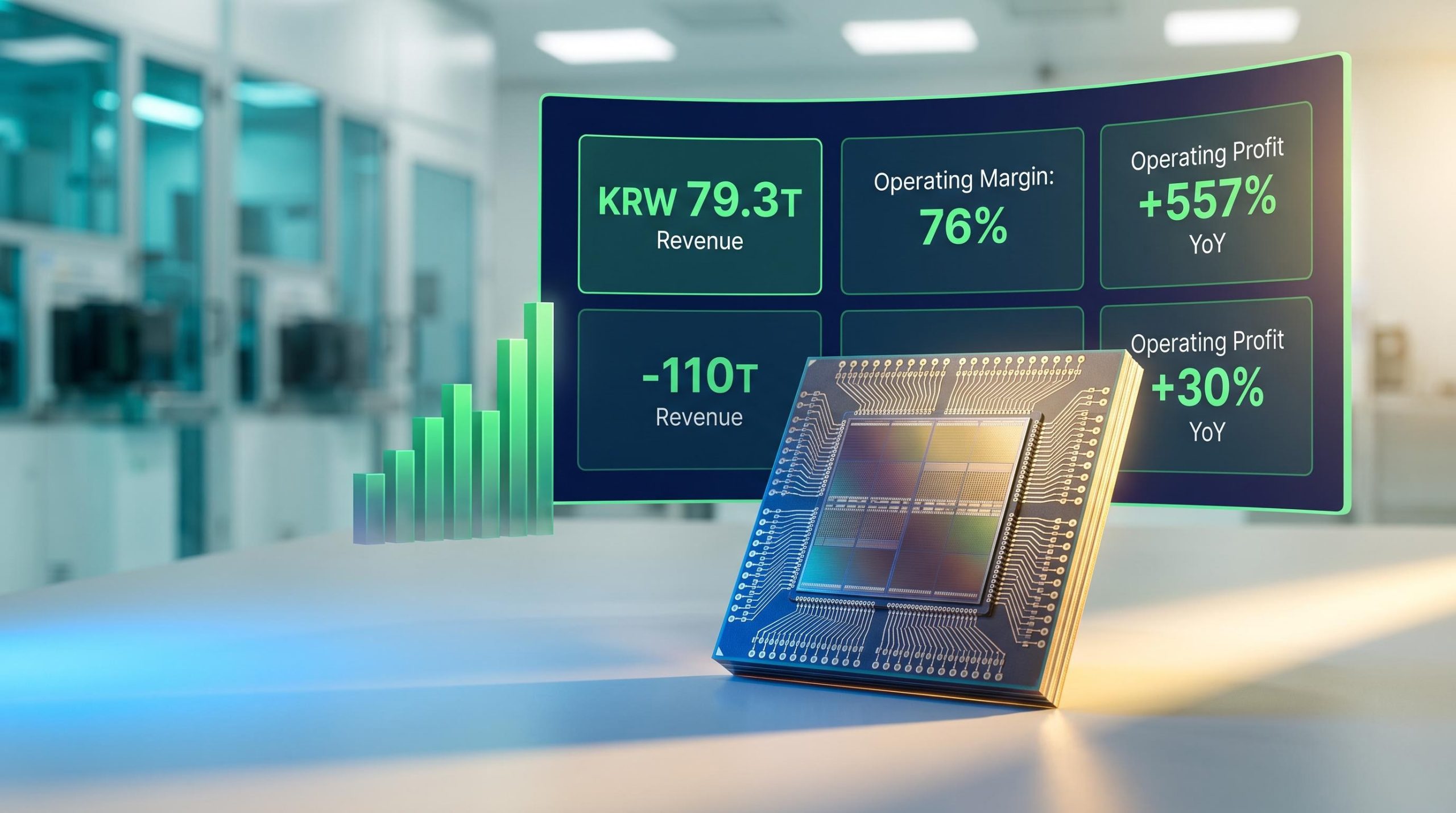
SK Hynix just reported its best quarter in company history, and the numbers are not close: a 76% operating margin, KRW 79.3 trillion in revenue, and operating profit up 557% year-over-year. The driver is AI memory demand that has moved well past hype and into hard financial reality.
The results, reported on 29 July 2026 for the April-June quarter, land at a moment when investors are actively recalibrating how durable the AI hardware cycle actually is. SK Hynix is not a peripheral player here. As one of three companies that control global DRAM production and the leading supplier of high-bandwidth memory (HBM) to Nvidia, its results function as a real-time gauge of AI infrastructure spending.
Here is a clear picture of what drove the records, where the company says demand is heading through the rest of 2026, and what these numbers tell you about the broader AI memory cycle.
Record revenue and margins signal a memory cycle at full power
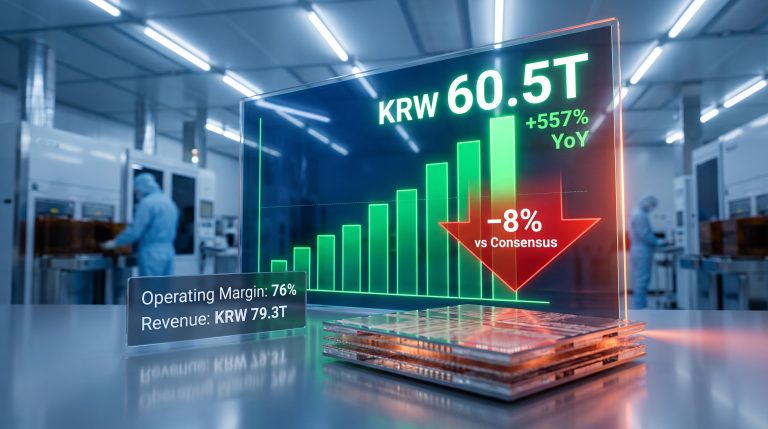
SK Hynix posted KRW 79.3 trillion in quarterly revenue, the highest in the company’s history, up 51% quarter-over-quarter and 257% year-over-year. Operating profit hit KRW 60.54 trillion, up 61% QoQ and 557% YoY.
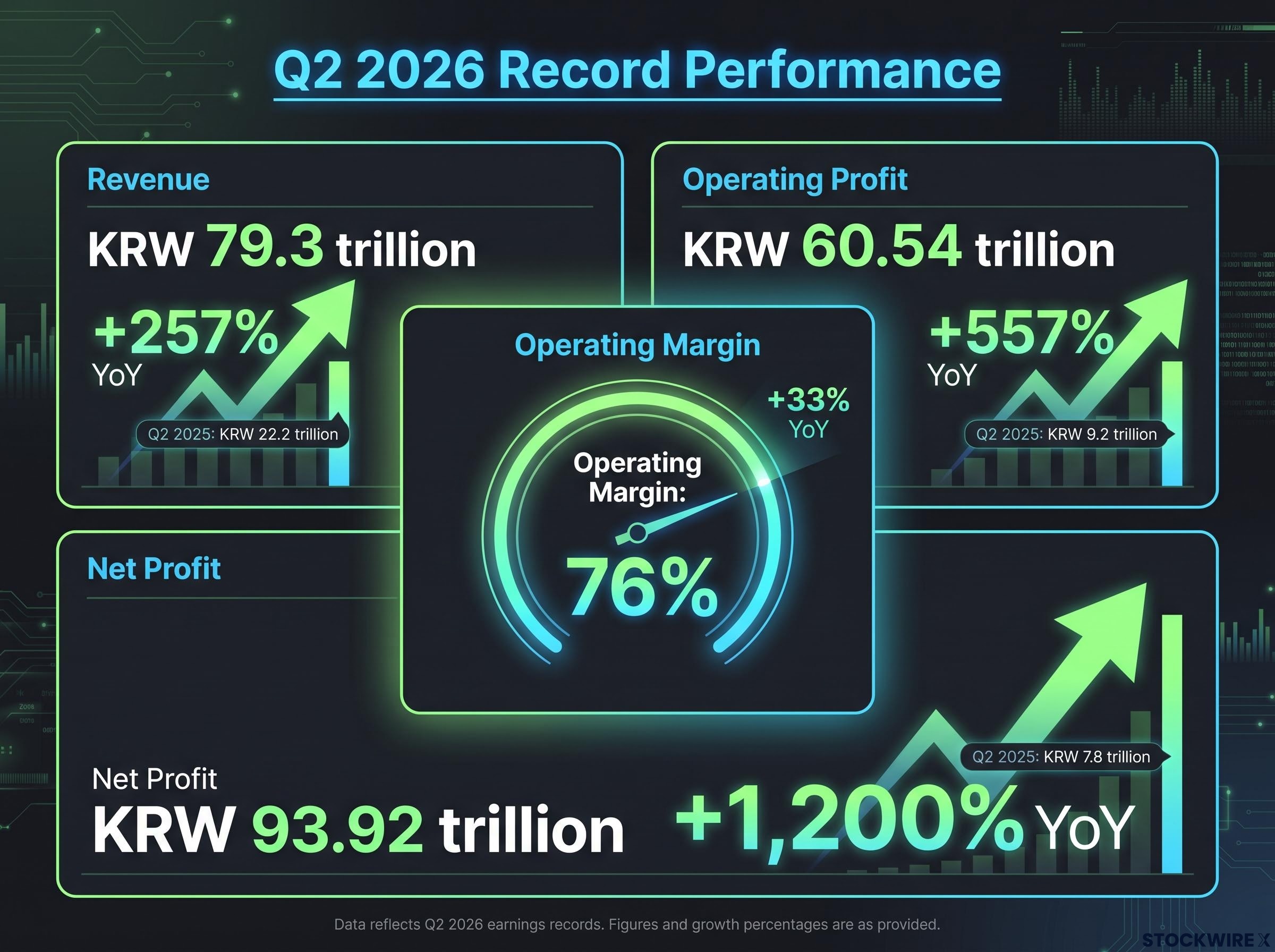
The single most analytically significant figure is the operating margin: 76%, also a company record. At a memory chip manufacturer, that number tells you pricing power has shifted decisively to the producer side of the market.
| Metric | Q2 2026 Value | QoQ Change | YoY Change |
|---|---|---|---|
| Revenue | KRW 79.3 trillion | +51% | +257% |
| Operating Profit | KRW 60.54 trillion | +61% | +557% |
| Operating Margin | 76% | Company record | Company record |
| EBITDA | KRW 64.56 trillion | +56% | +411% |
| Net Profit | KRW 93.92 trillion | +133% | +1,200% |
Operating profit did come in slightly below the LSEG SmartEstimate of approximately KRW 64 trillion. In context, that miss matters less than the fact that every core metric set an all-time high. Records across revenue, operating profit, and margin define the quarter, not the gap to the most aggressive forecast.
The SK Hynix investor relations disclosures for Q2 2026 confirm the record-breaking financial metrics reported on 29 July, including the KRW 79.3 trillion revenue figure and the 76% operating margin that together mark the strongest quarter in the company’s history.
SK Hynix characterised Q2 as a “record-breaking quarterly performance driven by high-value product sales amid strong AI demand.”
For investors watching semiconductor margins, this quarter is a high-watermark signal, not an outlier to dismiss. A 76% operating margin at a memory manufacturer confirms that SK Hynix is capturing outsized value from AI-driven demand, not merely growing shipments at thin spreads.
Why the headline net profit figure needs context
Net profit of KRW 93.92 trillion, implying a 118% net margin, was significantly boosted by a one-time gain from the sale of SK Hynix’s stake in Kioxia, estimated at approximately KRW 6.22 trillion. That figure inflated headline net profit but did not affect operating metrics. Operating profit and operating margin remain the more reliable indicators of underlying business performance.
When big ASX news breaks, our subscribers know first
What HBM and AI server demand actually look like inside the numbers
The aggregate results tell you the quarter was strong. The product-level breakdown tells you why the margin is where it is.
SK Hynix is the leading HBM supplier to Nvidia and one of only three global DRAM producers, alongside Samsung and Micron. That makes HBM, which is high-bandwidth memory designed specifically for AI processors, a strategic chokepoint in the AI hardware stack.
The commercial relationship underpinning that supplier dominance was formalised just days before these results landed: Nvidia CEO Jensen Huang confirmed the multiyear HBM partnership covering four product lines, embedding SK Hynix in Vera Rubin AI systems, Vera CPUs, RTX Spark PCs, and Jetson Thor robotics platforms rather than a single procurement cycle.
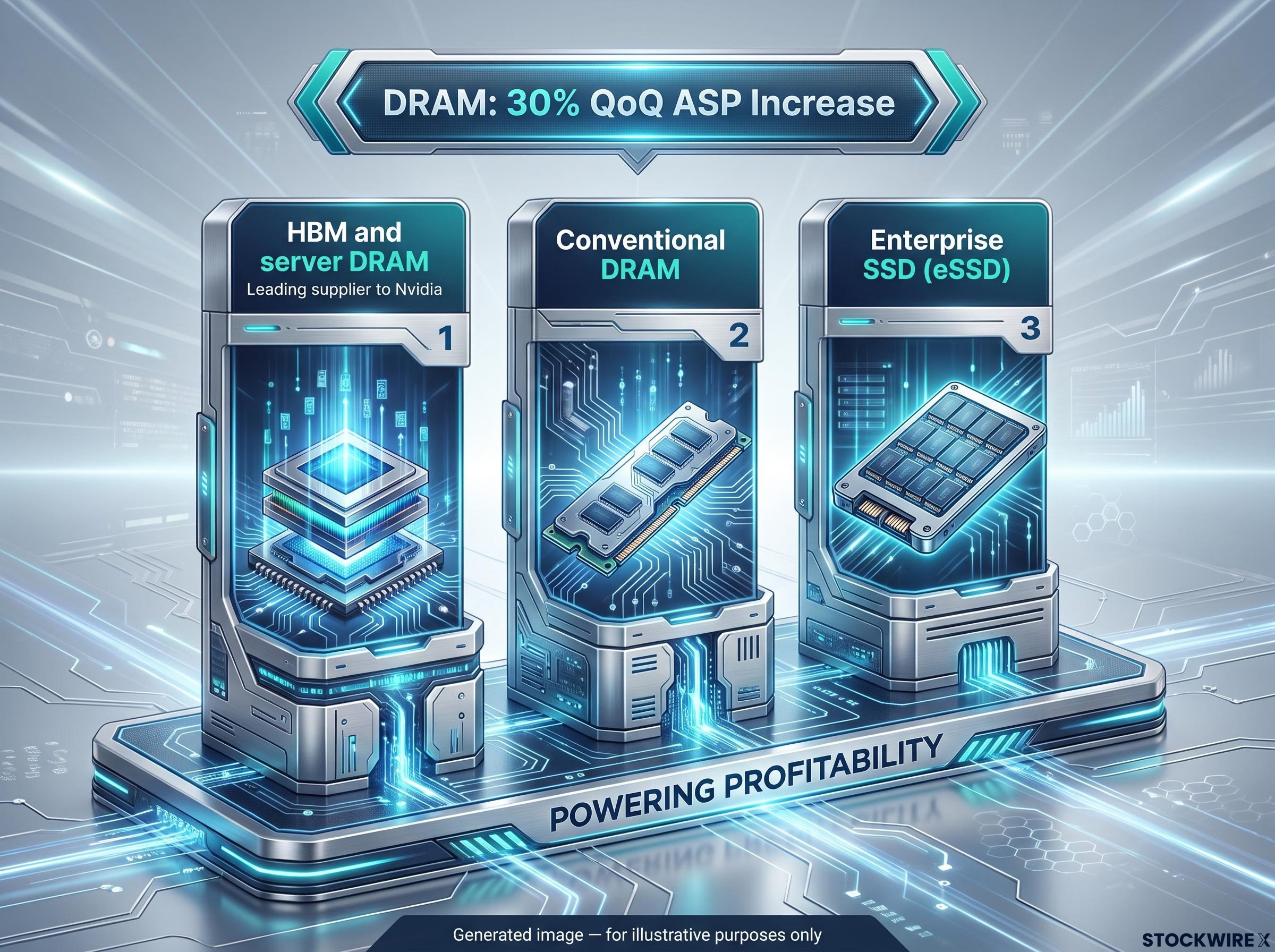
DRAM drove the margin story in Q2. Bit shipments grew by a high-single-digit percentage QoQ, a solid but not extraordinary volume increase. What moved the financials was pricing: average selling prices rose approximately 30% QoQ. A 30% sequential ASP increase tells you the pricing cycle is running faster than supply additions can offset, which is precisely the condition that sustains elevated margins into subsequent quarters.
The three product categories that powered Q2 profitability:
- HBM and server DRAM: The primary margin driver, benefiting from the shift toward high-value AI memory products and the 30% QoQ ASP increase across DRAM
- Conventional DRAM: Pricing strength extended beyond AI-specific products, indicating a broad memory market recovery rather than a narrow niche effect
- Enterprise SSD (eSSD): Demand driven by AI data centre storage requirements, including datasets, model checkpoints, and operational logs; explicitly cited by SK Hynix as a top-tier margin contributor
Understanding which products are driving the margin, not just the revenue, is what separates a surface reading of these results from an actionable investment perspective.
How the AI memory cycle works, and why SK Hynix sits at its centre
AI workloads are increasingly memory-bandwidth bound. That means the speed at which data moves between memory and the processor determines how fast the entire system runs. When memory cannot feed data to the chip quickly enough, compute capacity sits idle. This makes memory capacity, specifically HBM capacity, a direct constraint on AI chip performance.
Three companies control global DRAM production: SK Hynix, Samsung, and Micron. That oligopoly structure matters for investors because when AI demand is growing faster than memory capacity can scale, pricing power does not get competed away quickly. New entrants cannot spin up DRAM fabrication in a year. The capital requirements, process technology, and yield expertise create barriers that concentrate pricing leverage in the hands of the incumbents during an up-cycle.
The DRAM supply constraint underpinning those margin dynamics runs deeper than a single demand surge: SK Hynix has projected a global shortage lasting through 2030, with HBM inventory sitting at just 3-4 weeks industry-wide and all three major producers fully sold out through 2026, a condition that sustains pricing power regardless of quarterly volume fluctuations.
The company has indicated that AI adoption is no longer confined to large-scale training clusters, with demand spreading across inference workloads, edge computing, and vertical enterprise use cases, which collectively expand the addressable market for HBM and server DRAM.
What makes HBM different from standard DRAM
HBM stacks multiple DRAM dies vertically and connects them using through-silicon vias, tiny electrical pathways drilled through the silicon itself. This stacking places the memory physically close to the processor and delivers far higher bandwidth than standard DRAM modules. For AI workloads, that bandwidth advantage is critical: large matrix multiplications and transformer attention mechanisms move enormous volumes of data per compute cycle. Standard DRAM simply cannot keep up. The result is a significant price premium for HBM and high switching costs for AI chip designers who build their architectures around it.
Full-year 2026 guidance and what Q3 shipment projections signal
SK Hynix provided specific forward guidance that frames the rest of 2026:
- Full-year DRAM bit demand growth: forecast to reach the mid-20% range on a full-year basis
- Full-year NAND bit demand growth: projected to land in the high-teens percentage range for the full year
- Q3 2026 DRAM bit shipments: guided for a sequential increase of around 10% in the third quarter
- Q3 2026 NAND bit shipments: anticipated to grow by a low-single-digit percentage versus Q2
The company’s commentary points to AI use cases diversifying well beyond large-scale model training, with inference deployments, edge infrastructure, and enterprise-specific applications collectively broadening the pool of customers driving memory demand into subsequent quarters.
According to Visible Alpha consensus, Q3 is expected to deliver “another quarter of exceptional growth,” driven by sustained AI memory demand and elevated memory pricing.
Capacity additions are coming online, and management acknowledges this. But the supply-demand balance remains favourable to producers in the near term. Mid-20% DRAM bit demand growth for the full year, combined with continued sequential shipment increases in Q3, tells you management believes the AI-driven cycle has runway beyond a single blowout quarter. That is the difference between a cyclical peak and a structural step-change.
What SK Hynix’s record quarter tells you about the AI memory investment thesis
The Q2 results validate a specific thesis: AI memory demand is structurally powered, not a short-term surge, and the oligopoly dynamics of DRAM production concentrate the financial rewards among the three incumbents when demand outpaces supply.
A 76% operating margin paired with mid-20% full-year DRAM demand growth guidance means the right question for investors is not whether the cycle is strong, but how long it stays strong. The answer turns on two variables:
- Supply capacity additions: A faster-than-expected ramp in DRAM and NAND production capacity would compress average selling prices and squeeze margins from current levels
- Hyperscaler AI capex signals: Any deceleration in infrastructure spending commitments from major cloud providers would narrow the demand base that underpins premium HBM and server DRAM pricing
The demand broadening point works as a partial offset to both risks. With AI workloads proliferating across inference, edge, and enterprise environments, memory demand is spreading across a wider range of end customers rather than remaining concentrated among a small number of large-scale buyers. That diversification makes the earnings profile more resilient to single-customer swings.
Management tone was constructive but measured, acknowledging macro uncertainty while remaining clearly bullish on AI-driven demand. That combination, confidence with caveats, tends to be more investable than euphoria.
S&P Global Ratings’ memory chip price forecast through 2028 provides the external validation that management’s constructive tone is not isolated: with Samsung, SK Hynix, and Micron collectively controlling roughly 89% of global DRAM supply and all three redirecting capacity toward HBM, the structural tightening of commodity memory availability is now rated-agency confirmed.
This article is for informational purposes only and should not be considered financial advice. Investors should conduct their own research and consult with financial professionals before making investment decisions.
Where the AI memory cycle goes from here
SK Hynix’s Q2 2026 results are not simply a strong quarter. They are confirmation that the AI memory cycle is structurally powered, and the guidance numbers reinforce that reading. Record margins, a three-player oligopoly with intact pricing leverage, and a demand base that is broadening rather than narrowing add up to a cycle that looks durable rather than peaked.
What investors should track over the next two to three quarters: the trajectory of DRAM average selling prices as capacity additions come online, HBM supply allocation updates that signal whether SK Hynix is maintaining or extending its lead, and hyperscaler capex disclosures that confirm whether AI infrastructure spending is sustaining or decelerating. Those three data points will tell you whether the thesis is holding or softening before the next earnings cycle arrives.
Investors exploring how to position across the cycle, and specifically how to manage the 2027-2029 supply wave risk that management’s capacity commentary implicitly acknowledges, will find our comprehensive walkthrough of semiconductor cycle investing covers the five-indicator framework used to identify cycle turning points before quarterly results confirm them.
Past performance does not guarantee future results. Financial projections are subject to market conditions and various risk factors.