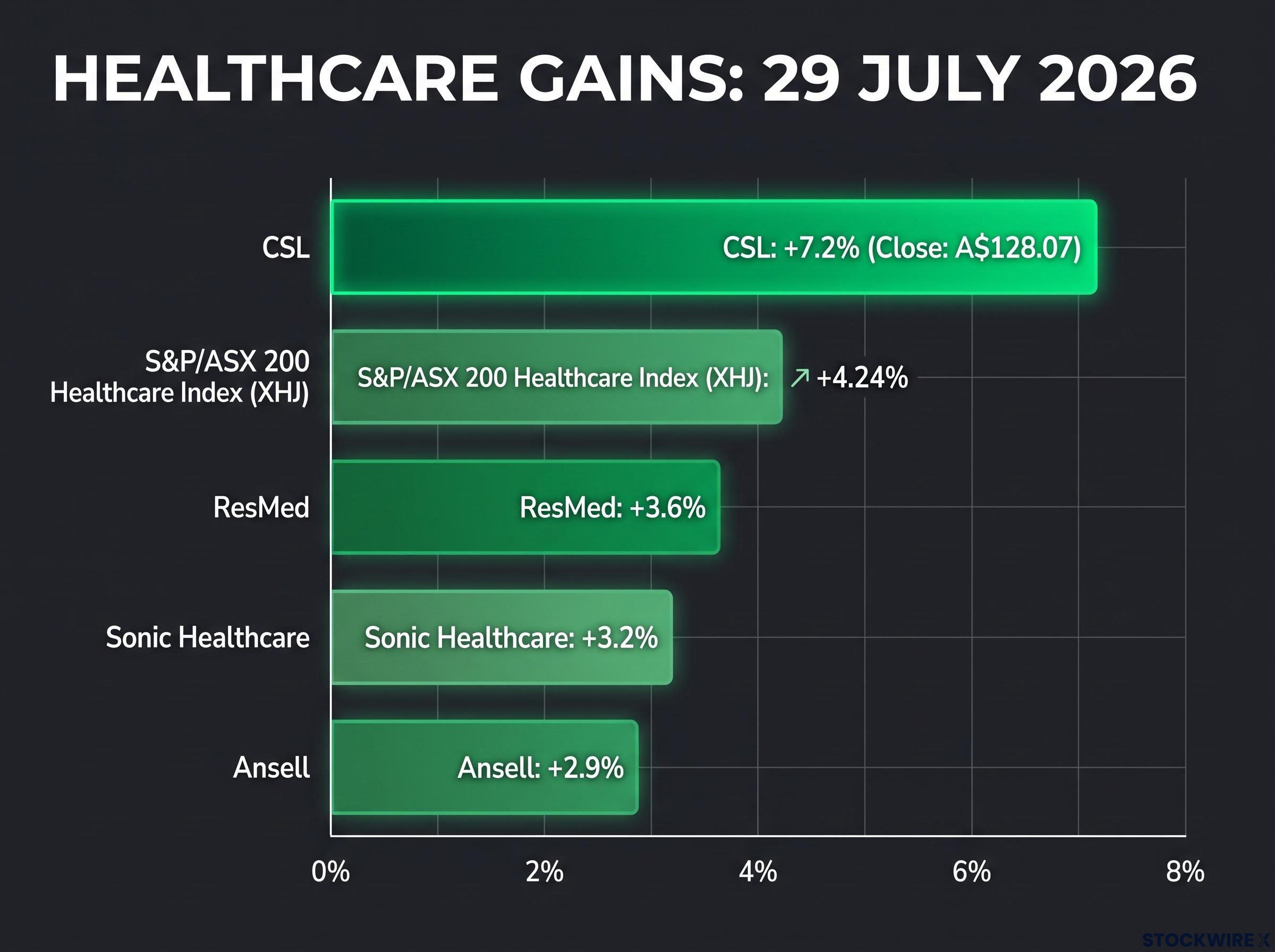
CSL jumped 7.2% in a single session on 29 July 2026, closing at A$128.07 after announcing a structured clinical and regulatory roadmap for its next-generation Horizon 2 manufacturing technology. It was the stock’s biggest single-day gain in recent memory, and the move pushed the ASX healthcare sector to a session gain not seen in over four years.
Two forces collided on the same trading day. CSL resolved a specific earnings overhang that had weighed on the stock for months, while a softer-than-expected June quarter inflation print sharply reduced the probability of an August RBA rate hike, pushed bond yields lower, and amplified gains across every long-duration healthcare name on the exchange.
Here is what the mechanics behind both forces actually tell you: which parts of the rally are durable, which depend on variables still unresolved, and the four specific milestones CSL investors need to track from here.
What CSL’s Horizon 2 announcement actually resolved
Before today, earnings forecasts for CSL had been downgraded partly because the Horizon 2 commercialisation timeline was undefined. Analysts could see the technology’s potential but had no structured path to price it into forward estimates. That ambiguity sat on the stock like a weight with no expiry date.
The announcement changed the shape of that uncertainty. CSL did not simply signal intent; it disclosed a defined, regulator-engaged programme with three specifics that gave investors enough structure to re-rate:
- Pre-existing engagement with both the Food and Drug Administration (FDA) and the European Medicines Agency (EMA) on the regulatory pathway, materially lowering perceived execution risk
- A named trial commencement date of mid-2027
- A named manufacturing facility in Kankakee, Illinois, where clinical trial activity will proceed concurrently with the expansion of manufacturing capacity at that site
The stock initially jumped approximately 5.4% in early trading on the news before extending gains through the session to close up 7.2%. The specificity of the announcement, named regulator, named facility, named date, is what separated this from a routine corporate progress update and explains why the market re-rated rather than merely acknowledged.
When big ASX news breaks, our subscribers know first
What is Horizon 2 and why does it matter for CSL’s earnings?
Horizon 2 is CSL’s patented next-generation immunoglobulin manufacturing process. It is designed to extract significantly higher immunoglobulin yields from each volume of plasma while improving cost efficiency per unit.
The core value proposition: higher yields per plasma volume improve margins and expand effective manufacturing capacity without proportional increases in capital expenditure.
That earnings pathway matters because it connects directly to the downgraded forecasts covered above. Consensus estimates for CSL had been cut partly because the timeline for Horizon 2’s contribution to margins and capacity was unknown. With clinical trials now expected to commence in mid-2027 at the Kankakee facility, analysts have a concrete framework for modelling when those margin improvements could begin flowing through.
The Horizon 2 efficiency programme sits within a broader CSL operational target of $500-$550 million in annualised savings by FY28, meaning the clinical trial timeline announced on 29 July 2026 is not just a regulatory milestone but a direct input into whether the company hits its medium-term cost structure commitments.
For an investor evaluating CSL, Horizon 2 is not a side project. It is the mechanism by which the company intends to restore previously downgraded earnings expectations, which means its progress directly affects whether consensus forecasts recover. That is why a manufacturing technology trial triggered a 7.2% share price move.
How softer inflation sent bond yields down and lifted the whole sector
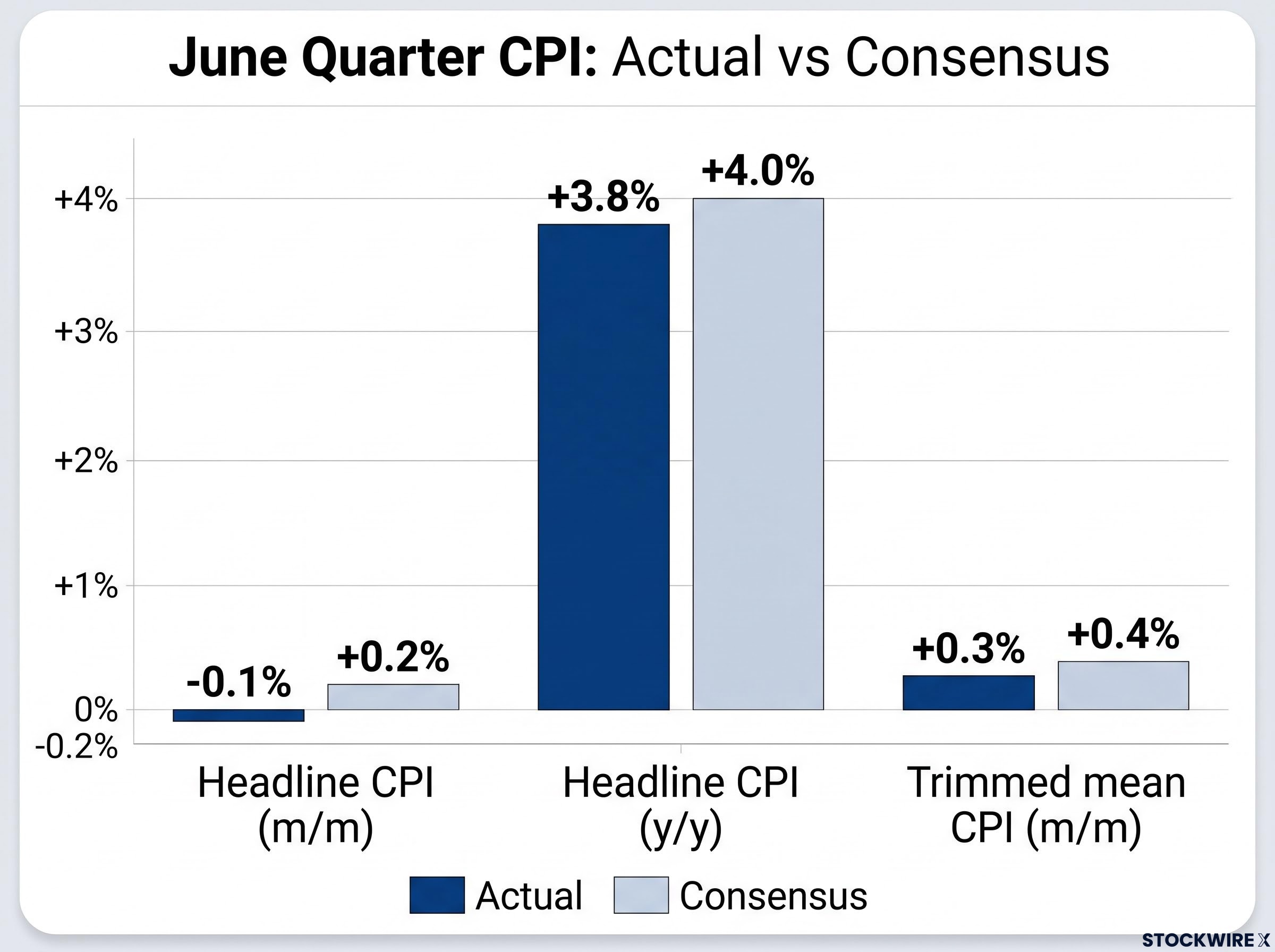
The Australian Bureau of Statistics (ABS) released June quarter Consumer Price Index (CPI) data on 29 July 2026, and all three headline readings came in softer than consensus, an unusually clean sweep.
The ABS Consumer Price Index release for the June quarter 2026 recorded a headline monthly fall of 0.1% against a consensus forecast of +0.2%, making it one of the cleaner downside surprises in recent quarters and the direct trigger for the sharp repricing of August RBA rate hike expectations.
| Measure | Actual | Consensus forecast |
|---|---|---|
| Headline CPI (m/m) | -0.1% | +0.2% |
| Headline CPI (y/y) | +3.8% | +4.0% |
| Trimmed mean CPI (m/m) | +0.3% | +0.4% |
The rate probability shift was immediate and sharp.
The chance of an August Reserve Bank of Australia (RBA) rate hike, as priced by markets, fell from 21% before the data to just 4% after the release.
The 3-year Australian government bond yield declined to 4.5% after the print. Lower bond yields reduce the discount rates applied in valuation models for companies with earnings projected far into the future, which mechanically increases the present value of those distant cash flows. Large-cap healthcare companies carry exactly that profile, making the sector disproportionately sensitive to yield movements in both directions.
Rate-driven valuation compression is the structural mechanism that made the 29 July CPI print so consequential for sector prices: the S&P/ASX 200 Healthcare Index delivered an annualised return of approximately -11.92% over the five years to mid-2026, with rising discount rates applied to long-duration earnings identified as the primary cause rather than any deterioration in underlying business performance.
The result was broad. The S&P/ASX 200 Healthcare Index (XHJ) advanced 4.24%, recording its best individual trading session in more than four years. Key constituents moved in sympathy:
- ResMed (ASX: RMD): +3.6%
- Sonic Healthcare (ASX: SHL): +3.2%
- Ansell (ASX: ANN): +2.9%
The breadth of the sector move confirms that falling yields, not CSL-specific enthusiasm, drove the majority of gains across healthcare names. That means the rally in ResMed, Sonic, and Ansell was macro-driven and therefore contingent on the rate outlook staying benign.
Why the inflation relief may not be the full story
The CPI beat was real, but its composition was structurally uneven. Lower prices for imported goods, the tradeables component of the index, were a key factor pulling the headline figure down. The RBA has limited direct influence over import prices through its monetary policy settings.
The RBA tightening cycle that preceded the 29 July relief print was unusually compressed: the Board lifted the cash rate to 4.35% across three consecutive meetings from a starting point of 3.85% in January 2026, with all four inflation measures still above the 2-3% target band at the time of the most recent hike.
The components that matter most to the RBA told a different story:
- Tradeables inflation (imported goods): softened, driving the headline beat
- Non-tradables and services inflation (tied to domestic demand, wages, and housing): posted readings that moved higher within the same report
Services inflation and non-tradables are the readings the RBA watches most closely when setting rates, because they reflect domestic economic conditions the bank can actually influence. Those readings did not soften.
The practical implication is clear. The August rate hike risk is substantially priced out, but a rate increase at the November 2026 meeting remains a genuine possibility should Q3 inflation data pick up again. Healthcare investors who bought the sector-wide rally on rate relief alone should understand that the valuation boost is conditional on inflation staying subdued through Q3 2026, and the components that matter most to the RBA were not the ones that softened.
This article is for informational purposes only and should not be considered financial advice. Investors should conduct their own research and consult with financial professionals before making investment decisions.
Four milestones that will determine whether today’s re-rating holds
The 29 July 2026 announcement marks the beginning of a multi-year monitoring period. Each of the following milestones represents a credibility checkpoint for the Horizon 2 thesis, and together they form a structured watchlist rather than a speculative roadmap:
- Ongoing FDA and EMA regulatory interactions. Both regulators are already engaged. Any shift in trial design scope, data requirements, or timeline from either agency will be market-sensitive and should be treated as a signal about execution risk.
- Kankakee facility construction and commissioning progress. Capital expenditure tracking and construction milestones at the Illinois plant run concurrently with trial preparation. Delays or cost overruns here could affect the entire Horizon 2 rollout schedule.
- Mid-2027 trial commencement date. This is the primary credibility event. Given how much of today’s re-rating is tied to this specific timeline, any slippage is likely to be particularly market-sensitive.
- Management earnings guidance on Horizon 2 implications. Upcoming CSL results presentations are the venue where management will need to quantify how Horizon 2 affects plasma yield, margins, and previously downgraded medium-term targets. That guidance will determine whether consensus forecasts start recovering.
Investors who understand these four signposts can evaluate future CSL announcements not as isolated news items but as confirmations or disruptions of the earnings thesis that drove today’s re-rating.
Clinical milestone taxonomy matters here because the four signposts identified for Horizon 2 are not equivalent in terms of market sensitivity: regulatory interaction updates, facility construction progress, trial commencement, and management guidance each carry different informational weight and operate on different timescales within a multi-year development programme.
What changes after today, and what still has to be proven
Two things happened on 29 July 2026, and they have different shelf lives. CSL resolved a specific structural overhang by converting the Horizon 2 commercialisation timeline from open-ended uncertainty into a defined, regulator-engaged programme. That resolution is durable in the sense that the roadmap now exists; the information cannot be un-announced.
The macro component is different. The sector-wide valuation uplift, the 4.24% gain across the XHJ index, was driven by lower bond yields following softer CPI data. That tailwind is not guaranteed to hold. Should Q3 inflation data come in higher than expected, particularly across services and non-tradables, the repricing of rate expectations could push yields back up and claw back a portion of today’s valuation gains.
The distinction matters for positioning. CSL closed at A$128.07, up 7.2%. The mid-2027 trial commencement date is the next major credibility test for the Horizon 2 thesis. November 2026 is the next macro variable to watch if inflation data surprises higher. Investors who understand which part of today’s move was structural and which was macro-conditional are better positioned to decide whether to add, hold, or trim at current levels.
Past performance does not guarantee future results. Financial projections are subject to market conditions and various risk factors.