Meta shares climbed more than 4% in pre-market trading on 26 August 2026, the same morning the company agreed to pay up to $16.68 billion to resolve child-harm claims brought by 29 state attorneys general. A stock rising on a multibillion-dollar settlement day is not a contradiction. It is a statement about what the market feared more: the number, or the uncertainty.
The settlement was reached during active trial proceedings in the Northern District of California, one day after Instagram head Adam Mosseri delivered testimony that undercut Meta’s defence on teen safety features. By agreeing to these terms, Meta has eliminated what was previously its most significant unquantified legal exposure from this round of state-level litigation. It does not remove all of them.
Here is what the settlement’s structure, its accounting implications, and the legal exposure still outstanding mean for anyone holding or evaluating Meta stock, broken down into the specific variables that will determine whether this is containment or the start of something longer.
What the $16.68 billion settlement actually commits Meta to
The headline figure is a maximum obligation, not a cheque Meta writes tomorrow. The $16.68 billion is structured as guaranteed instalments over 10 years beginning after the effective date, with potential contingency payments. The agreement must clear a federal court in the Northern District of California before it carries legal force, and a hearing date has yet to be set. If procedural steps take longer than expected, the first cash payments may not arrive until 2027.
$16.68 billion is the maximum settlement value, payable in instalments over a decade following court approval. The payment architecture, not the headline number, is what determines how this obligation flows through Meta’s financial statements.
Meta denied the underlying allegations and did not admit wrongdoing. The 29 participating states, led by California, Colorado, Kentucky, and New Jersey, secured both financial terms and operational constraints.
Those constraints are nationwide and ongoing. Meta must implement:
- Default daily usage limits for teen users
- Nighttime access blocks
- Strengthened age-assurance tools
- Enhanced parental controls
- Independent auditor oversight of compliance
These are not one-off costs. They are product-level changes that could affect engagement metrics and monetisation among younger cohorts for years, even if they never appear as a discrete line item.
The distinction between a lump-sum obligation and a decade-long payment schedule is more than accounting detail. It determines how analysts model near-term free cash flow, how the charge interacts with capital allocation guidance, and whether this settlement lands as a short-term earnings event or a structural drag. That distinction is the reason the market moved the way it did.
When big ASX news breaks, our subscribers know first
Why the stock rose on a $16.68 billion settlement day
Start with what changed overnight. Before this deal, Meta faced a live jury trial with no cap on potential damages. A verdict could have been larger than $16.68 billion. It could have included structurally recurring obligations. It could have set precedent that invited copycat litigation in every jurisdiction. The settlement replaced all of that with a single number and a schedule.
That substitution, certainty for open-ended risk, is what pre-market buyers were pricing. A quantified ceiling is modellable. An uncapped jury verdict is not. The 4%-plus move (cited in some coverage as 4.4%) reflects the relief of knowing the worst-case scenario from this particular proceeding is now defined.
Only approximately 1.8% of teenage Instagram users had activated the “Take a Break” screen-time feature before Meta switched it to a default setting. Mosseri’s testimony disclosing this figure on 25 August 2026, one day before the settlement, reinforced the states’ argument that safety measures were superficial rather than protective, and likely accelerated both sides’ willingness to settle.
The 10-year instalment structure reinforces the positive reaction by limiting how much cash leaves in any single quarter. But one question remains unresolved and will matter more than the headline figure for anyone modelling forward earnings: accounting treatment.
If Meta presents the settlement as a clearly labelled one-time non-recurring charge (a charge that sits outside the company’s normal operating results and is excluded from the adjusted earnings figures analysts use for valuation), the market will strip it from forward models and the underlying business multiple stays relatively intact. If the charge is amortised or blended into operating expenses across multiple periods, it compresses margins quarter after quarter, and the valuation conversation changes. The next earnings call is where that classification gets confirmed.
Meta’s Q2 2026 results included a $2.4 billion legal charge alongside $1.18 billion in severance costs, establishing recent precedent for how the company handles large one-time items; the non-recurring charge classification applied to those Q2 items will likely inform how management presents the settlement obligation at the next earnings call.
What the settlement leaves unresolved: the legal risk stack still open
The multi-state settlement resolves the largest single proceeding. It does not close the file.
New Mexico: two rulings, both under appeal
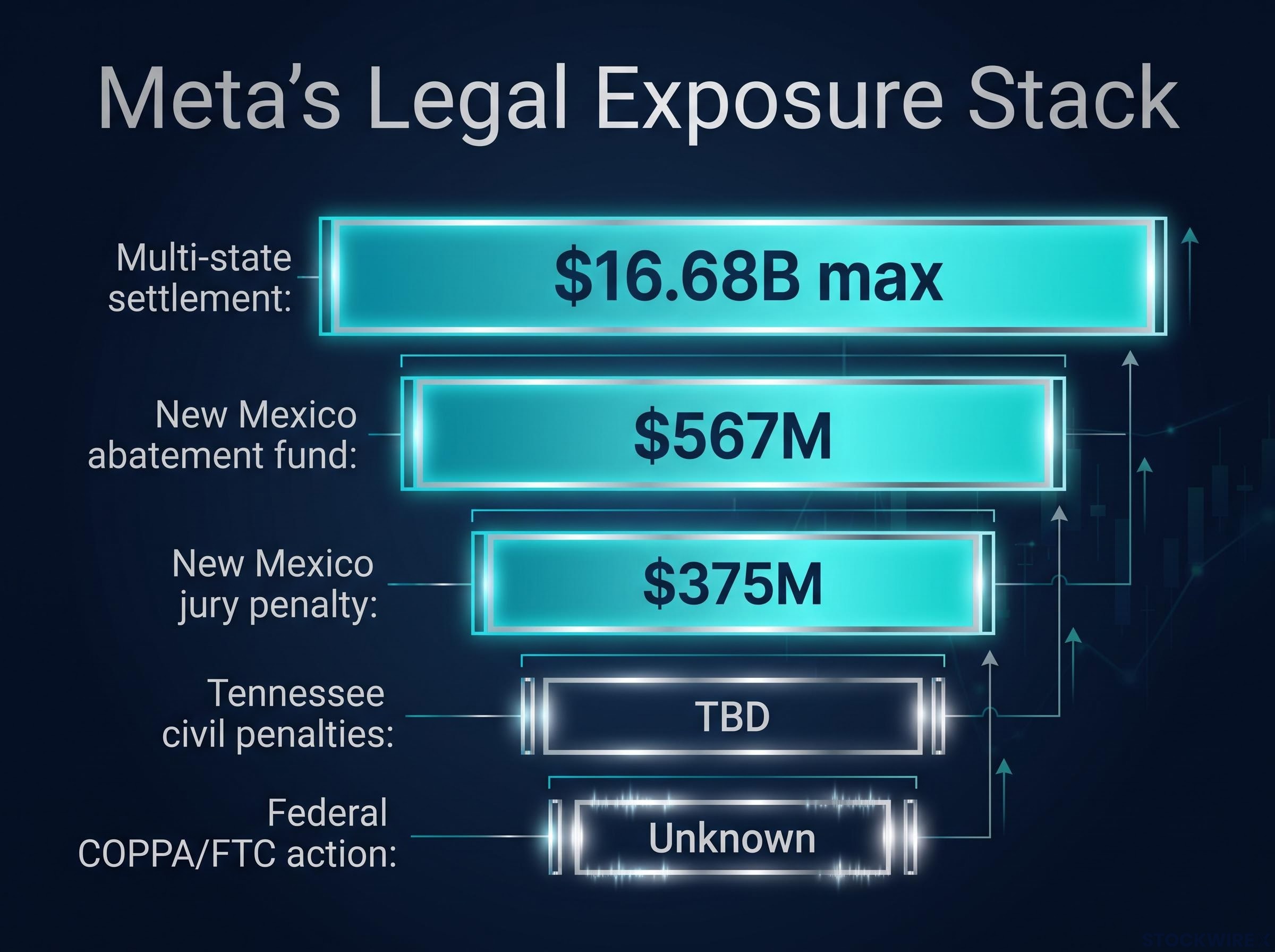
New Mexico has produced two separate adverse outcomes totalling approximately $942 million in combined exposure, and both are under appeal.
In March 2026, a New Mexico jury ordered Meta to pay $375 million in civil penalties after finding the company knowingly harmed children’s mental health and concealed information about child sexual exploitation on its platforms.
On 6-7 August 2026, a judicial order required an additional $567 million into an abatement fund to address harms to children, with added time-limiting obligations for youth usage in the state. Meta has stated its intention to appeal both rulings.
The multi-state settlement also forecloses one of the legal theories Meta had hoped to establish at trial: that ‘social media addiction’ carries no recognised psychiatric diagnosis, a platform liability theory whose acceptance by the court could have narrowed damages exposure across every related proceeding nationwide.
Speaking to CNBC, New Mexico Attorney General Raúl Torrez put the stakes in terms with direct relevance to investors: the same legal theory, if successfully pursued against larger states such as California, Florida, Texas, or New York, could generate exposure that dwarfs what New Mexico alone produced.
Tennessee and federal exposure: what remains active
Tennessee’s consumer-protection case, tried before a Nashville jury, puts Instagram’s specific design choices directly on trial. The state’s allegations name autoplay, endless scrolling, and push notifications as the features that caused harm. Opening arguments began 27 July 2026, and the trial is expected to run several more weeks. Tennessee is seeking civil penalties and court-ordered design changes, and the multi-state settlement does not resolve this proceeding.
Separately, the Federal Trade Commission (FTC) maintains independent enforcement authority under the Children’s Online Privacy Protection Act (COPPA), the federal law governing how companies collect and use data from children under 13. Nothing in the multi-state agreement forecloses federal action. No FTC enforcement filing is currently public, but historical precedent shows the agency has pursued companies even after state-level settlements. Individual states and cities not party to the 29-state coalition also retain the ability to bring independent actions.
| Obligation | Amount | Status | Court approval required |
|---|---|---|---|
| Multi-state settlement | $16.68B max | Pending federal court approval | Yes |
| New Mexico jury penalty | $375M | Under appeal | No |
| New Mexico abatement fund | $567M | Under appeal | No |
| Tennessee civil penalties | TBD | Trial ongoing | N/A |
| Federal COPPA/FTC action | Unknown | No action filed publicly | N/A |
The combined outstanding exposure, across New Mexico appeals and Tennessee, means the risk stack is compressed but not closed. Investors should treat these residual items as live variables in any model of Meta’s total legal cost rather than rounding them down to immateriality.
Three questions that will determine whether this settlement is a turning point or a prelude
The settlement itself is not the signal that tells you whether Meta’s legal chapter is closing or just entering a new phase. The next earnings call is. Three specific disclosures will shape whether the pre-market relief holds or fades.
- Settlement accounting classification: Does Meta present the charge as a one-time non-recurring item, or does it amortise or blend it into operating expenses? A one-time classification lets analysts strip it from forward earnings per share (EPS, the company’s profit divided by its shares outstanding) and EBITDA (earnings before interest, taxes, depreciation, and amortisation, a common measure of operating profitability). Amortised treatment compresses margins for years.
- AI capital expenditure guidance: Meta has projected up to $145 billion in AI infrastructure spending for 2026, funded primarily by an advertising business that generates approximately 98% of total revenue. The combination of $16.68 billion in settlement instalments and roughly $942 million in New Mexico exposure running alongside that programme forces a question: can Meta’s cash generation support all three obligations without guidance revision? Explicit reaffirmation would be a confidence signal. Any pullback would be read as either prudence or strain.
Meta’s AI infrastructure spending trajectory was already the dominant valuation debate before the settlement: the company raised its 2026 capex guidance to $125-145 billion in Q1, disclosed $107 billion in new contractual commitments, and paused share buybacks in the same quarter, a sequence that sent the stock down roughly 9% despite record earnings.

- Legal roadmap commentary: How management characterises the Tennessee trial, New Mexico appeals, and potential federal exposure will either build or undercut the case that the remaining risk stack is manageable. A credible containment narrative supports multiple stability. Any acknowledgment of material additional exposure caps near-term upside.
$16.68 billion in settlement obligations alongside up to $145 billion in planned AI capital expenditure: the scale comparison frames the investor question. If the 10-year instalment structure holds and cash generation remains intact, the two programmes may coexist. If not, one yields to the other.
This article is for informational purposes only and should not be considered financial advice. Investors should conduct their own research and consult with financial professionals before making investment decisions.
Risk compressed, not retired: where Meta’s legal story goes from here
The settlement is directionally positive for Meta’s equity story. It removes the largest single modellable unknown and replaces it with a structured, time-limited obligation. The 10-year payment schedule is the key structural reason why the near-term AI capital expenditure trajectory may not require revision, pending guidance confirmation.
But this is risk compression, not risk elimination. Two scenarios will determine how the settlement is remembered. In one, Tennessee, the New Mexico appeals, and federal enforcement trend toward containment, and the $16.68 billion becomes a costly but manageable chapter. In the other, a large Tennessee verdict, failed New Mexico appeals, or an FTC filing compound the financial and operational burden beyond what the market priced on settlement day.
For readers wanting to understand the full legal cycle that produced this settlement, our deep-dive into social media youth litigation risk covers the three layered theories, the sector-wide exposure across Meta, Snap, and Alphabet, and why injunctive relief targeting algorithm design may prove more costly than any financial penalty.
The settlement announcement is not the end of the analysis. The next earnings call is. That is where management either confirms the relief the market has priced, through accounting clarity, capex reaffirmation, and a credible legal roadmap, or introduces new variables that require models to be rebuilt.
The pre-market move of more than 4% is the baseline. What happens at the earnings call determines whether it was a lasting re-rating or a relief trade that fades. For anyone holding or evaluating the stock, that call, not the settlement headline, is the decision point.
Past performance does not guarantee future results. Financial projections are subject to market conditions and various risk factors.