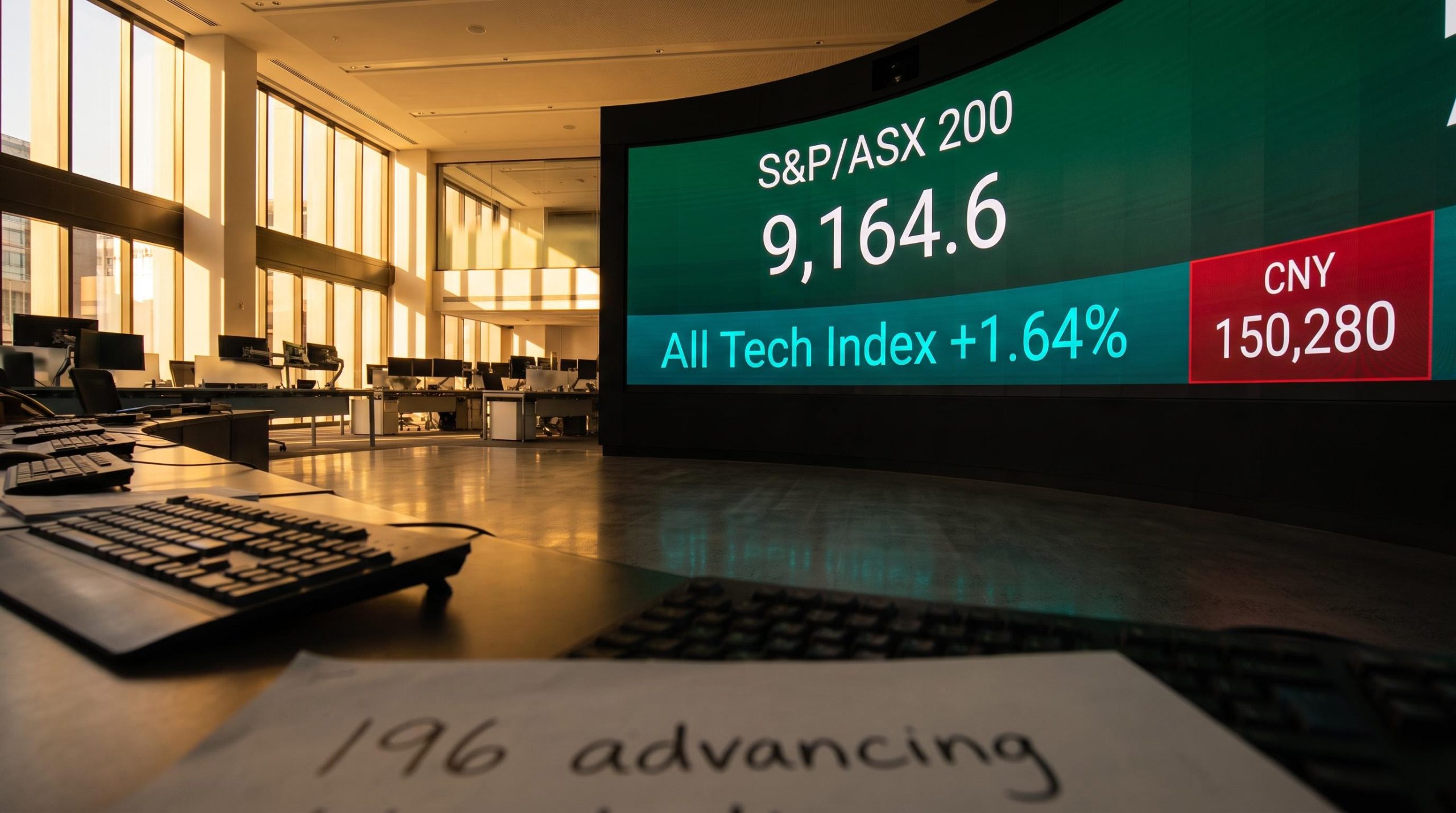
The S&P/ASX 200 finished Tuesday’s session at 9,164.6, a gain of 61.5 points or 0.68%, with nearly 196 stocks advancing across the ASX 300 against just 82 on the decline. That kind of participation is not a routine green day.
The session broke a pattern that had defined recent weeks. For the first time in several weeks, both Financials and Materials closed in positive territory on the same day, breaking a barbell dynamic that had seen one sector gain only at the other’s expense. The All Tech Index outran the broader market by a wide margin, closing up 1.64%, while Chinese lithium carbonate futures dropped around 6% in a single session, unwinding the prior two days of recovery for domestic battery metals stocks.
Here is the full picture of what moved the ASX today, what the earnings results rewarded and punished, and what the lithium selloff signals heading into Wednesday.
A broad advance built on more than index arithmetic
The headline return was 0.68%. The breadth told a more important story. Roughly 196 stocks advanced across the ASX 300 against 82 decliners, a ratio that confirms genuine buying interest across the market rather than a handful of large caps dragging the index higher.
Market breadth signals like the 196-to-82 advancer-decliner ratio carry more interpretive weight than headline index returns alone, because a narrow advance concentrated in large caps can produce an identical percentage gain while leaving the vast majority of the market underwater, a dynamic documented in detail across recent ASX sessions.
- S&P/ASX 200: 9,164.6, +0.68%
- All Ordinaries: 9,374.9, +0.63%
- All Tech Index: 3,193.2, +1.64%
Sector breakdown
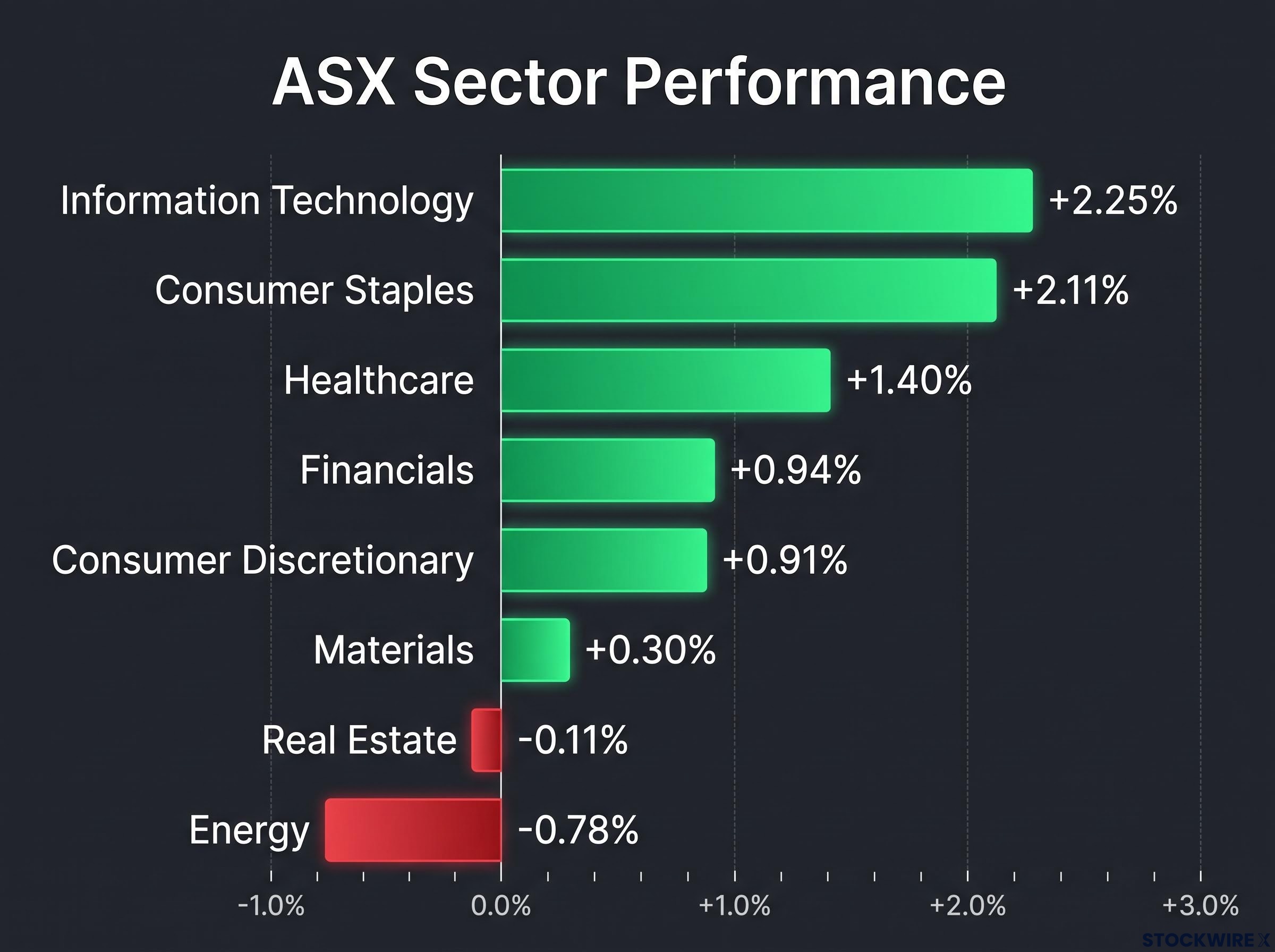
Information Technology led at +2.25%, its strongest session in weeks, followed by Consumer Staples at +2.11% on the back of Coles Group’s earnings beat. Healthcare added +1.40%, and Financials posted +0.94%, recording its best result across the prior 15 trading days following a decline of more than 10% from its 5 August peak.
| Sector | Move (%) | Index Close |
|---|---|---|
| Information Technology (XIJ) | +2.25% | 1,978.9 |
| Consumer Staples (XSJ) | +2.11% | 13,187.1 |
| Healthcare (XHJ) | +1.40% | 32,107.7 |
| Financials (XFJ) | +0.94% | 9,231.1 |
| Consumer Discretionary (XDJ) | +0.91% | 3,818.5 |
| Materials (XMJ) | +0.30% | 26,576.3 |
| Real Estate (XPJ) | −0.11% | 3,441.5 |
| Energy (XEJ) | −0.78% | 11,074.3 |
Brent crude easing during the session was sufficient to send oil and gas producers lower, making Energy the clear laggard of the day. Real Estate drifted marginally into negative territory, continuing to contend with the twin pressures of high benchmark bond yields and ongoing mortgage market weakness that have burdened the sector over the past three weeks.
Seeing Financials and Materials both close higher on the same day is worth pausing on. Through much of the recent period, buying in one of these sectors reliably coincided with selling in the other. That the pattern broke on Tuesday points to risk appetite expanding across the board, not simply cycling from one pocket of the market to another. A broadening rally carries more weight than a rotation.
The Australian dollar sat at $0.7145 against the US dollar, down 0.06%. S&P 500 futures pointed 0.21% higher.
Earnings results separate decisive beats from good-enough numbers
Tuesday’s sharpest theme was not which companies grew. It was which companies grew enough. Markets rewarded only clean beats, and stocks reporting solid absolute numbers that merely met or modestly cleared elevated expectations were sold hard.
The gainers told a straightforward story: surprise wins.
- Electro Optic Systems (EOS): +23.0% to $10.58. H1 FY26 underlying EBITDA (earnings before interest, taxes, depreciation and amortisation) swung from a loss of $14.9 million to a profit of $21.6 million. The day’s top performer in the ASX 300.
- ARB Corporation (ARB): +13.9% to $21.51. H1 FY26 net profit after tax (NPAT) of $92.4 million versus a forecast of $83.6 million. Beat on revenue, margins, and offshore expansion.
- Coles Group (COL): +4.9% to $23.75. Underlying NPAT of $1,255 million versus a forecast of $1,220 million, with cost management and private label growth highlighted.
- Suncorp Group (SUN): +8.0% to $19.37. Primary driver of the Financials sector recovery.
- Ansell (ANN): +8.2% to $41.36. Second consecutive session of follow-through buying after FY26 results.
- Judo Capital (JDO): +6.7% to $1.03. Two on-market director purchases totalling $156,122 and $10,700 supported sentiment.
- Zip Co (ZIP): +5.6% to $2.66. New US$300 million funding facility announced.
Where results disappointed
The decliners carried a more instructive pattern.
- Nanosonics (NAN): −17.1% to $3.05, hitting a 52-week low on a result that dented confidence in its growth trajectory.
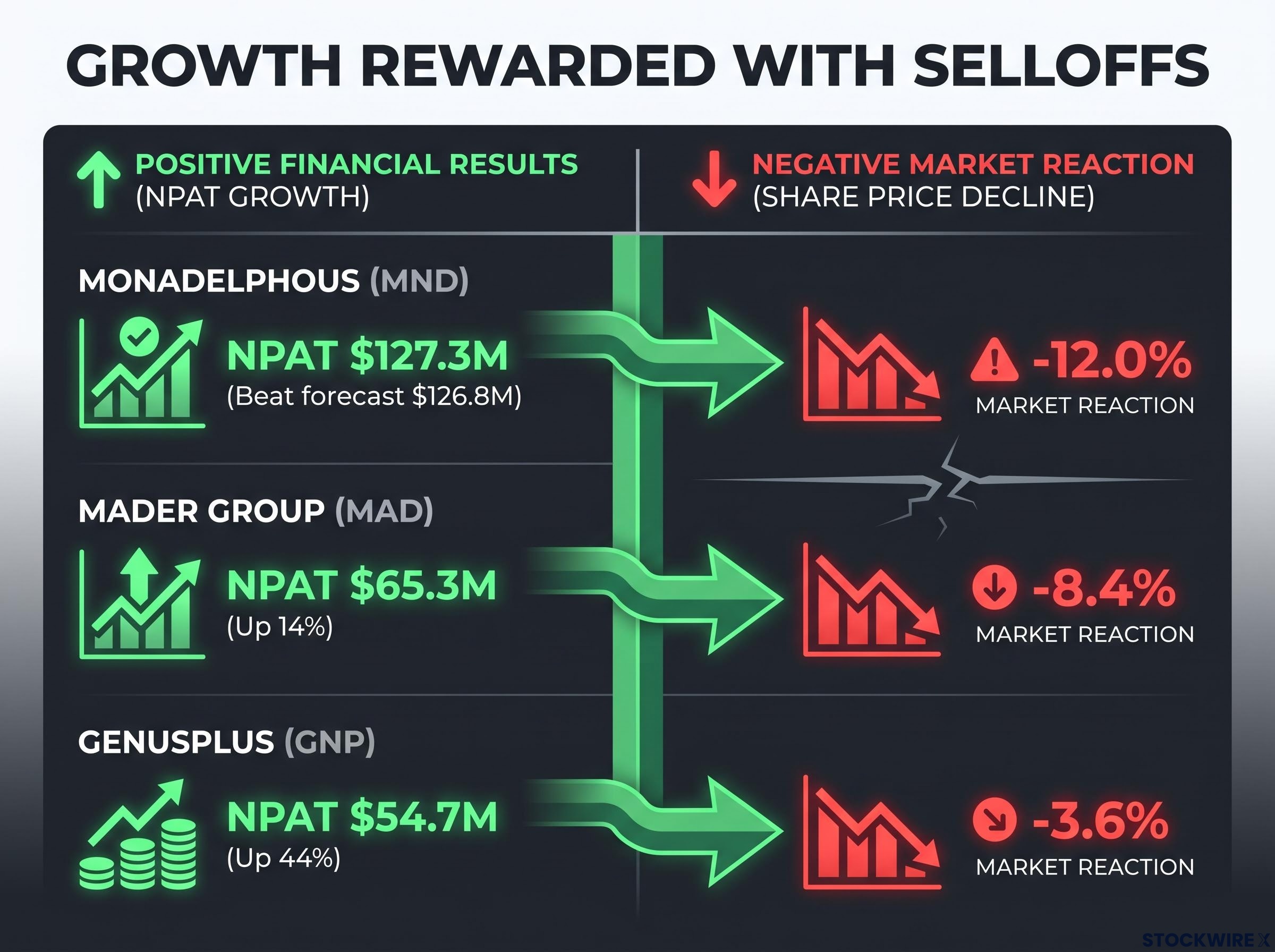
- Monadelphous (MND): −12.0% to $28.50. NPAT of $127.3 million versus a forecast of $126.8 million. A marginal beat, but positioning had clearly run ahead.
- SiteMinder (SDR): −11.0% to $3.40. Double-digit decline post-results.
- Mader Group (MAD): −8.4% to $6.63. NPAT of $65.3 million, up 14% year-on-year, and still sold.
- GenusPlus (GNP): −3.6% to $8.61. Underlying NPAT of $54.7 million, up 44% year-on-year, and still sold.
Monadelphous reported genuine profit growth, beat its consensus forecast, and fell 12% in a single session. That tells you everything about where positioning sat heading into the result.
The pattern is consistent. GenusPlus grew NPAT by 44% and was punished. Mader Group grew by 14% and was punished. In both cases, the absolute numbers were strong. The problem was that expectations and positioning had already priced in better, and merely delivering good was not enough to hold the stock up. Understanding this dynamic matters heading into Wednesday, when Lovisa reports full-year results after entering Tuesday’s session up 5.2% on pre-result optimism. That kind of run-up compresses the margin for a positive market reaction, even on a genuine beat.
Earnings season positioning explains why a 44% NPAT increase at GenusPlus and a 14% gain at Mader Group both resulted in share price declines: when institutional holders have already priced in strength, delivering good results is insufficient to absorb the selling pressure that follows a crowded long.
Lithium’s two-day recovery erased in a single session
On Tuesday, GFEX lithium carbonate futures declined around 6% to settle at CNY 150,280 per tonne, marking their sharpest one-session fall in more than a month.
The prior two days of tentative gains across ASX lithium stocks were reversed in a matter of hours. The selling was sector-wide, with no company-specific announcements driving the declines.
- Liontown Resources (LTR): −8.7% to $1.21
- Pilbara Minerals (PLS): −6.0% to $5.14
- Elevra Lithium (ELV): −5.8% to $9.07
- Wildcat Resources (WC8): −5.8%
- IGO (IGO): −4.9% to $8.34
- Core Lithium (CXO): −3.8% to $0.38
- Mineral Resources (MIN): −3.5% to $66.68 (carrying dual exposure to lithium and broader materials)
The structural problem is clear: Australian lithium equities remain tightly anchored to short-term Chinese futures pricing. A single adverse GFEX print was all it took to wipe out what the sector had clawed back over two sessions, and that tells you no credible floor has formed yet. Any stabilisation thesis for lithium at current levels depends on sustained improvement in Chinese demand data, not short-term price bounces that can be wiped out overnight.
Lithium sector positioning across ASX equities has remained tightly anchored to short-term Chinese futures pricing throughout the 2026 recovery cycle, a structural feature that explains why a single adverse GFEX print on Tuesday was sufficient to erase two sessions of gains across Pilbara Minerals, Liontown, and IGO simultaneously.
For readers with lithium exposure or considering entry, Tuesday’s move is a direct signal that this remains a high-sensitivity trade on Chinese commodity futures rather than a fundamentals-driven environment.
What Wednesday’s session inherits
Tuesday was a genuinely strong session by internal market metrics. Three unresolved questions will determine whether it holds.
- Lovisa’s full-year result (Wednesday 26 August): The stock entered Tuesday up 5.2% on pre-result optimism. Tuesday’s own earnings dynamic, where positioning punished anything less than a clean beat, sets a high bar. A strong result confirms Consumer Discretionary rotation has legs. Anything softer sets up a reversal that reads back into the broader session’s credibility.
- Technology sector durability: The IT sector gained 2.25% on Tuesday, with WiseTech climbing 4.6% to $45.47, Nuix adding 12.3% for a second straight session, and Data#3 rising 5.8% to $11.73 also for a second consecutive day. Whether this is genuine recovery from prior sharp declines or a single-day bounce depends on what upcoming results and global risk sentiment deliver.
- Lithium’s next GFEX print: Lithium carbonate futures closed at CNY 150,280 per tonne. Wednesday morning opens with whatever China does next, and the sector has shown no ability to absorb even a modest move lower.
The full ASX reporting calendar for August 2026 covers broker consensus NPAT, EPS, and DPS estimates for 78 named companies, giving investors the specific forward earnings benchmarks that determine whether Wednesday’s Lovisa result and subsequent reports clear or fall short of market expectations.
US futures pointed modestly higher overnight, with S&P 500 futures at 7,686.0 (+0.21%) and Nasdaq futures at 29,240.75 (+0.46%). The Australian dollar held at $0.7145.
Tuesday gave the market breadth, sector breadth, and a set of earnings results that separated conviction from hope. Wednesday will test whether any of it sticks.
This article is for informational purposes only and should not be considered financial advice. Investors should conduct their own research and consult with financial professionals before making investment decisions.