The Swiss franc is losing ground right now for the same reason it almost always recovers: the Swiss National Bank (SNB) has very little room to move. That structural constraint, a policy rate pinned near zero with limited appetite for intervention, is precisely what makes the franc soft in the short term and resilient over the medium term. The two dynamics look contradictory. They are not. They are sequential.
The timeline is compressing. The European Central Bank (ECB) is expected to deliver its second rate increase in September 2026, just weeks away, widening the yield gap between euro-denominated and franc-denominated assets further. For anyone tracking EUR/CHF or making currency-related investment decisions, the question is not simply whether the franc weakens or strengthens. It is when the first dynamic gives way to the second.
Here is what the EUR/CHF institutional consensus actually tells you about timing, magnitude, and the specific conditions that would break the framework in either direction, with the levels and scenarios you need to orient against.
What is pushing the franc lower right now
The near-term pressure on the franc is not about the SNB actively weakening its currency. It is about the progressive removal of something that was supporting it: the expectation of an SNB rate hike.
As recently as early 2026, markets were still pricing a first SNB rate increase around mid-2027. That timeline is now being pushed back. Economist surveys compiled by Bloomberg and Reuters place the first hike no earlier than mid-2027, with many respondents pushing it into early 2028. Reported internal SNB expectations suggest the policy rate stays at zero through end-2027. Each downward revision strips out a layer of cyclical support for the franc.
Commerzbank FX analyst Michael Pfister frames this as the core near-term mechanism. As Pfister argues (via FXStreet), the market’s residual rate hike pricing is improbable given Switzerland’s inflation profile, and the progressive elimination of that pricing is what generates EUR/CHF upside in the near term.
Commerzbank’s Michael Pfister identifies market pricing of an SNB rate hike by mid-2027 as improbable given Switzerland’s prevailing inflationary environment, and argues that the progressive removal of that expectation is the primary source of near-term franc weakness.
Switzerland’s consumer price pressures are expected to remain contained in the months ahead, keeping the SNB firmly constrained from any normalisation of policy. Meanwhile, the ECB’s projected September 2026 rate increase widens the yield differential further, making euro-denominated assets relatively more attractive. The mechanism is straightforward: capital follows yield, and the yield gap is moving in the euro’s favour.
The yield differential driving near-term EUR/CHF upside is itself a product of how ECB monetary policy tools interact with market pricing: the Deposit Facility Rate functions as the currency anchor, and EUR moves are largest when ECB action deviates from what OIS curves have already priced in.
The key point for your positioning: this is a repricing event with a finite duration, not a structural downtrend. Once rate hike expectations are fully priced out, the cyclical headwind expires. Three variables tell you where you are in that process:
- Swiss CPI releases: continued muted prints accelerate the repricing; any uptick pauses it
- SNB communications: any signal that the SNB is comfortable with extended zero rates confirms the repricing timeline
- ECB rate decisions: particularly the September 2026 meeting, which sets the near-term ceiling on the rate differential
When big ASX news breaks, our subscribers know first
Where EUR/CHF is actually headed: the institutional consensus
What makes the current EUR/CHF forecast environment unusual is not the direction of the consensus. Most institutions agree the pair drifts modestly higher in the near term. What is notable is how tight the range is.
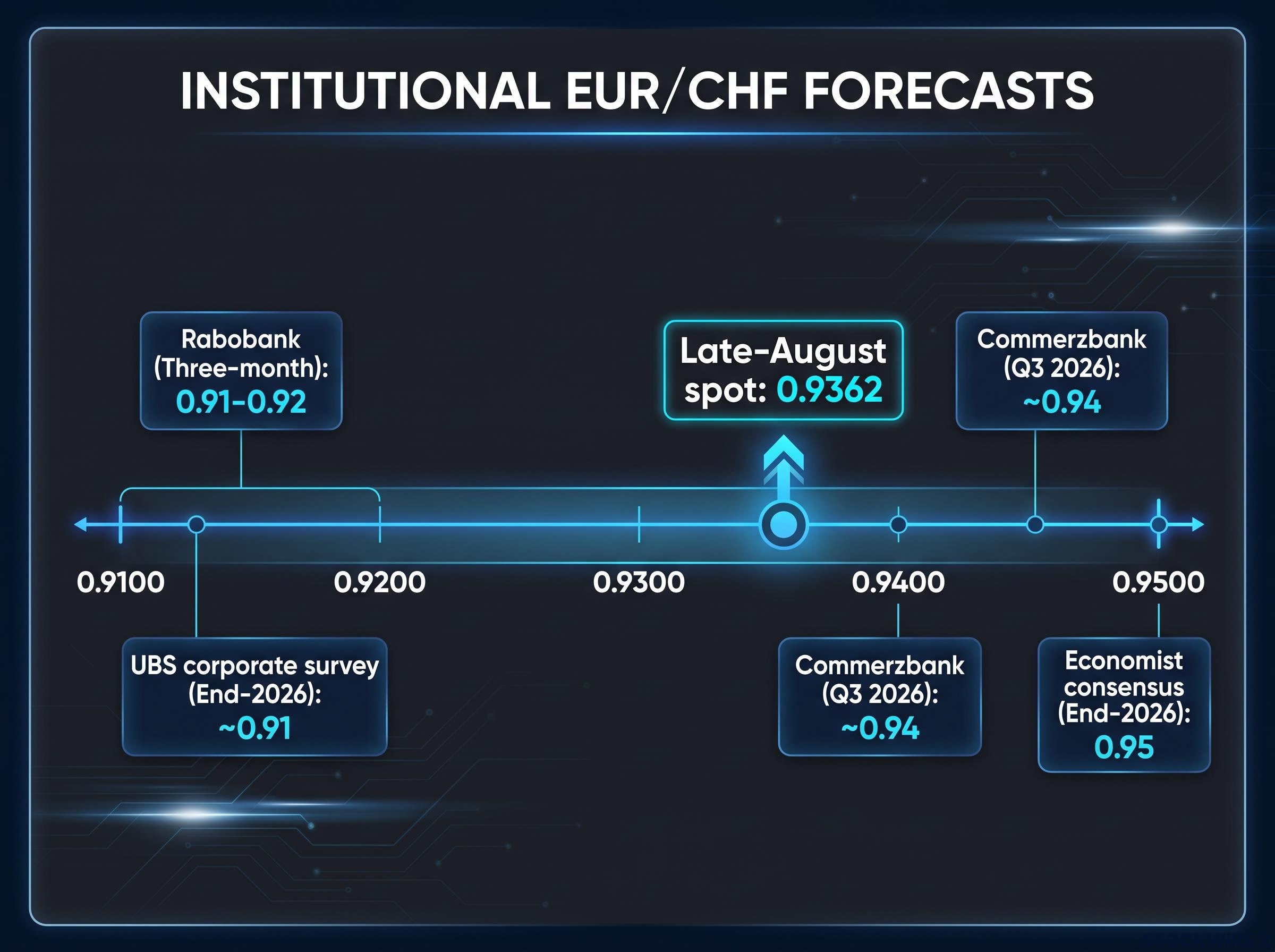
The mainstream institutional view clusters EUR/CHF in the 0.91-0.95 band over the next 12-18 months. That is not a wide corridor. It tells you the debate among major forecasters is about amplitude and timing, not about whether the franc is headed for sustained collapse.
| Institution | EUR/CHF Target | Timeframe | Directional Skew |
|---|---|---|---|
| Commerzbank | ~0.94 | Q3 2026 | Neutral |
| Rabobank | 0.91-0.92 | Three-month | CHF-friendly |
| UBS corporate survey (300 firms) | ~0.91 | End-2026 | CHF-friendly |
| Economist consensus | 0.95 | End-2026 | EUR-friendly |
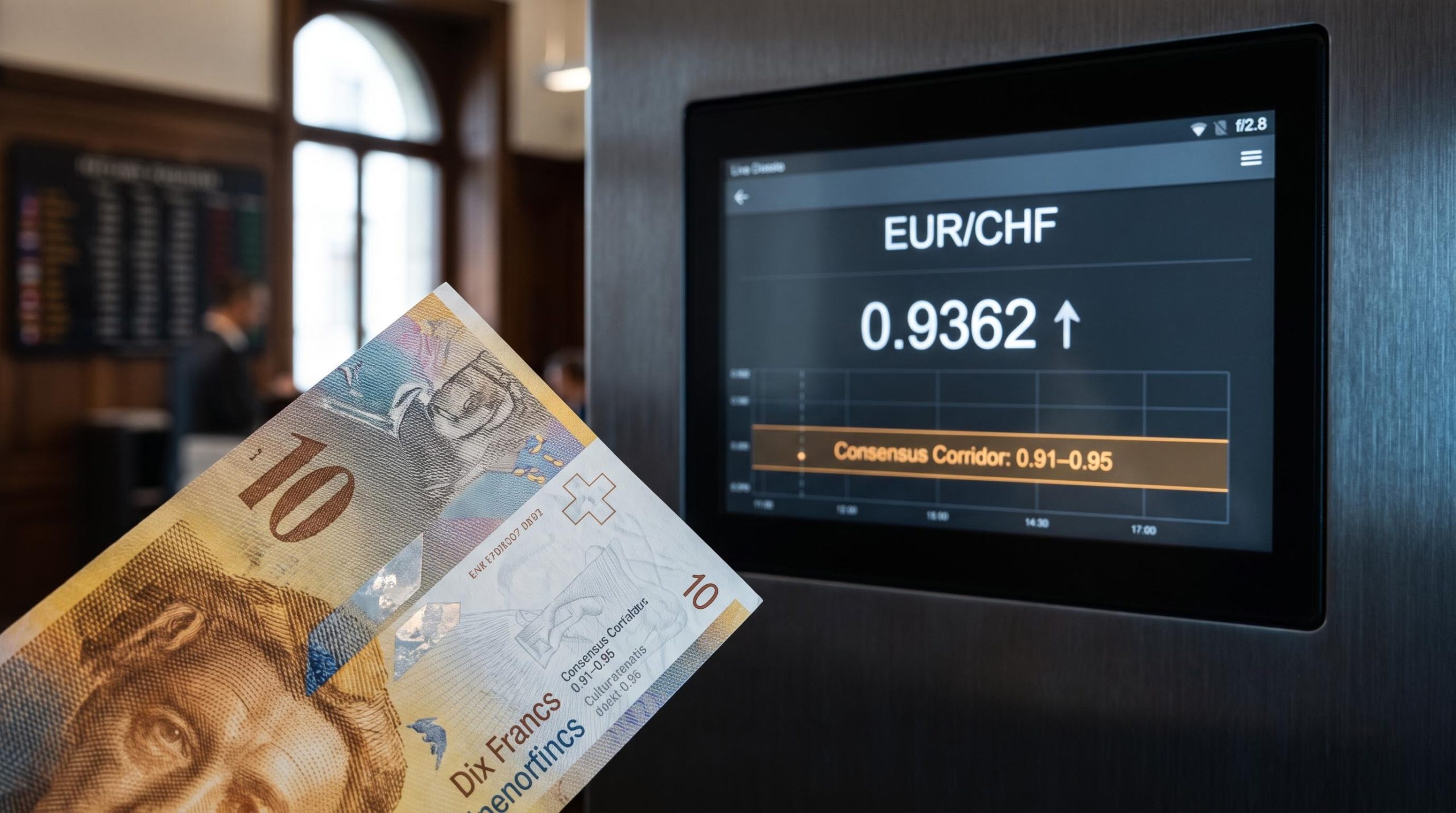
Late-August spot sits near 0.9362, which is already inside the consensus corridor. Commerzbank’s Pfister targets approximately 0.94 by the close of Q3 2026, placing the near-term ceiling only a few cents above current levels. The economist consensus of 0.95 by end-2026 represents the upper bound; no major institution is projecting EUR/CHF significantly above that level under baseline assumptions.
At the other end, Rabobank’s three-month target of 0.91-0.92 and the UBS corporate survey result of approximately 0.91 by end-2026 establish a floor that is not far from spot either. The range is contained. The skew within it, however, is worth your attention.
What the skew toward CHF strength tells investors
When you look at the balance of institutional views, the downside EUR/CHF scenarios are closer to several institutions’ base cases than the upside scenarios are. Rabobank’s base case sits near 0.91-0.92. The UBS survey of 300 Swiss firms lands at 0.91. The geopolitical risk scenario, where safe-haven inflows push EUR/CHF toward approximately 0.90, is not a tail risk when two major institutions already have base cases in the low 0.91s.
The SNB’s limited appetite for intervention reinforces this asymmetry. Switzerland’s structural current-account surplus provides a fundamental underpinning for franc strength that does not disappear during cyclical softness. What this tells you is that within the 0.91-0.95 corridor, the risks are skewed toward the lower end rather than the upper, and any positioning that assumes EUR/CHF trends persistently above 0.94 is betting against the weight of the institutional distribution.
Why the Swiss franc bounces back in the medium term
The same SNB policy constraint that enables near-term franc softness is what makes the medium-term recovery almost self-reinforcing. When the market has fully absorbed the removal of residual rate hike expectations, likely through 2027-2028, the SNB’s narrow range of available tools comes into sharp focus. The bank lacks the room to reduce rates meaningfully and has shown little appetite for more assertive currency intervention, leaving it with scant capacity to push back against franc appreciation once the underlying structural forces take hold.
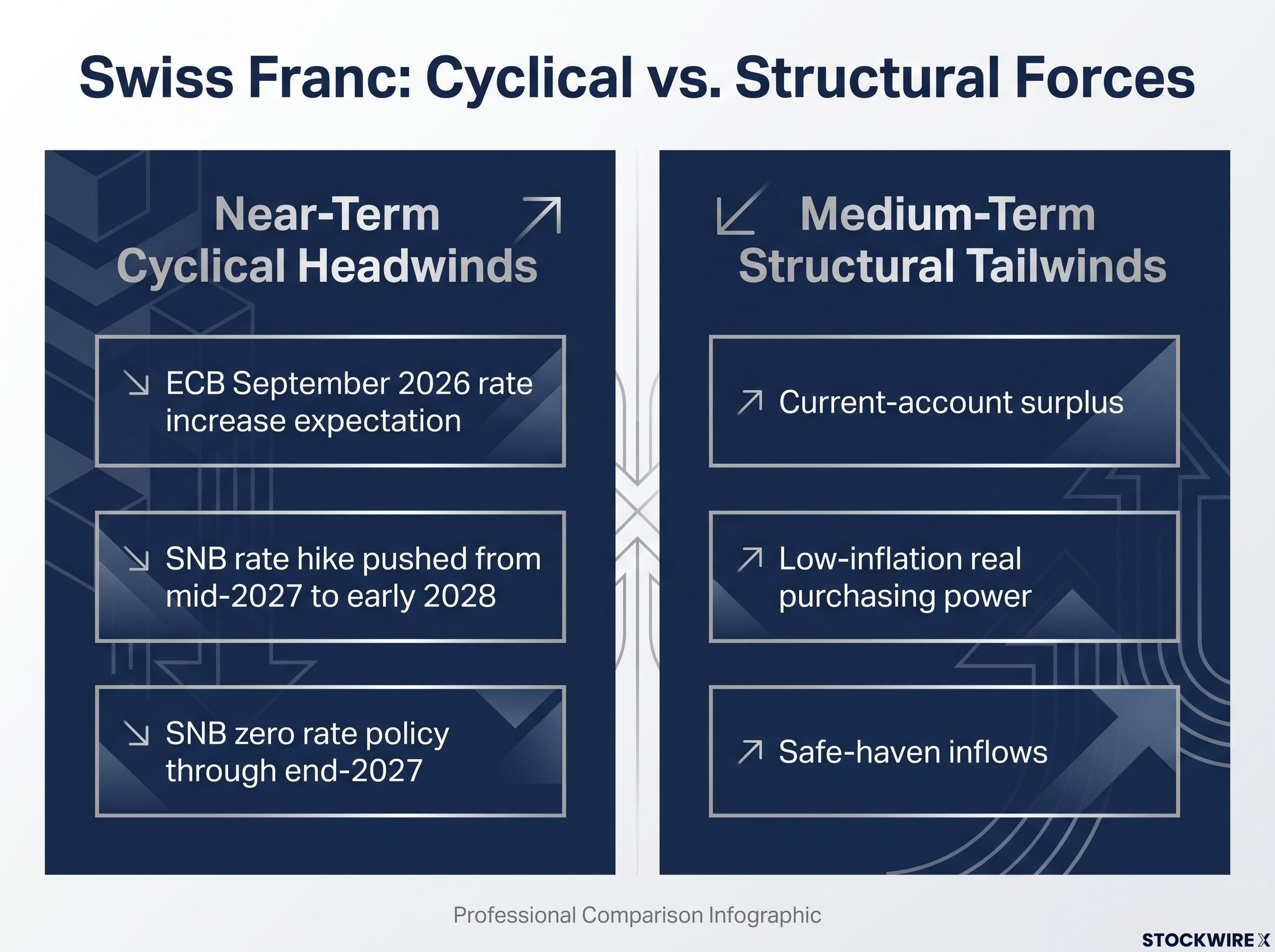
Those structural forces are well-documented and persistent:
- Current-account surplus: Switzerland consistently runs a surplus, creating ongoing demand for francs in the real economy
- Low-inflation real purchasing power: the muted inflation environment preserves the franc’s real value relative to higher-inflation currencies, a slow but compounding advantage
- Safe-haven inflows: in risk-off episodes, capital flows into CHF reliably, providing a floor that other currencies lack
Safe-haven inflow dynamics do not always behave as the textbook predicts: supply shocks force central banks to raise rather than cut rates, compressing bond prices and pushing capital toward energy-exporting currencies rather than traditional defensive assets, which can temporarily mute the CHF demand that would otherwise accelerate the medium-term recovery thesis.
UBS wealth-management research characterises the franc as subject to structural appreciation forces that are dominant over longer horizons, with cyclical fluctuations, including the current repricing phase, representing transitory dynamics within a longer-term appreciation trend.
USD/CHF forecasts reinforce the medium-term picture. The consensus clusters near 0.78 for late 2026, with projections moving toward the mid-0.70s further out, implying continued CHF strength against the dollar even as EUR/CHF softens modestly.
For an investor with a 12-24 month horizon, the near-term EUR/CHF softness within the 0.91-0.95 corridor is a timing question, not a thesis question. The structural case for CHF recovery does not require the ECB-SNB differential to narrow. It requires only that the differential’s directional pressure stops being the dominant force, and every month that passes brings the market closer to that inflection point.
Scenario map: what would break the two-speed thesis in either direction
The two-speed framework is not a prediction to accept passively. It is a thesis you can test against incoming data. Here are the conditions that would shift it in either direction.
| Scenario | Trigger Conditions | EUR/CHF Direction | Timeline |
|---|---|---|---|
| CHF weakness extends | ECB tightens beyond September; prolonged Swiss disinflation; sustained global risk-on | Toward 0.95 or modestly above | Q4 2026 – H1 2027 |
| Base case: two-speed plays out | ECB delivers September hike; SNB holds; EUR/CHF drifts to 0.93-0.94 | Range-bound 0.91-0.95 | Through 2027 |
| CHF strengthens early | Geopolitical risk spike; ECB policy reversal; safe-haven inflows surge | Toward 0.90 or below | Any time (event-driven) |
The consensus does not support EUR/CHF moving significantly above 0.95 under current baseline assumptions, which means the upside scenario is capped while the downside scenario (CHF strength) has no equivalent floor constraint.
The CHF weakness extension scenario, where EUR/CHF drifts toward 0.95 or modestly above, depends critically on ECB tightening beyond consensus projections; UBS has specifically flagged that markets may be underpricing the total hike count for 2026, which would widen the yield differential further and extend the cyclical headwind on the franc.
Four variables to monitor in order of analytical priority:
- Swiss CPI prints: the primary input for SNB rate expectations; continued muted readings confirm the repricing timeline
- SNB policy communications: any shift in language around rate normalisation accelerates or delays the framework
- ECB rate decisions: the September 2026 meeting is the nearest checkpoint; whether EUR/CHF responds as the rate-differential thesis predicts will validate or complicate the framework
- EUR/CHF technical behaviour within the 0.91-0.95 corridor: persistent trading near the upper bound supports the base case; a break below 0.91 signals the medium-term recovery is arriving ahead of schedule
The September 2026 ECB decision, now weeks away, is the first observable test. If EUR/CHF moves toward the upper end of the corridor following the rate decision, the two-speed framework is tracking. If it fails to respond or reverses, a scenario deviation is in play, and the monitoring variables above tell you which one.
Positioning for a franc cycle that is already in motion
The two-speed framework reduces to a clear decision architecture. Near-term EUR/CHF softness within the 0.91-0.95 corridor is a cyclical repricing dynamic with a defined expiry: the completion of SNB hike expectation removal, expected through 2027-2028. Medium-term CHF recovery is structurally grounded in Switzerland’s current-account surplus, low-inflation purchasing power, and safe-haven demand. It requires no new catalyst. It requires only the cessation of the current cyclical headwind.
The September 2026 ECB meeting is the first decision checkpoint. Its outcome either validates the baseline trajectory or signals that one of the alternative scenarios is in play.
The asymmetry of risk is where this becomes decision-relevant:
- The SNB’s constrained toolkit limits its ability to resist franc appreciation once structural forces reassert
- Switzerland’s current-account surplus provides persistent real-economy demand for CHF
- Safe-haven inflows create a floor that intensifies during precisely the conditions that would most concern investors
Institutional consensus and the SNB’s own policy constraints both point to downside EUR/CHF risk (CHF strength) being more probable than a sustained break above 0.95. The two-speed thesis is not a symmetric bet. It is a skewed setup where the timing varies but the directional destination is broadly agreed. Investors who understand that sequencing can use near-term EUR/CHF softness as a positioning window rather than reacting to it as a directional signal.
For investors wanting to translate the EUR/CHF positioning framework into equity portfolio decisions, our dedicated guide to Swiss equities and currency exposure examines how the franc’s two-speed cycle affects SMI-listed holdings, including the specific withholding-tax and concentration risks that global investors need to account for.
This article is for informational purposes only and should not be considered financial advice. Investors should conduct their own research and consult with financial professionals before making investment decisions. Past performance does not guarantee future results. Financial projections cited are subject to market conditions and various risk factors.