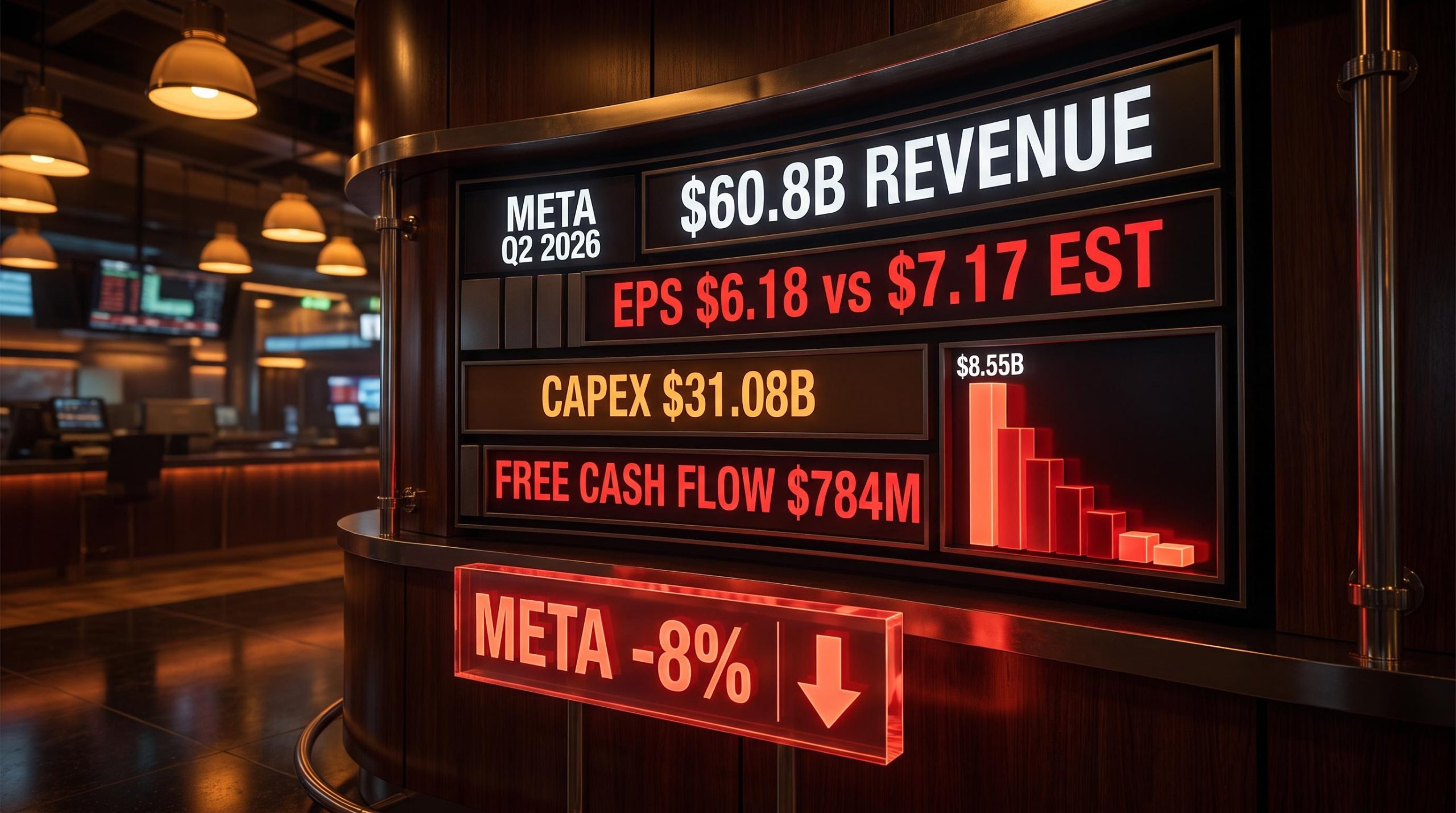
Meta Platforms just beat its own revenue target for Q2 2026 and then watched its shares fall roughly 8% in after-hours trading anyway, because investors focused almost entirely on what it cost to produce that revenue.
A $60.8 billion top line looks strong in isolation. Underneath it sits $42 billion in expenses, $31 billion in capital spending, $2.4 billion in legal charges, and free cash flow that shrank from $8.55 billion a year ago to $784 million. The divergence between Meta’s headline growth and its underlying financial condition is not a rounding error. It is the story of what AI infrastructure investment actually looks like on a financial statement, at hyperscaler scale, before the returns arrive.
Here is each layer of the quarter broken apart so you can separate the parts of the business that are genuinely healthy from the parts that explain why professional investors moved quickly to the exit after tonight’s 29 July earnings release, and evaluate META stock on the actual numbers rather than the headline.
Revenue held up. Everything below the top line did not.
Meta reported Q2 2026 revenue of $60.8 billion, representing 28% year-over-year growth. That figure came in above the Wall Street consensus forecast of $60.19 billion and near the top of the company’s own guidance range of $58-61 billion. This was a genuine top-line beat, driven by the core advertising engine performing exactly as the market had modelled.
The ad business delivered on both volume and pricing:
- Ad impressions grew 14% year-over-year
- Average price per ad climbed 12% year-over-year
- Family daily active people reached 3.60 billion, up 3% year-over-year
Then the earnings line arrived.
$6.18 reported earnings per share versus the $7.17 Wall Street had expected.
That miss, a 14% year-over-year EPS decline, tells you that Meta’s advertising machine is functioning exactly as expected. The cost structure surrounding it has grown at a pace that erodes the financial benefit of that growth for shareholders. The gap between top-line health and bottom-line pressure is the first thing any investor needs to understand before deciding whether tonight’s selloff is overreaction or rational repricing.
When big ASX news breaks, our subscribers know first
Three cost items that turned a revenue beat into an earnings miss
Q2 total costs and expenses reached $42.03 billion, a 55% increase year-over-year. Costs growing at roughly twice the rate of revenue made a substantial EPS decline mathematically unavoidable. Three distinct charges did the damage, and their character matters as much as their size.
Meta’s Q2 2026 earnings press release confirms total costs and expenses of $42.03 billion, capital expenditures of $31.08 billion, and the $2.4 billion legal charge that combined to drive the quarter’s EPS shortfall.
| Cost Item | Amount | Character |
|---|---|---|
| Legal charges | $2.4 billion | One-time (regulatory exposure made visible) |
| Severance costs | $1.18 billion | One-time (tied to May 2026 workforce reduction) |
| Capital expenditures | $31.08 billion | Recurring (AI infrastructure, growing) |
The legal charges reflect Meta’s ongoing exposure to privacy, content moderation, and antitrust actions. The severance costs are the upfront price of an efficiency reset that management framed as aligning the organisation with an AI-centric roadmap: costs hit immediately, savings materialise later. The capex line is the one that is not going away. Full-year 2026 guidance sits at $125-145 billion.
The concentration of three separate cost shocks inside a single quarter means the Q2 EPS figure understates normalised earnings power. But do not dismiss the miss as purely a timing quirk, because the largest cost driver is permanent and growing.
The Q1 2026 selloff followed the same template: a forward cash flow repricing triggered by the original $125-145 billion capex guidance raise produced a comparable 9% after-hours decline on what was then described as one of the strongest quarters in the company’s history.
What $31 billion in capex does to free cash flow
Q2 2026 free cash flow dropped sharply to $784 million, compared with $8.55 billion in the same quarter a year prior. A free cash flow margin of approximately 1-2% on more than $60 billion of revenue is structurally inconsistent with how mega-cap technology companies are typically valued. Free cash flow is the cash a company generates after covering its capital spending, and it is the metric that underpins buyback programmes, dividends, and valuation models.
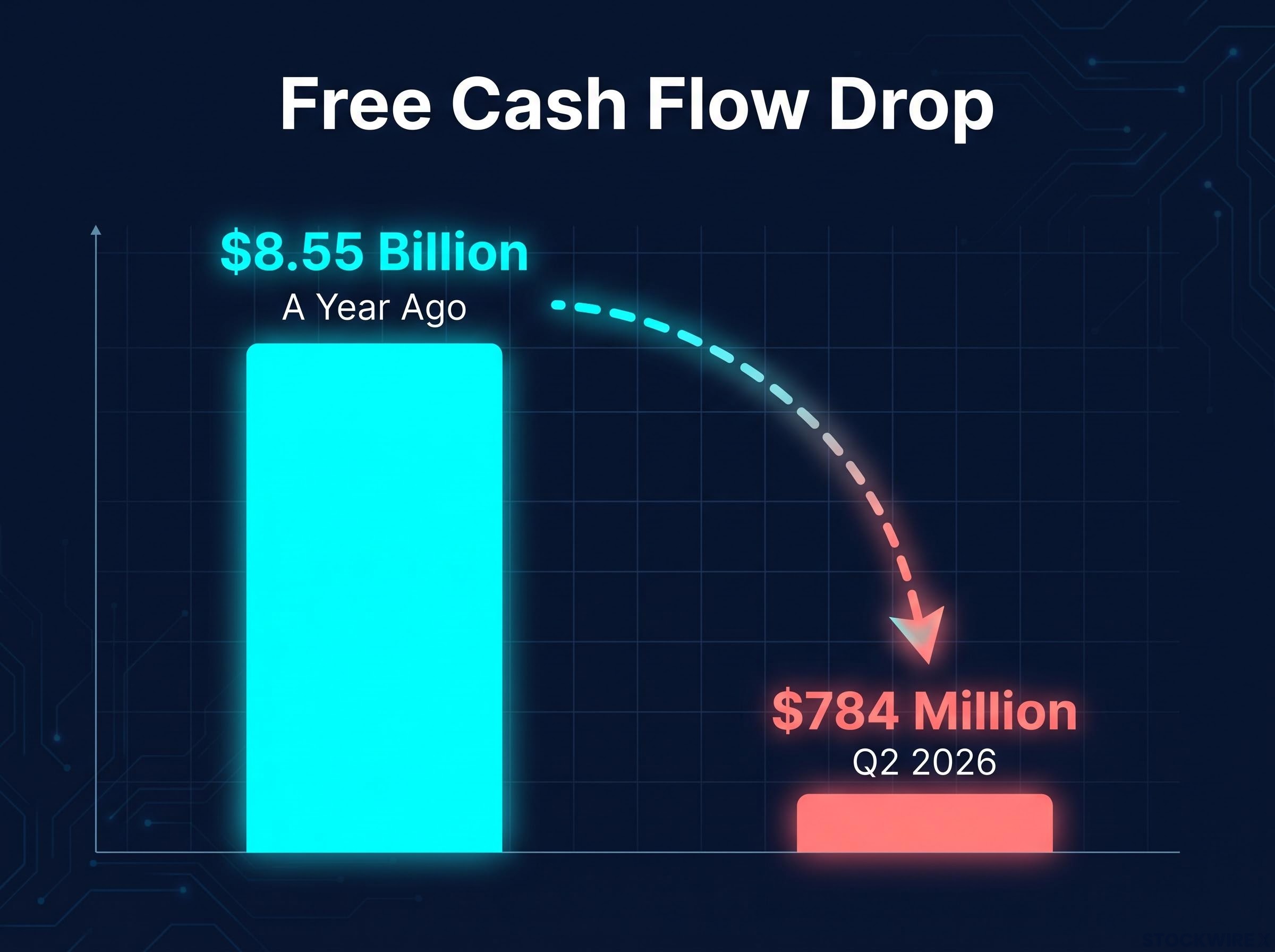
The timing mismatch explains the gap: capex hits the cash flow statement immediately, while the AI infrastructure it funds is expected to generate returns over multiple years.
Why Meta is spending $125 billion on AI infrastructure this year
The $125-145 billion full-year capex envelope is not general corporate expansion. It is explicitly tied to three categories of AI infrastructure:
- Data centres to house the compute capacity
- AI chips to power training and inference workloads
- Compute infrastructure to connect and scale both
CEO Mark Zuckerberg framed the investment as foundational rather than speculative during tonight’s earnings call.
Zuckerberg noted that AI is driving improvements across the company’s core advertising operations and opening up new opportunities in the enterprise space, with those gains already becoming tangible.
Q2 capex of $31.08 billion actually came in slightly below the pre-earnings estimate of approximately $33 billion, but the scale is still extraordinary. Meta is committing to near-hyperscaler scale AI infrastructure at the same time its platform advertising business is still growing at 28% year-over-year, creating a simultaneous growth-and-investment dynamic that is unusual even among mega-cap peers.
A July 2026 internal memo revealed AI infrastructure cost efficiency gains that cut the per-gigawatt build cost from approximately $45 billion to $22 billion, meaning the $125-145 billion capex envelope may be purchasing more than twice the compute capacity Wall Street had been modelling.
The strategic case for this spending is coherent. But coherent strategy and near-term shareholder value are not the same thing. The payoff timeline for this infrastructure is measured in years, not quarters.
Guidance that came in just below where analysts needed it to land
Meta guided Q3 2026 revenue to $61-64 billion, putting the midpoint at $62.5 billion.
$62.5 billion midpoint versus the $63.24 billion consensus Wall Street had modelled.
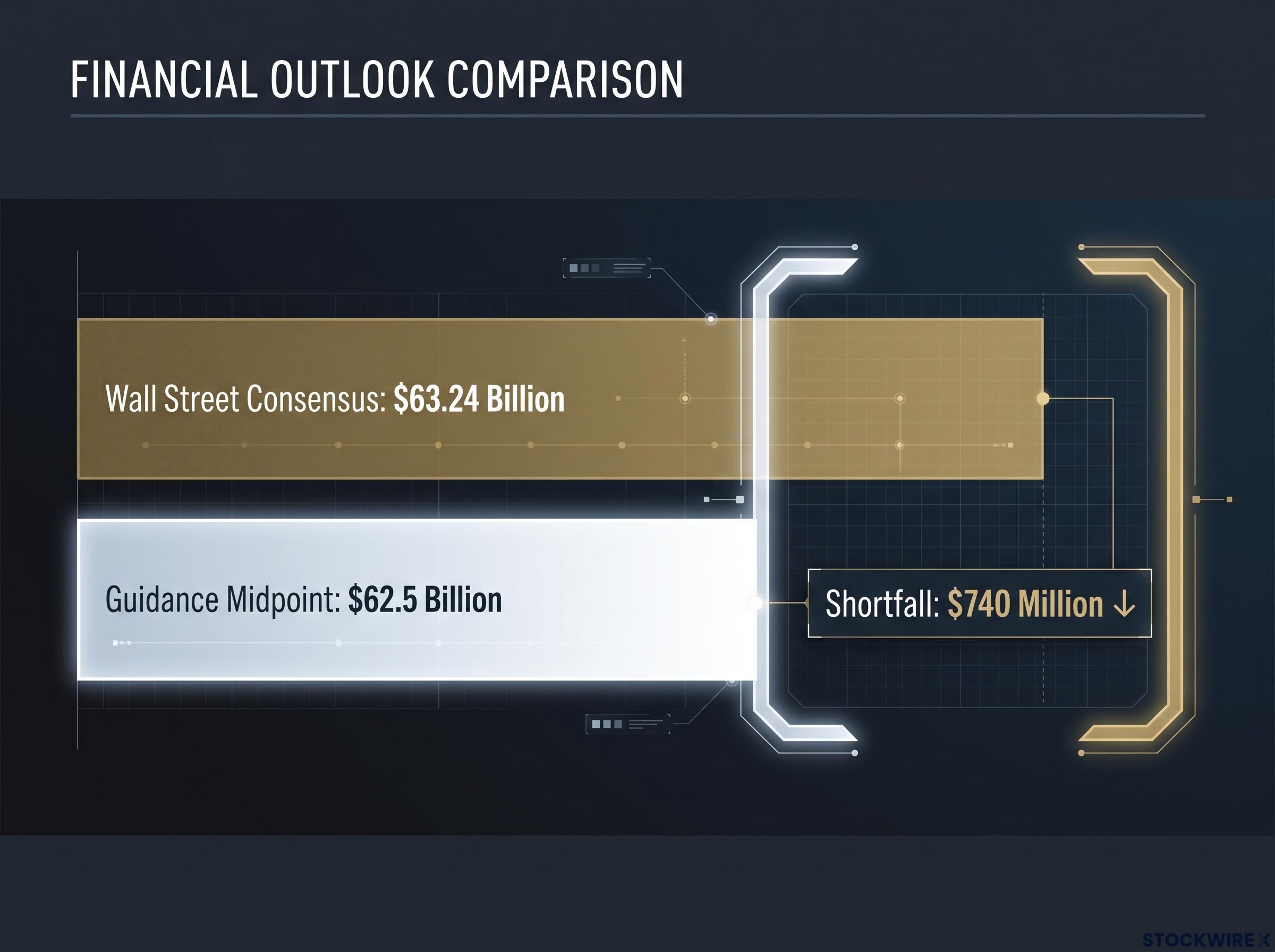
A $740 million shortfall at the midpoint does not look large in isolation. For a company that had been trading at a premium multiple supported by a consistent pattern of beats and raises, it lands differently. Consider the contrast between what the market expected and what it received:
- Expected: Another quarter of beats and raised guidance
- Delivered: A substantial EPS miss, a below-consensus guidance midpoint, and a lift to the floor of the full-year expense range to account for Q2 legal charges
The expense revision signals that cost pressure does not dissipate in the second half. For an investor holding META at a premium valuation, this is not a technical miss. It is a signal that the positive surprise cycle supporting that premium may be pausing, and that demands a valuation rethink. The approximately 8% after-hours decline reflects exactly that recalibration.
How the bull and bear cases diverge from here
The Q2 print brought into sharp relief the central tension that analysts had flagged heading into the quarter: whether AI-driven revenue improvements could offset the drag from AI investment on margins and cash flow. The answer, for now, is that they cannot. What happens next depends on the time horizon you are evaluating.
The bear case in the near term
- Expenses growing at roughly 55% year-over-year versus revenue growth of 28% implies margin pressure across multiple quarters, not just Q2.
- Free cash flow near zero ($784 million versus $8.55 billion a year prior) limits buyback capacity and reduces appeal to cash-flow-focused institutional investors.
- If AI infrastructure does not produce visible monetisation evidence on a reasonable timeline, the current capex pace risks appearing excessive relative to returns.
The bull case over the long term
- Meta’s advertising engine is large, growing, and globally dominant. The platform family’s 3.6 billion daily active people is a reach asset that no competitor can replicate at similar scale.
- If AI infrastructure delivers superior ad targeting, measurement, and enterprise AI revenue, the current compression period may prove to be the price of a decade of compounding.
- Legal and severance charges are real but non-recurring. Their removal from future quarters improves the underlying earnings baseline.
The 8% after-hours decline reflects the market’s near-term verdict, not a permanent reappraisal of Meta’s business model. Which frame applies to you depends almost entirely on your time horizon: if free cash flow recovery matters in the next 12 months, the bear case deserves serious weight; if you are comfortable with a 3-5 year infrastructure payoff window, the bull case is defensible.
What investors should watch in the quarters ahead
The tension between top-line health and infrastructure-driven cost pressure is unlikely to resolve in a single quarter. The next two to three earnings releases will be decisive for sentiment. Three specific variables will determine whether the current compression is a temporary investment phase or a structural problem:
- Capex trajectory: Whether the $125-145 billion full-year guidance is revised upward or begins to plateau signals management’s own read on whether spending is approaching peak intensity.
- AI monetisation visibility: Concrete, quantifiable evidence that AI infrastructure is improving ad targeting, generating enterprise revenue, or creating new product categories. Narrative alone will not be sufficient to sustain the current spend rate.
- Legal charge environment: Whether the $2.4 billion Q2 charge was an isolated event or the beginning of a pattern that continues to compress GAAP earnings in future quarters.
Meta Compute, the cloud division Bloomberg reported in July 2026, represents one proposed answer to that monetisation question: selling spare AI capacity to external buyers would generate direct infrastructure revenue that does not depend on advertising yield improvements.
The $2.4 billion Q2 legal charge does not represent the ceiling of Meta’s legal exposure: four state attorneys general are seeking up to $1.4 trillion in a youth safety case scheduled for trial on 18 August 2026, a figure nearly equal to the company’s entire market capitalisation.
The next observable data point is Q3 revenue against the $62.5 billion guidance midpoint. Free cash flow recovery from its current $784 million level is the metric that will signal whether the investment phase is beginning to produce returns or continuing to consume them.
Whether the AI infrastructure investment produces returns that justify the current compression is the question this story ultimately resolves around, and it will take 12-24 months of evidence, not a single quarter, to answer.
The reader does not need a verdict tonight. Track these three variables as the evidence accumulates, and let the fundamentals, not a single evening’s price move, shape the conclusion.
This article is for informational purposes only and should not be considered financial advice. Investors should conduct their own research and consult with financial professionals before making investment decisions. Past performance does not guarantee future results. Financial projections are subject to market conditions and various risk factors.