Nvidia reports fiscal second-quarter results after the closing bell today, with analysts projecting total revenue of around $92.18 billion for the period. That figure would mark roughly a doubling of sales compared with the same quarter last year, and would represent the strongest growth pace the company has delivered in seven quarters.
The stakes extend well beyond Nvidia itself. For months, this single company’s quarterly prints have functioned as the most closely watched signal for the health of the entire AI infrastructure cycle. A strong beat paired with confident forward guidance reinforces the case that hyperscaler spending on AI compute remains in a land-grab phase. A miss, or a beat shadowed by cautious commentary, resets expectations across semiconductors, cloud infrastructure, and AI-adjacent equities simultaneously.
Here is what the numbers, the product roadmap, and the guidance commentary will tell you about where the AI trade stands heading into the second half of 2026. The data points that matter most tonight are not the headline revenue figure but the three variables buried in the guidance strip and management’s earnings call language.
What the $92 billion consensus actually requires
Start with what Nvidia actually reported a year ago. In the fiscal second quarter of FY26, the company generated approximately $46.7 billion in total revenue, up 56% year over year. Data centre revenue in that quarter came in at roughly $41.1 billion, also up 56%. Those were already enormous numbers.
Figures compiled by LSEG and cited by Reuters put the street’s FY27 Q2 revenue estimate at approximately $92.18 billion in total, implying year-over-year growth of roughly 100% on a base that was itself the product of several consecutive quarters of extraordinary expansion.
Nvidia’s Q1 FY2027 earnings delivered $81.62 billion in revenue, beating consensus by more than $2.4 billion and producing a Q2 guidance figure of $91 billion that effectively set the bar the company now faces tonight.
The consensus bar: LSEG data places the FY27 Q2 revenue estimate at approximately $92.18 billion, which would be close to twice the $46.7 billion Nvidia recorded in the equivalent quarter one year prior.
What makes this expectation unusual is how closely it aligns with management’s own forecast. Nvidia guided for $91 billion, plus or minus 2%, with non-GAAP gross margins of approximately 75%, up from the low-70% range in FY26 Q2. The company has, in effect, pre-endorsed the target. That narrows the margin for surprise in both directions: any shortfall will be judged not as a miss against external estimates but against management’s own commitment.
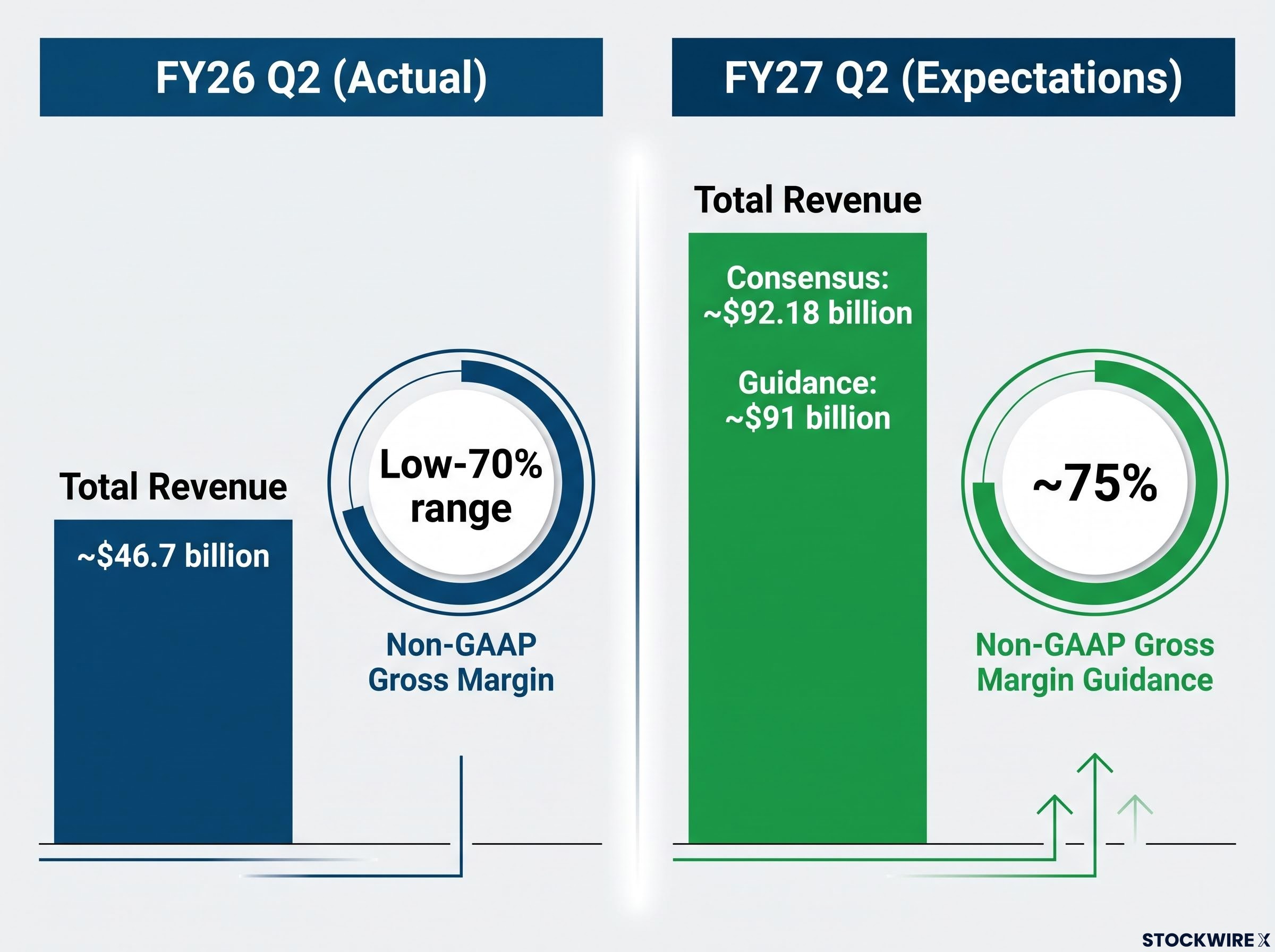
| Metric | FY26 Q2 (Actual) | FY27 Q2 (Consensus / Guidance) |
|---|---|---|
| Total Revenue | ~$46.7B (+56% YoY) | ~$92B (~100% YoY) |
| Data Centre Revenue | ~$41.1B (+56% YoY) | Not separately guided |
| Non-GAAP Gross Margin | Low-70% range | ~75% (company guidance) |
| Adjusted EPS | — | ~$2.09 (consensus) |
The gap between what the consensus implies and the year-ago reality matters for calibrating your reaction to any given outcome tonight. A 100% growth rate on a $46 billion base is a different problem from sustaining that pace on a $92 billion base next year. That asymmetry is already priced into the expectation, which is exactly why the guidance strip matters more than the headline.
When big ASX news breaks, our subscribers know first
The Blackwell-to-Vera Rubin handoff: smooth transition or demand air pocket?
The quarterly revenue number tonight will tell you what already happened. The product transition commentary will tell you what happens next.
Nvidia’s Vera Rubin platform, the successor to its Blackwell architecture, is in production and on track for deliveries in the second half of 2026. That makes it an imminent commercial reality rather than a distant roadmap item. For this specific Q2 report, Vera Rubin’s impact lands primarily in forward guidance and order visibility rather than in the reported revenue figure itself.
Three signals in management’s commentary tonight will separate the product cycle story from the headline number:
- Blackwell order run-rate and backlog language: Is management describing sustained demand or a natural wind-down?
- Vera Rubin customer commitment disclosures: Are hyperscalers pre-ordering, or waiting?
- Inventory and lead-time commentary: Any language suggesting customers are pacing orders differently than in prior quarters.
The prior session offered a taste of how the sector is positioned heading into the print. AMD gained 4.9% on Tuesday 25 August 2026, a move that reflected broad optimism across chip stocks rather than any AMD-specific catalyst.
What a smooth transition looks like versus a choppy one
In the positive scenario, customers overlap their Blackwell deployments with Vera Rubin pre-orders, maintaining consistent demand across both architectures. Management language in this case would emphasise strong backlogs, stable lead times, and a next-quarter guidance range that holds or expands.
The negative scenario looks different even if the headline number beats. Customers stretch procurement timelines while awaiting Vera Rubin, which shows up as softer forward orders, a wider guidance range, or rising finished-goods inventory. The observable difference sits in management’s language around backlog, lead times, and the width of the revenue guidance band for next quarter. Product cycle transitions are where even dominant chip companies have historically created demand gaps. What management says tonight about order visibility tells you more about Nvidia’s revenue durability into 2027 than the Q2 revenue figure itself.
Can the AI spending cycle actually sustain this pace?
Step back from tonight’s specific numbers and the question underneath them comes into focus. A $92 billion quarter effectively validates that hyperscalers remain in aggressive build-out mode. But the higher the revenue base climbs, the harder it becomes to sustain equivalent growth rates in subsequent quarters. The implied year-over-year growth rate for FY27 Q2 sits at approximately 95-100%. Even a modest deceleration in AI capital expenditure could translate into visibly slower top-line growth and a lower implied long-term trajectory.
The compounding scale challenge: Nvidia’s data centre revenue grew from a smaller base to approximately $41.1 billion in a single year-ago quarter. Near-doubling from that level requires hyperscaler spending to remain at or above current intensity, a condition that several of Nvidia’s largest customers have begun to question publicly.
In their most recent earnings reports, a number of Nvidia’s biggest technology customers disclosed pressure on free cash flows, prompting broader scrutiny of how long the current wave of AI capital expenditure can continue at its present intensity. The distinction that matters here is between capacity expansion (buying more GPUs to build out new data centre clusters) and optimisation (extracting more efficiency from existing infrastructure). A shift toward the latter would slow unit demand even if AI workloads continue to grow.
AI revenue diversification across sovereign programmes, enterprise on-premise deployments, and AI labs has become a structural feature of Nvidia’s demand base, meaning the hyperscaler free cash flow constraints cited in recent earnings calls do not capture the full picture of who is placing orders.
Two demand scenarios frame what to listen for tonight:
- Land-grab phase continues: Beat plus raised guidance, with management describing sustained or increasing order intensity from hyperscalers. This extends the AI infrastructure runway narrative.
- Early normalisation signals emerge: Beat but conservative guidance, or management commentary referencing customers optimising existing deployments rather than expanding. This would be the first credible signal of cycle maturity.
The Vera Rubin ramp in the second half of 2026 is expected to contribute meaningfully to sustaining elevated revenue levels. But if guidance tonight signals any shift from capacity expansion toward efficiency optimisation among Nvidia’s largest customers, that is a leading indicator for the entire semiconductor and cloud infrastructure complex, not just a single-company datapoint.
Why tonight’s report sets the price for the entire AI trade
Nvidia’s quarterly prints have functioned as a de facto barometer for semiconductor, cloud infrastructure, and AI-adjacent valuations. The sector reprices broadly around both the results and management commentary, regardless of individual company fundamentals.
Semiconductor sector divergence has become pronounced in 2026, with Nvidia posting 85% year-over-year growth while Qualcomm contracted 3.5% in the same period, a split that illustrates why a single Nvidia print reprices the entire sector even when company-level fundamentals vary sharply.
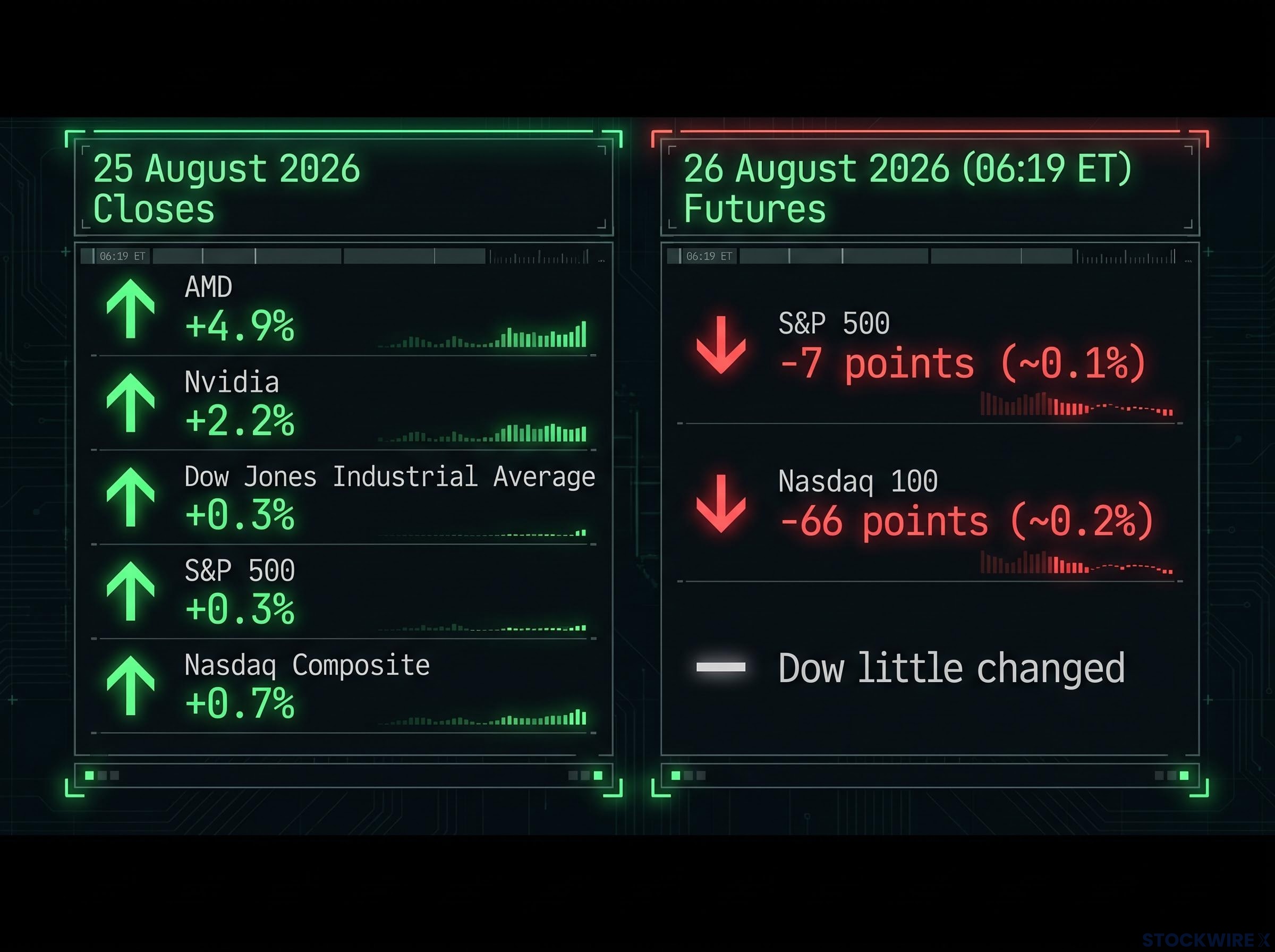
The pre-earnings market positioning heading into today reflects that dynamic. In the prior session on Tuesday 25 August 2026:
- The Dow Jones Industrial Average added 0.3%, matching a 0.3% advance in the S&P 500
- The Nasdaq Composite rose 0.7%, with AI-linked chip names among the primary drivers
- Nvidia shares closed up 2.2% while AMD surged 4.9%
By contrast, futures on the morning of 26 August 2026 were cautious. At 06:19 ET, S&P 500 futures were lower by around 7 points (roughly 0.1%), Nasdaq 100 futures had shed approximately 66 points (around 0.2%), and Dow futures were little changed.
The asymmetry between Tuesday’s sector rally and Wednesday morning’s cautious futures positioning tells you the market has already partially priced a strong result. That raises the bar for what constitutes a positive surprise tonight.
The two post-report scenarios and what each means for sector positioning
If Nvidia beats and raises guidance, the AI infrastructure runway narrative is confirmed for another quarter. Sector multiples hold or expand, and the forward visibility window extends into calendar year 2027 and beyond. This is the outcome the prior session’s gains were pricing.
If Nvidia beats but guides cautiously, or if management commentary references hyperscaler spending moderation, the cycle maturity narrative gains traction. That creates sector-wide multiple compression risk across semiconductors, cloud infrastructure, and AI-adjacent names. For investors holding positions in any of these categories, the guidance commentary tonight is as actionable as any individual stock’s earnings report, because it sets the ceiling and floor for the entire sector’s near-term repricing.
What changes after tonight, and what the numbers cannot tell you
Three variables will determine the market’s verdict beyond the headline revenue figure: the Q3 guidance range relative to consensus, management’s language on Vera Rubin customer commitments, and any commentary on hyperscaler free cash flow constraints. Together, these shape the forward view more than the backward-looking $92 billion target.
A $92 billion result, if achieved, confirms the AI infrastructure cycle’s scale but does not resolve the sustainability question. That will play out across the next two to three quarters as the Vera Rubin ramp tests whether hyperscaler capital budgets absorb successive chip generations smoothly or whether customers pause between architectures. If the transition is seamless, the bull case extends. If customers stretch procurement timelines, the cycle shows its first signs of maturation.
The report tonight sets the baseline. The more consequential datapoints arrive in the guidance strip and the earnings call commentary, not the headline revenue line.
For investors wanting to map the full structural picture behind tonight’s result, our deep-dive into AI capex versus monetisation examines which parts of the supply chain capture the value as hyperscalers absorb 93-94% of operating cash flow in AI infrastructure commitments.
This article is for informational purposes only and should not be considered financial advice. Investors should conduct their own research and consult with financial professionals before making investment decisions. Forward-looking statements regarding Nvidia’s guidance, product roadmap, and revenue trajectory are subject to change based on market developments and company performance.