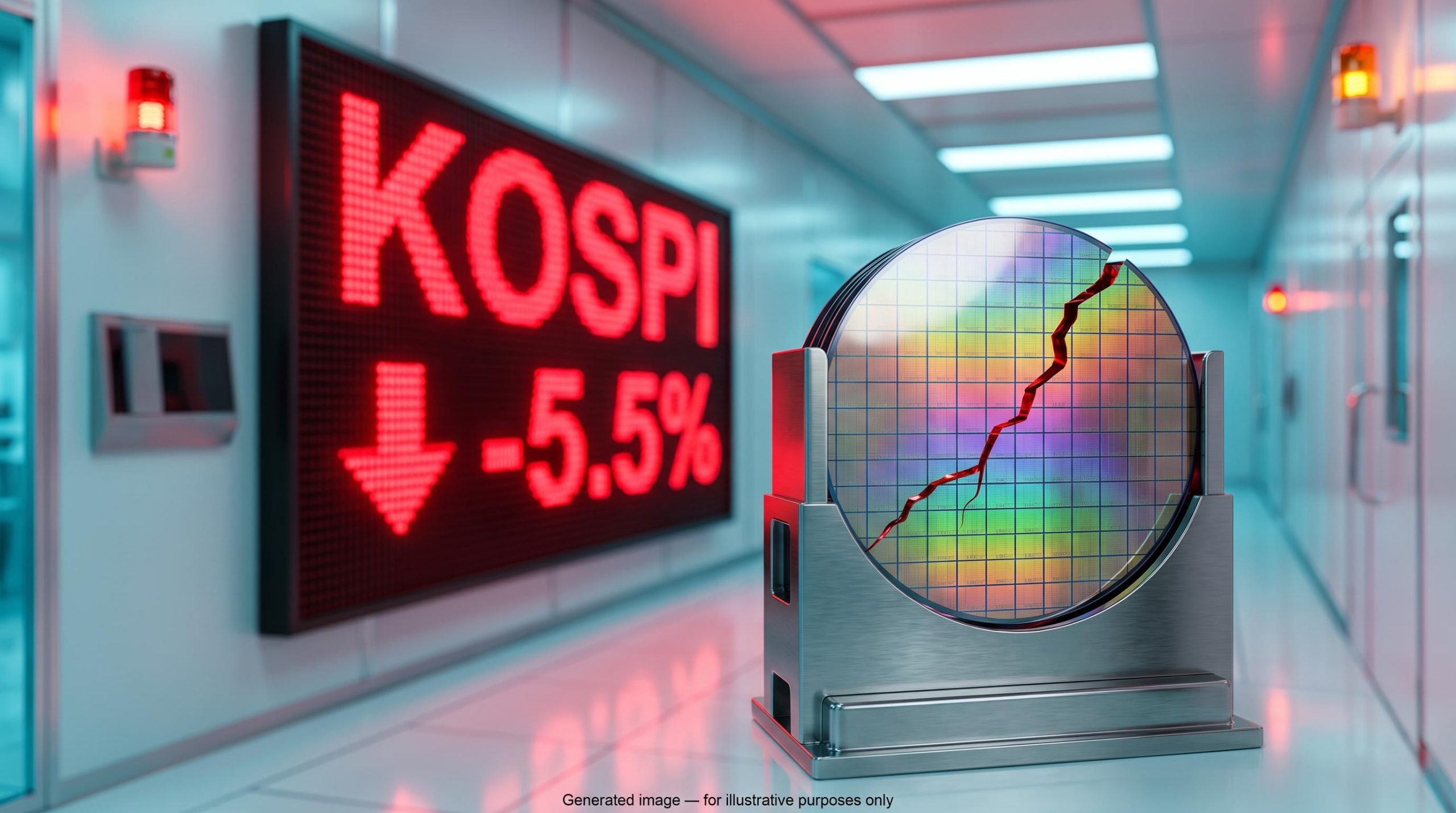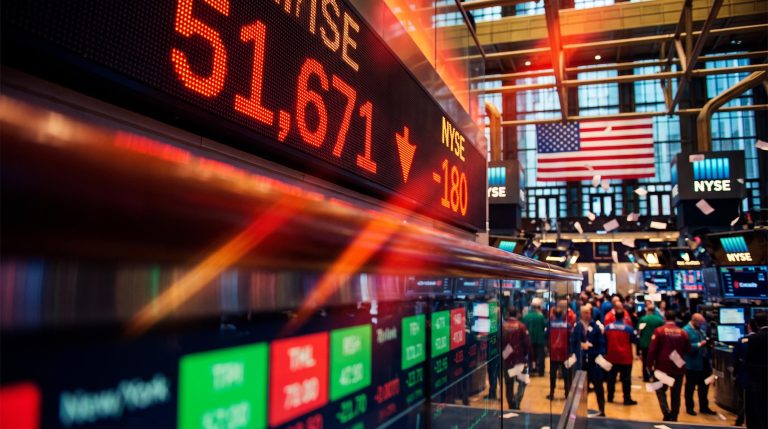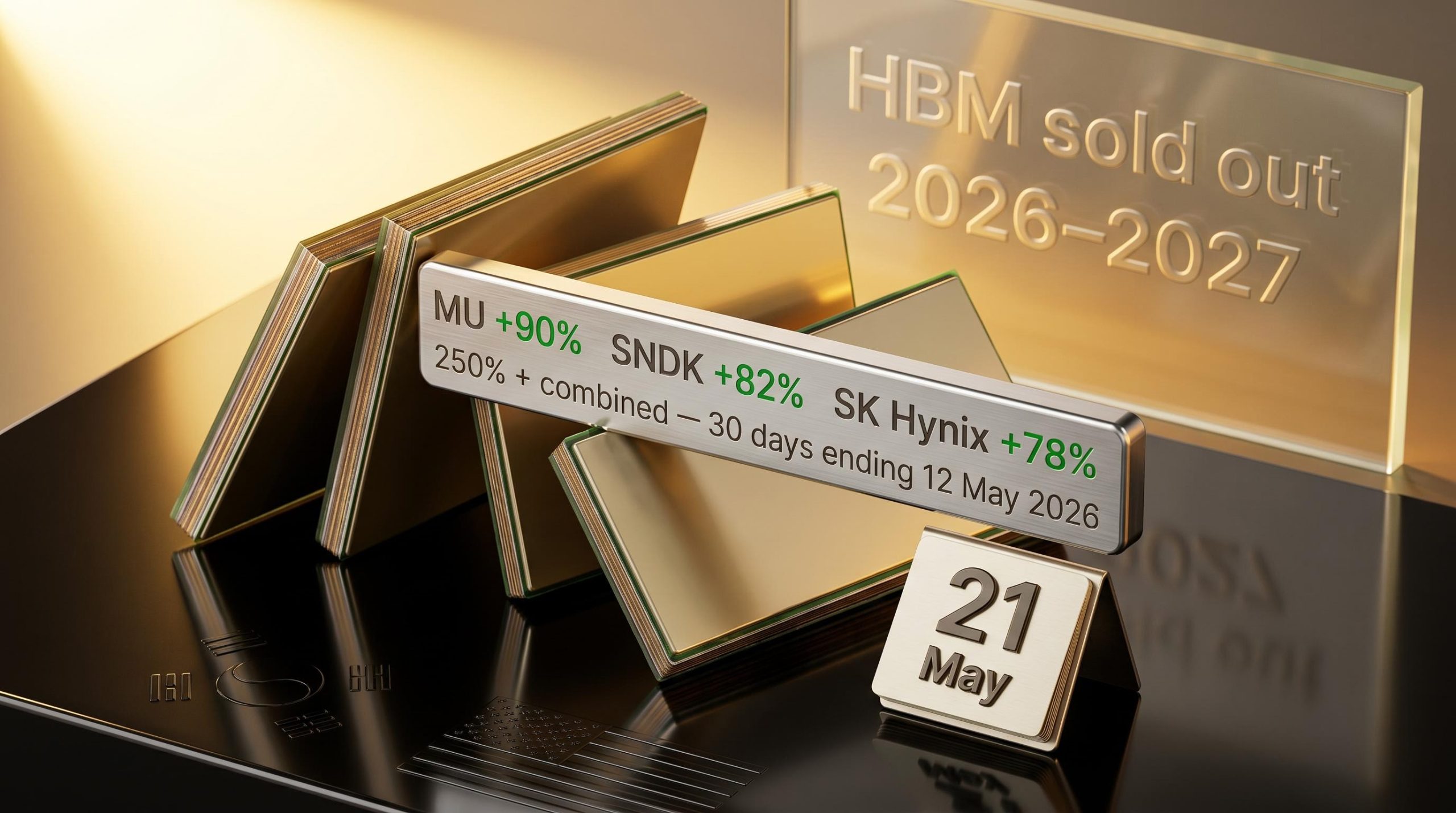
Three memory chip stocks, Micron (MU), Sandisk (SNDK), and SK Hynix, combined for gains exceeding 250% over the trailing 30 days ending 12 May 2026. That compression of returns would normally take years to accumulate in a sector known for cyclical volatility. The move was not confined to a single ticker or a single catalyst. It arrived at the intersection of sold-out high-bandwidth memory (HBM) capacity, a threatened Samsung strike scheduled for 21 May, and a US-China trade delegation that reshuffled competitive dynamics faster than most investors anticipated. What follows breaks down the five forces behind the rally, explains how HBM supply constraints work for readers new to memory market cycles, and identifies the risks that could unwind recent gains if conditions shift.
How far memory chip stocks have run, and why the breadth matters
The scale of the 30-day move is difficult to overstate. Micron gained approximately 90%. Sandisk rose roughly 82%, including a single-week surge of about 28%. SK Hynix climbed approximately 78% over the same window.
When three memory names with different product mixes, different geographic exposures, and different customer concentrations all move in the same direction at the same magnitude, the signal is structural. Investors are repricing the entire sector’s supply-demand outlook, not reacting to one company’s earnings beat or one product cycle. The broader semiconductor indices confirm the breadth: SOXX is up approximately 45% year-to-date in 2026, while SMH has surged more than 60%.
| Stock | 30-day return (approx.) | MU two-day surge |
|---|---|---|
| Micron (MU) | ~90% | ~20%+ |
| Sandisk (SNDK) | ~82% | N/A |
| SK Hynix | ~78% | N/A |
Inside the two-day spike: what changed on Monday morning
Within the broader 30-day trend, Micron recorded a standalone two-day surge of more than 20% during the week of 12 May. Intel gained approximately 18%, AMD roughly 12%, and the SOX index rose about 8% across those same two sessions. The catalyst was specific: the roster of the Trump administration’s China trade delegation became publicly known on Monday, with reports suggesting details circulated among market participants late the prior week. The two-day move was concentrated in memory and adjacent semiconductor names, not a broad market event.
When big ASX news breaks, our subscribers know first
Why HBM is the structural engine behind the whole rally
High-bandwidth memory, or HBM, is the product category underpinning the entire sector repricing. For readers less familiar with memory market structure, HBM is not standard DRAM. It is a specialised, premium-priced memory product designed to sit directly alongside AI accelerator chips, most notably Nvidia’s GPU lineup, inside datacentre servers. Three characteristics separate it from commodity DRAM:
- Stacked die architecture: HBM chips are built by vertically stacking multiple layers of DRAM dies, a manufacturing process that is significantly more complex and yield-constrained than standard single-layer DRAM production.
- Custom per-customer qualification cycles: Each HBM product must be validated and qualified for specific customer platforms, creating long lead times that prevent rapid supplier switching.
- Yield constraints: The stacking process limits how quickly manufacturers can add capacity, even when demand signals are strong and capital is available.
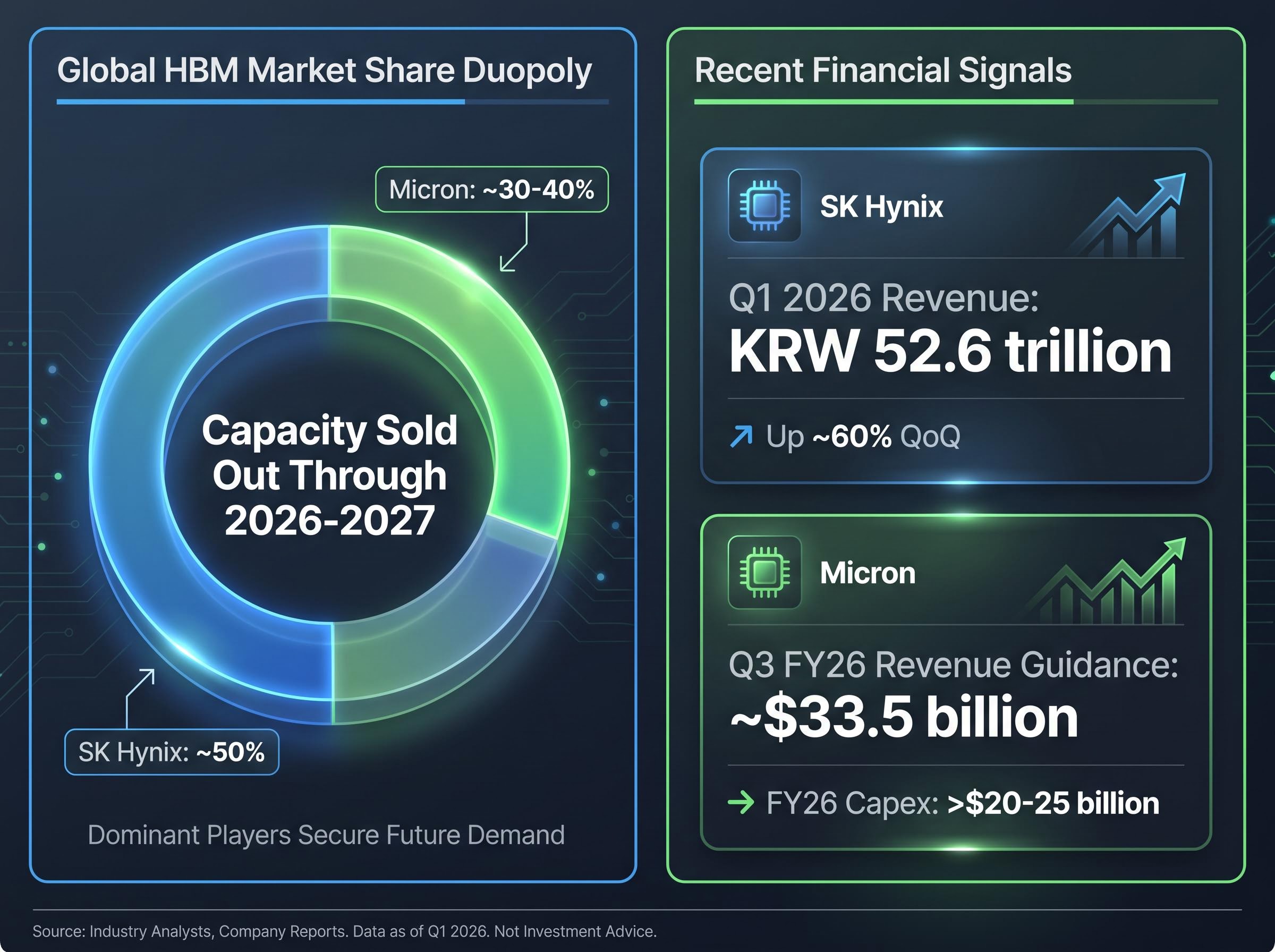
These constraints explain why two companies control the effective global supply. SK Hynix holds approximately 50% HBM market share and is Nvidia’s primary supplier. Micron holds roughly 30-40%. Together, their HBM capacity is sold out through 2026-2027.
AI-driven storage supply exhaustion is not isolated to HBM; enterprise hardware prices for high-capacity models surged up to 60% across the broader storage stack in early 2026, with major suppliers confirming sold-out production capacity through year-end and projecting further 10-20% price increases in H2.
HBM demand forecasts for 2025-2026 project year-on-year growth of approximately 130% in 2025 followed by 70% in 2026, a pace that outstrips the manufacturing capacity additions even the most aggressive capex programs can deliver in the same timeframe.
HBM capacity across SK Hynix and Micron is sold out through 2026-2027, a supply condition that persists not because producers are withholding investment, but because manufacturing complexity limits how quickly capacity can respond to demand.
The earnings confirm the demand pull. SK Hynix reported Q1 2026 revenue of KRW 52.6 trillion, up approximately 60% quarter-over-quarter. Micron guided Q3 FY26 revenue to approximately $33.5 billion, with full-year FY26 capital expenditure expected above $20-25 billion. SK Hynix has confirmed a US fab expansion in Indiana oriented toward HBM production. The capital is flowing, but the capacity is years away from relieving current tightness.
What the Trump-China delegation actually meant for competitive dynamics
The delegation story was widely reported as a diplomatic headline. The more consequential signal was competitive.
Micron CEO Sanjay Mehrotra joined the Trump administration’s China trade delegation. Nvidia CEO Jensen Huang was absent. Semiconductor capital equipment CEOs were also excluded. KC Rajkumar of Lynx Equity Strategies identified the analytical implication: Micron may have derived greater benefit from who was excluded than from its own CEO’s inclusion.
Rajkumar’s core observation was that the absence of equipment CEOs signals reduced likelihood of waivers for Chinese memory producers YMTC and CXMT, because those companies need access to advanced manufacturing tools to ramp competitive HBM capacity.
The chain of logic runs as follows:
- Equipment CEO exclusion from the delegation signals the administration is not prioritising tool-access concessions for Chinese fabs.
- Without tool-access waivers, YMTC and CXMT cannot meaningfully expand advanced memory production capacity.
- Constrained Chinese capacity means the competitive threat to US and Korean producers remains limited in the near term.
- Micron and SK Hynix retain pricing power in a market where their HBM supply is already sold out.
A complicating fact: in February 2026, Reuters reported that YMTC and CXMT were removed from the Entity List, reversing 2022 additions. No confirmed waivers for advanced semiconductor manufacturing tools have followed as of 12 May 2026, but the Entity List removal introduces genuine ambiguity about the long-term trajectory of US-China memory chip policy. Micron’s own Chinese market access remains unresolved.
The Samsung labour risk: supply anxiety is real even before a strike begins
No production has been disrupted. No DRAM output has declined. The Samsung strike has not started. Markets moved anyway, and the reason illustrates how supply-side pricing works in concentrated commodity markets.
The timeline is precise. In April 2026, the National Samsung Electronics Union (NSEU), representing approximately 36,000-40,000 unionised employees, rejected Samsung’s wage offer and voted overwhelmingly to authorise a strike. As of 11-12 May, unions and Samsung management remain engaged in active mediation talks. A 17-18 day work stoppage is scheduled to begin 21 May if mediation fails.
| Date | Event | Market implication |
|---|---|---|
| April 2026 | NSEU rejects wage offer, votes to authorise strike | Supply-risk premium begins building into memory pricing |
| 11-12 May 2026 | Active mediation talks ongoing | Uncertainty sustains elevated risk premium |
| 21 May 2026 | Planned 17-18 day strike if talks fail | Estimated 3-4% DRAM supply decline if strike proceeds |
Analysts estimate a potential DRAM supply decline of 3-4% if the strike proceeds as planned. In a market where HBM capacity is already sold out, even a modest reduction in Samsung’s output disproportionately tightens conditions for the one product where supply has no slack. Samsung reported Q1 2026 revenue of KRW 134 trillion, up approximately 43% quarter-over-quarter, confirming the demand environment is strong regardless of the labour dispute’s resolution.
Samsung’s HBM yield challenges remain the most consequential competitive variable in the memory sector; the company holds below 30% of the HBM market compared to SK Hynix’s approximately 62% share, and a successful HBM4 qualification with Nvidia would represent a material shift in the supply concentration that currently benefits SK Hynix and Micron.
Rajkumar has noted that even a successful negotiation resolution would likely be insufficient to reverse gains already realised in memory chip pricing. Markets price in the probability of supply events before they materialise; the stock response can precede and sometimes exceed the actual operational impact.
Where analysts are divided: the sustainability debate
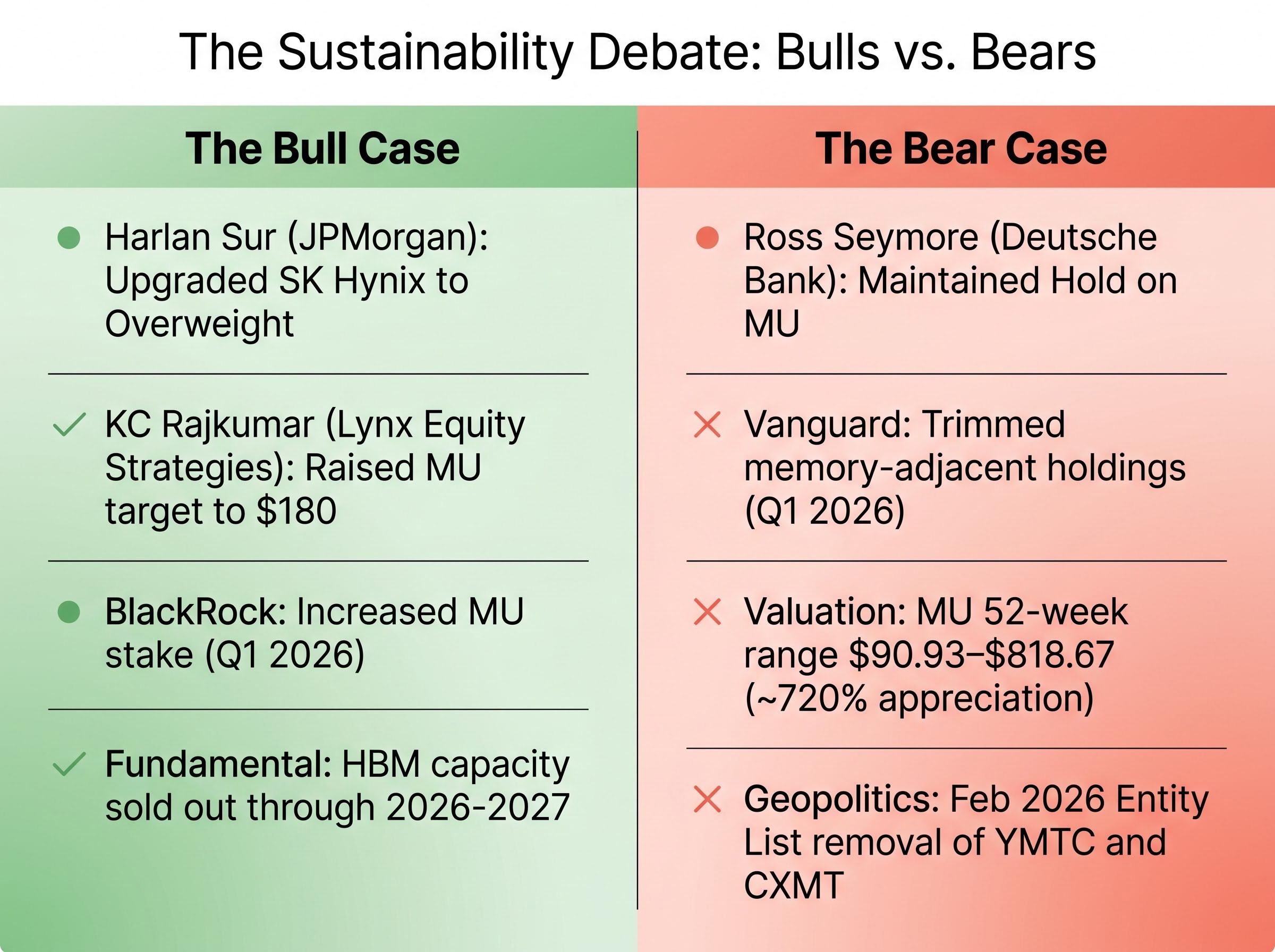
The bull and bear cases for memory stocks are unusually far apart. That gap itself is informative.
The bull case in brief
- HBM capacity sold out through 2026-2027, with no near-term mechanism for rapid supply additions
- SK Hynix Q1 revenue of KRW 52.6 trillion (up ~60% QoQ) and Micron Q3 FY26 guidance of ~$33.5 billion represent strong earnings beats
- BlackRock increased its MU stake in Q1 2026 filings, signalling institutional accumulation
- Harlan Sur at JPMorgan upgraded SK Hynix to Overweight, citing DRAM supply tightness
- KC Rajkumar at Lynx Equity Strategies raised his MU price target to $180
The bear case in brief
- Ross Seymore at Deutsche Bank maintained a cautious Hold stance on MU, warning of peak HBM pricing risk in H2 2026
- Vanguard trimmed memory-adjacent holdings in Q1 2026 filings
- PC and smartphone DRAM demand growth remains in the low single-digit per cent range year-over-year, with AI and datacentre HBM driving the bulk of revenue growth, creating concentration risk
- The February 2026 Entity List removal of YMTC and CXMT introduces long-term uncertainty about Chinese supply additions
- MU’s 52-week range of $90.93-$818.67, reflecting approximately 720% appreciation over the past year, raises valuation stretch concerns at current multiples
The specific variable that most determines which camp proves correct: whether HBM pricing holds through H2 2026 or begins to soften as Samsung resolves its labour dispute and incremental capacity comes online. The next data point, whether it arrives from Samsung mediation, H2 pricing signals, or hyperscaler capital expenditure updates, will carry outsised weight.
What the rally signals about how memory chip cycles now work
The traditional memory chip cycle followed a predictable pattern: capex surge, oversupply, price crash, inventory correction, recovery. That pattern assumed memory was a commodity product where supply could scale roughly in proportion to investment.
HBM has altered that logic. Supply is structurally constrained by manufacturing complexity, not by capex decisions alone.
The advanced packaging for AI chip market outlook identifies the shift from traditional single-layer packaging to 2.5D and 3D stacking technologies as a structural inflection point, one that simultaneously drives AI accelerator performance gains and locks in the yield-constrained manufacturing dynamic that keeps HBM supply inelastic.
HBM capacity constraints are engineering-driven, not purely capex-driven, which limits how quickly supply can respond to demand even if producers commit capital aggressively.
Agentic AI demand as a permanent consumption floor is a key structural argument separating the current rally from prior memory supercycles; AMD procurement data cited in sector-wide analysis suggests agentic workloads running continuously 24/7 are converting episodic chip demand into baseline consumption, with the server CPU market projected to exceed $120 billion by 2030.
The three-catalyst convergence that produced this rally (AI demand pull, supply-side Samsung risk, and geopolitical trade policy) represents a pattern investors should expect to recur as AI infrastructure buildout continues through the late 2020s. The structural demand driver is not cyclical; it is tied to hyperscaler capital expenditure that shows no sign of moderating.
Three forward variables warrant close monitoring:
- Samsung mediation outcome before 21 May: resolution removes the supply-risk premium; failure reinforces it
- H2 2026 HBM pricing trajectory: the single most important data point for the bull-bear debate
- Bureau of Industry and Security (BIS) policy shifts affecting YMTC and CXMT tool access: any confirmed waivers would reintroduce Chinese supply competition
The clock is ticking: what the next 10 days will tell investors
The five forces behind this rally, AI-driven HBM demand, sold-out supply conditions, the Samsung labour risk, competitive relief from US-China trade policy dynamics, and strong earnings confirmation, converged within a single 30-day window. That convergence explains the magnitude. Whether it persists depends on what happens next.
21 May is the immediate binary event. If Samsung mediation fails and the strike proceeds, the supply-risk premium embedded in memory stocks receives reinforcement. If talks succeed, some of the recent risk-driven multiple expansion may partially reverse.
The broader durability question rests on HBM sold-out conditions persisting through 2026-2027. Every data point on Nvidia capital expenditure, every hyperscaler AI spending update, and every BIS policy signal is now, by extension, a memory sector indicator. The structural case has been made. The market is now waiting to see if the structure holds.
The hyperscaler capex-to-revenue lag introduces a timing risk that sits beneath the structural supply thesis: Morningstar analyst Dennis Li has identified an 18-24 month gap between committed infrastructure spend and proven revenue generation, and Gartner estimates only 20% of current AI agent pilots are scalable to production by 2027, which means the demand floor for HBM could face a plateau before new supply capacity is fully absorbed.
This article is for informational purposes only and should not be considered financial advice. Investors should conduct their own research and consult with financial professionals before making investment decisions. Past performance does not guarantee future results. Financial projections are subject to market conditions and various risk factors.