Chinese manufacturers account for approximately two-thirds of the optical transceivers flowing into U.S. AI data centres, and the Federal Communications Commission (FCC) is now moving to restrict that supply through a new proposed rule.
Optical transceivers are specialist components that translate between electrical and optical signals, enabling high-speed data movement across fibre connections within data centre networking fabrics at 400G and 800G speeds inside AI clusters. The FCC’s rationale is national security: concerns that Chinese-made modules could enable data theft, malware installation, or service disruption at U.S. data centres. The rule is still being drafted, with officials aiming to finalise it before the close of 2026, and would proceed through the FCC Covered List and equipment authorisation process rather than as an immediate blanket ban.
For anyone tracking hyperscaler capital expenditure or AI deployment timelines, the story here is not about a clean policy swap. It is about a supply chain concentration that cannot be unwound quickly, a 12-to-24-month supply gap that is already beginning to shape infrastructure planning, and a set of commercial consequences that the market has not fully priced in. Here is how the proposed restriction works, why a simple substitution is not possible, and what it means for U.S. AI infrastructure spending.
Why the FCC is targeting optical transceivers now
The stated rationale is straightforward: Chinese-manufactured transceivers sit inside the physical infrastructure of U.S. data centres, and the FCC considers their presence a vector for data interception, malware delivery, and potential service disruption. The concern is that these components operate at the layer where data moves, making them a higher-risk category than passive hardware.
The implementation mechanism, however, is narrower than the headline suggests. According to Raymond James analyst commentary, the likely path involves updates to the FCC Covered List and equipment authorisation process:
What FCC 26-50 already does:
- Closes loopholes for equipment containing parts from Covered List entities
- Applies to specific previously identified vendors and component categories
What the proposed rule would add:
- Prevents new Chinese optical transceiver models from obtaining FCC authorisation to enter the U.S. market
- Leaves already-approved models initially unaffected for continued import and sale
- May create a special conditional authorisation path for foreign vendors subject to security agency review
The gap between the security rationale and the likely implementation tells you the FCC is threading a needle. A blanket immediate ban and a new-model authorisation freeze carry radically different timelines and market impacts, and the agency appears to be choosing the latter, at least at launch.
The FCC optical transceiver restriction is one layer in a broader regulatory architecture: AI chip export controls targeting Chinese-headquartered entities were tightened in May 2026 under a headquarters-based licensing standard, closing a gap through which Chinese-affiliated companies had sourced restricted processors via third-country subsidiaries.
When big ASX news breaks, our subscribers know first
Two-thirds of global supply, and no quick replacement
The concentration numbers set the scale of the problem. According to Counterpoint Research, Chinese producers together hold around two-thirds of global transceiver supply by volume, and their share of worldwide optical datacom transceiver revenue stands at roughly 60%.
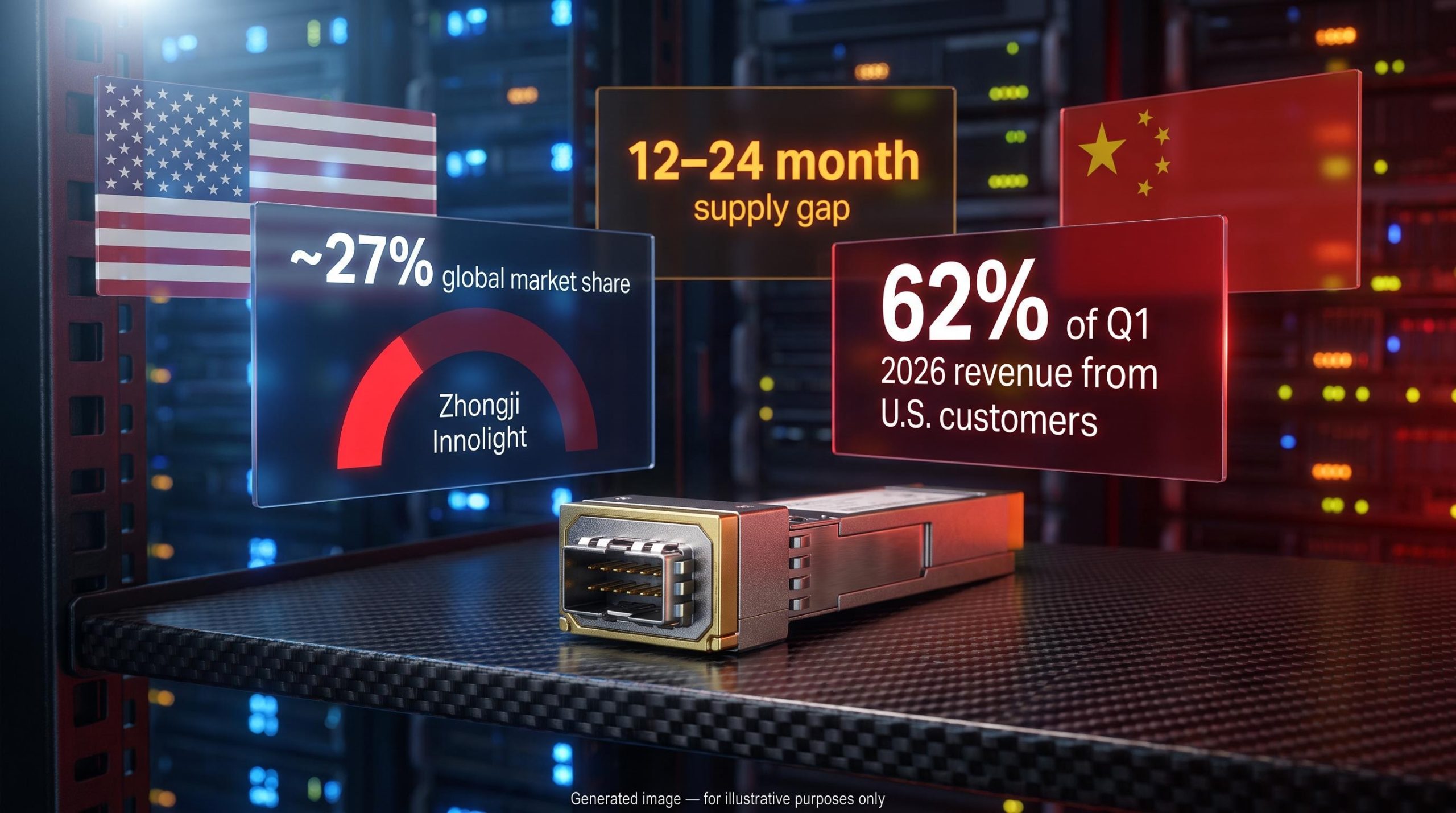
Counterpoint Research data show that Zhongji Innolight commands approximately 27% of global data-centre optical transceiver revenue and is the leading supplier of 800G modules into Nvidia AI cluster builds. The company drew 62% of its first-quarter 2026 revenue from U.S. customers. Eoptolink Technology, meanwhile, directs 96% of its total sales to overseas buyers, with comparable concentration in high-speed AI infrastructure modules.
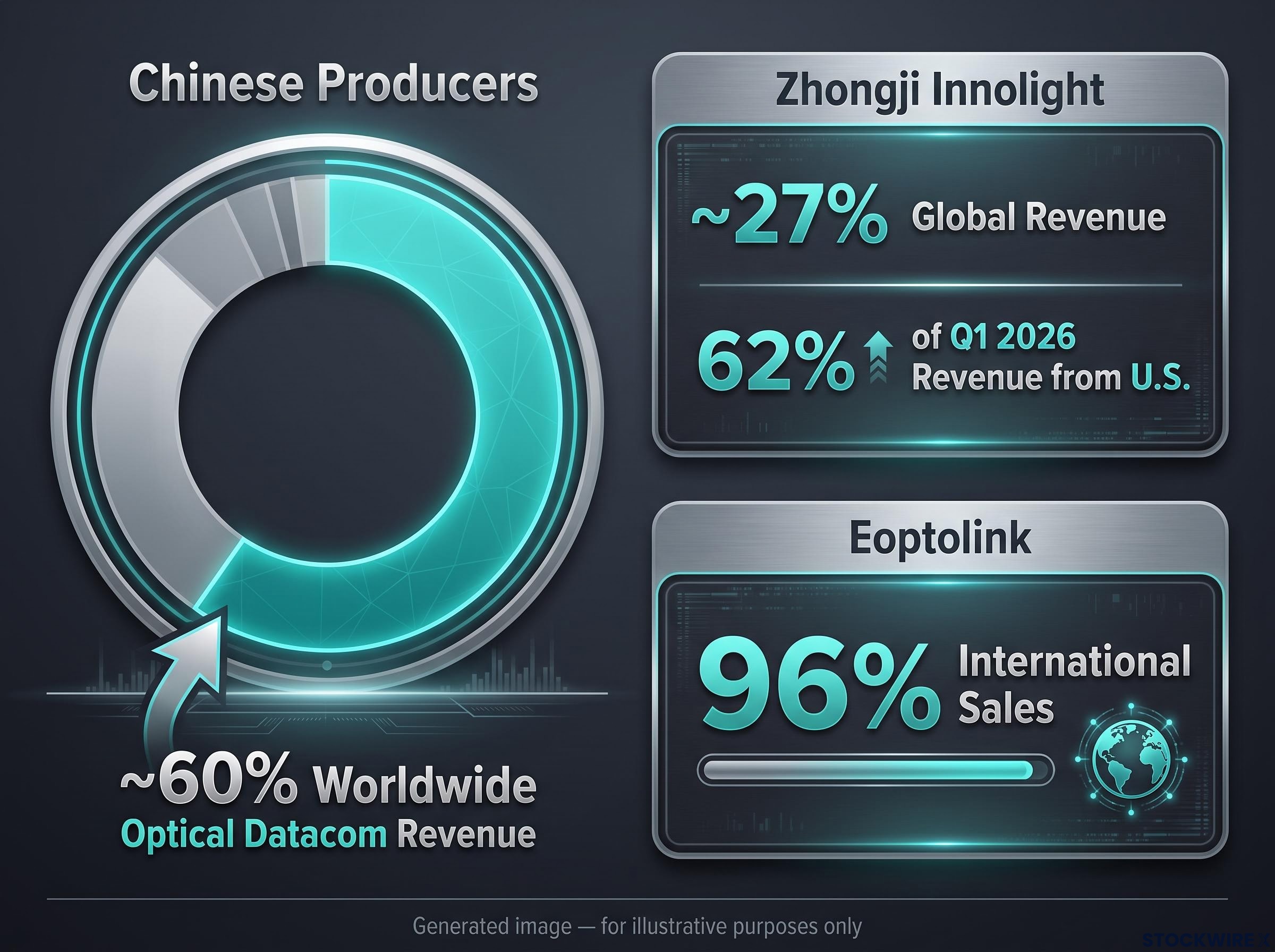
That 62% U.S. revenue figure for Innolight is worth sitting with. This is not a one-sided dependency: the Chinese vendors need U.S. customers as much as U.S. hyperscalers currently need the Chinese vendors, and that bilateral exposure will shape how both sides respond to regulatory pressure.
Named Western alternatives exist. Lumentum, Coherent, and Applied Optoelectronics (AAOI) all produce optical transceivers. At present, none of these suppliers has sufficient cleanroom capacity, packaging automation, or manufacturing yield to take on the volumes that Chinese producers currently deliver within the near term.
Lumentum’s 90% year-over-year revenue growth in fiscal Q3 2026 illustrates how acute optical interconnect demand has become at the infrastructure layer, a tailwind that a supply restriction would redirect rather than eliminate, concentrating procurement pressure on the Western vendors that regulators are implicitly backing.
| Vendor | Headquarters | Estimated global market share | U.S. revenue exposure |
|---|---|---|---|
| Zhongji Innolight | China | ~27% (by revenue) | 62% of Q1 2026 revenue |
| Eoptolink | China | Significant (exact figure N/A) | 96% international sales |
| Lumentum | United States | N/A or limited public data | Primarily U.S./Western |
| Coherent | United States | N/A or limited public data | Primarily U.S./Western |
| AAOI | United States | N/A or limited public data | Primarily U.S./Western |
Counterpoint Research analyst Neil Shah has stated that treating the optical transceiver market as cleanly divisible along geographic lines misreads how the broader hardware ecosystem is structured.
How the supply chain actually works (and why a clean cut is not possible)
The optical transceiver supply chain is not two separate networks that can be disconnected at a border. It is an integrated ecosystem where U.S. and Chinese producers depend on each other at multiple layers.
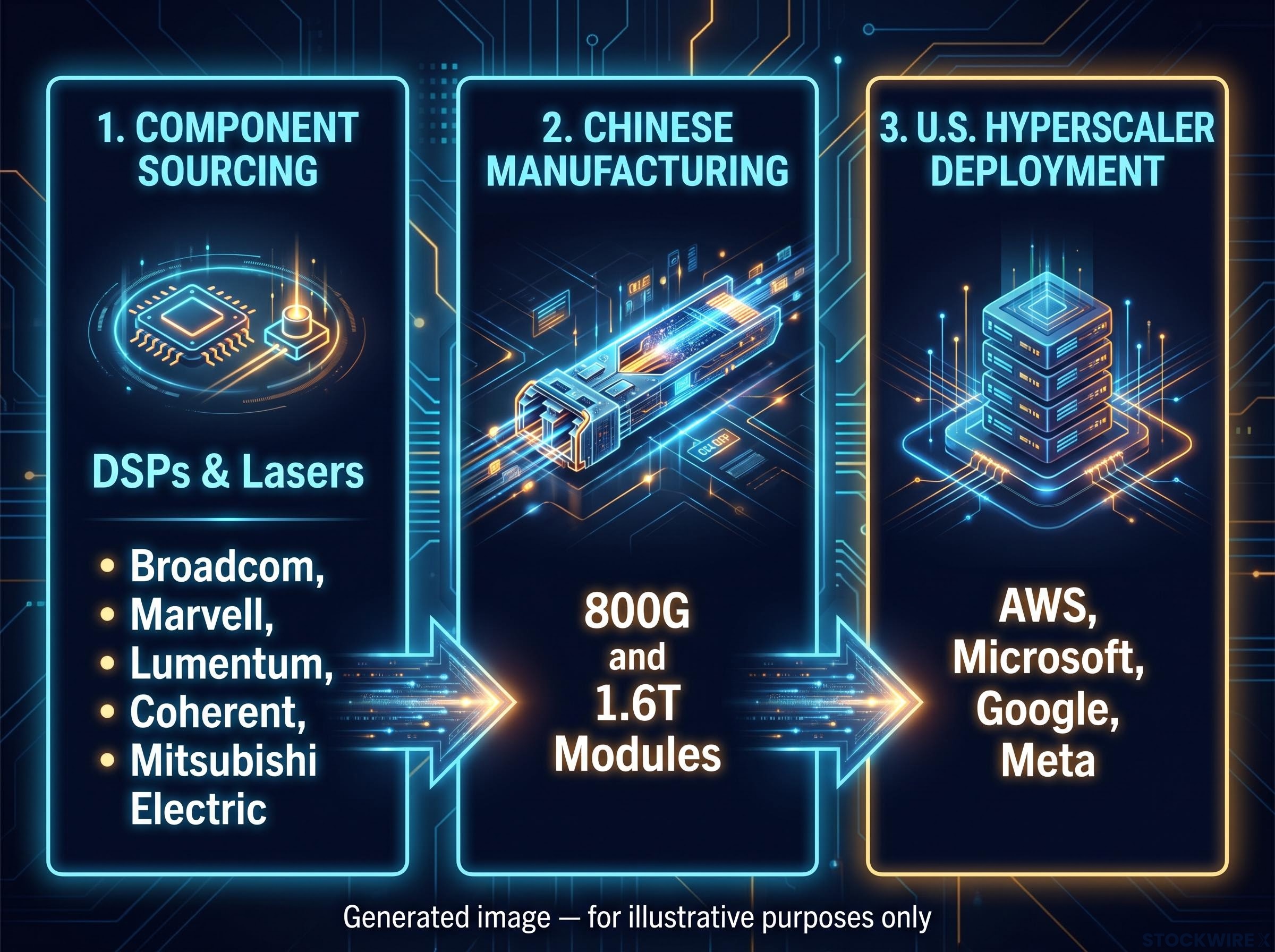
The dependency runs in sequence:
- U.S. digital signal processor (DSP) and laser components ship to Chinese optical manufacturers. DSPs, the chips that process signals inside a transceiver, come from Broadcom and Marvell. Laser components come from U.S. and Japanese suppliers including Lumentum, Coherent, and Mitsubishi Electric.
- Chinese manufacturers produce 800G and 1.6T modules using those inputs, at scale and yield rates Western facilities cannot currently match.
- Finished modules ship to U.S. hyperscalers for deployment inside AI cluster networking fabric.
Restricting step three does not leave steps one and two unaffected.
The countermeasure risk that cuts both ways
A U.S. restriction could prompt Chinese manufacturers to reduce U.S. component sourcing. More consequentially, the Chinese government could restrict exports of indium phosphide wafers (a compound semiconductor material used to produce the lasers inside transceivers), a countermeasure that would hit Western optics vendors relying on Chinese supply chain inputs. If this restriction escalates, the straightforward “U.S. vendors win” thesis gets complicated quickly.
What this means for hyperscaler AI timelines and capex efficiency
Combined hyperscaler capital expenditure plans from AWS, Microsoft, Google, and Meta collectively run into the hundreds of billions of dollars. The primary investor risk from this proposed restriction is not that spending falls. It is that spending becomes less efficient.
The scale of the efficiency risk becomes clearer against the spending baseline: hyperscaler capital expenditure across Amazon, Microsoft, Alphabet, and Meta reached $130 billion in Q1 2026 alone, with full-year 2026 projections near $725 billion, meaning even a modest reduction in compute utilisation rates compounds into material return shortfalls at these volumes.
GPU clusters ordered and built but unable to be fully interconnected are GPU clusters operating below capacity. Training efficiency at scale is tightly bound to network bandwidth and latency, and optical transceivers are the gating component at 800G and emerging 1.6T speeds. Under-connected GPUs are under-utilised GPUs, and that directly drags on return on invested capital.
Counterpoint Research analyst Neil Shah has cautioned that a rushed ban creates a real risk of hardware supply shortfalls, driving up costs and pushing back the timelines on which AI cluster deployments can proceed.
Analysts at Counterpoint Research estimate the supply gap will take between 12 and 24 months to close. That window maps directly onto the payback period for current hyperscaler GPU investments, meaning optical constraints are not an abstract inconvenience but a real variable in whether the largest AI infrastructure programmes in the world deliver the returns they have promised. Raymond James analysts have noted that hyperscalers may front-load purchases of already-authorised Chinese transceiver models before restrictions tighten.
Three near-term operational impacts to track:
- Risk of shortages and higher prices for non-Chinese transceivers as demand shifts to constrained Western supply
- Potential delays to next-generation data centre architectures at 800G and 1.6T speeds
- Reduced GPU utilisation rates during any supply gap period, directly affecting compute revenue generation
The variables that determine how disruptive this actually becomes
The difference between a manageable regulatory adjustment and a meaningful constraint on AI infrastructure buildout comes down to three unresolved definitional questions:
- Scope: new models versus existing shipments. Will the restriction cover only previously unauthorised optical transceiver models seeking entry into the U.S. market (the Raymond James base case), or also to currently shipping 800G and 1.6T products? The answer determines whether this is a forward-looking freeze or a near-term supply shock.
- Domicile definition: ownership versus production location. How will the FCC treat a Chinese-owned vendor manufacturing in a third country such as Thailand? If “Chinese” means ownership rather than production location, the effective scope of the ban could be far broader than the base case, and that distinction deserves a line in any investor model.
- Covered List expansion breadth. Will optical module vendors be treated like Huawei and ZTE (comprehensive restrictions) or subject to more nuanced, model-specific conditional approvals? The precedent chosen here shapes the entire enforcement architecture.
The FCC comment and rulemaking process through 2026 is where these definitions will be fought over and settled. That process, not the draft rule itself, is the primary variable to monitor.
What U.S. infrastructure planners and investors should be doing now
For infrastructure planners and CIOs:
- Audit vendor concentration across Innolight and Eoptolink exposure in current and planned deployments
- Validate interoperability of alternative optics vendors with existing switches and network interface cards (NICs)
- Consider strategic stockpiling of critical 400G and 800G transceiver SKUs before rules tighten
- Engage in the FCC comment process directly; hyperscalers that argue publicly for phased, predictable implementation have historically shaped the final scope of equipment authorisation rules, and that lever is available now
For investors:
- Distinguish between Western optics vendors with credible near-term capacity ramp (Coherent, Lumentum, AAOI) and those exposed to ramp risk before assuming a simple share-gain thesis
- Build the 12-to-24-month supply gap timeline into hyperscaler capex efficiency models; the question is not whether these companies will spend, but whether their spending generates the compute utilisation they have projected
- Treat this as an evolving tail risk with a regulatory overhang, not a fully priced-in shock; the FCC comment period through 2026 is the primary process to watch
Investors wanting to position across the optical networking and power supply layers that this restriction most directly affects will find our full explainer on AI infrastructure stocks covers Lumentum, Bloom Energy, and four other names that doubled in the first five months of 2026, including the volatility ranges investors must accept at current valuations.
A supply chain problem that policy cannot solve quickly
The tension at the centre of this story is genuine. U.S. policy objectives around national security and supply chain independence are legitimate, but the structural realities of the optical transceiver market, including Chinese producers holding around two-thirds of global supply, a gap of up to two years before Western alternatives can scale, and deeply interwoven cross-border dependencies, mean that any credible implementation path carries real near-term costs for AI infrastructure efficiency.
The medium-term adjustment path is visible: hyperscalers will likely enter long-term contracts with Western vendors, support capacity expansion, and rethink network topologies. But this is a multi-year structural shift, not a quarterly transition.
The FCC comment and rulemaking process through 2026 will determine the scope and phase-in timeline. For both infrastructure planners and investors, that process is the single most important variable shaping what this restriction ultimately costs, and how long the friction lasts.
This article is for informational purposes only and should not be considered financial advice. Investors should conduct their own research and consult with financial professionals before making investment decisions. Forward-looking statements regarding regulatory outcomes and supply chain adjustments are speculative and subject to change based on policy developments and market conditions.