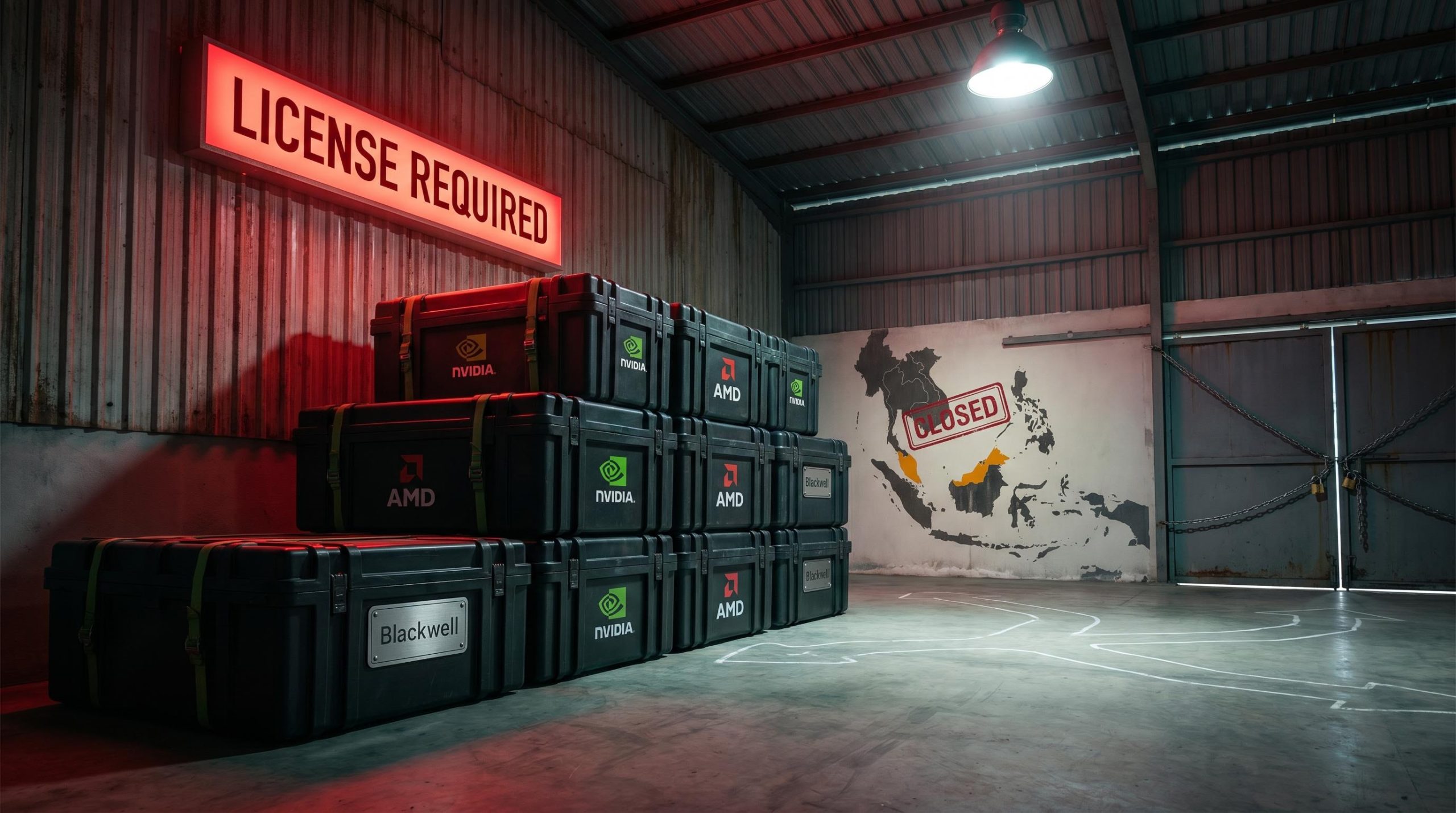
For roughly one year, a quiet regulatory gap may have allowed hundreds of thousands of advanced U.S. AI chips to reach Chinese-affiliated companies through a simple workaround: routing shipments through subsidiaries in places like Malaysia. On Sunday, 31 May 2026, the U.S. Department of Commerce moved to shut that channel down.
The new guidance applies licensing requirements to any entity headquartered in China, regardless of where that entity physically operates. It targets specific processors including Nvidia’s Rubin and Blackwell chips and AMD’s MI350x, and it arrives as investors holding either stock try to assess what tightened export enforcement means for revenues tied to China-adjacent demand.
What follows explains how the loophole worked, what the new rule changes, which chips and companies fall directly in scope, and what a parallel situation involving Nvidia’s H200 processor signals about the broader regulatory environment both chipmakers are now navigating.
How a one-year enforcement gap opened the door for chip diversion
The gap did not appear overnight. It was the product of three sequential decisions, each one creating the condition the next exploited:
- The Biden administration introduced the AI Diffusion rule in its final days in office, designed to manage global access to advanced AI chips.
- In approximately May 2025, the Trump administration announced it would not enforce the AI Diffusion rule, leaving the restrictions effectively dormant.
- Because existing rules did not explicitly require licensing based on the headquarters location of the ultimate beneficial owner, shipments to Chinese-affiliated entities operating through third-country subsidiaries were not clearly prohibited during this period.
The AI Diffusion rule in the Federal Register, published in January 2025, established export controls on advanced computing integrated circuits and AI model weights with the stated aim of cultivating secure ecosystems for responsible AI diffusion, making the Trump administration’s subsequent decision not to enforce it a significant departure from the Biden-era framework.
The result was an enforcement vacuum that persisted for approximately one year.
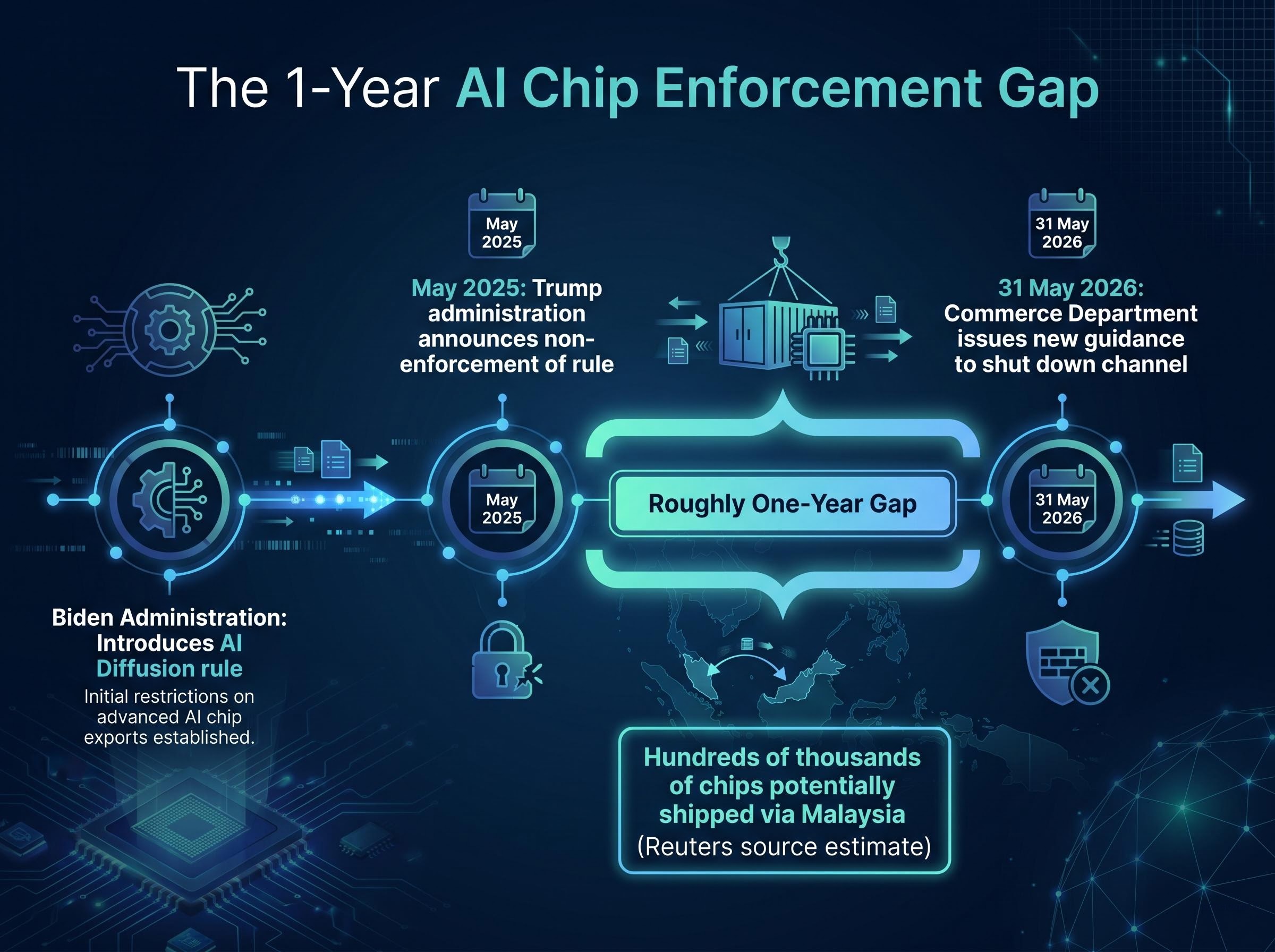
An anonymous chip industry source with supply-chain knowledge, cited by Reuters, estimated that potentially hundreds of thousands of chips may have been shipped during this roughly one-year window. The figure has not been independently verified.
The Malaysia routing mechanism
The routing channel was straightforward. Chinese AI firm subsidiaries based in countries like Malaysia could receive chip shipments that would have been restricted if sent directly to China-headquartered entities. The prior rules’ silence on headquarters-based licensing, combined with the Trump administration’s non-enforcement stance, made this third-country routing viable.
No licence was clearly required. No enforcement action was triggered. The chips moved.
When big ASX news breaks, our subscribers know first
What the new Commerce Department guidance actually requires
The new guidance, issued on 31 May 2026, applies a single decisive standard: licensing is now required for any entity headquartered in China, regardless of where that entity is physically operating or receiving shipments.
This headquarters-based trigger is the mechanism that closes the gap. By anchoring the licensing requirement to the ultimate beneficial owner’s location rather than the shipment destination, the guidance forecloses the third-country subsidiary routing channel that operated throughout the enforcement vacuum.
The table below compares the prior and new regulatory frameworks:
| Attribute | Prior Standard (AI Diffusion rule, unenforced) | New Guidance (May 2026) |
|---|---|---|
| Licensing trigger | Shipment destination | Headquarters location of receiving entity |
| Geographic scope | Country-level restrictions (China) | Extraterritorial (any location, if HQ is in China) |
| Enforcement basis | Not enforced (May 2025 onward) | Active Commerce Department guidance |
Understanding AI chip export restrictions and why they target headquarters
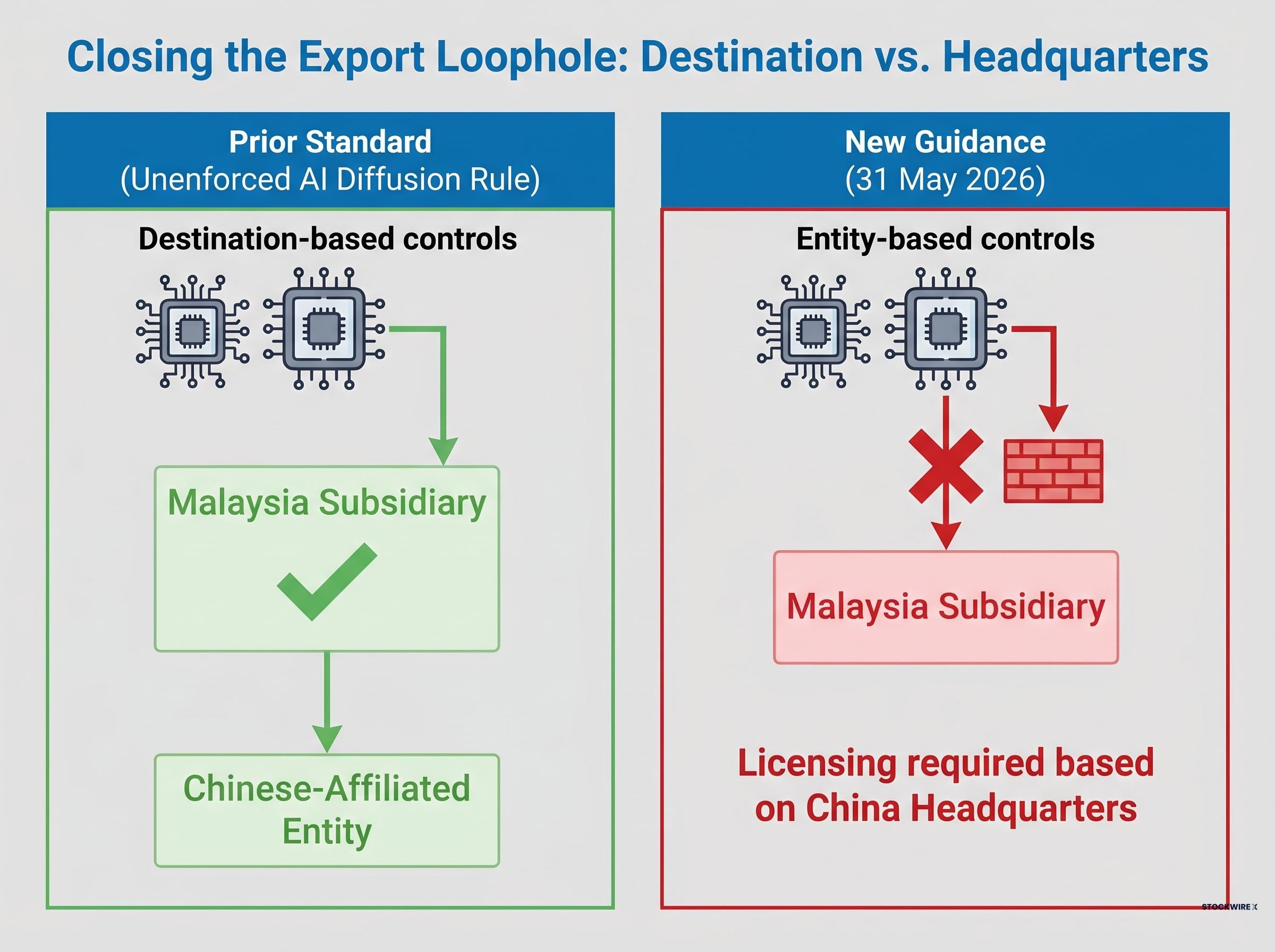
U.S. export controls work by designating categories of restricted goods and specifying who can receive them under what conditions. The distinction that matters here is between two approaches:
- Destination-based controls restrict shipments to a specific country. If a chip is addressed to China, it requires a licence. If it is addressed to Malaysia, it may not, even if the buyer is a Chinese-headquartered firm operating through a Malaysian subsidiary.
- Entity-based controls restrict shipments to a specific type of buyer, defined by affiliation or headquarters, regardless of where that buyer sits. A Chinese-headquartered company in Malaysia, Singapore, or anywhere else triggers the same licensing requirement.
Entity-based controls anchored to headquarters are structurally harder to route around than destination-based rules. The third-country subsidiary pattern that operated during the enforcement gap exploited the destination-based logic. The new guidance replaces that logic with an entity-based standard designed to foreclose exactly that workaround.
Nvidia and AMD: which chips fall under the new rules
Three specific processors are now subject to the new licensing requirements for Chinese-headquartered entities:
| Chip | Company | New Guidance Status | Delivery to Chinese Entities (as of 31 May 2026) | Blockage Type |
|---|---|---|---|---|
| Rubin | Nvidia | Licence required | Subject to new rules | U.S. export control (new guidance) |
| Blackwell | Nvidia | Licence required | Subject to new rules | U.S. export control (new guidance) |
| MI350x | AMD | Licence required | Subject to new rules | U.S. export control (new guidance) |
| H200 | Nvidia | U.S. clearance granted (~10 firms) | Zero deliveries completed | Chinese regulatory inaction |
The H200 situation: cleared but undelivered
A separate, concurrent complication involves Nvidia’s H200, described as the company’s second-most powerful AI processor. Approximately 10 Chinese firms held U.S. government clearance to purchase the H200 as of 31 May 2026.
No deliveries had been completed.
The obstacle is not U.S. export control non-compliance. Chinese regulatory approval had not been granted, with Chinese authorities reportedly supporting domestic chip producers instead of facilitating H200 purchases, according to Reuters, citing individuals familiar with the matter. This is a distinct situation from the new guidance, and investors should avoid conflating the two when assessing Nvidia’s China-adjacent revenue exposure.
The H200 dual-approval deadlock involves a specific set of named buyers, including Alibaba, Tencent, and ByteDance, whose U.S. clearances have been commercially neutralised by Beijing’s customs block, a situation that the Bureau of Industry and Security’s January 2026 shift to case-by-case review made structurally more permissive on the U.S. side even as the controlling barrier moved to Beijing.
What this means for Nvidia and AMD investors
Post-guidance analyst commentary and stock price reaction data tied specifically to the 31 May 2026 guidance were not available at the time of writing. The guidance was issued on a Sunday, and market response will only become visible when trading resumes.
Analyst commentary and stock price reaction to the 31 May 2026 guidance were not yet available at the time of publication. Investors should monitor financial press and brokerage research in the days following for updated assessments.
Two categories of risk warrant ongoing attention:
Nvidia’s Q1 FY2027 guidance explicitly excludes Data Centre compute revenue from China, confirming that management is not modelling near-term resolution of the approval deadlock, a posture that reflects a broader collapse from approximately 17% of total revenue in fiscal year 2024 to roughly 13% in fiscal year 2025 as successive export control rounds reduced China market access.
- Direct product licensing impact. Sales of Rubin, Blackwell, and MI350x to Chinese-headquartered entities, wherever those entities operate, now require U.S. licensing. Any demand previously served through third-country subsidiaries during the enforcement gap is now subject to the new standard.
- Enforcement posture signal. The Trump administration’s shift from non-enforcement back toward active restriction suggests the regulatory floor has moved. Investors who assumed the initial non-enforcement stance would persist indefinitely should reassess that assumption.
The Reuters-cited estimate of hundreds of thousands of chips potentially shipped during the gap, while unverified and sourced to a single anonymous industry contact, provides context for the scale of demand the new rules may now constrain or redirect.
The bigger picture: a regulatory posture that just shifted
The 31 May 2026 guidance represents more than a licensing update. An administration that initially declined to enforce the AI Diffusion rule has now issued new guidance that tightens restrictions and applies extraterritorial licensing logic that is structurally harder to circumvent than the destination-based rules the prior loophole exploited.
Because this is guidance rather than a new statute or formal rulemaking, investors and companies should monitor whether it is accompanied by rulemaking that would embed the headquarters-based standard more formally in regulation.
U.S. AI chip export controls carry bipartisan Congressional backing and are grounded in national-security law rather than executive trade authority, placing them outside the jurisdiction of trade negotiators and making them structurally durable in ways that tariff arrangements or summit-level agreements cannot easily reverse.
Key developments to watch in the coming weeks:
- Post-guidance analyst commentary quantifying revenue exposure for Nvidia and AMD
- Signals from the Commerce Department’s Bureau of Industry and Security regarding formal rulemaking
- Any revenue guidance revisions from Nvidia or AMD in response to the new licensing requirements
- Chinese regulatory developments on the H200 approval situation
The regulatory floor for U.S. AI chip exports has moved. The one-year window of permissive enforcement is closed, and the direction of travel is toward tighter, entity-based controls.
The regulatory clock has reset for U.S. AI chip exports
After a year of non-enforcement, the Commerce Department has reasserted active licensing requirements for Chinese-affiliated entities purchasing the most advanced U.S. AI chips, wherever those entities operate. The specific chips now in scope, Nvidia’s Rubin and Blackwell and AMD’s MI350x, face a headquarters-based standard that makes third-country routing no longer a viable workaround.
The H200 situation adds a separate layer: U.S. clearance alone does not guarantee delivery when Chinese regulators have their own priorities. Investors holding Nvidia or AMD stock should monitor Reuters and the Commerce Department’s Bureau of Industry and Security for follow-on enforcement actions, formal rulemaking, and any public statements from either company in the days ahead.
This article is for informational purposes only and should not be considered financial advice. Investors should conduct their own research and consult with financial professionals before making investment decisions. These statements regarding potential revenue impacts and regulatory developments are speculative and subject to change based on market developments and company performance.