
The Food and Drug Administration (FDA) has approved the first mRNA-based seasonal flu vaccine in United States history, and it belongs to Moderna. The agency cleared mFlusiva for adults 50 and older on approximately 6 August 2026, making this the biotech’s fourth product to clear the FDA and its fifth to receive regulatory clearance anywhere in the world.
The timing matters as much as the milestone. Moderna has spent the better part of two years under sustained investor pressure to prove its mRNA platform can generate commercial traction beyond COVID-19. This approval is not just a product launch; it is a platform validation event arriving at the moment the company needs it most.
Here is the investor read: the approval’s dual-pathway regulatory structure, the commercial opportunity in a 154-million-dose U.S. market, the conditional risk still attached to the most valuable age cohort, and the near-term signals that will determine whether Moderna’s diversification story holds up under real-world execution pressure.
The FDA’s decision explained: what Moderna actually received
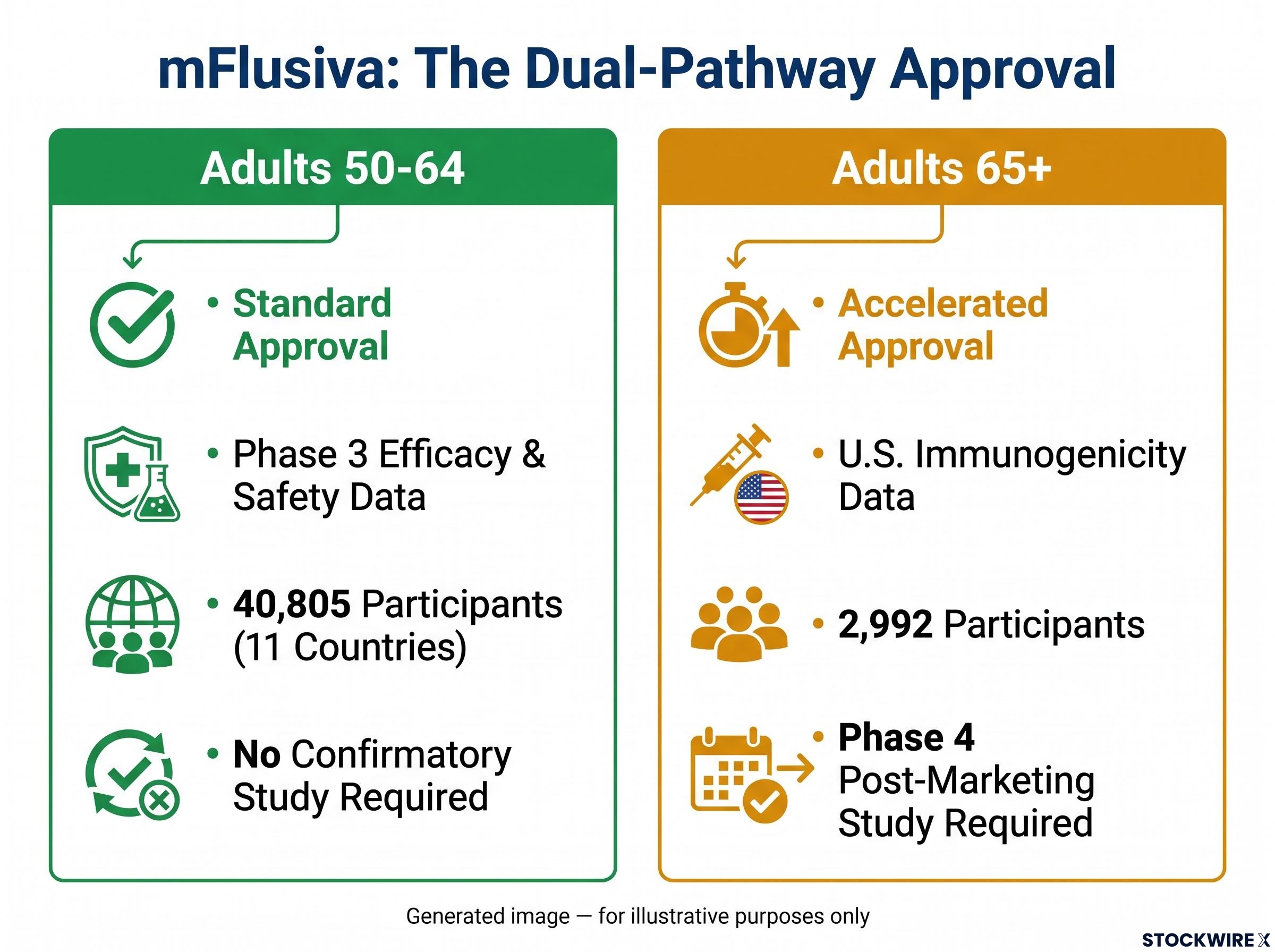
The approval covers adults 50 and older, but it does not operate as a single regulatory clearance. The FDA split its decision along two distinct pathways, divided at age 65.
Adults 50-64 received standard full approval, supported by Phase 3 efficacy and safety data drawn from a pivotal trial that ran across 11 countries with 40,805 adult participants. Adults 65 and older were granted accelerated approval, a conditional pathway grounded in immunogenicity findings from a dedicated U.S. study in which 2,992 participants took part. Under that accelerated pathway, Moderna is obligated to run confirmatory Phase 4 post-marketing studies to establish actual clinical benefit in the older age group.
The FDA’s Vaccines and Related Biological Products Advisory Committee (VRBPAC) voted 9-0 that benefits outweigh risks in both age groups, with the vote occurring on approximately 18 June 2026. The PDUFA goal date was 5 August 2026; the approval followed one day later.
| Age group | Approval type | Data basis | Confirmatory study required |
|---|---|---|---|
| Adults 50-64 | Standard (full) approval | Phase 3 efficacy and safety data (40,805 participants) | No |
| Adults 65+ | Accelerated approval | U.S. immunogenicity data (2,992 participants) | Yes (Phase 4 post-marketing study) |
That dual structure tells you something important before you draw any conclusions about the revenue ceiling. The approval is real, but its most commercially valuable cohort, adults 65 and older, carries a conditional element that remains unresolved.
When big ASX news breaks, our subscribers know first
How this approval almost did not happen
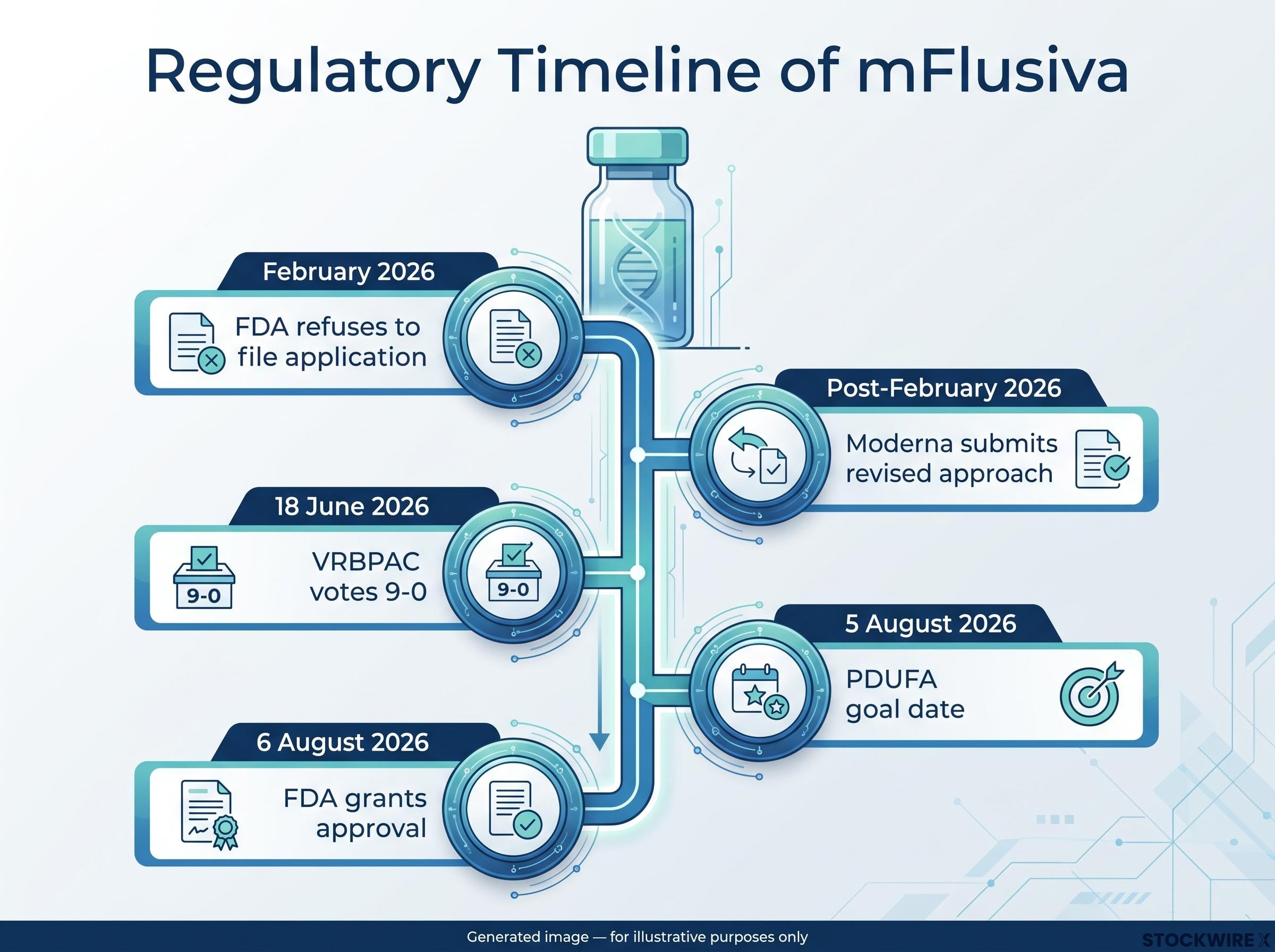
This was not a straightforward regulatory path. The FDA refused to file Moderna’s application in February 2026, citing a specific methodological concern: the comparator used in the pivotal trial did not represent the best available standard of care.
Moderna responded with a revised approach that included a commitment to the confirmatory post-marketing study for the 65-plus population. The FDA reversed course, accepted the application, and proceeded to review.
The timeline ran as follows:
- February 2026: FDA refuses to file Moderna’s mFlusiva application over comparator concerns.
- Post-February 2026: Moderna submits revised approach with Phase 4 study commitment; FDA accepts the application.
- 18 June 2026: VRBPAC votes 9-0 that benefits outweigh risks in both age groups.
- 6 August 2026: FDA grants approval along the dual-pathway structure.
The 9-0 VRBPAC vote was the decisive turning point. A unanimous advisory committee outcome is an unusually clean regulatory signal, and it effectively reversed the negative narrative that had built around the February refusal.
The initial refusal-and-reversal tells you that the FDA is not treating mRNA flu products with COVID-era deference. Future regulatory submissions in this programme will face the same methodological scrutiny. That is both a risk for investors to carry forward and a signal that the regulatory relationship has normalised, which is what a durable commercial platform requires.
FDA staffing losses have introduced unpredictable approval backlogs across vaccines and novel biologics since 2025, a structural constraint that explains in part why the agency’s methodological scrutiny on mFlusiva’s comparator choice reflects a more demanding post-COVID regulatory posture rather than an isolated procedural issue.
What mRNA flu vaccines are and why the platform distinction matters
Most flu vaccines are manufactured using chicken eggs. The process works, but it is slow to update, and in seasons where the circulating flu strain mutates away from the strain chosen months earlier for vaccine production, effectiveness drops. Cell-based vaccines (grown in mammalian cell cultures rather than eggs) offer a partial improvement, but the fundamental timeline constraints remain.
mRNA vaccines work differently. Instead of growing the virus or a component of it, the manufacturing process synthesises a genetic instruction set that tells the body’s own cells to produce the target protein. When a flu strain shifts, the antigen sequence in the mRNA can be updated more rapidly than egg-based processes allow.
The three major flu vaccine manufacturing approaches:
- Egg-based: Dominant market share; slow to adapt to strain changes; lowest production cost per dose.
- Cell-based: Faster than egg-based; used by CSL Seqirus (Flucelvax); still constrained by cell-culture timelines.
- mRNA: Fastest to update antigen sequences; Moderna’s mFlusiva is the first approved in the U.S.; manufacturing scalability still being proven at seasonal flu volumes.
In the Phase 3 pivotal trial, mFlusiva demonstrated approximately 27% greater relative efficacy versus a standard-dose flu vaccine in adults aged 50 and older. That figure is not just a product selling point. It is evidence that mRNA technology can outperform the existing standard of care in a mature, competitive market, which is the proof point investors needed to assign higher probability-adjusted value to Moderna’s non-COVID pipeline.
The Phase 3 trial data for mRNA-1010, published in the New England Journal of Medicine, reported approximately 26.6% greater relative efficacy versus a standard-dose flu vaccine, a figure consistent with the 27% edge cited in Moderna’s pivotal submission and the underlying basis for the platform’s clinical differentiation claim.
The commercial opportunity, and the obstacles Moderna still faces
The U.S. flu vaccine market projected approximately 154 million doses for the 2025-2026 season, according to CDC seasonal supply data.
That is a large, predictable market. It is also one with deeply entrenched incumbents. Sanofi (Fluzone High-Dose, Flublok), CSL Seqirus (Fluad adjuvanted, Flucelvax cell-based), and GSK (Fluarix, FluLaval) have long-standing distribution relationships with pharmacy chains, health systems, and pharmacy benefit managers (PBMs), the organisations that negotiate drug pricing and formulary placement for insurers and employers.
| Manufacturer | Product | Technology | Target population |
|---|---|---|---|
| Moderna | mFlusiva | mRNA | Adults 50+ |
| Sanofi | Fluzone High-Dose / Flublok | Egg-based / recombinant | Adults 65+ / adults 18+ |
| CSL Seqirus | Fluad / Flucelvax | Adjuvanted egg-based / cell-based | Adults 65+ / all ages |
| GSK | Fluarix / FluLaval | Egg-based | Broad population |
Moderna’s differentiation case rests on the 27% relative efficacy edge and manufacturing adaptability. But several open questions remain. Pricing strategy in a commoditised market is unproven. Channel penetration into pharmacy and health system networks takes time. The margin profile relative to COVID products is not yet established in public disclosures.
Moderna indicated it planned to begin distributing mFlusiva to select U.S. retailers within weeks of the approval, targeting the 2026-2027 flu season as its first commercial window. Even with a superior product, market share in a mature category accrues slowly. The pace of channel penetration over the first two commercial seasons will be the real test of the revenue thesis.
The 65-plus risk: what happens if the confirmatory trial falls short
Accelerated approval is a conditional pathway. The FDA grants market access based on a surrogate endpoint (in this case, immune response data) while requiring the company to run confirmatory studies proving actual clinical benefit. If those studies fail, are delayed, or are not completed on schedule, the FDA has the authority to withdraw the indication.
In recent years, the agency has strengthened its enforcement posture around confirmatory study requirements, making withdrawal of accelerated approvals a more credible regulatory outcome than it was a decade ago.
Accelerated approval has become a more scrutinised pathway across the FDA’s biologics and vaccine divisions; recent cases in small-molecule oncology have demonstrated that confirmatory study failures can result in full indication withdrawal, raising the practical stakes of the Phase 4 commitment Moderna has now accepted for the 65-plus cohort.
Why this cohort carries outsized commercial weight
The 65-plus population is disproportionately important to mFlusiva’s commercial case. Older adults have higher vaccination rates, higher disease burden from influenza, and they overlap directly with the demographic targeted by Sanofi’s and CSL Seqirus’s high-dose and adjuvanted products. Loss or restriction of the 65-plus indication would materially reduce the addressable market and could require repositioning or additional trials.
For investors, the confirmatory trial outcome is arguably as commercially significant as the approval itself, because the highest-burden, highest-revenue demographic is the one still subject to conditional clearance.
Variables to track:
- Confirmatory trial endpoint design: whether the FDA requires clinical effectiveness data (e.g., reduced influenza illness) versus immunogenicity comparisons, which affects difficulty and cost.
- Timeline communications from Moderna on Phase 4 study completion.
- FDA correspondence disclosures that may signal regulatory satisfaction or concern.
- Any interim data signals from the confirmatory programme.
What the approval changes for Moderna’s valuation story, and what to watch next
Moderna shares closed down 1.28% in the session prior to the approval announcement, then rose in extended-hours trading following the news. That pattern, muted pre-event trading followed by a positive post-announcement reaction, is consistent with how markets typically handle widely anticipated binary catalysts. The overhang removal often matters more than the specific magnitude of the move.
The valuation impact of mFlusiva’s approval is likely larger than the standalone net present value of mFlusiva sales alone. The approval provides evidence that mRNA is a durable, repeatable platform capable of supporting a diversified commercial portfolio beyond COVID, and that platform credibility incrementally de-risks every other asset in Moderna’s pipeline.
Platform credibility is the mechanism by which a single commercial approval recalibrates the probability-adjusted value assigned to every other asset in a pipeline; the logic is that demonstrated efficacy in one indication provides independent evidence that the underlying delivery mechanism functions as intended, compressing the perceived scientific risk across adjacent programmes.
The approval contributes to Moderna’s story along two channels. First, a flu vaccine generates recurring seasonal revenue tied to predictable annual cycles, a structurally different profile from lumpier COVID demand. Second, demonstrated efficacy across both COVID-19 and influenza increases the probability-adjusted value investors can assign to pipeline assets that have not yet reached the market.
Near-term catalysts to watch, in priority order:
- Pricing disclosures and volume guidance for the 2026-2027 flu season.
- Channel and distribution partnership announcements with pharmacy chains and health systems.
- Phase 4 confirmatory trial design and timeline communications for the 65-plus indication.
- Initial uptake data from the first commercial flu season.
Medium-term pipeline optionality, distinct from the mFlusiva launch:
- Personalised oncology vaccines (neoantigen programmes).
- Combination respiratory vaccines (COVID/flu/RSV candidates).
- Latent virus vaccine programmes.
These are platform-level developments, not outcomes flowing directly from the flu approval. But investors who previously assigned high uncertainty to non-COVID mRNA programmes now have a second commercial-stage product as confirmatory evidence to update that assessment.
A landmark approval with work still to do
The first mRNA flu vaccine approval in U.S. history is a genuine milestone, Moderna’s fourth FDA-cleared product and a validation of its platform across two major respiratory indications. It removes a material regulatory overhang and opens a recurring seasonal revenue line in a 154-million-dose market.
The conditional structure matters, though. The 65-plus indication, the most commercially valuable cohort, rests on accelerated approval with confirmatory studies still ahead. And commercial execution in a mature market with entrenched incumbents is unproven.
Investors who track pricing disclosures, channel partnership announcements, and Phase 4 trial timeline communications will have the clearest view of whether this approval translates into the durable commercial diversification Moderna’s valuation story requires.
This article is for informational purposes only and should not be considered financial advice. Investors should conduct their own research and consult with financial professionals before making investment decisions. Forward-looking statements regarding commercial performance, trial outcomes, and pipeline developments are subject to change based on market conditions and regulatory developments.