Two memory chip giants beat earnings estimates this week and still lost billions in market capitalisation before the opening bell. That reaction captures exactly where AI semiconductor expectations have arrived in August 2026.
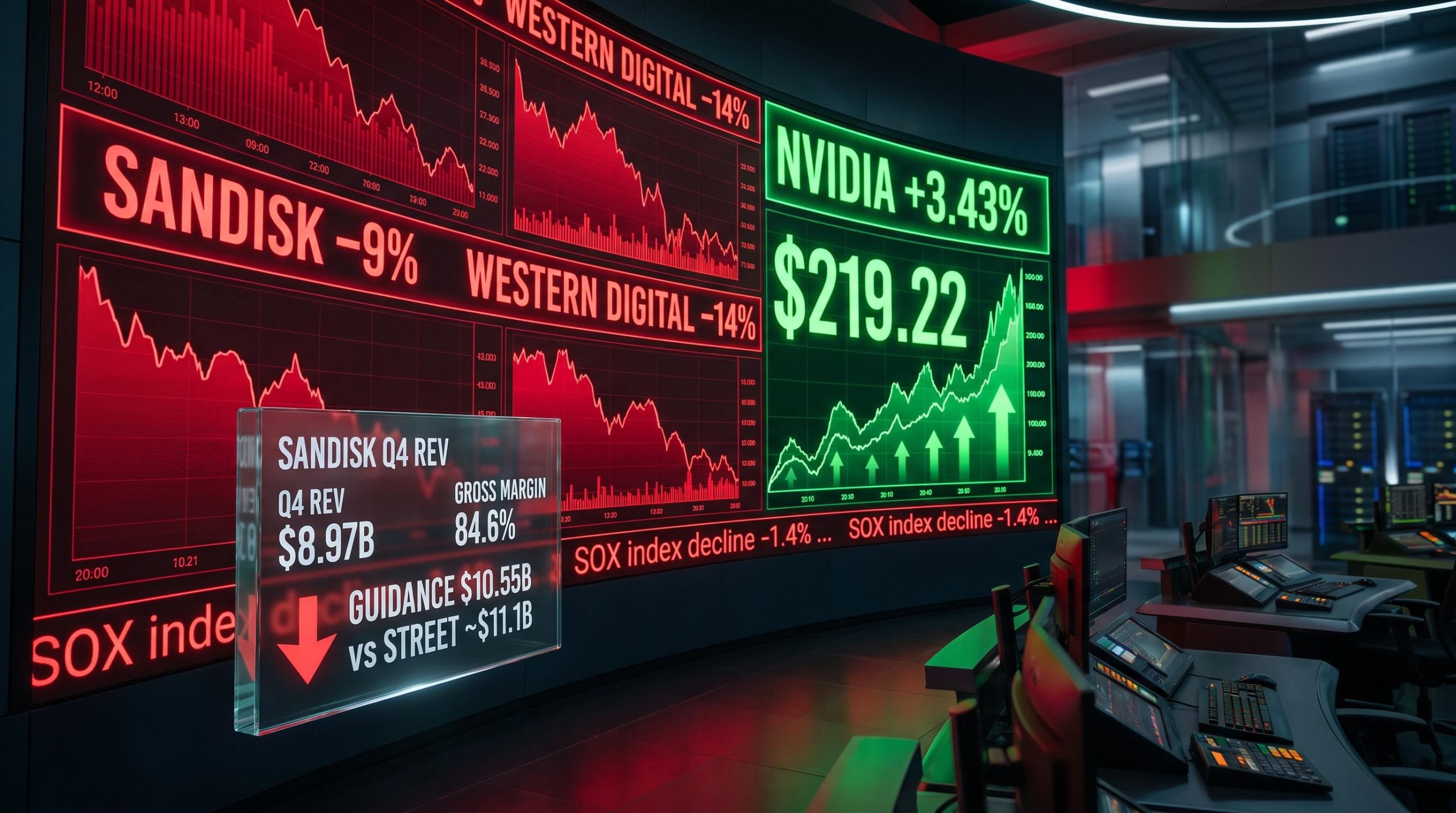
Sandisk fell more than 9% in pre-market trading on 6 August. Western Digital dropped more than 14%. AMD had already shed over 7% the day prior, and the Philadelphia Semiconductor Index (SOX) declined 1.4% on 5 August. By the time Asian markets opened, the selling had spread into South Korean and Japanese equities. These are not the reactions of investors digesting bad results. They are the reactions of a market that had priced in a trajectory the companies themselves are no longer willing to confirm.
Here is what the numbers actually show, why guidance became the flashpoint rather than earnings, and which signals matter most for investors navigating this semiconductor stock reset over the coming weeks.
The earnings beats that the market refused to celebrate
Both Sandisk and Western Digital delivered quarterly results that, in any normal environment, would have been celebrated. The numbers were strong. The market sold them anyway, and the gap between what the companies reported and what the stocks did next morning tells you everything about where expectations had settled.
| Company | Q4 Revenue (Actual vs. Expected) | Q4 EPS (Actual vs. Expected) | Next-Quarter Revenue Guidance vs. Street | Pre-market Decline (6 Aug) |
|---|---|---|---|---|
| Sandisk | $8.97B vs. ~$8.4-8.48B | $39.25 vs. mid-$34 | $10.55B midpoint vs. Street ~$11.1-11.2B | Over 9% |
| Western Digital | $3.75B vs. ~$3.69B | $3.56 vs. ~$3.29-3.31 | $4.1B (±$100M) | Over 14% |
Both companies beat revenue and earnings per share (EPS) estimates comfortably. Sandisk’s non-GAAP gross margin hit 84.6%, a figure that reflects genuine pricing power. The problem was not in the rearview mirror. It was in the windscreen.
Earnings beats driving selloffs are not a new phenomenon in this cycle: TSMC’s most profitable quarter on record also produced a roughly 3% share price decline on earnings day and a broader SOX drop, establishing the pattern that Sandisk and Western Digital are now repeating.
Goldman Sachs analysts characterised both reports as beats accompanied by weak guidance relative to elevated expectations, not fundamental deterioration. Goldman’s own revenue model for Sandisk’s next quarter sat at approximately $11.65 billion, more than a billion dollars above where the company guided.
The results themselves validate AI-driven demand. But the guidance gap reveals how much speculative optimism had been loaded into both stocks ahead of the print. Separating “guidance miss” from “demand miss” is the most important distinction investors can make right now.
When big ASX news breaks, our subscribers know first
Why stocks up 200-469% have almost no margin for guidance disappointment
The scale of the selloff only makes sense once you see the scale of the rallies that preceded it. Both stocks had been on runs that compressed years of normal appreciation into months:
- Sandisk: up approximately 469% year-to-date as of early August, stock trading near $1,200 before declining over 9% (some reports cite 9-11%) in pre-market on 6 August
- Western Digital: up approximately 202% year-to-date, stock pushed to the low-$440s after a decline of more than 14% (some reports cite 14-16%) in pre-market on 6 August
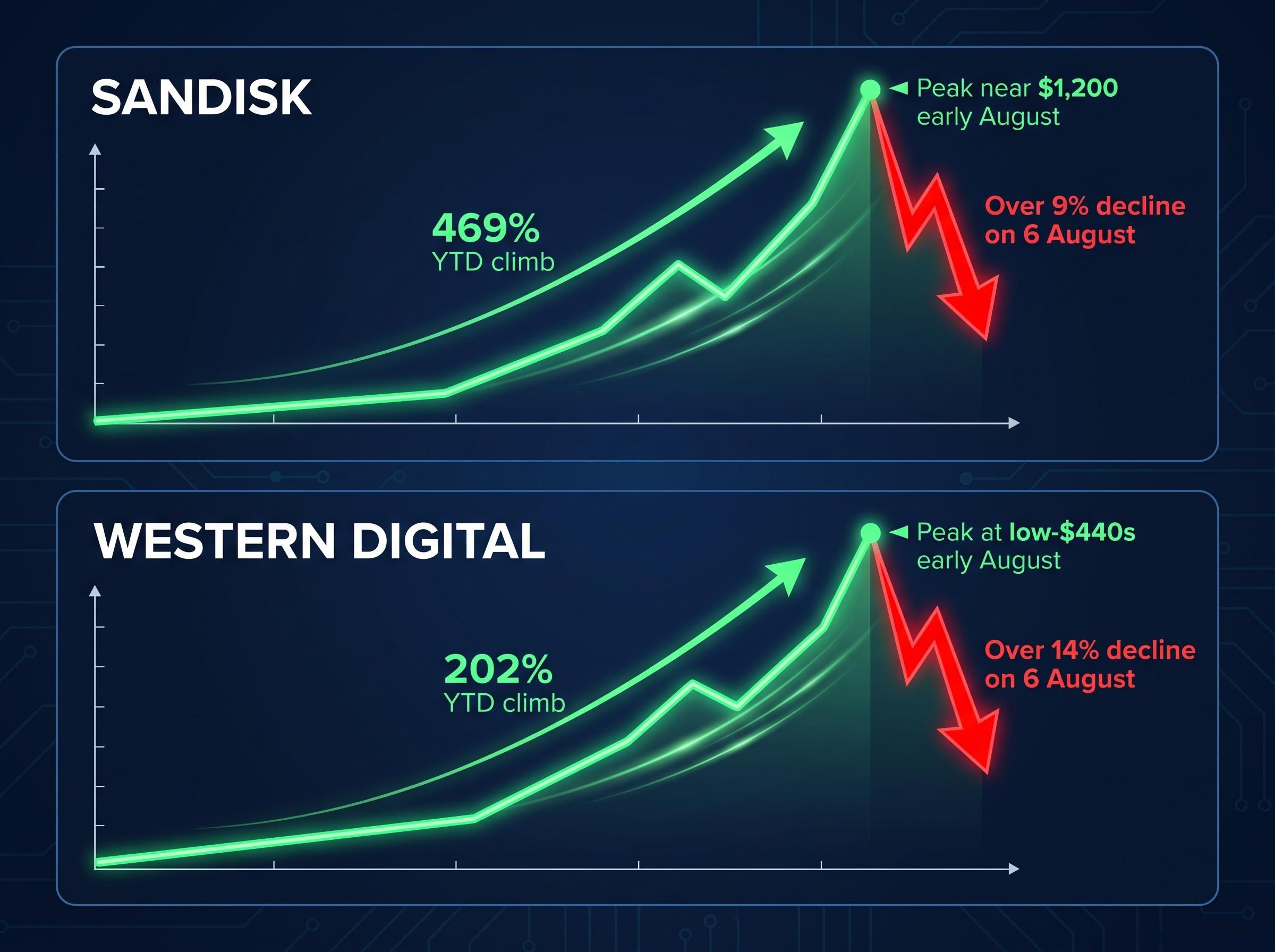
When a stock has nearly quintupled in under eight months, its price embeds an assumed growth trajectory. Every dollar of that gain reflects a bet that future quarters will not just be good but will be good at an accelerating rate. A guidance number that comes in 5% below the most aggressive models does not just shave 5% off the stock. It forces a recalculation of every quarter’s assumed growth rate that was baked into the multiple.
Sandisk’s 84.6% non-GAAP gross margin cuts both ways here. It confirms that current conditions are strong, but it also sets an extraordinarily high bar. Sustaining margins at that level requires demand intensity and pricing discipline to hold simultaneously across future quarters.
For investors holding these names, the size of the decline is not a signal of how bad the news was. It is a signal of how much optimism had already been priced in, and that is a meaningfully different investment problem.
What AI demand actually looks like beneath the selloff
Strip the price action away, and the underlying demand picture remains firm. Both Sandisk and Western Digital reported dramatic year-over-year revenue and EPS growth, driven by surging demand for DRAM (dynamic random-access memory, the high-speed memory chips that power data centres), NAND (the flash storage chips used in solid-state drives), and enterprise storage tied to AI cloud services and large language model training.
Sandisk’s gross margin of 84.6% confirms that demand is healthy enough to sustain pricing power. Companies with collapsing demand do not hold margins at those levels.
The memory supercycle structure driving these results is anchored by hyperscaler capex projected to reach $725 billion in 2026, with AI data centre operators now accounting for an estimated 70% of total memory shipment volumes, a demand concentration that makes the current cycle meaningfully different from prior DRAM upcycles.
The structural AI story, data-centre buildouts, inference workloads, cloud AI services, remains intact. What is being repriced is the slope of the growth curve, not its direction.
The difference between a slower ramp and a stalled cycle
Markets had extrapolated early-cycle hypergrowth into a straight-line, multi-year trajectory. Management teams are now guiding to more sustainable ramps, and that gap between assumption and guidance is where the selling pressure originates.
Inventory normalisation (where customers work through chips they have already ordered before placing new orders) and capacity additions (where manufacturers bring new production online, easing supply tightness) are normal features of a maturing growth cycle. They moderate the growth rate. They do not reverse it. The diagnostic tool is management language on earnings calls: companies framing softness as timing and inventory digestion are telling a different story from companies flagging structural demand slowing.
“The AI trade is under pressure” and “the AI trade is over” are two entirely different statements. The current data supports only the first.
AMD’s stumble and the contagion path into Asian markets
The selling did not stay in one country or one subsector. The SOX fell 1.4% on 5 August, and the pressure extended into the 6 August Asian trading session, where memory-exposed names bore the brunt:
- Samsung Electronics and SK Hynix each posted losses during the 6 August session, weighing on South Korea’s KOSPI index
- Japan’s Nikkei 225 also weakened as semiconductor names dragged on the broader index
- AMD fell approximately 7.04% on 5 August, trading at $482.05, after its results and guidance failed to match investor hopes for rapid AI accelerator share gains against NVIDIA
The transmission mechanism is straightforward. Samsung and SK Hynix trade as global AI memory demand barometers. When U.S. guidance disappoints, investors extrapolate that signal to Korean and Japanese peers, even where local fundamentals remain solid. The global semiconductor supply chain is tightly integrated; U.S. earnings repricing does not stay domestic.
For investors in Korean or Japanese semiconductor ETFs, or in diversified Asia-Pacific equity positions, the pressure they may be seeing is imported expectations risk, not a change in local business conditions.
NVIDIA’s divergence and what a two-tier AI trade means for the sector
While memory and storage names were selling off, NVIDIA moved in the opposite direction.
NVIDIA gained approximately 3.43% on 6 August, trading at $219.22 on volume of approximately 158 million shares.
That divergence is not an anomaly. It reflects a structural split in how investors are pricing different parts of the AI value chain. The AI trade is separating into two tiers:
NVIDIA demand diversification beyond hyperscalers, toward sovereign AI programmes, AI labs, and enterprise on-premise deployments, is a key reason the stock held up while memory and storage names sold off, because its revenue base now includes counter-cyclical buyers that do not pause orders when inventory digestion slows cloud procurement.
- Tier 1: Core accelerators (NVIDIA and direct AI training and inference hardware), perceived as having the most durable demand and the most direct link to AI spending growth
- Tier 2: Memory, storage, and peripheral logic (Sandisk, Western Digital, AMD), strong fundamentals but greater exposure to inventory cycles, pricing shifts, and the gap between AI demand growth and quarterly earnings translation
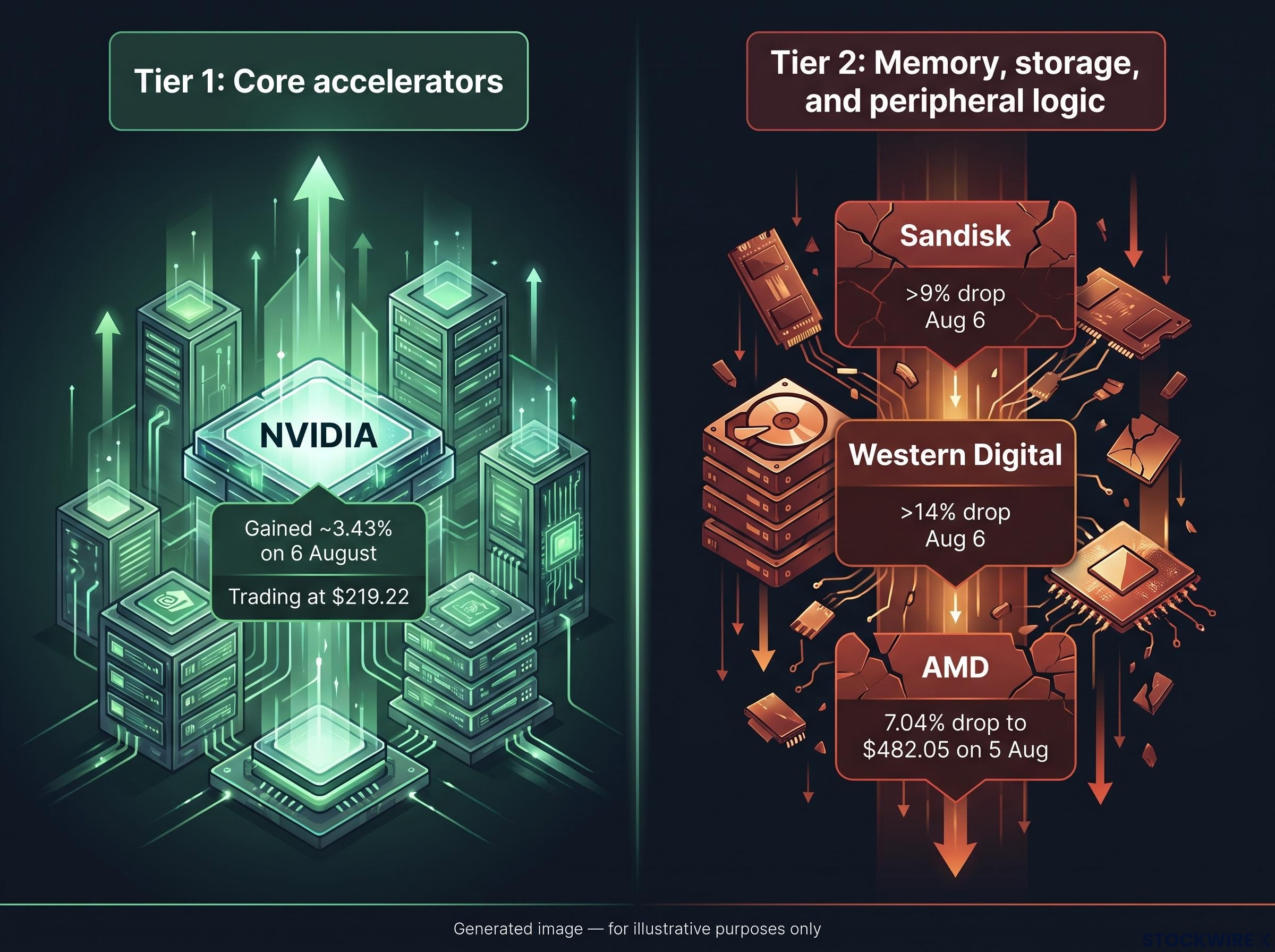
The NVIDIA divergence gives investors a live signal about where durable AI conviction is currently concentrated. But it also highlights a fragility: the entire sector’s sentiment anchor depends on NVIDIA continuing to deliver. If Tier-2 guidance disappointments persist, investors may eventually test whether Tier-1 growth can remain immune. Conservative guidance from NVIDIA would likely trigger a sector-wide repricing that makes this week’s selloff look contained.
Knowing which tier a holding belongs to changes the appropriate reaction to guidance disappointments and informs how much buffer to build around near-term expectations.
Five signals that will determine whether this is a rough patch or a deeper reset
The data available today supports watching rather than acting on incomplete information. These five signals, observed over the coming weeks, will either confirm the expectations-reset thesis or complicate it:
- Management guidance language on upcoming calls. Watch whether Samsung, SK Hynix, AMD, NVIDIA, Sandisk, and Western Digital frame softness as inventory digestion and timing, or as structural demand slowing. The framing matters more than the numbers.
- Margin trajectories. Sandisk’s 84.6% gross margin is the benchmark. Sustained margins above 80% support the thesis of healthy demand with manageable competition. Rapid compression would suggest oversupply or pricing deterioration.
- SOX technical behaviour. The 1.4% decline on 5 August is the starting point. A break of key support levels could accelerate momentum-driven selling as systematic strategies de-risk the sector, regardless of fundamentals.
- Asian memory peer performance. Continued weakness in Samsung Electronics and SK Hynix would confirm the expectations reset is global rather than confined to U.S.-listed names.
- NVIDIA’s relative performance. As long as NVIDIA holds up, it anchors sentiment in the AI trade. Conservative guidance or a miss from NVIDIA would likely trigger the sector-wide repricing that Tier-2 names have so far absorbed alone.
What the reset changes, and what it does not
The AI demand direction is not in question. What investors are repricing is how quickly each segment of the semiconductor value chain can convert that demand into reportable earnings growth that justifies multiples built during a year of extreme price appreciation.
That means differentiating by tier, moderating near-term growth assumptions for memory and storage, and focusing on guidance quality and margin sustainability on the next round of earnings calls. The results this week confirmed that AI-driven chip demand is real. They also confirmed that the market had been pricing it as if “real” and “infinite” were the same thing.
For investors wanting a structured framework for acting on these signals, our dedicated guide to semiconductor cycle positioning covers the five-indicator sequence for de-risking memory and storage holdings before the 2027-2029 supply wave compresses multiples, including which tier to reduce first.
This article is for informational purposes only and should not be considered financial advice. Investors should conduct their own research and consult with financial professionals before making investment decisions. Past performance does not guarantee future results. Financial projections are subject to market conditions and various risk factors.