The Supreme Court of New South Wales heard ASIC’s application to wind up Capital Guard AU Pty Ltd on 27 July 2026, one day before this article’s publication. The firm stands accused of raising approximately $17.4 million from around 80 investors through bond-style products that, according to ASIC, may never have existed as described.
The case has moved at a pace that signals how seriously the regulator treated the alleged misconduct. ASIC cancelled the firm’s Australian Financial Services (AFS) licence on 29 June 2026, filed its Supreme Court application on 13 July 2026, and secured a final hearing date of 27 July 2026. That is licence cancellation to courtroom in under a month.
Here is what the allegations involve, what ASIC says happened to the money, and what the approximately 80 affected investors need to do now to position themselves for whatever recovery process follows. If you hold a product sold by Capital Guard, the steps at the end of this article apply to you directly.
What the Supreme Court hearing decided
The final hearing took place at 2pm on 27 July 2026 before Justice Nixon in the Supreme Court of New South Wales. ASIC sought a winding-up order on just and equitable grounds, the legal mechanism courts use when a company’s continued operation is considered fundamentally contrary to the interests of those it affects.
As of 28 July 2026, no ASIC media release, published court judgment, or McGrathNicol announcement has publicly confirmed whether the order was granted. ASIC’s media release 26-152MR, published 14 July 2026, confirms the application and the scheduled hearing but does not report an outcome. A decision is expected imminently.
ASIC media release 26-152MR, published 14 July 2026, confirms the winding-up application and scheduled hearing date but does not report an outcome, leaving affected investors reliant on subsequent announcements from the court and McGrathNicol.
How the matter reached the courtroom
The procedural timeline tells its own story. ASIC filed its originating process on 13 July 2026. The matter was listed for directions on 20 July 2026. The final hearing followed just one week later.
The AFS licence cancellation on 29 June 2026 was not the end of ASIC’s action against Capital Guard but the opening move: the earlier cancellation decision documented how a fabricated Macquarie Bank bond prospectus was used to direct retail investor funds into a product that never existed, and set a 29 June 2027 deadline for affected investors to lodge an AFCA complaint.
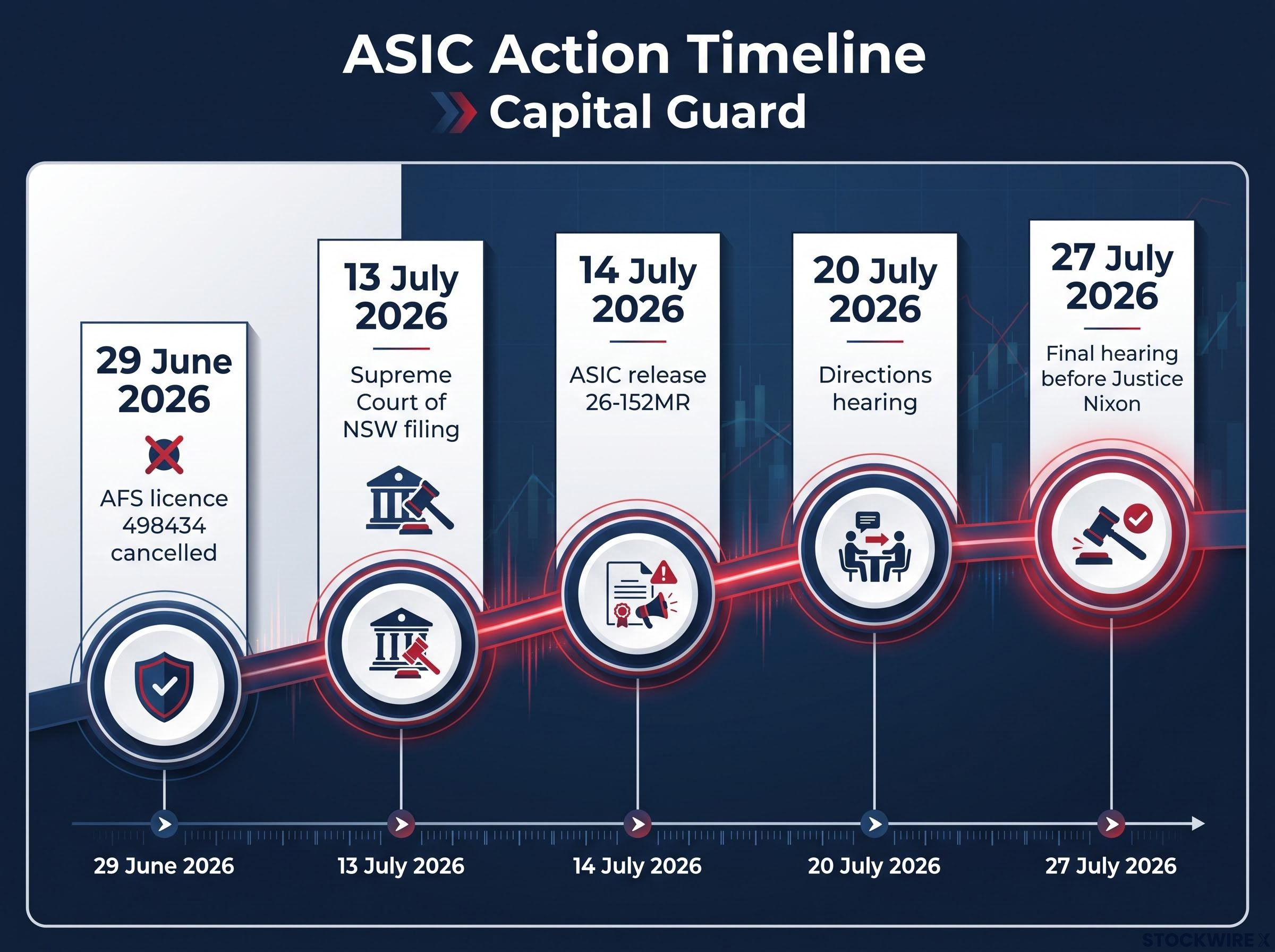
| Date | Event |
|---|---|
| 29 June 2026 | ASIC cancels Capital Guard’s AFS licence (number 498434) |
| 13 July 2026 | ASIC files originating process in Supreme Court of NSW |
| 14 July 2026 | ASIC media release 26-152MR confirms application and hearing details |
| 20 July 2026 | Directions hearing; ASIC publishes notice of winding-up application |
| 27 July 2026 | Final hearing before Justice Nixon at 2pm; outcome pending public confirmation |
Two weeks from application to final hearing is not routine. It tells affected investors that ASIC assessed this matter as urgent, which has direct implications for how anyone still holding a Capital Guard product should treat any ongoing communications from the firm.
When big ASX news breaks, our subscribers know first
The scale of alleged investor harm: $17.4 million and what remains traceable
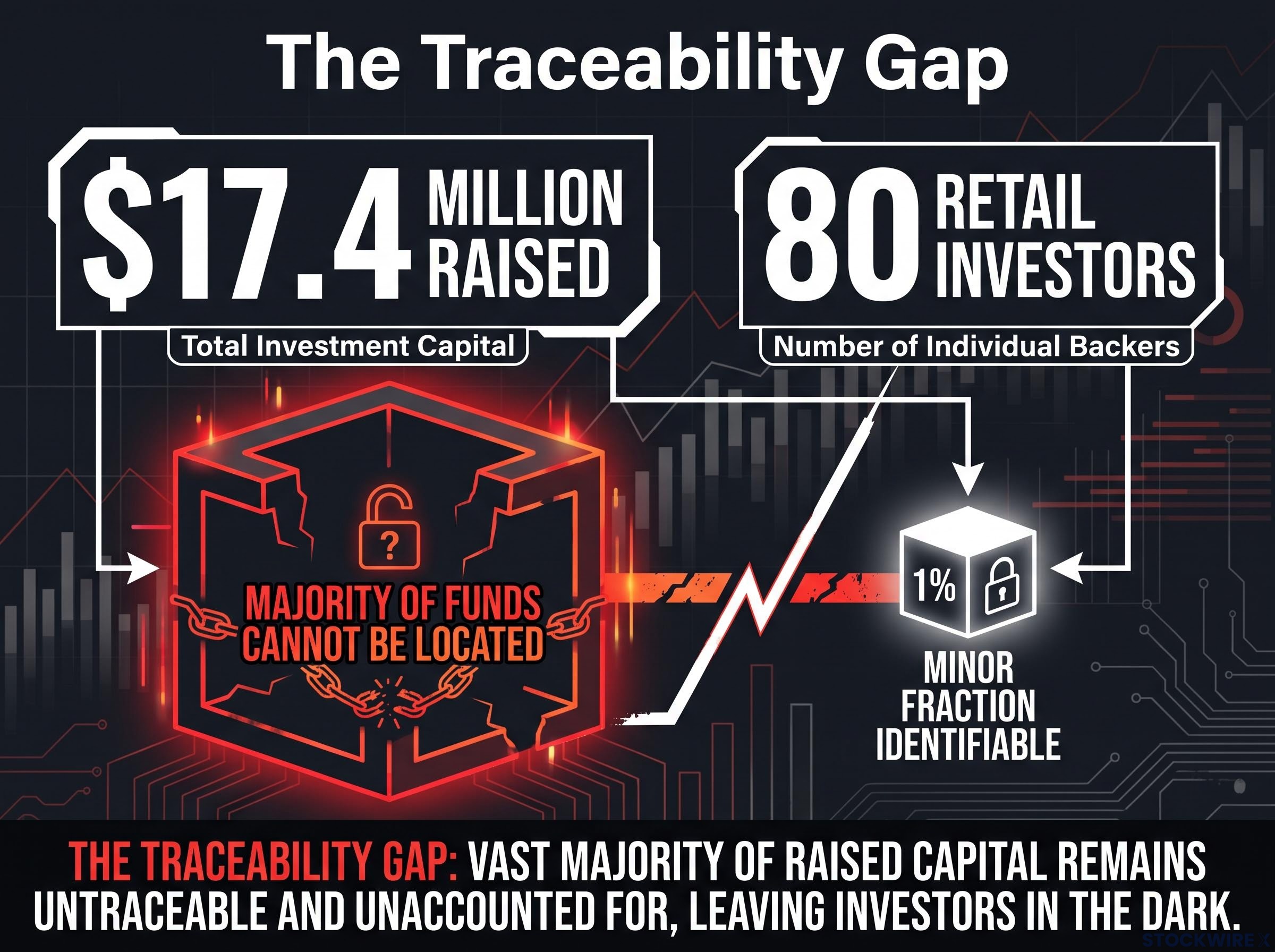
According to ASIC’s allegations, Capital Guard collected approximately $17.4 million from roughly 80 investors who were sold bond or bond-like products.
The figure that matters most sits beneath the headline number. ASIC’s application materials indicate that the vast bulk of those funds cannot be located, with only a minor fraction identifiable across the company’s bank accounts and payment platforms.
ASIC alleges that approximately $17.4 million was collected from roughly 80 investors, with the regulator’s investigation able to account for only a small fraction of that total across the company’s known financial accounts and payment platforms.
Let that gap sit for a moment. The distance between $17.4 million raised and the funds ASIC can currently locate defines the recovery environment facing affected investors.
The three fund-related allegations at the centre of this matter are:
- Approximately $17.4 million raised from roughly 80 retail investors through bond or bond-like products
- The majority of funds were not used as represented to investors
- The regulator has been able to trace only a minor portion of the total across the firm’s known financial accounts and platforms
Even if a winding-up order is granted and liquidators are appointed, the low traceability finding tells affected investors that the recovery process will be difficult and distributions are likely to be partial at best. This is ASIC’s allegation, not a judicially confirmed finding, but it sets a realistic baseline for anyone entering the creditor process.
What Capital Guard AU was actually doing: the conduct allegations
The scale of harm is one thing. The alleged mechanism is another.
ASIC’s investigation found that Capital Guard promoted bond or bond-like products that may not have existed as described. At least one bond was falsely represented as issued by Macquarie Group, one of Australia’s largest and most recognised financial institutions. The firm also allegedly submitted fabricated records to its external auditor.
That fake Macquarie bond allegation carries particular weight. It shows the alleged deception was targeted: investors were given a credible institutional name to override the due diligence instincts that might otherwise have prompted harder questions. ASIC has identified this pattern, attaching a well-known brand to a fabricated product, across multiple enforcement actions in this space.
The three categories of alleged conduct are:
- Misrepresentation of products: Promotion of bonds or bond-like instruments that may not have existed as described, including at least one product falsely presented as a Macquarie Group bond
- Provision of false documents: Fabricated records submitted to the firm’s external auditor, undermining the governance checks designed to protect investors
- Misuse of client monies: Funds raised from investors not used as represented
These findings underpinned ASIC’s decision to cancel Capital Guard’s AFS licence (number 498434) on 29 June 2026, as detailed in ASIC media release 26-141MR. The licence cancellation, in turn, preceded and directly connected to the winding-up application filed two weeks later.
How this case fits ASIC’s broader crackdown on bond-style product fraud
Capital Guard is not an isolated enforcement event. The case sits within ASIC’s publicly stated focus on unlicensed or non-compliant operators selling bond or fixed-income-style products to retail investors, a segment the regulator has identified as a priority area.
ASIC enforcement priorities for 2026 and beyond include private credit, digital assets, and financial reporting misconduct, and the Capital Guard matter sits within a broader pattern of escalating regulatory action: Australian courts ordered a record $830 million in civil penalties connected to ASIC’s work in FY2025-26, signalling that the price of systemic financial harm has been fundamentally repriced.
What makes this particular case instructive is how many of the warning signs ASIC associates with problematic operators appear in a single matter: governance failures, regulatory non-compliance, misuse of client monies, and product misrepresentation, all present simultaneously.
Warning signs ASIC says retail investors should recognise
The Capital Guard case illustrates the red flags ASIC has identified across this segment:
- An operator whose AFS licence has been recently cancelled or suspended
- Product returns that appear inconsistent with prevailing market rates for comparable fixed-income instruments
- Association with a major institutional name (in this case, Macquarie Group) without verifiable documentation from that institution confirming the product’s legitimacy
- Opacity around governance, auditing, and how investor funds are held and deployed
- Bond or bond-like product structures that cannot be independently verified through public registries or the named issuer
For retail investors holding bond or bond-like products from smaller or lesser-known issuers, this case is a practical prompt. Verify the issuer’s AFS licence status on ASIC’s professional registers. Confirm the legitimacy of the underlying security directly with the named institution. Do not rely solely on documentation provided by the seller.
ASIC’s professional registers allow retail investors to verify an operator’s current AFS licence status in real time, including whether a licence has been recently cancelled or suspended, which is the first verification step for anyone evaluating a bond or fixed-income product from a smaller issuer.
What affected investors should do now, and what comes next in the recovery process
ASIC’s application named Robert Michael Kirman and Jacinta Lee Nielsen of McGrathNicol as proposed liquidators. If the court grants the application, their role would centre on assuming control of the company, examining its financial affairs, and working to secure and recover whatever assets remain for the benefit of creditors and investors.
As of 28 July 2026, no public confirmation of their appointment has been issued. Affected investors should treat the creditor registration process as pending until one of the authoritative channels below confirms the appointment.
The steps affected investors should take, in sequence:
- Monitor the three confirmation channels: ASIC’s media centre, the Supreme Court of NSW online registry and published judgments, and McGrathNicol’s website and announcements
- Confirm appointment before attempting to register: Do not act on unofficial information or third-party claims about the liquidation status
- Register as a creditor with the appointed liquidators once their appointment is confirmed: This is the mechanism through which affected investors participate in whatever distribution is ultimately possible
- Seek independent legal or financial advice regarding your specific exposure: Given the low traceability of funds alleged by ASIC, individual circumstances will vary significantly
Given that ASIC alleges only a small proportion of the $17.4 million remains traceable, registering as a creditor is not optional for affected investors. It is the only way to participate in whatever distribution process the liquidation ultimately delivers.
The creditor priority queue under the Corporations Act places most retail investors behind secured creditors and priority claimants, a structural feature of the insolvency process that the First Mutual Private Equity winding-up, involving approximately $53 million in investor funds, illustrates in comparable circumstances.
What this case signals for investors in non-major-bank bond products
The procedural timeline speaks for itself. Licence cancellation to court application: approximately two weeks. Application to final hearing: approximately two weeks. When ASIC moves on acute cases, it moves fast.
But for the approximately 80 investors in Capital Guard products, ASIC’s speed offers limited comfort. The damage, according to the regulator’s own allegations, had already been done. The funds had already been raised, the products had already been misrepresented, and the majority of the money had already become difficult to trace.
That is the lesson this case reinforces for anyone evaluating bond-style products from smaller issuers. Regulatory enforcement can be rapid once misconduct is identified, but it is a response mechanism, not a prevention mechanism. The only reliable protection sits before the investment: verifying the operator’s licence, confirming the product’s legitimacy with the named issuer, and questioning returns that look too good relative to what comparable products offer in the current rate environment.
ASIC director disqualification under Section 206F of the Corporations Act is a parallel regulatory tool that can be deployed alongside or after a winding-up action, and the ASIC Banned and Disqualified Persons Register is a publicly searchable resource any investor can use to check whether an operator’s principals carry prior regulatory history.
This article is for informational purposes only and should not be considered financial advice. Investors should conduct their own research and consult with financial professionals before making investment decisions. The allegations described in this article are based on ASIC’s application materials and have not been judicially determined at the time of publication.